







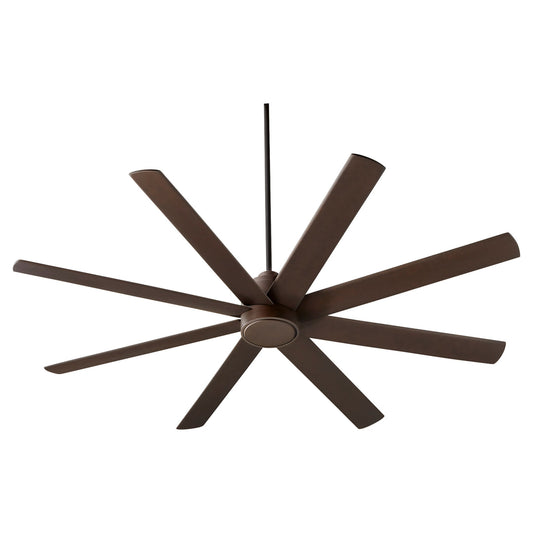


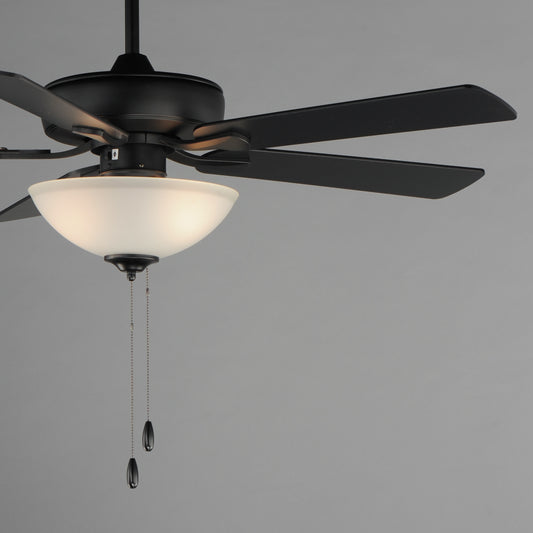


Stay Cool in Style: Your Ultimate Guide to the Best Ceiling Fans for Your Living Room
Let's be real, picking the best ceiling fans for your living room isn't about finding a single mythical "perfect" fan. It’s a design quest! The mission? To find your perfect cocktail of killer style, serious cooling power, and clever tech. The right fan is so much more than an appliance; it's a statement piece that delivers a double whammy of comfort and design, turning your main hangout spot into a breezy, stylish sanctuary.
Why Your Living Room Fan is the Star of the Ceiling
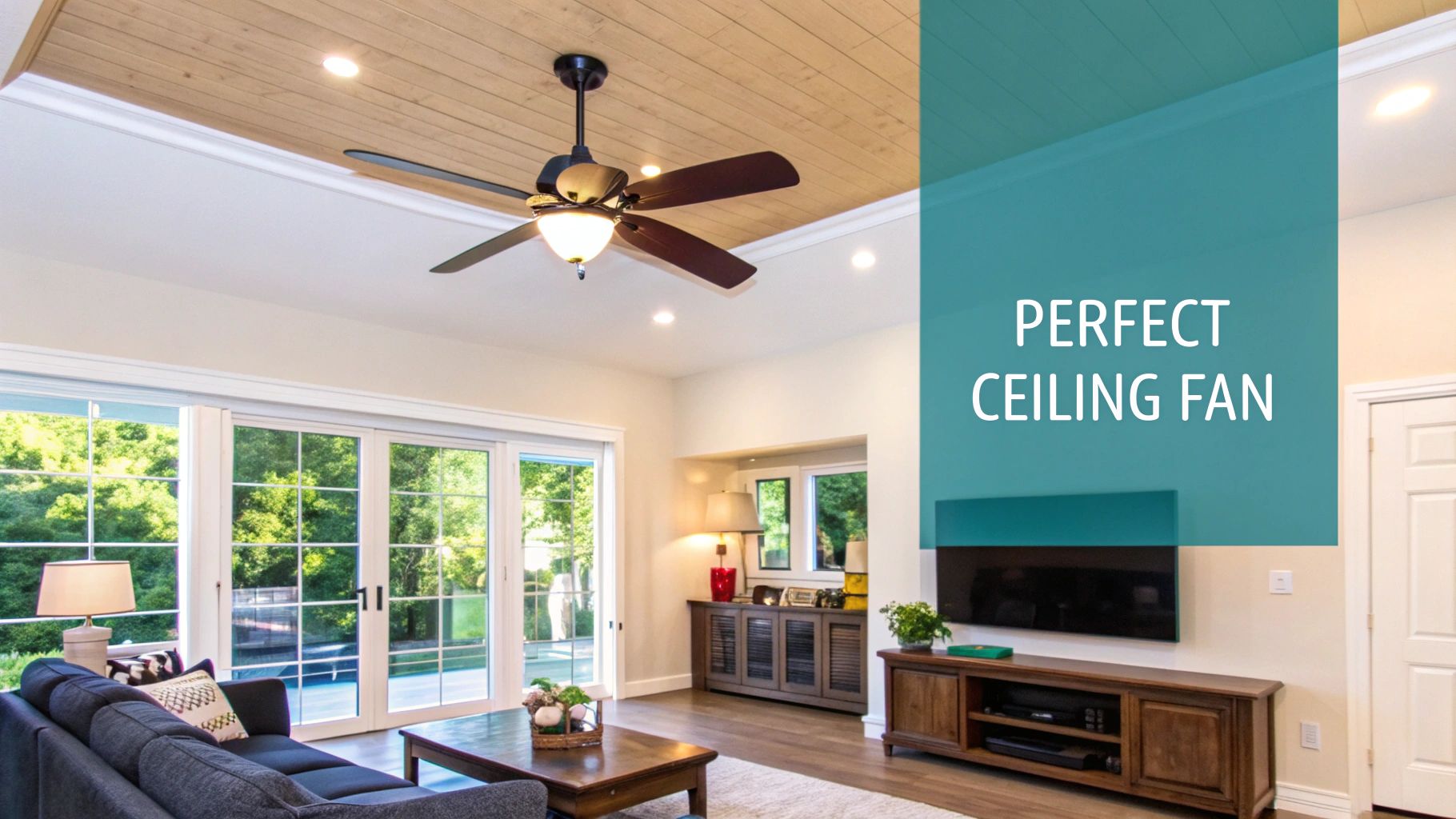
Think of a ceiling fan less as a utility and more as the crowning jewel of your living room. It's one of the few pieces of decor that’s actually alive with movement. It naturally draws the eye upward, injects a bit of dynamic energy, and ultimately sets the entire vibe of the room. A killer fan doesn't just push air around; it pulls your entire design vision together.
This "fan-as-decor" mindset is blowing up. More homeowners are on the hunt for fixtures that are as gorgeous as they are functional, and the market is buzzing. The global ceiling fan market was valued at a cool USD 11.39 billion in 2024 and is projected to soar to USD 16.18 billion by 2032. If you want to geek out on the numbers, you can explore more data on this growing market trend.
Key Factors at a Glance
Diving into the fan world can feel like a whirlwind, but it really boils down to a few core elements. Nail these from the get-go, and you'll be choosing your fan like a seasoned pro.
- Airflow (CFM): This is the heavyweight champ of fan specs. It measures how much air the fan actually moves. A higher CFM (Cubic Feet per Minute) means a more powerful, refreshing breeze—a total non-negotiable for larger living rooms where everyone gathers.
- Blade Span: This is simply the fan's diameter, and it dictates how far the cool air travels. Matching the blade span to your room's size is the secret sauce for even, effective circulation.
- Motor Type: Today's DC motors are the rockstars of the fan world. They're whisper-quiet, ridiculously energy-efficient, and give you way more speed settings than clunky old-school AC motors.
The classic rookie mistake? Falling for a fan on looks alone. While style is a huge deal, a fan that's too small for the room or has a wimpy motor will just be a pretty, useless decoration. You'll be left feeling underwhelmed and stuffy, no matter how cool it looks.
A Quick Reference for Your Search
To keep things simple, here’s a quick-glance table to help you prioritize. Think of it as your cheat sheet for finding the best ceiling fan for your living room.
Living Room Ceiling Fan Quick Reference Guide
| Key Factor | What It Means | Why It Matters for Your Living Room |
|---|---|---|
| Airflow (CFM) | The volume of air a fan circulates per minute. | A CFM of 4,000-6,000+ is ideal for ensuring consistent comfort in spacious living areas. |
| Blade Span | The full diameter of the fan, from blade tip to tip. | Larger rooms (over 175 sq ft) require a span of 52 inches or more for effective cooling. |
| Motor Type | The engine driving the fan, typically AC or DC. | DC motors are whisper-quiet and up to 70% more efficient, perfect for a relaxing living space. |
| Style & Finish | The aesthetic design, materials, and color of the fan. | The fan should complement your decor, whether it's modern, rustic, or industrial. |
Keeping these points in mind transforms fan shopping from a technical chore into a fun design project. Now, let’s get into the nitty-gritty of sizing your fan perfectly.
Sizing Your Fan for Optimal Airflow
Choosing the right size ceiling fan isn't some tiny detail—it's pretty much the most important decision you'll make to achieve that perfect, "ahhh"-inducing breeze.
Think of it this way: putting a tiny fan in a huge living room is like trying to cool down a backyard barbecue with a handheld mister. It looks like it's doing something, but nobody's actually feeling the relief. On the flip side, a massive, hurricane-force fan in a small room creates an unpleasant wind tunnel. No thanks.
The goal is to hit that "Goldilocks" zone where the fan moves air across the whole room without being overwhelming. To do that, you need to match the fan's blade span (the full diameter from tip to tip) with your room's square footage.
Matching Blade Span to Room Size
First thing's first: grab a tape measure. Get the length and width of your living room, then multiply them to find the square footage. A room that’s 15 feet by 20 feet, for example, is 300 square feet.
Once you have that number, picking the right blade span is a breeze. Here’s a simple cheat sheet:
- Up to 75 sq. ft. (small dens or offices): Look for a fan with a 29-36 inch blade span.
- 76 to 175 sq. ft. (most bedrooms or smaller living rooms): A 42-48 inch span is a great fit here.
- 176 to 350 sq. ft. (standard large living rooms): This is the sweet spot for most living rooms. You'll want a fan with a 52-60 inch span for broad, consistent airflow.
- Over 350 sq. ft. (great rooms and open-concept spaces): Go big with a fan that has a blade span of 62 inches or more. For really massive spaces, you might even consider installing two fans for balanced circulation.
Nailing this measurement is the key to finding a fan that actually performs well. A properly sized fan doesn't have to work as hard, which means it runs quieter and more efficiently. For a deeper dive, you can learn more about choosing the right ceiling fan size for maximum efficiency in our complete guide.
Why Ceiling Height Matters Just as Much
Sizing isn't just about how wide your room is; height is just as critical. Your fan needs to hang at the right distance from the floor to move air effectively and safely.
The ideal spot is 8 to 9 feet above the floor. At this height, the fan can push a column of air down that spreads out perfectly across the room.
If a fan is mounted too high (over 9 feet from the floor), the breeze will fizzle out before it ever reaches you. Too low, and it can feel like a hurricane and become a safety hazard.
This is where a downrod comes into play. A downrod is simply the metal pipe connecting the fan motor to the ceiling mount, letting you hang the fan at the perfect height. If you have standard 8-foot ceilings, a "flush mount" or "hugger" style fan that sits right against the ceiling might be fine. For anything taller, a downrod is a must.
Here’s a quick guide for picking the right downrod length:
| Ceiling Height | Recommended Downrod Length |
|---|---|
| 9 ft | 6-inch downrod |
| 10 ft | 12-inch downrod |
| 12 ft | 24-inch downrod |
| 14 ft | 36-inch downrod |
Most premium fans—especially those over $300—come with a short downrod in the box (usually 4-6 inches). But always measure your ceiling before buying, because you might need to purchase a longer one separately to get the best performance. With these two measurements in hand—blade span and downrod length—you’re all set to pick a fan that will keep your room comfortable for years.
If a fan's size determines how far it can reach, its motor is the heart that gives it power and personality. The engine under the hood is what separates a gentle, quiet breeze from the powerful gust you need on a sweltering summer day. When you're looking for the best ceiling fans for your living room, understanding the motor is what turns a good purchase into a great one.
The motor is what truly drives your fan's performance, and they're definitely not all created equal. You’ll generally run into two types: the classic Alternating Current (AC) motors and the more modern Direct Current (DC) motors.
The Old Guard: AC Motors
AC motors are the traditional workhorses that have powered ceiling fans for decades. They’re reliable, usually cheaper upfront, and get the job done with a few basic speed settings, often controlled by a pull chain.
But they have their downsides. AC motors are heavier, often produce a noticeable hum, and are far less energy-efficient. Think of an AC motor like a dependable old car—it’ll get you where you need to go, but it’s not going to be the quietest, smoothest, or most fuel-efficient ride.
The New Standard: DC Motors
For a premium living room experience, DC motors are the clear winners. A DC motor is like the modern electric car of the fan world—it's sleek, whisper-quiet, and incredibly efficient. This is the technology you'll find in high-quality fans priced at $300 and up, and for good reason.
DC motors bring a lot to the table, making them perfect for a primary living space:
- Whisper-Quiet Operation: They produce almost no audible motor hum, so your living room stays a peaceful retreat.
- Energy Efficiency: DC motors use up to 70% less energy than their AC counterparts. You'll actually see the savings on your electricity bills over time.
- More Speed Options: Instead of the usual three speeds, DC motors often come with six or more, giving you precise control over your comfort.
- Smarter Features: This advanced motor makes it possible to include features like a reverse function on the remote, which is perfect for circulating warm air in the winter.
Decoding Airflow: CFM Explained
While the motor is the engine, the real measure of its power is CFM, or Cubic Feet per Minute. This number tells you exactly how much air a fan moves. A higher CFM rating means more powerful air circulation—it's what you actually feel as a cool breeze.
It's a common mistake to think that more blades or a bigger fan automatically means more power. CFM is the only number that truly reflects a fan's cooling ability. A well-designed three-blade fan with a high CFM can easily outperform a clunky five-blade fan with a weak motor.
For a large living room, you’ll want to look for a fan with a CFM rating of 4,000 to 6,000 or higher. This ensures the fan can effectively move air throughout the entire space, getting rid of those stagnant hot spots and keeping things comfortable. The relationship between the motor, blade design, and CFM is complex, but for those who want to dive deeper, you can explore the impact of fan blade count on efficiency in more detail.
This quick guide below breaks down the core steps to make sure you choose a fan that's not just stylish but perfectly suited for your space.
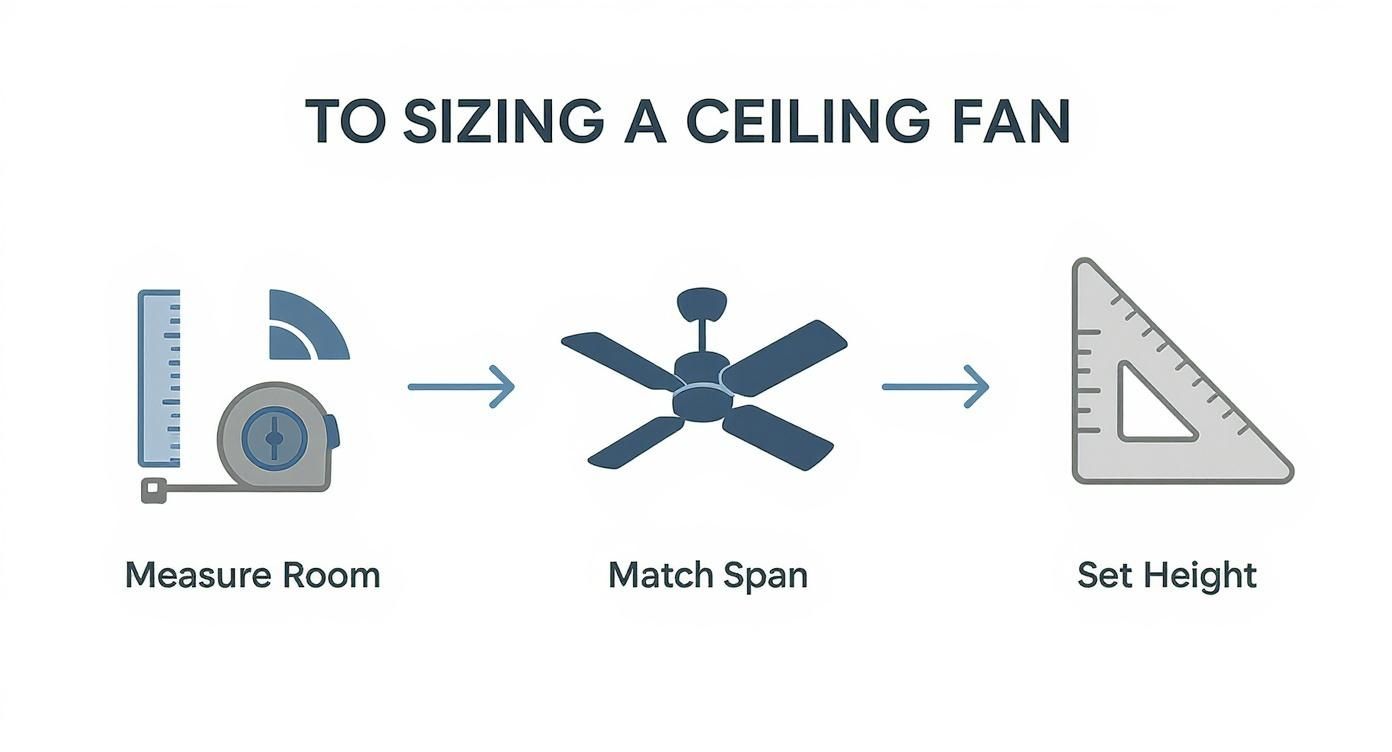
As you can see, matching the blade span to your room's size and getting the height right are fundamental to good performance. By focusing on a powerful DC motor and a high CFM rating, you're making sure your new fan will be an effective and efficient centerpiece in your living room for years to come.
Matching Fan Style to Your Living Room Decor
Once you've nailed the technical stuff like sizing and motor specs, you get to the really fun part: picking a fan that not only works like a dream but looks absolutely fabulous doing it. A ceiling fan isn't just a spinning appliance anymore; it's a major design feature that can either tie your whole living room together or stick out like a sore thumb. The best fans feel like a natural extension of your home's personality.
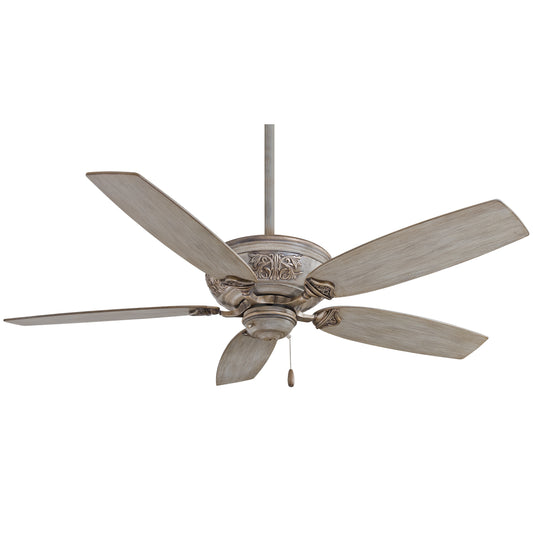
Think of it as choosing a piece of kinetic art for your ceiling. It hangs right in the middle of your most-used space, drawing the eye up and setting the tone for the entire room. A sleek, minimalist fan can make a modern room feel even more intentional and chic, while a fan with warm wood blades adds an organic, cozy vibe to a rustic or farmhouse space.

Finding Your Fan's Design Personality
The secret is to match the fan's core elements—its materials, finish, and overall shape—to the decor you already have. Let's break down some of the most popular styles and what makes them tick.
Choosing the right style is all about complementing your existing interior design. The right fan can feel like the finishing touch a room was missing. Below is a quick guide to help you match popular fan styles with common living room decor themes.
Matching Fan Styles to Your Living Room Decor
| Fan Style | Key Characteristics | Best For Living Room Decor |
|---|---|---|
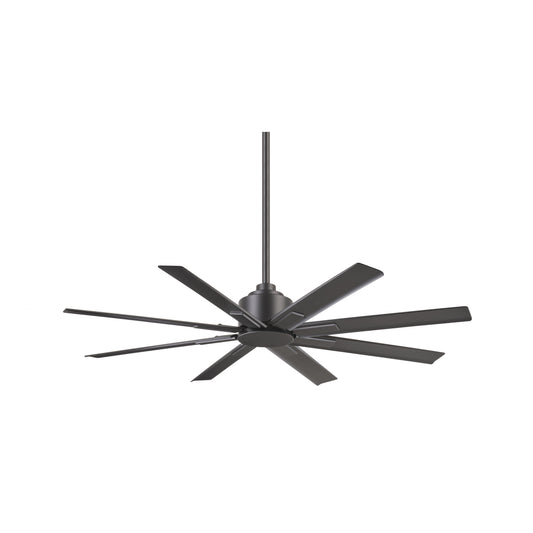
| Modern & Minimalist | Clean lines, 2-3 sleek blades, uncluttered design. Finishes like matte black or white. | Contemporary, Scandinavian, or any space that values simplicity and an open feel. |
| Industrial & Loft | Raw materials, exposed hardware, metal cages. Finishes like brushed nickel or dark bronze. | Urban lofts, converted warehouses, or rooms with brick walls and exposed ductwork. |
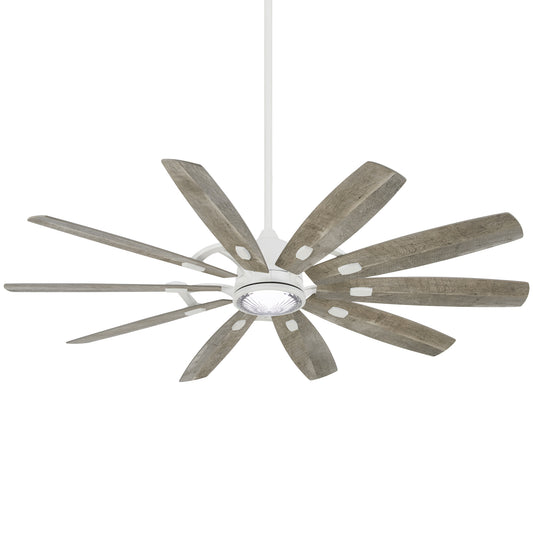
| Rustic & Farmhouse | Natural wood blades (weathered oak, walnut), simple motor housing in black or bronze. | Farmhouse, modern farmhouse, coastal, or any decor aiming for a cozy, welcoming vibe. |
| Transitional | Blends classic and modern elements. Simple curves, versatile finishes like satin nickel. | A wide range of styles; a safe and elegant choice that bridges different design eras. |
By aligning the fan's aesthetic with your room's overall theme, you ensure it enhances the space rather than clashing with it. A well-chosen fan becomes an integrated part of your design story.
Materials and Finishes: The Mood Setters
The materials and finish you choose have a huge impact on the room's atmosphere. A fan is a mix of textures that can bring real depth and character to your living room.
For instance, a fan with rich, dark walnut blades and a brushed bronze motor housing creates a feeling of classic warmth and sophistication. It would be right at home in a traditional living room with leather furniture and warm tones.
On the other hand, a fan with sleek silver blades and a polished nickel body feels cool, contemporary, and almost futuristic. It's the perfect choice for a minimalist space dominated by glass, metal, and neutral colors. For more ideas, you can check out our guide on ceiling fan design trends for more inspiration on pairing finishes with your decor.
A great rule of thumb from designers is to aim for a monochromatic look if you want the fan to disappear. A matte white fan on a white ceiling will blend right in, letting other decor be the star. For a bolder approach, use the fan as an accent, like a matte black fan against a light ceiling to create a striking contrast.
The Power of Integrated Lighting
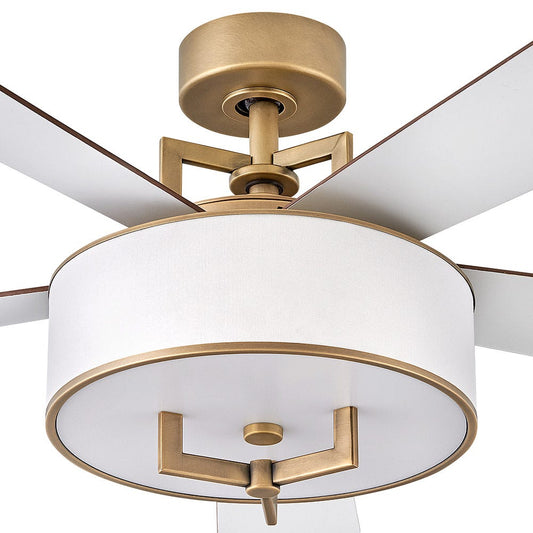
Finally, don’t forget about the lighting. Many of the best ceiling fans for living rooms now come with integrated LED light kits that are both powerful and dimmable. This is a huge plus, as the fan can double as the main overhead light source for the entire room.
Look for models that offer adjustable color temperatures. This feature lets you switch between a cool, bright light for daytime activities and a warm, soft glow for relaxing in the evening. A fan with a beautiful light fixture isn't just a fan—it's a two-in-one statement piece that delivers comfort, light, and style. The Aerovon DC 54" Fan with LED Light, priced at $579.95, is a fantastic example of this, offering a sleek design that works in multiple decor styles while providing excellent, dimmable light.
Exploring Smart Features and Modern Controls
Let’s be honest: the days of yanking on a pull chain and hoping you get the right speed are over. When you invest in a quality ceiling fan (think $300+), you’re not just getting better airflow—you’re getting a whole suite of modern features designed to make life ridiculously easy. This is where the best living room fans really pull away from the pack, transforming from a simple appliance into a seamless, brilliant part of your home.
The first step into modern convenience is the trusty handheld remote. No more fumbling for a dangling chain in the dark or heaving yourself off the couch. With a remote, you can adjust fan speed, dim the lights, and even reverse the fan's direction without moving an inch. It's a massive upgrade in day-to-day usability.
https://www.youtube.com/embed/PG05pZ6S8w0
The Rise of the True Smart Fan
While a remote is great, Wi-Fi connectivity is the real game-changer. A true smart fan syncs right up with your home network, unlocking a world of automated comfort. It lets you control everything from a smartphone app or, even better, with the sound of your voice.
Picture this: you walk in the door, arms full of groceries, and just say, "Alexa, turn the living room fan to high." It’s not science fiction anymore; it’s a standard feature on many top-tier fans. These models integrate perfectly with the most popular voice assistants, including:
- Amazon Alexa
- Google Assistant
- Apple HomeKit
That kind of hands-free control makes comfort feel instant and completely effortless.
Practical Benefits That Go Beyond Cool Gadgets
Smart features are more than just a party trick. They offer real, tangible benefits that can simplify your routine and even help you save on energy bills. Once your fan is connected, you can set it and forget it.
For instance, you can use scheduling to have your fan turn on a few minutes before you get home, so you always walk into a cool, welcoming space. You can also program it to switch to a lower, quieter speed at night for gentle circulation while you sleep. The possibilities are totally customizable to fit your lifestyle.
One of the most underrated smart features is the ability to reverse the fan from your app. Forget climbing a wobbly ladder to flip a tiny switch. Now, you can reverse the motor’s direction with a single tap. This simple action pushes the warm air trapped at the ceiling back down into the room during winter, making your space feel cozier and potentially shaving a little off your heating costs.
Investing in a Seamless Experience
When you choose a smart fan, you’re really investing in a more responsive and intelligent home. Models like the Andros 52" Smart Ceiling Fan, priced at $439.95, come with these advanced capabilities built right in. Its powerful DC motor isn't just quiet and efficient—it’s fully compatible with smart home ecosystems, giving you precise control over your environment.
This integration is what it’s all about. A smart fan doesn't just add another device to your network; it streamlines your comfort. Whether you’re setting a schedule, using your voice to adjust the speed, or reversing the blades for the season, these modern controls deliver a level of convenience and efficiency that was once unimaginable. It’s this technological leap that truly defines a premium living room fan today.
Our Top Premium Living Room Ceiling Fan Picks
Alright, we've walked through all the specs and styles. Now for the fun part—let's check out some real-world examples. I’ve put together a few of our top premium picks that absolutely nail what a great living room ceiling fan should be. These aren't just fans; they're long-term investments in your home's comfort, style, and efficiency. Each one earns its price tag with powerful DC motors, impressive airflow, and smart features that just make life better.

For the Modern Minimalist: The Andros Smart Fan
If your home is all about clean lines and an uncluttered vibe, the Andros 52" Smart Ceiling Fan is going to be your new best friend. At $439.95, it’s a masterclass in minimalist design paired with some serious tech. Its sleek three-blade profile and simple motor housing let it blend right into modern or Scandinavian-inspired living rooms, allowing your other decor to shine.
But this fan is more than just a pretty face. Its energy-efficient DC motor is whisper-quiet, keeping your living room the peaceful retreat it’s meant to be. It also comes ready for your smart home, letting you control its six speeds and dimmable light with Alexa, Google Assistant, or an app on your phone. The Andros is proof that top-tier performance doesn't need to shout.
It's a common myth that you need five or more blades for powerful airflow. The Andros proves that smart engineering and blade design matter most, moving a ton of air with a clean, three-blade look.
For a Touch of Rustic Elegance: The Aviation Fan
For anyone who loves the warmth and character of natural materials, the Aviation 60" Ceiling Fan is a true showstopper. Coming in at $659.95, this fan is defined by its beautifully crafted solid wood blades that bring an organic, sophisticated feel to a room. It’s the perfect finishing touch for modern farmhouse, rustic, or even coastal living rooms where texture is everything.
With its massive 60-inch wingspan, the Aviation is built for great rooms and open-concept layouts, moving a huge volume of air with total grace. Its powerful DC motor ensures that even when it’s working its hardest, the fan stays quiet and perfectly balanced. This model is the perfect example of a fan that’s both a high-performance cooling machine and a stunning piece of decor.
For Versatile and Timeless Style: The Aerovon Fan with LED
It can be tough to find a fan that doesn't lock you into one specific style, but the Aerovon DC 54" Fan with LED Light nails that versatility. At $579.95, its soft curves and transitional design feel right at home in both classic and contemporary living rooms. It doesn't demand attention but instead adds a layer of understated elegance.
The integrated LED light is a huge plus, offering plenty of dimmable light that can easily serve as the main source for your room. With its efficient DC motor and an included remote, the Aerovon delivers all the convenience and performance you'd expect from a premium fan. It's one of the best all-around options for anyone who wants a fan that looks great and works even better.
Alright, you've got the big picture on how to choose a living room fan. But a few questions always pop up right before you make the final call. Let’s clear the air on those common head-scratchers so you can buy with total confidence.
Can I Just Install a Ceiling Fan Myself?
If you’re comfortable with basic electrical work, you can absolutely tackle a fan installation on your own. Most quality fans today come with pretty clear instructions.
But—and this is a big but—if you’re looking at old wiring, have super high ceilings, or the thought of flipping breakers and messing with wires makes you sweat, hiring a licensed electrician is the safest and smartest move. A pro will make sure the fan is anchored securely (this is critical!) and wired correctly, giving you peace of mind that it’s safe and will perform exactly as it should.
Do More Blades Actually Mean a Better Fan?
Nope, not really. This is one of the biggest myths in the fan world—that more blades automatically equal more air. The truth is, a fan's real power comes down to its motor (measured in CFM) and the engineering of its blades.
A high-performance three-blade fan with a beefy DC motor can easily outperform a five-blade fan that has a weak, generic motor. Think of it this way: the number of blades is mostly about style.
When you're comparing two fans, ignore the blade count at first. Go straight for the CFM rating. That number tells you the real story of how much air it's capable of moving.
Is a Smart Fan Really Worth the Extra Money?
For a room you use as much as the living room, a smart fan is a total game-changer and definitely worth the investment. It’s more than just a neat gadget.
Imagine adjusting the fan speed during a movie without getting up, or scheduling it to turn on before you get home. Or, even better, reversing the fan’s direction for winter with a simple voice command instead of climbing a ladder. Many of the best models over $300 include these features, and they truly add a new layer of convenience and modern comfort to your home.
At Fan Connection, we believe finding the perfect fan should be simple and fun. Our curated collections are designed to help you discover a fan that perfectly matches your living room's style and your family's comfort needs.
Explore our full range of premium fans at https://www.fanandlights.com.


