

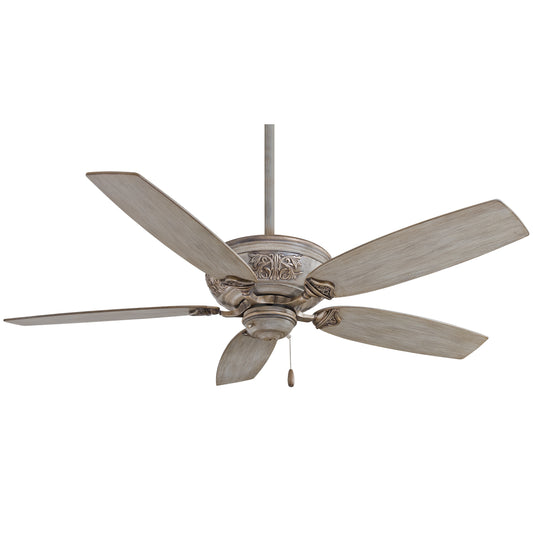

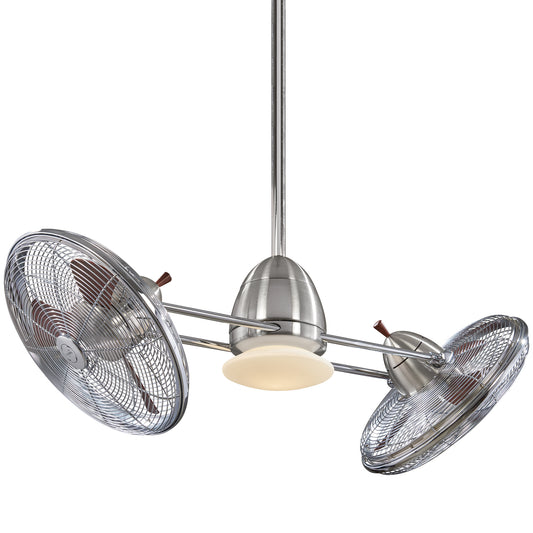

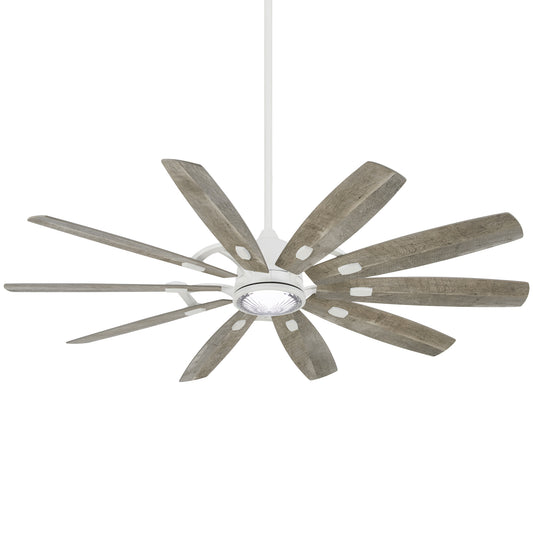

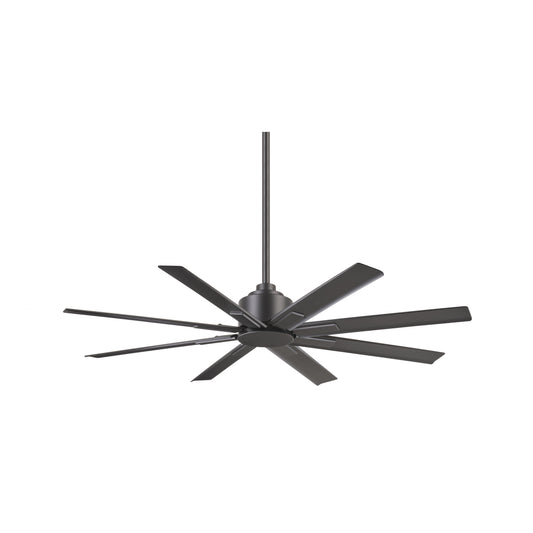






Finding the Best Modern Ceiling Fans
Ready to upgrade your space? When you start looking for the best modern ceiling fans, you quickly realize it's about more than just picking something that spins. It's an investment in jaw-dropping performance, top-notch materials, and a design that acts as the perfect finishing touch for your room. The top-tier models often start around $300, and for good reason—that price point gets you an ultra-quiet DC motor, serious airflow, and high-end finishes that cheap fans just can't match.
Your Guide to Choosing a Modern Ceiling Fan
Let's be honest, navigating the world of modern ceiling fans can feel like a design minefield. You need the function, but you refuse to sacrifice form. The great news? Today’s best fans are engineered to be both beautiful and powerful, acting as a true centerpiece instead of an awkward afterthought.
Forget those clunky, chain-pull fans from your childhood. We're talking about sleek, architectural pieces that blend right into your decor, making your friends ask, "Where did you get that?"
The trick is knowing what to look for. A premium fan isn't just about how it looks—it's about the sophisticated technology humming quietly inside. This guide will walk you through the core concepts that separate an average fan from a truly exceptional one. We'll cover everything from motor types to blade design, giving you the confidence to make a smart choice.
Understanding the Investment
So, why does a higher price tag—typically over $300—often mean a better fan? It all comes down to quality and innovation. In this range, you're not just paying for a brand name; you're paying for real, tangible upgrades:
- Advanced DC Motors: These are the gold standard. They're whisper-quiet, use up to 70% less energy than old-school AC motors, and give you a ton of speed options for precision control.
- Superior Materials: Instead of cheap plastic or flimsy composites, you’re getting things like solid, warp-resistant wood blades, cast aluminum, and heavy-gauge steel housings that are built to last.
- High-Performance Airflow: Premium fans are engineered for maximum air movement, which is measured in CFM (Cubic Feet per Minute). A higher CFM means a stronger, more effective breeze that you can actually feel.
Think of it as an investment in your home's comfort and style. A well-made fan will run silently for years, lower your energy bills, and look fantastic doing it. For a little more inspiration on what's trending, check out our deep dive into the latest ceiling fan design trends in our detailed article.
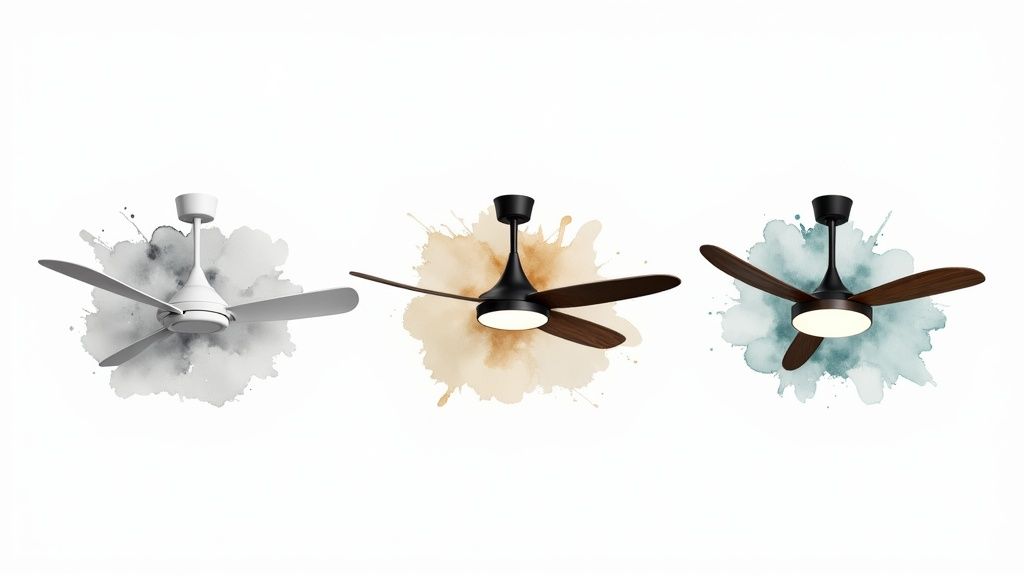
The goal is to find a fan that complements your room without overwhelming it. For most modern aesthetics, a minimalist fan with three blades in a finish that matches the ceiling creates a clean, unobtrusive look that feels intentional and stylish.
To help you narrow down the options, let’s take a look at the most popular modern styles and where they really shine. This quick comparison will help you visualize which type of fan is the perfect fit for your space and budget.
Modern Ceiling Fan Styles at a Glance
This table breaks down the common styles you'll find in the over-$300 category, helping you match a fan's aesthetic to its ideal home.
| Style | Key Characteristics | Best For | Typical Price Range |
|---|---|---|---|
| Minimalist | 2-3 sleek blades, no visible hardware, neutral finishes (matte white/black). | Scandinavian, contemporary, and modern interiors where less is more. | $300 - $600 |
| Industrial | Caged designs, metallic finishes (brushed nickel, oil-rubbed bronze), exposed bolts. | Lofts, urban spaces, and rooms with exposed brick or concrete. | $350 - $700 |
| Organic Modern | Natural wood blades (walnut, maple), soft curves, warm metallic accents. | Mid-century modern, bohemian, and transitional spaces needing a touch of warmth. | $400 - $800+ |
| Smart / "Hugger" | Low-profile (flush mount), integrated smart features, often with a simple, tech-forward look. | Rooms with low ceilings (under 8 ft), home offices, and smart-home setups. | $300 - $650 |
Choosing a style isn't just about looks—it's about finding a fan that feels like a natural extension of your home. Whether you're going for an invisible, barely-there vibe or a bold statement piece, the right modern fan is out there.
The Tech Behind a Superior Ceiling Fan
When you're choosing a modern ceiling fan, you're buying a lot more than just a pretty fixture. You're bringing home a piece of smart engineering designed for top-tier performance, efficiency, and quiet. To really get what makes a premium fan stand out, we need to pop the hood and look at what makes it tick.
The most important part is the motor—the heart of the machine. It’s like comparing an old gas-guzzler to a modern hybrid; the difference is night and day. Older, conventional fans run on AC (Alternating Current) motors. They get the job done, but they’re clunky by today’s standards. They eat up more power, often have a noticeable hum, and usually only give you three speed settings.
This is where high-end modern fans pull ahead: they’re equipped with DC (Direct Current) motors. This is the real game-changer. A DC motor is incredibly efficient, using up to 70% less energy than its AC cousin. That means real savings on your electricity bills over the years. They’re also virtually silent, so the only thing you hear is the gentle whisper of moving air, not a distracting motor noise.
Key Takeaway: The upgrade to a DC motor is one of the biggest reasons to invest in a quality fan. You get whisper-quiet performance, serious energy savings, and way more speed options for perfect climate control—often up to six distinct settings.
The True Measure of Airflow: CFM
While the motor is crucial, the real number you need to know for performance is CFM, which stands for Cubic Feet per Minute. This isn't just marketing fluff; it’s the single most important spec that tells you exactly how much air the fan can move. A higher CFM means a more powerful fan and a stronger breeze.
Think about it: a small fan with a low CFM might be okay for a tiny home office, but it won’t even make a dent in a large living room with high ceilings. The best fans are engineered to maximize CFM, making sure they can properly circulate air through the whole space. Don't get sidetracked by how many blades it has or how big it looks; always check the CFM.
The demand for these powerful, efficient fans is booming. The global ceiling fan market hit about USD 13.06 billion in 2024 and is expected to keep climbing, all thanks to people like you wanting better, energy-saving technology. You can dig into more of the data behind this trend by reading the full market analysis on Renub Research.
How Blade Design Perfects Performance
Of course, the motor can't do all the work alone. The blades are where the magic of moving air actually happens, and their design is a careful balance of physics and art. Three key things work together to create great airflow without making a racket.
-
Blade Pitch: This is simply the angle of the blades, measured in degrees. A steeper pitch, usually between 12 and 15 degrees, lets the blades "scoop" up more air with every spin, which creates a higher CFM. Cheaper fans often have flatter blades that just spin around without moving much air at all.
-
Blade Shape and Material: The aerodynamic shape of the blades is just as important as their angle. Modern designers craft blades that slice through the air with the least resistance possible, which cuts down on both drag and noise. Materials like solid paulownia wood or molded ABS are picked not just for looks but because they resist warping and stay balanced over time, preventing that annoying wobble.
-
Blade Count: Here’s a surprise: more blades don't automatically mean more airflow. In fact, fans with fewer blades—like those popular three-blade minimalist designs—are often more efficient at moving air. While the number of blades is mostly a style choice, you can learn more about how it all works in our guide on the impact of fan blade count and efficiency.
At the end of the day, knowing a little about these technical details gives you the power to see past a fan's good looks. By checking out the motor type, CFM rating, and blade engineering, you can confidently pick a modern ceiling fan that performs just as beautifully as it looks.
How To Size and Mount Your Fan Perfectly
Choosing the right size for a modern ceiling fan is a lot like picking the right tool for a job. A fan that’s too small for the room will have to work overtime just to make a dent, leaving you feeling underwhelmed and stuffy. On the flip side, an oversized fan can turn your living room into a wind tunnel, making it more distracting than comfortable.
The key is matching the fan’s blade span—that’s the full diameter from blade tip to blade tip—to your room’s square footage. This isn't just about looks; it's about hitting that sweet spot where the fan circulates air efficiently and quietly, creating a perfect breeze without having to be cranked up to its highest setting.
Matching Fan Size to Room Dimensions
Let's get down to the numbers. First, you’ll need your room’s square footage. Just grab a tape measure and multiply the room’s length by its width. With that number in hand, finding the right fan is easy.
Here’s a quick cheat sheet:
- Small Rooms (up to 75 sq. ft.): Think home offices, laundry rooms, or even a spacious walk-in closet. A smaller fan with a 29 to 36-inch blade span will do the trick.
- Medium Rooms (76 to 175 sq. ft.): This is your typical bedroom or family room. A 42 to 48-inch blade span is usually the perfect fit here.
- Large Rooms (176 to 350 sq. ft.): For big spaces like great rooms, open-concept living areas, or master suites, you'll need more oomph. Look for fans with a 52-inch or larger blade span.
If you want to dive a bit deeper, our guide on choosing the right ceiling fan size for maximum efficiency has even more tips to help you nail the decision.
This handy infographic helps visualize the process, guiding you based on your room's dimensions.
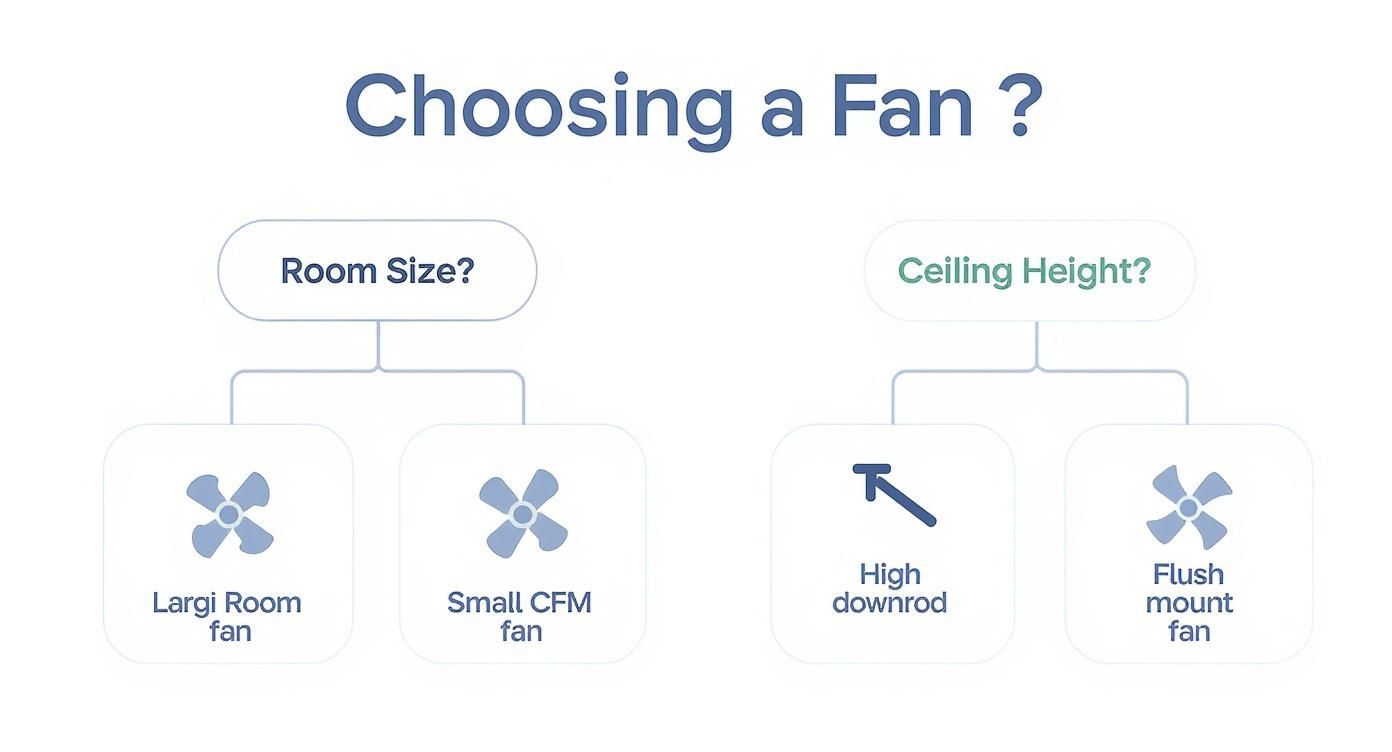
As you can see, it all comes down to two things: the size of your room and the height of your ceiling. Get those right, and you're well on your way.
Mounting Your Fan for Optimal Airflow
Once you've picked the right size, the next puzzle piece is mounting it correctly. And for this, your ceiling height is everything. The golden rule is that fan blades should hang at least 7 feet from the floor for safety, but the ideal height for the best airflow is between 8 and 9 feet.
There are three main ways to mount a fan, each suited for different ceilings.
Flush Mount (or "Hugger") Fans: These are your go-to for low ceilings (under 8 feet tall). They mount directly against the ceiling—or "hug" it—to give you as much headroom as possible while still delivering a nice, gentle breeze.
Standard Mount Fans: For rooms with standard 8- to 9-foot ceilings, this is what you’ll use. These fans come with a short downrod (usually 3 to 6 inches long) that positions the fan perfectly for efficient air circulation.
Downrod Mount Fans: Got tall or vaulted ceilings (10 feet or higher)? A longer downrod is a must. It lowers the fan into that 8-to-9-foot sweet spot, ensuring the air actually gets down to where you can feel it instead of just swirling around near the ceiling.
To help you put it all together, here is a quick reference guide that matches room size with blade span and ceiling height with the right downrod.
Ceiling Fan Sizing and Downrod Length Guide
| Room Size (Sq. Ft.) | Recommended Blade Span | Ceiling Height | Recommended Downrod Length |
|---|---|---|---|
| Up to 75 | 29" - 36" | 8' or less | Flush Mount |
| 76 - 175 | 42" - 48" | 9' | 6" |
| 176 - 350 | 52" - 56" | 10' | 12" |
| 350+ | 60" or larger | 12' | 24" |
| 350+ | 60" or larger | 14' | 36" |
Figuring out the downrod length yourself is pretty simple: just take your ceiling height in feet and subtract 9. So, for a 12-foot ceiling, you'd need a 3-foot (or 36-inch) downrod. By getting the size and mounting just right, your new modern ceiling fan will be more than just a fixture—it’ll be a seamless part of your home’s comfort system.
Smart Controls and Integrated Lighting
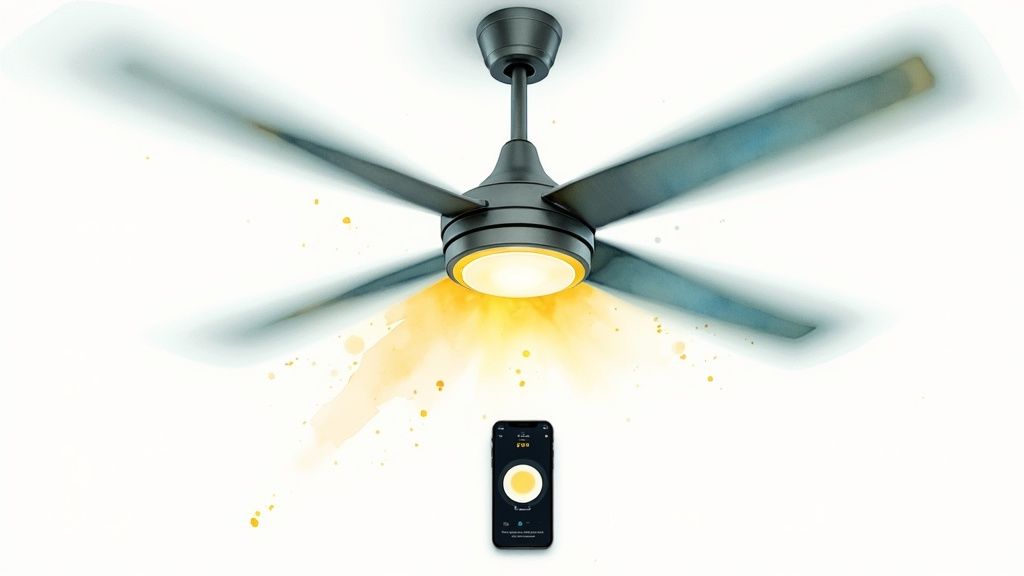
The best modern ceiling fans have grown up. They've moved far beyond the clunky pull-chain, evolving into smart home hubs that blend powerful cooling with clever tech and sophisticated lighting. What was once just a functional appliance is now a centerpiece of convenience and style.
Gone are the days of stumbling around in the dark for a switch. High-end fans now come with Wi-Fi connectivity as a standard feature, letting you control every function right from your smartphone. Imagine tweaking the fan speed from your bed or having it kick on minutes before you get home on a sweltering day.
This isn't some niche gadget anymore; it's rapidly becoming the norm. The global smart ceiling fan market is exploding, expected to hit USD 993.6 million by 2025. This wave is driven by homeowners—the residential sector makes up over 80% of the market—who want appliances that fit seamlessly into their connected lives. You can get the full picture in this market analysis from Grand View Research.
Voice Commands and Smart Home Integration
The real magic begins when your fan starts listening. Premium models are built to work flawlessly with smart home ecosystems like Amazon Alexa and Google Home. A simple phrase—"Alexa, set the living room fan to medium"—is all it takes.
This hands-free control is more than just a cool party trick; it’s about making your home life genuinely effortless. It’s a lifesaver when your hands are full, you're settled in for a movie, or you just don't feel like getting up. You can even group your fan with other smart devices for powerful routines, like a "Goodnight" scene that dims the lights, slows the fan, and nudges the thermostat all at once.
The Evolution of Fan Lighting
Lighting on ceiling fans has completely transformed. Forget those bulky, unflattering glass bowl light kits from the past. Today’s top-tier fans feature sleek, fully integrated LED light arrays designed to be as beautiful as they are functional.
These aren't just an afterthought; they're a core part of the fan's design. The built-in LEDs are often powerful enough to be the main light source for a room, all while being incredibly energy-efficient and rated to last for tens of thousands of hours. This integrated approach creates a clean, minimalist look that’s a perfect match for modern decor.
A key feature to look for is dimmability. The best modern fans offer a smooth, flicker-free dimming range, letting you go from bright task lighting to a soft, ambient glow for relaxing evenings.
Understanding Lumens and Color Temperature
To pick a fan that gives you the right kind of light for your space, you need to get familiar with two concepts: lumens and color temperature. These tell you how bright the light is and what "mood" it creates.
-
Lumens (lm): This is just a measure of brightness. The higher the lumen count, the brighter the light. If you want the fan to be the main light source in your room, look for something that puts out at least 1,500 lumens.
-
Color Temperature (Kelvin or K): This describes the color of the light, from warm and cozy to cool and crisp. Think of it as the light's personality.
- Warm White (2700K - 3000K): This is that inviting, yellowish glow you get from a traditional lightbulb. It’s perfect for bedrooms and living rooms where you want a relaxing vibe.
- Cool White (3500K - 4100K): A brighter, more neutral white light that’s great for kitchens, home offices, and bathrooms where you need to see clearly.
- Daylight (5000K+): An intense, bluish-white light that mimics natural daylight. It’s best for task-heavy spaces like workshops or garages.
Many of the best modern ceiling fans now come with adjustable color temperature, giving you the power to change the lighting to fit any activity or time of day. When you combine that flexibility with smart controls and powerful illumination, your fan does a lot more than just move air—it truly enhances your home.
Investing in Quality for Long-Term Value
When you start shopping for a modern ceiling fan, it's easy to get drawn in by a low price. But I always tell people to think of it less like a quick purchase and more like a long-term investment in their home. It completely shifts your perspective. A premium fan, especially one in the $300 and up range, isn’t just a fixture—it’s an upgrade to your home's comfort, efficiency, and even its value.
It’s a lot like buying a high-end appliance for your kitchen. You spend a bit more on a well-engineered product because you know it's built to last and will perform reliably for years. The same exact logic applies here. A higher upfront cost almost always translates to better materials, quieter motors, and smarter tech that will genuinely save you money down the line.
What Your Investment Truly Buys
When you step up to that premium level, you're not just paying for a brand name. You're getting tangible improvements that make a world of difference in your day-to-day life. These aren't just minor bells and whistles; they're the core components that define how well a fan works and for how long.
Here’s a quick breakdown of what that extra investment really gets you:
- Higher-Quality Materials: Forget basic plastics and composites. We’re talking about fans crafted from solid Paulownia wood, aircraft-grade aluminum, and heavy-gauge steel. These materials don’t just look incredible; they're built to resist warping and corrosion, ensuring your fan stays perfectly balanced and beautiful for its entire life.
- Ultra-Quiet DC Motors: As we covered earlier, the jump from a standard AC motor to a DC motor is a game-changer. This is the single biggest upgrade you can make, guaranteeing whisper-quiet operation while using up to 70% less energy. That’s a return on your investment you’ll see on every single electricity bill.
- Cutting-Edge Smart Features: Most premium fans come loaded with the latest smart home integrations. This means you can control them seamlessly with your phone or voice commands—a level of convenience and automation you just won't find in budget models.
Put it all together, and you get a fan that does more than just move air. It actively enhances your living space with quiet efficiency and sophisticated control.
A robust warranty is one of the clearest signs of a manufacturer's confidence in their product. Many high-end modern ceiling fans come with lifetime motor warranties and generous coverage on other parts, giving you peace of mind that a cheaper fan simply can't offer.
Energy Savings and Long-Term Value
One of the biggest, yet often overlooked, perks of investing in a premium fan is the long-term energy savings. Many of the best modern ceiling fans are ENERGY STAR certified, which means they meet strict efficiency guidelines set by the U.S. Environmental Protection Agency.
On average, an ENERGY STAR certified fan is 60% more efficient than a conventional fan and light unit. That efficiency isn't just good for the planet; it’s great for your wallet. Over the fan's lifespan, the money you save on electricity can easily add up to more than the initial price difference, making it a truly smart financial decision.
The combination of a powerful DC motor and an aerodynamic blade design means the fan creates incredible airflow without having to work very hard. This cuts down on energy use all year round—not just in the summer. In the winter, you can reverse the motor to help circulate warm air, which can even help lower your heating costs. Ultimately, choosing a premium modern ceiling fan is a savvy investment in durability, performance, and lasting value.
Our Top Picks for Modern Ceiling Fans
Alright, now that we've covered all the technical stuff, let's get to the fun part—seeing how all these features come together in the real world. To help you connect the dots between specs and style, we’ve put together a few of our favorite best modern ceiling fans.
Every fan on this list is an investment piece, priced over $300, so you know you’re getting the quality, performance, and durability we’ve been talking about. Instead of just giving you a long, random list, we’ve grouped our top picks into collections that speak to different needs and tastes. It makes it a lot easier to find a fan that doesn't just cool the room but truly completes it.
Minimalist Masterpieces
For those who believe less is more, these fans are all about clean, unobtrusive design. They’re built to blend right into your ceiling, pushing serious air without drawing a ton of attention. With their sleek profiles, three-blade designs, and no visible hardware, they're a perfect match for contemporary, Scandinavian, or modern spaces.
- The Aerovon Fan ($378): This fan is a study in quiet confidence. Its simple, three-blade design and matte finish just work. The powerful DC motor runs dead silent, and the integrated LED gives off clean, efficient light, making it a go-to for bedrooms and living rooms where you want a calm, uncluttered vibe.
Statement Makers
Let’s be honest—sometimes a ceiling fan should be more than just a utility. It should be a piece of art. This collection is for the bold. These fans use unique materials, dramatic shapes, and eye-catching designs to become an instant focal point in any room. They’re proof that a high-performance cooling machine can also be a stunning centerpiece.
- The Artemis XL5 ($978): This fan is pure sculpture. Its five gracefully curved, liquid-nickel blades create a dynamic visual, even when it’s not spinning. It's an incredible choice for great rooms or spaces with vaulted ceilings where you want to make a dramatic and stylish impact.
Smart Home Savvy
If you're all about tech, these fans are the ultimate in convenience and control. They come ready with Wi-Fi connectivity and full smart home integration, so they’ll respond to your voice, your phone, or whatever schedule you set. This collection is where modern fan technology really shines, blending high-efficiency cooling with effortless automation.
- The Apex Smart Fan ($478): This model nails the balance between a sleek, modern look and powerful smart features. Just connect it to your Wi-Fi, and you can control its six speeds and dimmable light from anywhere. Or, better yet, use voice commands through Alexa or Google Home for truly hands-free comfort.
These examples are just a taste of how diverse and stylish the world of premium ceiling fans has become. It’s a market driven by a global demand for both style and efficiency. It's fascinating to see that the Asia-Pacific region currently accounts for about 52% of the total market share, largely fueled by new construction and rapid urbanization. If you want to dive deeper into the global trends, you can learn more about the ceiling fan industry on MarkNtel Advisors.
Common Questions About Modern Ceiling Fans
Alright, let's tackle some of the questions that pop up when you're zeroing in on the perfect modern ceiling fan. You've got the technical specs down, but what about the day-to-day practicalities?
We get these questions all the time, so here are some straightforward answers to help you make that final choice with complete confidence.
Are More Blades on a Ceiling Fan Better?
This is a classic, but the answer is surprisingly, no. The number of blades is really more about aesthetics than performance. A fan's real power—its ability to move air—comes down to its motor and the angle of its blades, a term we call blade pitch.
Fans with just two or three blades often have that clean, minimalist look we love in modern design, and they can be total workhorses when it comes to moving air. While a fan with four or five blades might run a little quieter, the extra blades can sometimes create more drag, which can actually hold back the airflow a bit.
The most honest measure of a fan's strength is always its CFM rating.
The Bottom Line: Don't get hung up on counting the blades. A high-CFM, three-blade fan will almost always run circles around a low-CFM, five-blade model. Focus on the CFM, and you'll know exactly how much of a breeze you're getting.
Can I Use a Modern Ceiling Fan in Winter?
Absolutely! This is one of the best-kept secrets of getting the most out of your fan. Nearly all modern fans come with a reversible motor, a simple feature that makes them a year-round asset.
When winter rolls around, you just flip a switch to make the fan run in a clockwise direction on its lowest speed. Instead of pushing air down, this motion pulls cool air up. That, in turn, gently pushes the warm air that naturally rises and gets trapped at your ceiling back down into the room where you can actually feel it.
It’s a super simple and effective trick to help circulate heat more evenly. It gives your heating system a break and can even help trim down your energy bills.
Is Professional Installation Necessary?
We know it’s tempting for a skilled DIY-er to want to install a fan themselves, but we always recommend hiring a licensed electrician. A ceiling fan is a heavy, constantly moving appliance, and when it comes to that, safety is everything.
An electrician will make sure the electrical box in your ceiling is properly braced and rated to handle the fan's weight and motion—something a standard light fixture box often isn't. They’ll also guarantee all the wiring is done correctly and up to code, which is a must, especially for the best modern ceiling fans that have smart home features.
Think of professional installation as insurance. It protects your fan, makes sure it works flawlessly from day one, and keeps your warranty intact.
At Fan Connection, we believe an informed customer is a happy customer. Explore our curated collections to find a fan that not only looks incredible but also meets all your performance needs. Find your perfect fan at https://www.fanandlights.com.


