











how to cool a room without ac: Quick, practical tips
When the summer sun is really beating down, knowing a few tricks to cool a room without AC isn't just a skill—it's a lifesaver. The best methods are the ones that work fast. We're talking about creating a cross-breeze, using the simple power of a damp cloth, and pulling out the classic ice-and-fan trick for some targeted relief. These quick wins can make your space feel cooler in just a few minutes.
Your Instant Relief Plan for a Sweltering Room
When your room starts feeling more like an oven than a comfortable living space, you need solutions that work right now. This isn't about long-term projects; this is your emergency action plan for getting comfortable immediately. The goal is simple: stop the heat from building up and create a refreshing environment, usually with stuff you already have lying around.
The absolute simplest and fastest method? Create a cross-breeze. Just open windows on opposite sides of your room or home. This lets the cooler evening or morning air flow through, pushing all that hot, stagnant air out. It's such a basic move, but the difference it makes is huge—swapping that oppressive heat for a gentle, cooling current.
The Classic Ice Fan Trick
For a more direct hit of cold air, it's time to bring out the legendary ice-and-fan combo. Think of it as a DIY air conditioner that actually works on the same basic principles.
- The Setup: Grab a shallow bowl or pan, fill it with ice cubes (or even a frozen water bottle), and place it right in front of a portable fan.
- How It Works: As the fan blows across the ice, the air gets chilled. That colder air then gets circulated around the room, giving you a concentrated stream of relief exactly where you need it.
- The Result: It's not going to cool down your whole house, but it’s remarkably effective for personal cooling. It's perfect if you're stuck at a desk or trying to get to sleep on a hot night.
This whole trick is just a clever way to use evaporative cooling. The energy (heat) in the air is used to melt the ice and evaporate the water, which in turn cools down the air around it. Simple science, big relief.
Personal Adjustments for Immediate Comfort
Sometimes, the quickest way to feel better is to cool yourself down, not just the room. A few small personal adjustments can have a surprisingly big impact on your comfort level.
Start with what you're wearing. Go for loose-fitting clothes made from natural, breathable fabrics like cotton or linen. These materials let air move close to your skin and help wick away sweat—which is your body's own natural cooling system. And don't forget to stay hydrated. Drinking plenty of cool water helps keep your internal body temperature regulated from the inside out.
Here's a pro-tip for instant relief: apply a cool, damp cloth to your pulse points. Think wrists, neck, and the crooks of your elbows. Your blood vessels are closer to the surface in these spots, so this little trick helps lower your overall body temperature much faster.
Mastering Airflow with Strategic Ventilation
If you want to cool a room without AC, you have to start thinking differently about airflow. It's not just about cracking open a window; it's about being strategic—actively managing how air gets in, moves through, and finally leaves your home. With a few simple principles, you can turn your space into a much more efficient self-cooling system.
One of the most powerful tricks up nature's sleeve is something called the stack effect. You've probably noticed it without realizing it. It’s the simple fact that hot air rises. You can use this to your advantage by opening a window on a lower floor and another on a higher one, like an upstairs bedroom or even an attic vent. This creates a natural chimney effect, where the stuffy, warm air inside rises and flows out the top window, pulling in cooler, fresher air through the bottom one.
Creating a Powerful Cross Breeze
The stack effect is fantastic for multi-story homes, but creating a strong cross-breeze is a total game-changer for any space. All you need are at least two windows, ideally on opposite sides of the room or your home. But here's the secret most people miss: use a fan to exhaust the hot air, not just blow it around.
Stick a box fan in one window so it's facing outward. This literally pushes the trapped, hot air out of the room. Now, open another window across the room. What you've just done is create a pressure difference that actively sucks the cooler outside air into your space. The result is a steady, refreshing breeze that can be surprisingly powerful.
So many people make the mistake of only pointing fans into a room. While that provides some immediate relief, using one to push hot air out is far more effective at actually lowering the room's temperature. It's about removal, not just redistribution.
Timing Your Ventilation for Maximum Impact
When it comes to ventilation, timing is everything. You're trying to flush out heat and welcome in cool air, so you have to work with the daily temperature cycle, not fight against it.
This little diagram shows a few quick methods for instant cooling, combining a good cross-breeze with other simple tricks.
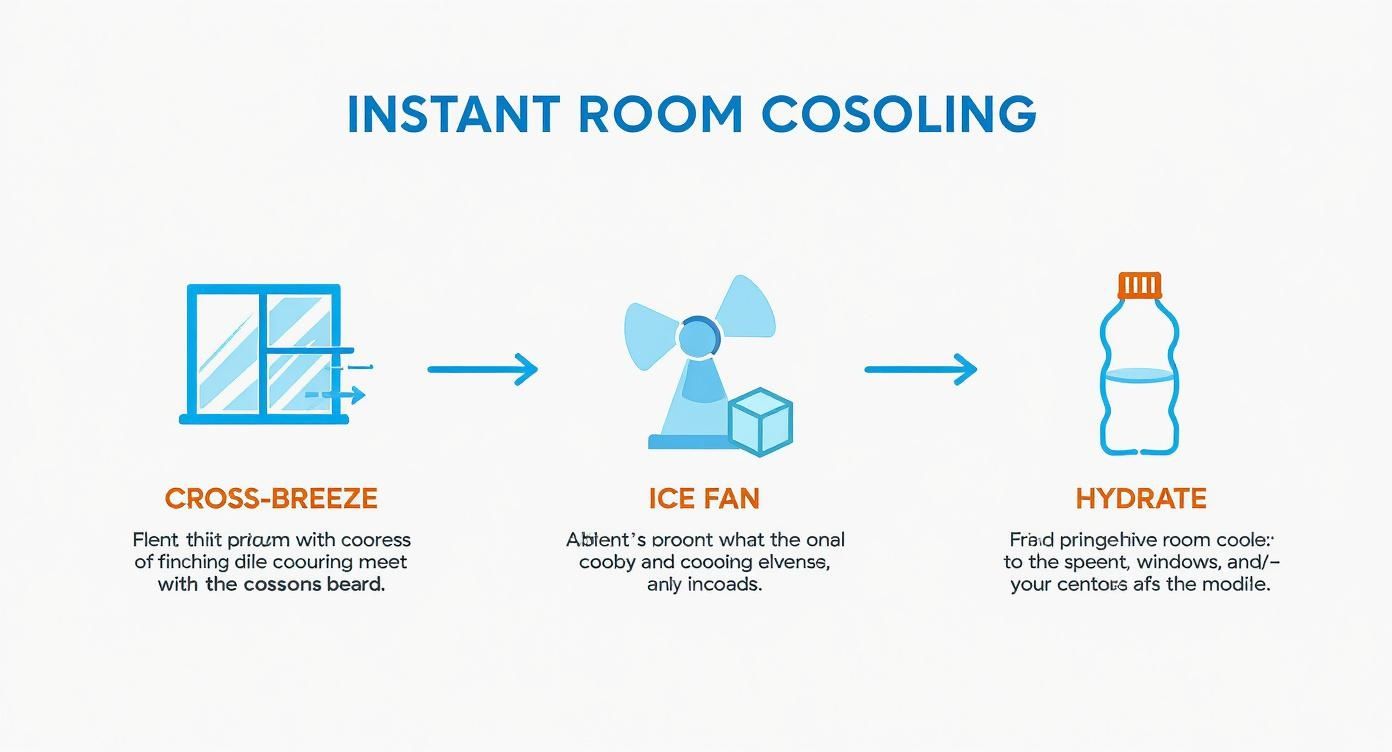
The key takeaway here is that active cooling methods like cross-breezes and ice fans are most effective when you also take care of yourself by staying hydrated.
The absolute best times to ventilate are during the coolest parts of the day—usually late at night and in the early morning. During these cooler hours, open up your windows wide and use your fan setup to pull in as much of that crisp, cool air as you can. Then, just as the sun starts to peek over the horizon and the outdoor temperature begins to rise, shut everything down. Close your windows and draw your curtains or blinds to trap all that wonderful cool air inside for as long as possible.
Learning these natural cooling methods is more important than ever. Projections suggest that by 2050, up to 4 billion people could still lack access to air conditioning even as global temperatures continue to climb. You can read more about these projections on cooling access from Nature Communications.
If you have ceiling fans, getting them to work in concert with your ventilation efforts is a huge part of your success. You can check out some creative ceiling fan placement ideas to really dial in your home's circulation.
Using Fans Like a Pro for Maximum Cooling
Let’s get one thing straight: a fan isn’t an air conditioner. It doesn't actually lower the temperature in a room. What it does do is create a wind-chill effect, making you feel cooler by helping sweat evaporate from your skin. But there's a huge difference between just pointing a fan in your direction and using it strategically to create a legitimately powerful cooling system.
The biggest mistake I see is people just turning on a fan and hoping for the best. To really beat the heat, you need to think about airflow, direction, and even how to create your own wind tunnels. It's all about working smarter, not just blowing hot air around.
Unlocking Your Ceiling Fan's Potential
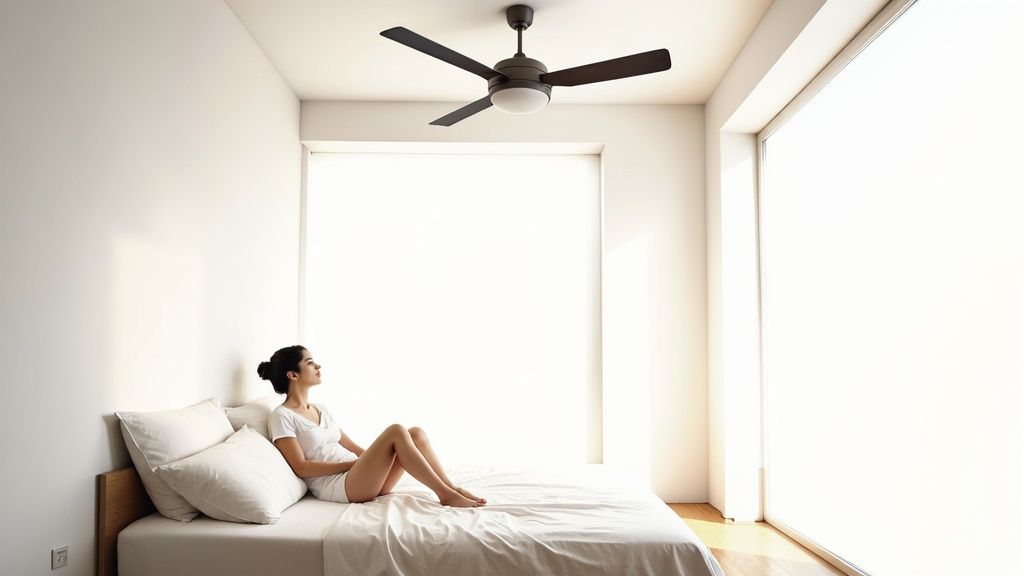
Your ceiling fan is easily one of your best allies in the fight against summer heat, but only if it's spinning the right way. For summer, the blades need to rotate counter-clockwise.
This direction creates a direct dowraft, pushing air down and creating that refreshing breeze you're after. In the winter, you’ll flip the switch to run it clockwise, which helps circulate warm air that's risen to the ceiling. But for summer cooling, counter-clockwise is the only way to go. It's a simple fix that makes an incredible difference. To learn more about how they work year-round, you can check out the breezy benefits of having a ceiling fan in our full guide.
A correctly set ceiling fan can make a room feel up to 4°F cooler, which means you can raise your thermostat setting without feeling any less comfortable. That one adjustment can lead to some serious energy savings over a hot summer.
Creating a Strategic Wind Tunnel
If you don't have a ceiling fan, a couple of well-placed box or pedestal fans can create a surprisingly effective "wind tunnel." This is a big step up from just using a single fan for a cross-breeze and works wonders in larger rooms or on those truly sweltering days.
Here’s how to set it up:
- Place one fan in a window facing outward. Just like with a cross-breeze, its job is to push hot, stale air out of the room.
- Position a second fan on the opposite side of the room, facing inward. This one will pull in cooler air from outside (or another, cooler part of the house).
- Make sure the fans are aimed to create a direct path of airflow right through the space you use most, like across your bed or couch.
This two-fan system actively forces a current of air through the room, constantly swapping out the warm air for fresher, cooler air from outside.
Investing in a High-Performance Cooling Solution
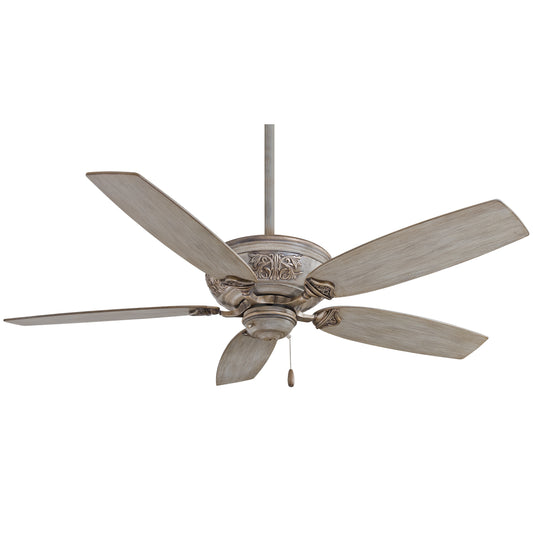
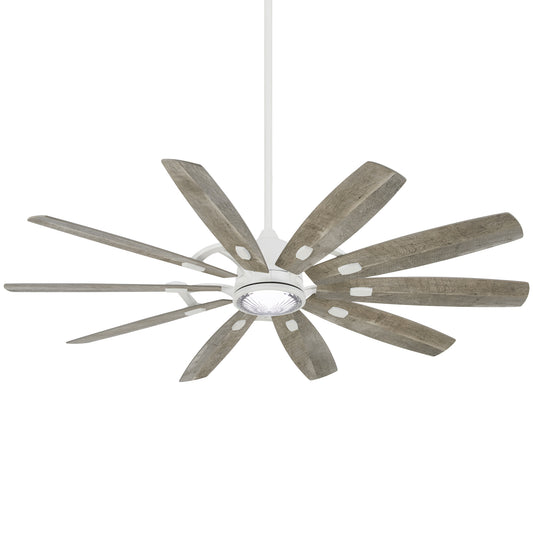
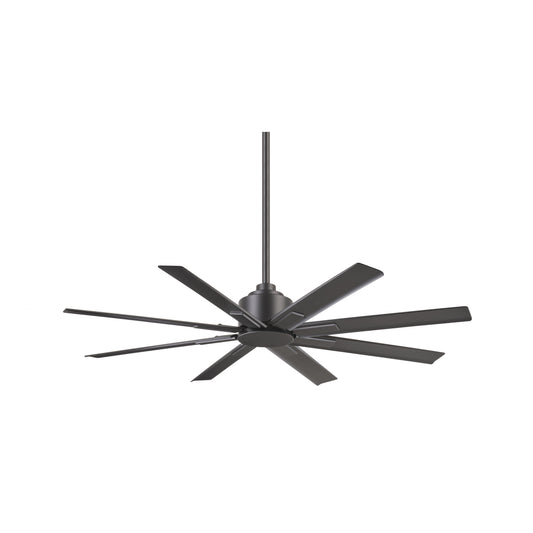
While clever fan placement works wonders, sometimes you just need more power. This is where investing in a premium, high-performance ceiling fan can be a total game-changer for anyone serious about cooling a room without AC.
We’re not talking about your average, wobbly hardware store fan. Brands like Minka-Aire and Fanaway engineer their products for maximum air movement and efficiency. They are meticulously designed pieces of equipment.
- Superior Aerodynamics: They use uniquely pitched blades—not flat ones—built on principles borrowed from aviation to move a ton more air with less energy.
- Powerful, Silent Motors: High-end DC motors are incredibly energy-efficient and operate almost silently. You get all the breeze with none of the distracting noise.
- Smart Features: Many models costing $300 or more include smart controls. You can adjust the speed from an app, set schedules, and even link them to your smart home system.
An investment in a high-quality ceiling fan is really an investment in long-term, sustainable comfort. It delivers incredible cooling power while using just a fraction of the electricity of an air conditioner, making your home more comfortable and your energy bills a lot more manageable.
Blocking Solar Heat Before It Enters Your Room
While getting the air moving is a huge part of cooling a room without AC, the most effective strategy is to get ahead of the problem. It’s all about stopping the sun’s intense heat from ever sneaking inside in the first place.
Think of your windows as giant magnifying glasses. On a sunny day, they let in a tremendous amount of solar radiation, quickly turning your comfortable room into a stuffy greenhouse.
Your first line of defense is right at the window itself. We’re talking about more than just your standard privacy blinds. Heavy, light-colored blackout curtains or dedicated thermal blinds are game-changers. They’re designed with a special backing that reflects sunlight and insulates the glass. Keeping these closed, especially on south- and west-facing windows during peak sun, can cut down on heat gain in a big way.

Taking the Fight Outside
Interior treatments are good, but exterior solutions are even better. Why? Because they stop the heat before it even touches the window pane. This is where options like awnings and reflective window films really shine.
- Awnings and Overhangs: An awning can be a fantastic investment. It physically blocks direct sunlight from hitting your window during the hottest hours of the day. The impact is huge—studies have shown that window awnings can reduce solar heat gain in the summer by up to 65% on south-facing windows and a whopping 77% on west-facing ones.
- Reflective Window Film: This is a more subtle but highly effective option. A special film is applied directly to the outside of your window, reflecting a huge portion of the sun's heat and UV rays before they can penetrate the glass. The best part? It does all this without blocking your view.
These external methods create a crucial buffer zone. They prevent your windows from heating up and radiating that warmth into your room all day long.
The core principle is simple but powerful: the best way to deal with solar heat is to never let it into your home. An untreated window is a doorway for heat, while a well-shaded one is a shield.
The Bigger Picture on Cooling
Adopting these heat-blocking strategies does more than just make your room more comfortable. It’s a meaningful step toward energy conservation on a larger scale.
Globally, our reliance on air conditioning is skyrocketing. Cooling systems consumed around 2,100 terawatt-hours of electricity back in 2022. That demand contributes to about 3% of total greenhouse gas emissions, and that number is set to grow as projections show the number of AC units could surpass 5.5 billion by 2050. You can learn more about the global impact of cooling from Our World in Data.
By implementing smart, passive cooling techniques like exterior shading, you reduce your personal need for an energy-hungry air conditioner. You end up with a living space that’s not just more comfortable, but more sustainable, too.
Tackling Humidity to Feel Instantly Cooler
You know the old saying: "It's not the heat, it's the humidity." It’s more than just a classic summer complaint—it's the absolute truth. High humidity wraps the air in a wet blanket, stopping your body's natural air conditioner (sweat) from doing its job.
When sweat can't evaporate, heat gets trapped right against your skin. That's what makes an 85°F day feel like a sticky, miserable 95°F.
So, managing moisture is your secret weapon. If you can knock down the humidity, you can completely change how the temperature feels, even if the thermometer barely budges. You’re just letting your body cool itself down the way it was meant to.
The Power of a High-Quality Dehumidifier
One of the most effective ways to attack indoor humidity is with a dedicated dehumidifier. It might seem odd to run another appliance that gives off a little heat, but trust me, the trade-off is almost always worth it. Pulling that excess moisture from the air makes the room feel crisp and so much more comfortable.
If you're serious about this, investing in a high-capacity unit is the way to go. A premium dehumidifier, which can run $300 or more, delivers powerful moisture removal and smart features that really make a difference.
- Smart Humidity Control: The best models have a built-in humidistat that automatically keeps the room at your ideal humidity level, so it only runs when it needs to.
- Continuous Drainage: Look for a unit that lets you hook up a hose for continuous drainage. No more lugging a heavy, full water tank to the sink every few hours.
- Energy Efficiency: An Energy Star rating is a must. These models are designed to pull a ton of water from the air without sending your power bill through the roof.
This kind of investment does more than just keep you comfortable; it actively protects your home from mold and mildew.
A dehumidifier can make a room feel 3-5°F cooler just by cutting the moisture in the air. That change in the "feels-like" temperature is often all it takes to go from miserable to perfectly fine.
Natural Ways to Reduce Indoor Moisture
Beyond plugging something in, there are a few simple habits you can adopt to keep indoor humidity under control, especially on those really soupy days. You’d be surprised what a big impact these small adjustments can have.
Start by paying attention to activities that create steam. Try to avoid things like boiling pasta or running the dishwasher during the peak heat of the afternoon. If you have to, make sure you're running your kitchen's exhaust fan to pull that damp air outside.
The same idea applies to showers. Go for shorter, cooler showers if you can, and always run the bathroom fan for at least 20-30 minutes after you’re done to clear out all that steam.
This kind of accessible cooling is a big deal on a global scale. In 2022, a staggering 1.2 billion people in poor rural and urban areas were at high risk from extreme heat simply because they lacked cooling solutions. You can learn more about this global cooling access gap from the great work being done by Sustainable Energy for All. Learning to make our homes more livable without being totally dependent on AC is a vital skill for all of us.
Common Questions About Staying Cool Without AC
Even with a solid game plan, trying to beat the heat without an air conditioner can bring up a few questions. Let's walk through some of the most common ones I hear, so you can fine-tune your approach and finally get some relief.
Do Fans Actually Cool the Air in a Room?
This is the big one, and the short answer is a hard no. Fans don't actually lower the temperature of the air itself. What they do is create a wind-chill effect.
Think of it this way: a fan moves air across your skin, which helps your sweat evaporate faster. That evaporation is your body's natural cooling system in action. This process makes you feel cooler, even if the thermostat reading hasn't budged an inch. It's why a room with a fan feels instantly stuffy the moment you turn it off—the air was never colder, you just lost your breeze.
What Is the Single Most Effective DIY Cooling Trick?
While the old ice-bowl-in-front-of-a-fan trick is great for immediate, personal relief, the single most effective strategy for cooling down an entire room is creating a strategic cross-breeze with an exhaust fan.
Most people just point a fan into a room and let it blow hot air around. The real game-changer is placing a box fan in one window facing outward, actively pushing the hot, stale air out of your space. Then, by opening another window (preferably on the opposite, shadier side of the house), you create a natural pressure system that pulls cooler outside air in to replace what was just pushed out. You're actively exchanging the air in your room, not just recycling it.
The secret to a truly cool house is blowing air out of the room. When you do this correctly, you create a vacuum that draws cooler outside air in through another open window. It's simple physics, and it works wonders.
How Can I Keep My Bedroom Cool Enough to Sleep?
Heat and sleep are basically enemies. Your body's core temperature needs to drop for you to fall asleep and stay asleep, which feels next to impossible when your bedroom is sweltering.
Your best bet is a multi-pronged attack:
- Block the Sun: This is non-negotiable. Keep your bedroom blinds and curtains drawn shut all day, especially on windows that get hit with direct sun. Preventing that solar heat from getting in is your first and best line of defense.
- Ventilate at Night: The moment the temperature outside dips below your indoor temperature, open those windows up. Use the exhaust fan trick we just talked about to flush out all the heat that built up during the day and pull in the cooler night air.
- Optimize Your Fan: If you have a ceiling fan, make sure it’s spinning counter-clockwise. This creates a direct downdraft over your bed, giving you that gentle, consistent breeze you need to stay comfortable all night. The energy efficiency and cost savings of ceiling fans make them an excellent, eco-friendly choice for nighttime cooling.
By combining these tactics, you can create a much more sleep-friendly environment, helping your body cool down naturally without ever touching an AC remote.
Ready to upgrade your home's airflow with a powerful, stylish, and efficient solution? Explore the curated collections at Fan Connection and find the perfect ceiling fan to transform your space.


