











Three Blade Fans The Ultimate Buyer's Guide
Step into any well-designed modern home, and you'll probably spot a sleek three-blade fan turning overhead. It's not a coincidence that this style has become so popular; these fans are the perfect blend of minimalist good looks and powerful, quiet performance. Their clean, uncluttered profile makes them a natural fit for just about any contemporary, industrial, or minimalist space. Forget the clunky, wobbly fans of yesteryear—today's three-blade models are a whole vibe.
Why Three Blades Are the Go-To for Modern Comfort
A modern three-blade fan is more than just an appliance—it's an architectural feature that feels like a cool upgrade. It boosts a room's style while delivering fantastic air circulation, proving you don’t have to pick between form and function. This simple idea has caught on with homeowners and designers everywhere, which is why you see them so often.
The numbers back this up, too. A quick look at the global ceiling fan market shows a clear winner. In 2023, fans with three or fewer blades held a massive 74.7% of the market share, bringing in around USD 9 billion worldwide. This isn't a fluke. It's the direct result of their winning combination of style, energy efficiency, and affordability. You can learn more about ceiling fan market trends and see for yourself how these designs are leading the pack.
But this popularity is about more than just looks. It’s all about smart engineering that simply works better.
The Power of Simplicity
The real beauty of a three-blade fan is its elegant simplicity. It doesn't have the visual busyness of fans with more blades, which helps create a feeling of openness and sophistication. This makes them a fantastic choice for rooms where you want the decor to shine, not the fixtures. It’s like the perfect accessory that completes the outfit without stealing the show.
- Minimalist Vibe: Fewer blades mean a cleaner, more modern look that complements a ton of different styles without overwhelming the space.
- Seamless Integration: They tend to blend right into the ceiling, feeling like a natural part of the room's design instead of a clunky add-on.
- Versatile Finishes: Whether you're looking for matte black, brushed brass, or natural wood, these fans come in finishes that can either make a statement or blend in quietly.
For a lot of interior designers, the three-blade fan is a no-brainer. Its understated elegance provides that crucial comfort without messing up the visual flow of a carefully designed room.
Where Performance Meets Style
While the design is a huge plus, three-blade fans are also serious performers. The engineering behind them is all about moving air as efficiently as possible to create a breeze you can actually feel. Unlike fans with more blades that sometimes just seem to stir the air around, a good three-blade model creates a strong, direct airflow.
That's why at Fan Connection, we've curated an extensive collection of top-tier three-blade models. A perfect example is the Artemis IV, priced at $788. It perfectly captures this idea with its stunning design and powerful performance, making it a smart investment in both comfort and style.
The Aerodynamic Secret Behind Fewer Blades
It’s a classic head-scratcher: how can a fan with fewer blades actually move more air? It feels like it goes against common sense, but the answer is buried in some surprisingly simple aerodynamic principles. The secret isn't about having more paddles to push the air, but about moving air with as much speed and as little resistance as possible. It's less about brute force and more about clever physics.
Think of each fan blade less like a paddle and more like a tiny, sophisticated airplane wing. Just like a wing is designed to generate lift, a fan blade is angled—a feature we call blade pitch—to create a pressure difference. As the blade slices through the air, it creates "lift" that forces air downward, creating that refreshing breeze you feel.
Now, think of the fan's motor as its engine. Every single blade it has to turn adds weight and, more importantly, drag. Drag is the force that resists motion. The more blades you have, the more resistance the motor has to fight against, which naturally slows down how fast it can spin.
Speed Over Surface Area
This is where the three-blade fan design really shines. With less drag holding it back, the motor can spin the blades much, much faster. This higher velocity is the real key to creating a powerful, focused column of air that shoots straight down. You don’t just feel air being stirred around; you feel a distinct, cooling downdraft. It's the difference between a gentle puff and a real "ahhh, that's better" breeze.
On the flip side, fans with five or more blades spin slower simply because there's more resistance. They move air more gently and across a wider area, creating a softer, ambient circulation instead of a strong breeze. Neither is better than the other; they just do different jobs. But for powerful, direct cooling, the high-speed efficiency of three-blade fans is tough to beat.
This visual shows how the core elements of a three-blade fan work together to deliver on style, performance, and comfort.

As you can see, a fan's effectiveness is really a balance of good looks, powerful airflow, and the overall feeling of comfort it creates.
Debunking The 'More Blades, More Air' Myth
This brings us to one of the biggest misconceptions out there. A fan's real performance isn’t measured by how many blades it has, but by its CFM, or Cubic Feet per Minute. This number tells you the actual volume of air the fan is capable of moving. Think of it as the fan's horsepower rating.
A fan's CFM rating is the result of a delicate partnership between motor power, blade pitch, and rotational speed. A powerful motor can handle a steeper blade pitch and spin it faster, which adds up to a much higher CFM and far better cooling.
This is exactly why just adding more blades doesn't guarantee you'll get more airflow. If the motor isn't strong enough to overcome the extra drag and keep its speed up, the fan's performance will actually get worse. High-quality three-blade fans are engineered with powerful motors specifically designed to work in harmony with the lower blade count, maximizing both speed and efficiency. For a deeper dive, you can explore the impact of fan blade count and fan efficiency in our detailed guide.
Choosing a premium model ensures you get this synergy right. The Minka-Aire Aviation, priced at $599.95, is a perfect illustration of this engineering. Its powerful DC motor is precisely paired with three elegantly angled blades to produce impressive airflow without sacrificing its quiet operation or stunning looks. By choosing a fan based on proven performance metrics like CFM instead of just counting the blades, you’re making a smarter choice that guarantees real comfort.
How To Choose Your Perfect Three Blade Fan
Picking out the right three-blade fan isn't just about finding a style you love—it’s about matching the fan’s performance to your room's specific needs. Get this part right, and you’ll enjoy the perfect blend of comfort and efficiency. The process is pretty straightforward once you know what to look for, and it all begins with two simple measurements: the size of your space and the height of your ceiling.

These two numbers are your foundation. They determine the fan's blade span and how it needs to be mounted. It's a common mistake, but an undersized fan will just spin without moving much air, while an oversized one can feel like a wind tunnel in a small room. And if it’s mounted too high or too low, you won't get that optimal cooling effect you’re after.
Match The Fan To Your Room
First things first, measure your room's square footage. This measurement points you to the ideal blade span—that's the diameter of the circle the blades make as they spin—to get the air moving properly. Don't skip this step, or you might end up with a fan that looks great but feels disappointing.
This quick reference guide is a great place to start. It helps you select the right fan blade span and target CFM based on your room's dimensions for optimal air circulation.
Matching Your Fan Size and Airflow to Your Room
| Room Size (Sq. Ft.) | Ideal Blade Span (Inches) | Recommended CFM Range |
|---|---|---|
| Up to 75 | 36 - 42 | 1,000 - 3,000 |
| 75 - 175 | 44 - 50 | 2,500 - 4,500 |
| 175 - 350 | 52 - 56 | 4,000 - 6,000 |
| Over 350 | 60 or larger | 5,500+ |
Once you’ve got your blade span sorted, you can focus on finding a fan that will deliver the airflow you need to stay comfortable.
Ceiling height is just as crucial. For both safety and performance, the fan blades should hang at least 7 feet from the floor. If your ceilings are taller than 8 feet, you'll need a downrod to lower the fan to the right height, making sure that breeze actually reaches you. Standard 8-foot ceilings work well with a short downrod or a flush-mount fan, while vaulted ceilings in a great room will call for a much longer one.
Understand The Power Of CFM
While size gets you in the ballpark, the real measure of a fan's cooling power is its CFM (Cubic Feet per Minute) rating. This number tells you exactly how much air the fan moves every minute. A higher CFM means a stronger breeze and more effective cooling, making it the single most important performance spec to look for.
Don't get caught up in blade count alone. A high-quality three blade fan with a powerful motor can easily produce a higher CFM than a five blade model with a weaker motor. Always prioritize CFM for real-world cooling performance.
Investing in a fan with a robust CFM rating ensures you'll feel that refreshing breeze on a hot day. The Minka-Aire Aviation 60" fan, for example, is a powerhouse engineered to deliver exceptional airflow, making it a powerful and stylish choice for larger spaces at $599.95.
Define Your Style And Features
With the technical specs out of the way, you can get to the fun part: choosing a design that looks great in your home. The finish of your three blade fan can completely change a room's vibe. Matte black offers a bold, modern look, brushed brass adds a touch of warm elegance, and natural wood blades bring an organic, calming feel to a space.
The demand for high-quality, stylish fans has exploded. In 2022, the global fan blades market was valued at USD 7.45 billion and is projected to hit about USD 10.43 billion by 2030. This growth shows just how much innovation is happening in blade design and materials right now.
Beyond looks, think about the features that will make your life easier.
- DC Motors: These are the new gold standard. They're way more energy-efficient (using up to 70% less energy) and run almost silently compared to older AC motors.
- Integrated LED Lighting: Many modern fans come with built-in LED lights, giving you an all-in-one solution for lighting and air circulation. Look for models with adjustable brightness and color temperature for total control over your room's ambiance.
- Smart Home Compatibility: Want ultimate convenience? A smart fan lets you control speed, lighting, and schedules with a remote, your phone, or even voice commands through Amazon Alexa or Google Assistant.
By thinking through each of these elements—size, CFM, style, and features—you can find the perfect three-blade fan for your home. For an even deeper dive, our comprehensive ceiling fan buying guide walks you through every detail of the process.
Taking a Look at Top-Tier Three-Blade Fan Designs
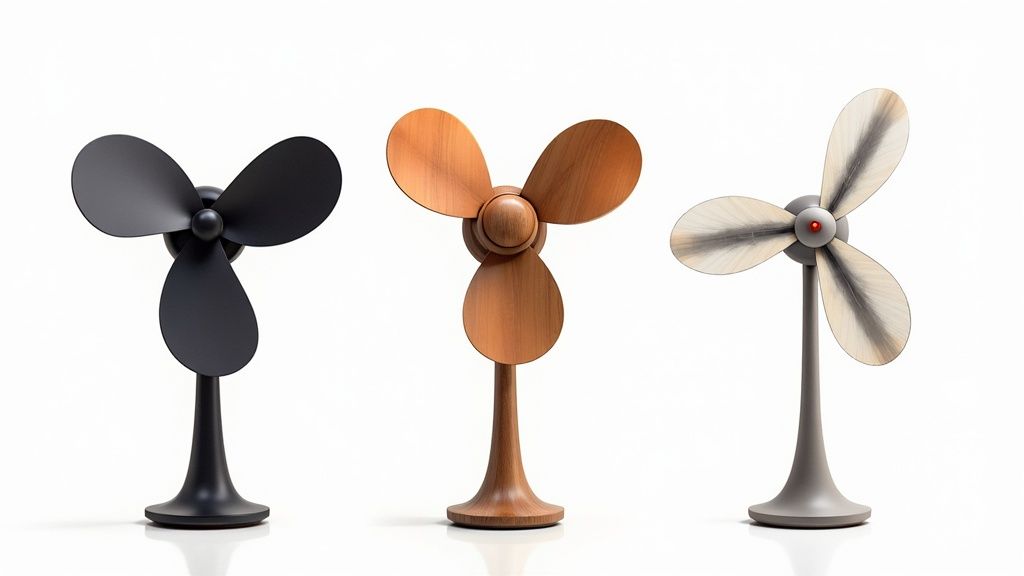
When you’re ready to graduate from purely functional to functional art, the world of premium three-blade fans really opens up. These aren't just simple appliances; they're statement pieces, engineered for incredible performance and designed to be the centerpiece of a room. Investing in a high-end fan isn’t just about looks—you're paying for whisper-quiet operation, powerful airflow, and craftsmanship that’s built to last.
This is where advanced tech meets beautiful design. Forget the wobbly, noisy fans you remember from the past. Today’s premium models have ultra-efficient DC motors, smart home integration, and blades crafted from stunning materials like carved wood or aircraft-grade aluminum.
Let’s check out a few standout models that show just how good it can get.
The Architectural Masterpiece: The Minka-Aire Artemis IV
The Minka-Aire Artemis IV 64" LED Smart Ceiling Fan is more than a fan—it's basically a flowing sculpture for your ceiling. Coming in at $788, its unique, continuous three-blade design creates a stunning visual effect whether it's spinning or standing still. It’s a perfect match for great rooms with vaulted ceilings or large, open-concept living areas.
What really sets it apart is the powerful yet silent DC motor. It moves a massive amount of air without making a sound. It's also fully loaded with smart tech, so you can control its speed, built-in LED light, and direction with a remote, wall control, or your favorite smart home system like Amazon Alexa or Google Assistant.
- Best For: Modern great rooms, expansive living areas, or any space where you want the fan to be a focal point.
- Why It's Worth It: You’re getting a piece of design history that also delivers top-tier performance and smart home convenience. The liquid nickel finish and etched lens shade add a layer of sophistication you just don't find in standard fans.
The Natural Innovator: The Minka-Aire Aviation
If you appreciate a blend of industrial design and natural elements, the Minka-Aire Aviation 60" Fan is a real showstopper. For $599.95, you get a design inspired by the elegant propellers of vintage aircraft. The fan features three beautifully crafted blades that deliver serious airflow, making it a powerhouse for both indoor and covered outdoor spaces.
This model is a perfect example of how three-blade fans can hit peak aerodynamic efficiency. The blade pitch is perfectly matched with its robust motor to create a strong, cooling breeze. It fits right in with spaces that mix modern and rustic styles, like a modern farmhouse living room or a sophisticated covered patio.
The real value in a fan like the Aviation is its versatility. It's not just powerful; it's also rated for damp locations, meaning you can bring that same high-end style and performance to your outdoor living spaces.
The Sleek Minimalist: The Minka-Aire Apex
Sometimes, the best design is the one that just blends in seamlessly. The Minka-Aire Apex 60" Smart Ceiling Fan, priced at $399.95, is the definition of minimalist elegance. Its clean lines and simple three-blade profile let it integrate into almost any contemporary decor without demanding attention. But don't let its understated look fool you—this fan is an absolute workhorse.
The Apex is built for quiet, efficient air movement in bedrooms, offices, or living rooms where comfort is king. Its smart features give you effortless control, and the included LED light is both functional and energy-efficient. This is the fan for someone who wants premium performance without all the visual noise, proving that high-end design can be both subtle and powerful.
Installation and Maintenance Made Simple
A high-quality three-blade fan is more than just a fixture; it's an investment in your home's comfort and style. With the right setup, it’ll run like a dream for years. Getting the installation right is the key to a quiet, wobble-free fan, but don’t worry—it’s more straightforward than you might think. And the long-term upkeep? That’s even easier.
Before you even think about opening the box, there’s one crucial safety check. Take a look at the electrical box in your ceiling where the fan will hang. It must be fan-rated. This means it’s built to handle the weight and constant motion of a ceiling fan. A standard box for a light fixture just isn't strong enough and can fail, which is a serious safety hazard. If you're not 100% sure, it's always worth calling an electrician to double-check.
The Installation Essentials
While every fan has its own quirks, the core installation process is pretty consistent. First things first: head to your circuit breaker and cut the power to the room. Safety always comes first. The basic steps involve putting together the fan's motor housing, attaching the blades, and then hanging the whole assembly from the fan-rated bracket on the ceiling.
Next up is the wiring for both the fan and its light kit, if it has one. This is where some folks start to feel a little out of their depth, and that's perfectly okay. If you aren't completely comfortable with electrical work, this is the perfect time to call in a licensed pro. An electrician will make sure everything is connected correctly and safely, giving you total peace of mind. For the confident DIYer, our step-by-step guide on how to install a ceiling fan safely offers a much more detailed walkthrough.
A Simple Plan For Long-Term Care
Once your new fan is spinning quietly overhead, keeping it in prime condition takes minimal effort. A simple maintenance routine a couple of times a year will keep it from wobbling or making noise and will help it last for years. Think of it as protecting your investment.
Here's a quick checklist to keep your three-blade fan running smoothly:
- Clean The Blades Regularly: Dust might seem harmless, but it can build up and throw the blades off balance, causing that annoying wobble. A quick wipe-down with a soft cloth or an extendable duster every few months is all it takes. Just steer clear of harsh chemical cleaners that could damage the blade finish.
- Check The Screws: A fan is always in motion, and over time, that can gently loosen screws. Twice a year, give the screws on the blades, mounting bracket, and light fixture a quick check to make sure they're snug. No need to overtighten—just make sure they’re secure.
- Listen For Changes: Your fan should be nearly silent. If you suddenly start to hear new clicking, humming, or grinding noises, it's usually a sign that something is loose or out of balance. A quick check-up can usually solve the problem.
A well-maintained three-blade fan is a quiet fan. Most noise issues don't come from the motor itself but from small, fixable things like a loose screw or unbalanced blades. A few minutes of simple upkeep can guarantee years of silent, powerful performance.
It's never been easier to find the perfect fan, thanks to the convenience of shopping online. The electric fan market was valued at an impressive USD 42.7 million in 2023 and is expected to climb to USD 53.6 million by 2033. With online sales now accounting for over 60% of all purchases, it’s clear that homeowners feel confident selecting and buying these key fixtures from the comfort of home.
Still Have Questions About Three-Blade Fans?
Even after getting all the details, it's totally normal to have a few more questions pop up. Picking out a new fixture for your home is a big deal, and we want you to feel 100% confident in your choice. Here are some of the most common questions we get about three-blade fans, with straightforward answers to help clear things up.
Think of this as the final check-in before you find the perfect fan.
Are Three-Blade Fans Better Than Five-Blade Fans?
One isn't automatically "better"—they're just built for different jobs. A three-blade fan is an airflow machine. It’s designed to spin faster, creating a strong, focused breeze that's perfect for anyone who really wants to feel the cooling effect.
Five-blade fans, on the other hand, usually spin a bit slower and are incredibly quiet. They excel at creating a gentle, room-filling circulation rather than a direct downdraft. It all comes down to what you need: powerful, direct cooling (go for three blades) or silent, gentle air movement (five blades are your friend).
Do Fewer Blades Mean Less Electricity?
Yep, in most cases, they're more energy-efficient. With less weight and drag, the motor doesn't have to work as hard to get those blades moving. This allows a three-blade fan to achieve high speeds and move a lot of air (high CFM) while sipping less power.
To really maximize those energy savings, always keep an eye out for models with a modern DC motor. These newer motors are a game-changer, using up to 70% less electricity than old-school AC motors. That translates to real savings on your utility bill over the fan's lifetime.
Can I Put A Three-Blade Fan On A Sloped Ceiling?
Absolutely. The vast majority of quality three-blade fans are designed right out of the box to work with sloped or vaulted ceilings. Just double-check the product specs to see the maximum angle the included hardware supports—it's typically up to 30 degrees.
If your ceiling has a steeper pitch than that, no problem. You'll just need a sloped ceiling adapter, which is a standard accessory that's easy to find.
Are Three-Blade Fans Louder Than Other Fans?
This is a common myth! The noise a fan makes has everything to do with the quality of its motor and a good installation, not the blade count. A high-end three-blade fan with a well-balanced DC motor will be virtually silent on its lower settings.
If you ever hear annoying humming, clicking, or rattling, it’s almost always a sign of a bad installation, wobbly blades that need balancing, or simply a low-quality motor.
Ready to find that perfect mix of modern style and powerful performance? Take a look through the hand-picked collections at Fan Connection and discover a world of premium three-blade fans ready to transform your space.


