








DC Ceiling Fan: A Guide to Quiet, Efficient, and Stylish Airflow
So, what exactly is a DC ceiling fan? Think of it as the modern, high-tech cousin to the traditional fans you grew up with. It’s powered by a direct current motor, which is a fancy way of saying it's built to be incredibly energy-efficient and whisper-quiet. This newer technology gives you way better speed control and opens the door to smart features, making it a serious upgrade for any home.
The Quiet Revolution in Home Comfort
Imagine settling onto the sofa for a perfect evening at home. You’re lost in a good book or your favorite show, and a gentle breeze is keeping the room perfectly comfortable. The only sounds you hear are the turning pages or the dialogue on the screen. What’s missing? That constant, low-level hum from an old, clunky ceiling fan—the noise you don’t even notice until it’s gone, and you realize how much more peaceful the room feels.
This is the new reality that DC ceiling fans bring to the table. They’re completely changing the game for home climate control, delivering a quiet sophistication that older fan technology just can’t touch.
The End of Distracting Noise
The difference between a classic AC fan and a modern DC fan is a bit like comparing a noisy old window air conditioner to a silent central air system. Sure, they both cool the room, but one does it with a constant, mechanical drone while the other works so discreetly you almost forget it’s even on.
A DC motor works differently, using magnets and a more direct flow of electricity that gets rid of the "electrical hum" so common in AC fans. The result is a nearly silent operation, which is a huge deal in spaces where you want to rest and relax. For bedrooms, nurseries, or home offices, a quiet environment isn't just a nice-to-have; it's essential for good sleep and focus. If you're really after that peaceful vibe, you can learn more about finding the right quiet ceiling fans for your bedroom.
A premium DC ceiling fan completely changes a room's atmosphere by cutting out audible distractions. It's an investment in pure tranquility.
More Than Just Quiet Operation
While the near-silent performance is a major selling point, the perks of upgrading to a DC ceiling fan don't stop there. This guide will walk you through all the advantages that are making them the go-to choice for homeowners and designers.
- Remarkable Energy Efficiency: We'll show you how a DC motor can use up to 70% less electricity than an old-school AC fan, which means real savings on your utility bills.
- Superior Control and Features: You get way more control over your comfort, from six or more speed settings to easy integration with your smart home setup.
- Elevated Design and Style: Modern DC fans are designed to be statement pieces. Here at Fan and Lights, you can check out premium models like the sleek Aerovon ($398) or the bold Aviation ($498) that look incredible in any style of room.
Choosing a DC ceiling fan isn't just about buying an appliance; it's about upgrading your home's comfort, efficiency, and overall look and feel.
How DC Fan Technology Actually Works
So, what’s the big deal with DC ceiling fans? Let’s break it down with a fun analogy. Think of a classic gas-guzzling muscle car from the 70s. It’s loud, powerful in a brute-force sort of way, and drinks fuel like there’s no tomorrow. That’s pretty much your traditional AC (Alternating Current) ceiling fan motor.
Now, picture a sleek, modern electric car. It’s whisper-quiet, incredibly responsive, and sips energy. That’s the DC (Direct Current) motor.
The real difference lies in how they handle electricity. An AC motor plugs right into your home's power, which constantly flips its direction. This process is inefficient, creating wasted energy as heat and that all-too-familiar "hum" we associate with old fans.
A DC motor, on the other hand, is a whole lot smarter. It takes that same AC power from your wall but first sends it through an internal transformer. This little converter turns the power into a stable, one-way direct current. This refined energy then powers a system of magnets, creating a smooth, nearly silent spin with way less energy loss.
The Power of Precision and Efficiency
This fundamental shift in how the motor works isn't just a small tweak—it's a complete performance overhaul that you can feel and measure right away.
Because a DC motor is so much more effective at using electricity, it needs a lot less power to get the job done. In fact, most DC ceiling fans consume up to 70% less energy than their AC cousins. That’s not just a number on a spec sheet; it’s a real reduction in your monthly power bill.
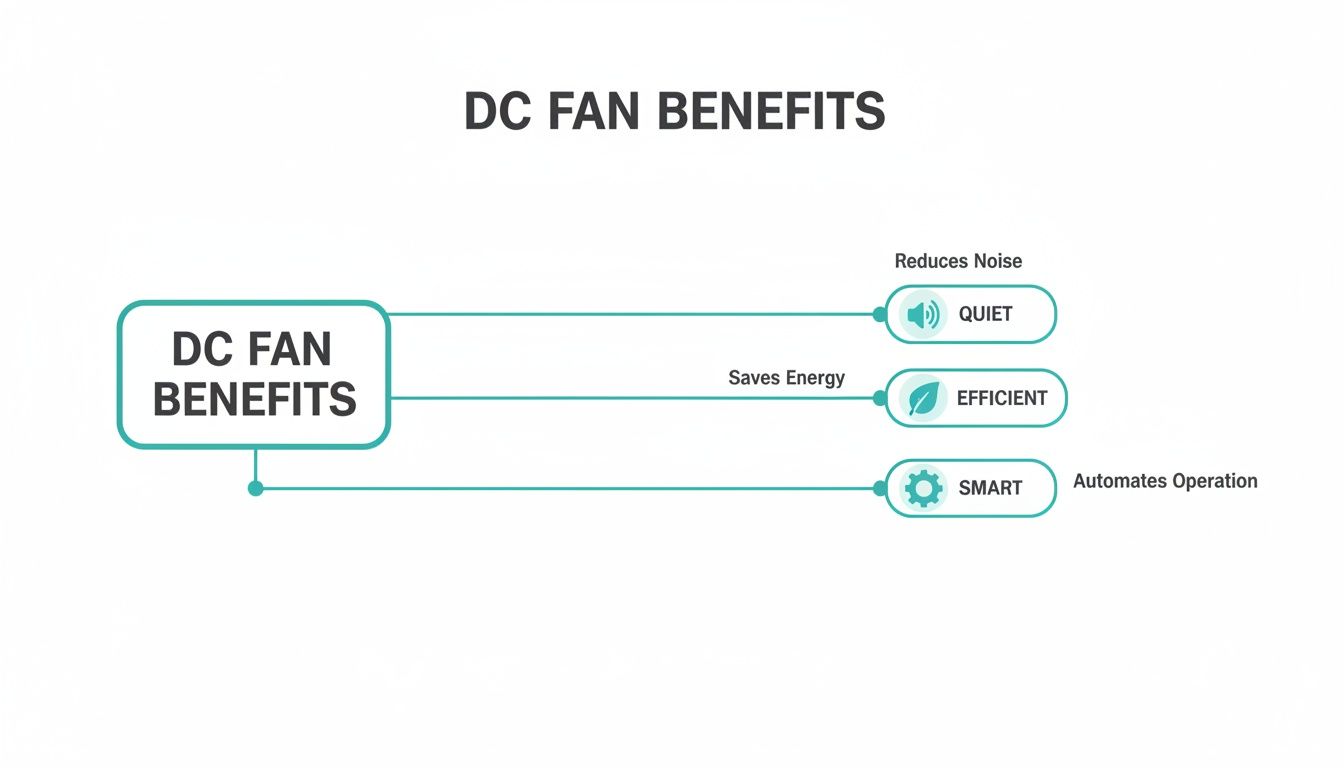
As you can see, it all comes down to three things homeowners love: quiet operation, serious energy savings, and smart capabilities.
More Speeds, More Comfort
Another huge win for DC motors is their incredible level of control. Traditional AC fans are stuck with just three settings: low, medium, and high. That’s because trying to control the speed of an AC motor is a clunky and inefficient process.
A DC ceiling fan, however, gives you a much wider range to play with. Since the motor's speed is managed by making tiny, precise adjustments to the electrical current, you often get six or more speed settings.
This means you can dial in the airflow perfectly. Want a barely-there, gentle breeze while you sleep? You got it. Need a powerful gust to cool down a room after a workout? No problem. That level of fine-tuning just isn't possible with older AC technology. For a great example, check out our collection of the best DC motor ceiling fans to see how modern models put this control to use.
A DC ceiling fan gives you a spectrum of comfort, not just a few settings. It’s the difference between a simple light switch and a full dimmer.
To help you see the differences at a glance, here’s a quick rundown of how AC and DC fans stack up.
AC vs. DC Ceiling Fan: A Quick Comparison
This table breaks down the key performance and feature differences between traditional AC ceiling fans and modern DC ceiling fans.
| Feature | Traditional AC Motor Fan | Modern DC Motor Fan |
|---|---|---|
| Energy Use | Higher; can use up to 100 watts | Much lower; often under 30 watts |
| Speed Options | Typically 3 speeds (low, medium, high) | Usually 6+ speeds for fine-tuning |
| Noise Level | More prone to humming and motor noise | Virtually silent operation |
| Control | Often pull chains or basic wall controls | Almost always includes a remote control |
| Smart Features | Rare; usually requires aftermarket add-ons | Often includes smart home integration |
| Reversible | Manual switch on the motor housing | Typically reversible from the remote |
| Size & Design | Motors are larger and bulkier | More compact, allowing for sleeker designs |
| Cost | Generally lower initial purchase price | Higher initial cost, but saves money over time |
As you can see, while an AC fan might be cheaper upfront, a DC fan offers superior performance, control, and long-term savings in almost every category. It's an investment in better comfort and efficiency for your home.
Calculating Your Savings and Year-Round Benefits
While the quiet operation and impressive tech specs are great, let's get to the part that really hits home: your wallet. This is where the investment in a DC ceiling fan truly starts to shine. Moving past watts and volts, the real story is about the tangible financial returns that make this technology such a smart home upgrade.
The incredible efficiency of a DC motor directly translates into lower utility bills all year long.
Think about it this way: a standard AC ceiling fan can easily gobble up 100 watts of electricity on its highest setting. In stark contrast, a comparable DC fan might only use around 30 watts to produce the same—if not better—airflow. That difference adds up faster than you'd think.
On average, a single DC fan can save a homeowner between $30 and $60 per year on electricity costs alone. Now, imagine you have fans in multiple rooms—the living room, master bedroom, and a home office. Those savings can easily triple, putting hundreds of dollars back in your pocket over just a few years.
Your Fan Paying for Itself
This long-term value is a game-changer, especially when you're looking at a premium model. A stunning, high-performance fan like the Artemis XL5 (often priced over $600) might seem like a big initial purchase. But when you factor in the annual energy savings, the fan literally starts to pay for itself over its lifespan.
By choosing an ultra-efficient DC model, you're not just buying a stylish fixture; you're making a calculated investment in your home's long-term financial health. The upfront cost is balanced by years of reduced energy consumption.
Beyond Summer: A Year-Round Money Saver
Here’s the best part: the financial perks of a DC fan aren't just limited to the summer heat. One of its most valuable features is the reversible motor, which is almost always controlled right from the remote. With a simple button press, your fan transforms into a year-round energy-saving powerhouse.
Here’s how it works:
- In the Summer (Counter-Clockwise): The blades push cool air straight down, creating a direct breeze that makes you feel several degrees cooler. This lets you nudge your thermostat up a bit, giving your expensive air conditioner a much-needed break.
- In the Winter (Clockwise): Reversing the blades to spin clockwise on a low speed gently pulls cool air up. This simple action pushes down the warm air that naturally rises and gets trapped at the ceiling, circulating it back into the room where you can actually feel it.
This gentle redistribution of heat helps your heating system work far more efficiently, which can make a real dent in your heating bills. This dual-purpose functionality is a key reason why so many homeowners are making the switch. For more tips on this topic, discover how energy-efficient ceiling fans can benefit you.
Choosing the Right Fan Size And Placement
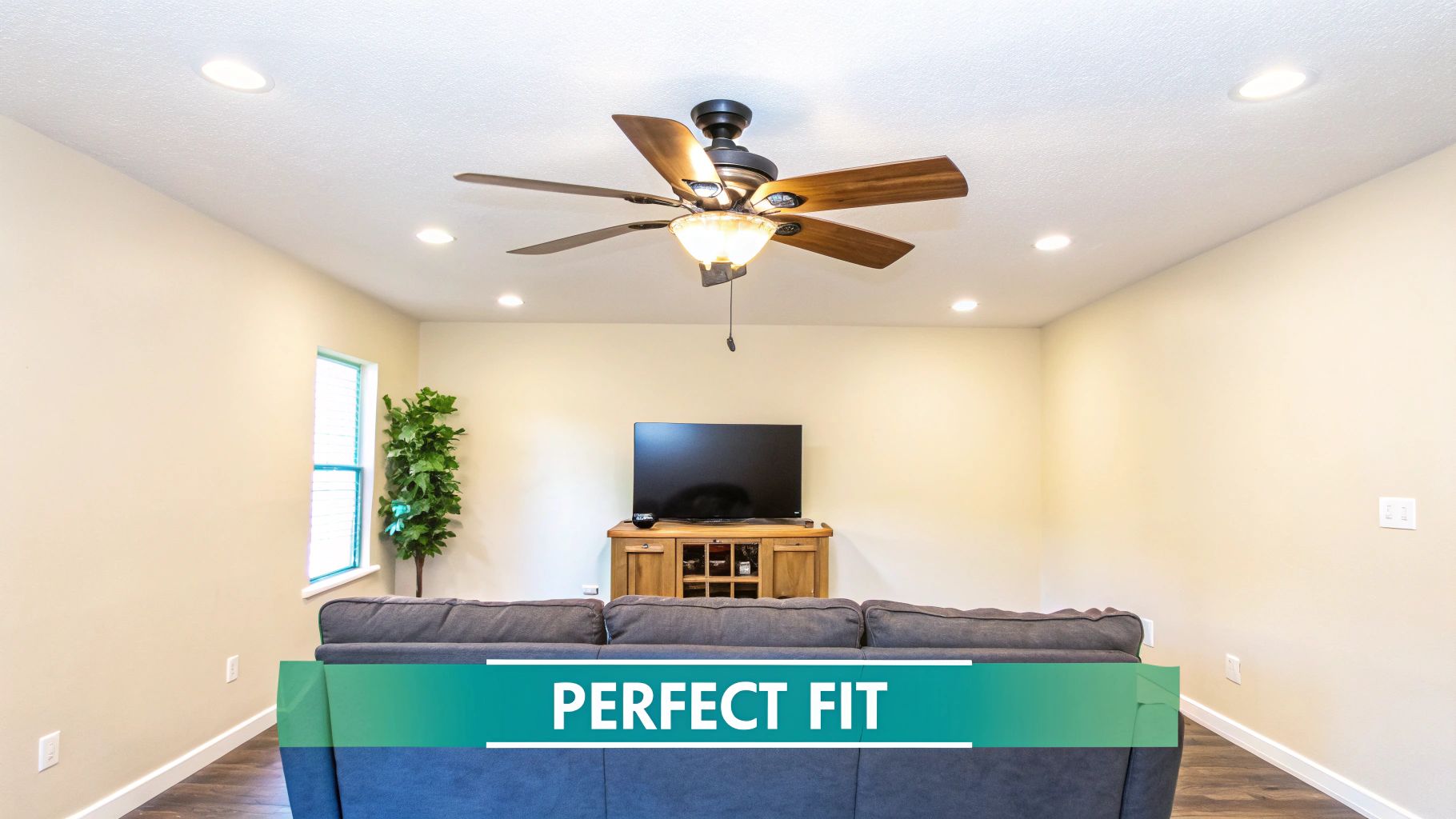
You’ve seen how a DC ceiling fan can transform your home with its quiet efficiency and cost-saving power. Now, let’s get practical. To unlock all that amazing performance, you need to choose the right size fan and put it in the perfect spot.
Getting this part right is the difference between a gentle, room-filling breeze and an underwhelming wobble. Think of your fan's blade span like the speaker size in a sound system. A small bookshelf speaker can't fill a concert hall, and a massive subwoofer is overkill for a tiny bedroom. The same logic applies here—you need to match the fan's power to the room's dimensions for optimal airflow.
Sizing Your Fan By Room Square Footage
The most important factor is the fan's blade span, which is the full diameter from one blade tip to the opposite. If a fan is too small for a large room, it’ll struggle to move air effectively, leaving stuffy, warm spots in the corners. On the flip side, a fan that's too big for a tiny space can create an uncomfortably windy, almost turbulent feeling.
Luckily, sizing is pretty straightforward. It’s all based on your room’s square footage, which you can find by multiplying its length and width.
Ceiling Fan Size Guide by Room Dimensions
Use this table to quickly find the recommended fan blade span based on your room's square footage for optimal air circulation.
| Room Size (Square Feet) | Recommended Fan Blade Span (Inches) |
|---|---|
| Up to 144 sq. ft. | 44 – 50 inches |
| 144 to 225 sq. ft. | 52 – 56 inches |
| 225 to 400 sq. ft. | 56 – 64 inches |
| Over 400 sq. ft. | 65 inches or larger |
For a quick reference, you can explore our detailed guide on choosing the right ceiling fan size for maximum efficiency to ensure you make the perfect choice. Matching the fan to your room ensures every corner gets that consistent, comfortable airflow you're after.
Ideal Placement For Perfect Performance
Once you’ve nailed down the right size, placement is the next critical step. Installing a fan in the wrong spot can seriously mess with its performance and even create a safety hazard. The goal is to center the fan in the room for even air distribution.
Here are the three golden rules of fan placement:
-
Height is Key: For the best airflow, the fan blades should hang 8 to 9 feet above the floor. This height creates the perfect balance, allowing the breeze to spread out effectively without being too intense. If you have ceilings lower than 8 feet, you’ll need a "hugger" or low-profile fan. For ceilings higher than 9 feet, an extension downrod is a must to bring the fan into that ideal zone.
-
Wall Clearance Matters: Make sure there’s at least 18 inches of clearance between the tip of the fan blades and any wall or obstruction. This prevents the airflow from getting blocked, which can cause choppy, inefficient circulation.
-
Special Cases Like Sloped Ceilings: Have a vaulted or angled ceiling? No problem. Most modern DC ceiling fans, like many in our collections, come with mounting hardware that can handle a slope. Just be sure to check the fan’s specs for the maximum angle it can accommodate.
Following these simple guidelines ensures your new DC ceiling fan not only looks great but also performs at its absolute best, delivering that quiet, consistent comfort you're after.
Exploring Modern Features and Smart Controls
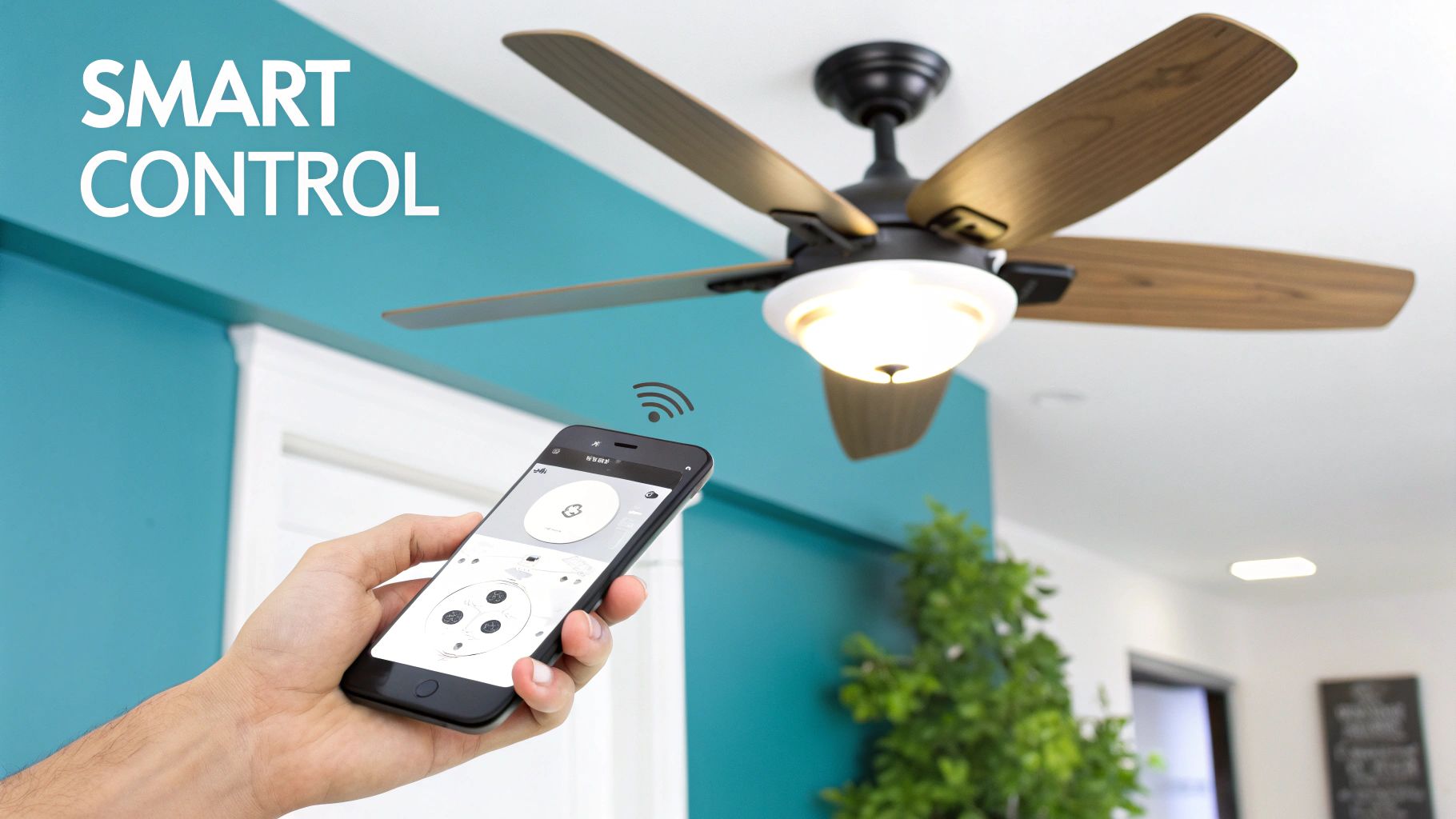
Let's be honest, today’s DC ceiling fans are a world away from the old, wobbly models you might remember. They're sophisticated, tech-savvy centerpieces that bring a whole new level of convenience and control right into your home. The advanced features packed into these modern marvels are what truly separates them from their old-school counterparts.
Gone are the days of fumbling with a pull chain. The incredible control offered by a DC motor completely changes how you interact with your fan. It’s not just about moving air anymore—it’s about creating the perfect atmosphere with the push of a button or a simple voice command.
Precision Control at Your Fingertips
One of the first things you'll notice with a DC ceiling fan is the remote control. While traditional AC fans are usually stuck with a clunky three-speed setting (low, medium, high), DC technology opens up a much wider spectrum of comfort.
Most DC fans come standard with a remote offering six or more speed settings. This lets you fine-tune the airflow with amazing precision. You can go from a barely-there, whisper-soft breeze perfect for sleeping to a powerful downdraft that quickly cools a stuffy room. That level of granular control means your comfort is always just right.
The difference is like having a simple on/off light switch versus a full-range dimmer. A DC fan gives you the power to set the exact mood and comfort level you want, not just pick from a few presets.
Seamless Smart Home Integration
This is where things get really exciting. Many premium DC ceiling fans are now designed to integrate flawlessly with popular smart home platforms, turning your fan into a responsive part of your automated home.
Just imagine:
- Voice Control: Simply say, "Alexa, turn the living room fan to 50 percent," without ever leaving the couch. It’s perfect for when your hands are full or you just want to relax.
- Automated Schedules: Use an app to schedule your fan to turn on a few minutes before you get home from work, or to switch to a lower speed in the middle of the night for a better sleep.
- Grouped Routines: You can even link your fan to other smart devices. A "Goodnight" routine could dim the lights, lower the fan speed, and adjust the thermostat all at once.
This kind of smart functionality turns the humble ceiling fan into an active player in managing your home's comfort. To see how these features fit into contemporary design, explore our collection of modern ceiling fans.
More Than Just a Fan, It's a Statement Piece
Modern DC fan design isn't just about what's inside the motor; it's about making a visual statement. Because DC motors are so compact, designers have the freedom to create sleek, bold, and artistic styles that can become the focal point of a room. The blade count and shape play a huge part in defining a fan's whole look.
For instance, a minimalist 3-blade design like the Aerovon ($398) gives you a clean, architectural look that’s perfect for modern and industrial spaces. Its simplicity is its strength, providing great airflow without any visual clutter.
On the other hand, a fan with more blades, like the impressive 6-blade Andros ($428), creates a bold, substantial presence. This style often feels a bit more traditional or transitional and is designed to make a powerful statement, especially in larger rooms with high ceilings. By exploring different blade setups, you can find a fan that not only performs beautifully but also perfectly completes your home's decor.
Time to Upgrade Your Home with a Premium DC Fan
So, after diving into the world of DC ceiling fans, you can probably see why this technology is the clear winner for just about any modern home. It's more than just a small upgrade; it's a smart investment that starts paying you back from the moment you flip the switch.
The advantages are tough to ignore. We're talking about real energy savings that make a dent in your utility bills, a whisper-quiet motor that won't interrupt your peace and quiet, and the kind of precise control over airflow that older AC fans just can't deliver. Now it's time to stop reading about the benefits and start feeling them for yourself.
Your Destination for Style and Performance
Finding the right fan shouldn't feel like a chore. At Fan and Lights, we've organized our collections to make it simple to find a DC ceiling fan that nails both your home's look and your performance needs. Think of our collections as a shortcut to finding your perfect match.
Ready to start looking?
- Check out our Modern Fan Collection for those sleek, clean designs that fit right into contemporary spaces.
- Want to create a more relaxed vibe? Our Tropical Fan Collection is perfect for bringing that breezy, resort-like feel home.
Choosing a premium DC fan also aligns with smart home improvements, like effective green retrofitting initiatives. It’s a simple step toward making your home more efficient and valuable in the long run.
Premium Models Built to Impress
If you want to see what this modern engineering looks like, you don't have to look far. Take the Aviation ($498), for instance—it’s a powerhouse that blends incredible airflow with a cool, industrial-inspired design. Or, if sharp, clean lines are more your thing, the Chisel ($388) makes a bold statement without overwhelming the room. These fans are what you get when you wrap top-tier DC motor tech in a package you'll be genuinely proud to show off.
When you choose a high-quality DC fan from Fan and Lights, you're investing with confidence. You’re not just buying another appliance; you’re upgrading your home's comfort, style, and efficiency for years to come.
With secure payment options, an expert team ready to help, and a handpicked selection of the best models out there, Fan and Lights is the place to find your next DC ceiling fan. Go ahead, take the next step and transform your space today.
Still Have Questions About DC Fans?
Even after digging into all the details, you might have a few questions left. That’s completely normal. Picking the right DC ceiling fan is a big decision, and we want you to feel totally confident before you make a move. Here are some of the most common things people ask us.
Think of this as a final sanity check before you upgrade. We've rounded up the key practical concerns and laid out clear, simple answers to help you lock in your choice.
Can I Use a DC Fan with a Wall Switch?
This one comes up all the time. While you’re probably used to a wall control for old-school AC fans, almost every DC ceiling fan is designed to work exclusively with its own remote control. The remote isn't just an accessory; it holds all the smart tech needed to talk to the fan's advanced motor and manage its many speeds and features.
Some higher-end models might offer a special wall controller you can buy separately. But here’s the most important takeaway: never hook up a DC fan to a standard dimmer wall switch. It can fry the fan’s sensitive electronics. For the best performance and to keep your fan safe, always stick with the remote.
Is a DC Ceiling Fan Really Worth the Higher Price?
Absolutely. The value goes way beyond the initial price tag. While a DC fan often costs a bit more upfront, it’s an investment that pays you back over and over again. The biggest return comes from massive energy savings—using up to 70% less electricity means smaller utility bills every month, and that really adds up over the years.
The extra cost of a DC fan is quickly offset by its lower operating costs, superior performance, and extended lifespan. It's not just an expense; it's an investment in your home's comfort and efficiency.
Beyond the savings, you're also paying for that whisper-quiet operation, a much wider range of speed settings for dialing in the perfect comfort level, and modern perks like smart home integration. A quality model like the Chisel ($388) is built to last, giving you quiet, reliable performance for years to come.
Do DC Fans Move as Much Air as AC Fans?
They sure do, and often more efficiently! Airflow is measured in Cubic Feet per Minute (CFM), and a good DC ceiling fan is engineered to deliver awesome CFM ratings while sipping on power. The advanced motors and aerodynamic blade designs on many DC models are built specifically to move air like a champ.
When you're comparing fans, don't just get hung up on the motor type—look at the CFM rating. You'll find that premium DC fans, like the powerful Aviation ($498), deliver incredible airflow that can easily handle large spaces. It's the perfect proof that efficiency and power really can go hand in hand.
Ready to experience the quiet power and stylish design of a DC fan for yourself? Explore the full range of premium models at Fan and Lights and find the perfect upgrade for your home. https://www.fanandlights.com


