











Best Ceiling Fans for Bedrooms: A Fun Buyer's Guide
When you're on the hunt for the best ceiling fan for your bedroom, the mission is a little different. You're not just trying to move air; you're crafting an oasis for rest. A truly great bedroom fan is a master of subtlety, blending a whisper-quiet motor, the perfect size for your space, and clever features designed for undisturbed sleep. The best options almost always start around $300, and for good reason—they're a serious investment in your personal sleep sanctuary.
Creating Your Ultimate Sleep Sanctuary
Finding the right ceiling fan for a bedroom is all about curating an atmosphere for perfect rest. Unlike the powerhouse fan you might want for a big living room, a bedroom fan needs to be quiet, gentle, and fit the room's style. It’s less about brute force and more about creating a consistent, calming airflow that actually improves your sleep without ever becoming a distraction.
Think of this guide as your roadmap to transforming your bedroom into that peaceful retreat. We'll get into why things like motor technology, blade span, and the right lighting are so critical for pulling off that perfect sleep environment. You're about to see how a high-end fan is really an investment in your own well-being.
Why a Premium Fan Is Worth It
It's tempting to grab a cheap fan, but investing in a premium model—usually one priced at $300 or more—delivers benefits you can immediately feel. The difference comes down to better engineering and quality materials that you can hear (or, more importantly, not hear).
- Silent Operation: This is the big one. High-end fans almost always use DC motors, which are virtually noiseless compared to the hum of traditional AC motors. For a light sleeper, this is a non-negotiable feature.
- Better Control: Premium fans give you more speed settings, letting you dial in that perfect, barely-there breeze that won’t leave you feeling chilled in the middle of the night.
- Superior Style: These models are designed to be beautiful fixtures, not just functional appliances. They can genuinely elevate your room's decor.
- Built to Last: Better construction means a longer lifespan and, crucially, wobble-free performance. No one wants to be kept awake by a rattling fan.
This focus on quality and performance is a big reason the global ceiling fan market, valued at around USD 12.3 billion in 2024, keeps growing. People everywhere are shifting toward energy-efficient cooling, and that trend highlights the rising demand for bedroom fans that blend style with silence. You can read more about these market trends for ceiling fans on marknteladvisors.com.
The real secret to the best bedroom ceiling fan isn’t just its power—it’s the silence. A high-quality fan with a DC motor can move air beautifully without the humming or clicking that wrecks a good night's sleep, making it an absolute must-have for a restful space.
Ultimately, choosing one of the best ceiling fans for your bedroom comes down to prioritizing your comfort. It means finding a fan that works silently in the background, providing a gentle breeze that helps you sleep deeper and wake up feeling more refreshed. It's a small luxury that makes a huge difference.
Before you start shopping, it helps to have a clear checklist of what matters most for a bedroom. Here’s a quick-glance table to keep the most critical factors top of mind.
Bedroom Fan Decision Checklist
This table breaks down the non-negotiables for a high-performance bedroom ceiling fan.
| Key Feature | Why It's Crucial for Bedrooms | What to Look For |
|---|---|---|
| Motor Type | Silence is everything. A noisy fan will disrupt sleep, defeating the purpose. | A DC (Direct Current) motor is your best bet. They are virtually silent and more energy-efficient. |
| Size (Blade Span) | The right size ensures gentle, consistent airflow without creating a wind tunnel. | Match blade span to room size: 44" for small rooms, 52" for standard rooms, 56"+ for large master bedrooms. |
| CFM Rating | Measures airflow efficiency. You want effective circulation, not overpowering wind. | Look for a moderate CFM (3,000-5,000) with multiple speed settings for fine-tuning the breeze. |
| Controls | Fumbling for a pull chain in the dark is a pain. Easy control is essential. | A handheld remote or wall control is a must. Smart fans with app or voice control offer ultimate convenience. |
| Integrated Lighting | Provides ambient light without needing a separate fixture, and the quality matters. | Dimmable, integrated LED lights with adjustable color temperature (warm to cool) are ideal for setting the right mood. |
Having these key features in mind will help you narrow down the options and find a fan that doesn't just look good, but actively contributes to a better night's sleep.
Matching Fan Size to Your Room's Layout
Getting the size and placement right is easily the most critical part of the process. This is what separates a gentle, sleep-inducing breeze from an annoying gust of air that just makes you feel cold. I like to compare it to buying speakers—you wouldn't put a massive concert stack in a small office, and the same logic holds true for finding the best ceiling fans for bedrooms.
Let's look past the generic charts for a minute and think about real-world rooms. What if you have an odd-shaped bedroom, a vaulted ceiling, or a bed that isn't perfectly centered? Your goal is always to create smooth, even air circulation without making it feel like a wind tunnel. An oversized fan will do just that, while a fan that's too small will struggle, forcing you to crank it up to a higher, noisier speed just to feel anything.
Finding the Right Fan Diameter
The first number you need to get right is the blade span, also known as the diameter. This ensures the fan has enough power for your room without being total overkill. When you nail the size, you can run the fan on a lower, quieter setting—exactly what you want for a peaceful night's rest.
Here are some simple guidelines based on room size:
- Small Bedrooms & Guest Rooms (Under 100 sq. ft.): For cozier spaces like these, a fan with a blade span under 44 inches is perfect. It moves enough air without physically or visually overwhelming the room.
- Most Master Bedrooms (100-250 sq. ft.): This is the sweet spot for a 52 to 56-inch fan. It’s the most common size for a reason and is versatile enough to cool the average master bedroom with a comfortable breeze.
- Large Suites & Open-Plan Bedrooms (Over 250 sq. ft.): If you've got a really expansive space, you'll need a fan that can move some serious air. Look for models with a blade span of 60 inches or more to ensure you get circulation from corner to corner.
This visual breaks down the core decisions you'll be making as you shop.
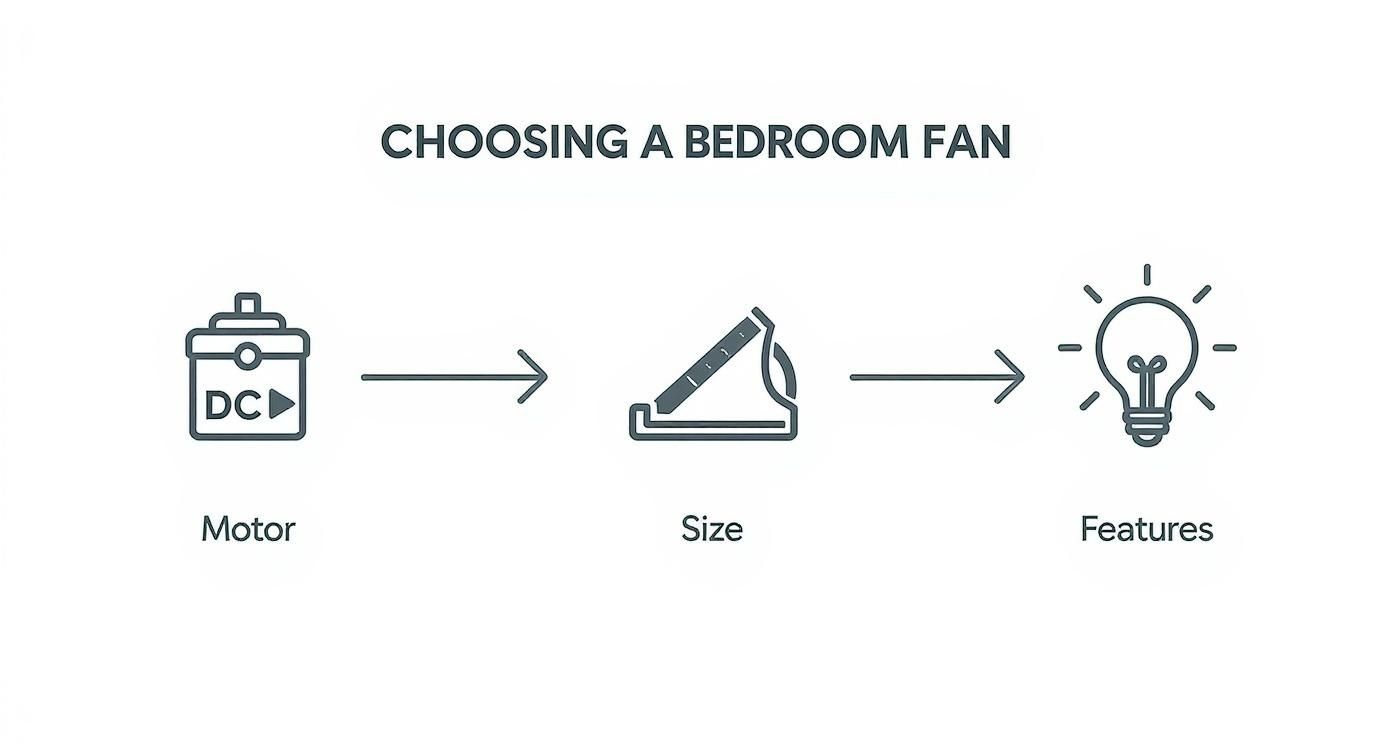
As you can see, the motor, the physical size, and the features you want are the three pillars of picking the right fan for your bedroom.
Mounting Options for Every Ceiling Height
Once you've settled on the diameter, the next make-or-break decision is the mounting type. This is all about your ceiling height, and it’s non-negotiable for both performance and safety.
A fan mounted too high won't move air where you can actually feel it. One that's too low is a genuine safety hazard. Building codes are very clear: fan blades must be at least 7 feet from the floor. From an airflow perspective, an 8 to 9-foot clearance is even better.
Here's the bottom line: The goal is to position the fan for maximum airflow without compromising safety. Proper mounting makes sure your investment in a quality fan actually pays off in comfort.
Here’s how to choose the right mount for your ceiling:
- Low Ceilings (Under 8 feet): You absolutely need a flush mount or hugger mount. These fans install directly against the ceiling with no downrod, giving you maximum headroom.
- Standard Ceilings (8-9 feet): Most fans come out of the box with a short standard downrod (usually 3-6 inches long) that’s perfect for this height. It positions the fan at the ideal level for great air circulation.
- High or Vaulted Ceilings (10 feet and above): An extended downrod is a must. Hanging the fan lower brings the blades down to where they can be effective. If you have a sloped or vaulted ceiling, you’ll also need a sloped ceiling adapter so the fan hangs level and doesn’t wobble.
For a deeper dive into all the calculations, our guide on choosing the right ceiling fan size for maximum efficiency has even more detailed advice.
Finally, a quick note on wall clearance. To be safe and prevent airflow from getting blocked, make sure the tips of the blades will be at least 18 inches away from any wall or other obstruction. Taking a few minutes to get these measurements right guarantees your new fan will run safely, quietly, and efficiently for years to come.
Why a DC Motor Is a Non-Negotiable for Bedrooms
Let’s talk about what really makes a bedroom ceiling fan great. You'll see CFM ratings (Cubic Feet per Minute) on every box, but the true hero for a quiet, comfortable bedroom is the motor. This is where the modern DC (Direct Current) motor completely leaves the old AC (Alternating Current) motor in the dust.
For a bedroom, a DC motor isn't just a nice-to-have; it's the only way to go.
When you're trying to sleep, even the slightest, most consistent hum can turn into a huge distraction. Older AC motors are notorious for that low-level buzz. DC motors, on the other hand, are engineered to be virtually silent. That isn't an exaggeration—the difference is night and day. You get all the airflow without any of the annoying noise.
The Power of Silence and Precision
Ever tried to find that perfect, barely-there breeze on a warm night? With a typical AC fan, you’re stuck with three speeds: too much, way too much, and off. It’s a frustratingly blunt tool when you need a delicate touch.
This is where DC motors really shine. They offer a much wider range of speed settings—often six or more. This level of control means you can dial in the airflow with incredible precision, finding that gentle whisper of a breeze that keeps you comfortable without making you cold. It’s the kind of subtle comfort that leads directly to better sleep.
Unpacking the Efficiency of a DC Motor
Beyond the silence and control, DC motors are champions of energy efficiency. This is where investing in a premium fan, like the stunning Peregrine Industrial Ceiling Fan (starting at $450), really pays off. Its advanced DC motor provides powerful circulation while sipping a fraction of the electricity its AC counterparts would guzzle.
This isn't a small improvement. Evolving standards like brushless DC motor (BLDC) technology have been a game-changer, slashing electricity consumption by up to 70% compared to traditional motors. This incredible efficiency has fueled their popularity in bedrooms globally, as you can see in trends across the ceiling fan market on fortunebusinessinsights.com.
That massive drop in energy use has a direct impact on your utility bills over the fan's lifetime. While the upfront cost of a DC motor fan is higher, the long-term savings make it a much smarter financial decision. You can learn more about the specific benefits in our detailed article on energy efficiency and cost savings with ceiling fans.
The takeaway is simple: A DC motor transforms a ceiling fan from a basic appliance into a sophisticated comfort tool. The silence, precision control, and energy savings make it an essential feature for any bedroom where rest is the top priority.
Why Durability and Longevity Matter
Another key benefit of DC motors is how they're built. They run with less friction and generate less heat than AC motors, which means less wear and tear on the internal parts over time. The result? A longer, more reliable lifespan for your fan.
A high-quality DC motor is built to last, ensuring your investment continues to provide quiet, wobble-free comfort for years to come. When you choose a fan like the Spitfire Ceiling Fan (around $500-$600), you're not just buying a stylish fixture; you're getting a piece of engineering designed for endurance. The robust DC motor inside is the reason it can run smoothly and silently, night after night.
Let's break down the core differences in a simple comparison.
| Feature | AC Motor (Traditional) | DC Motor (Modern) |
|---|---|---|
| Noise Level | Produces a noticeable hum | Virtually silent |
| Energy Use | Higher consumption | Up to 70% more efficient |
| Speed Control | Limited (usually 3 speeds) | Extensive (often 6+ speeds) |
| Motor Size | Larger and heavier | Smaller and more compact |
| Lifespan | Good | Excellent, runs cooler |
| Cost | Lower upfront cost | Higher initial investment |
Ultimately, choosing a DC motor is the single best decision you can make for your bedroom ceiling fan. The peace, customized comfort, and efficiency it provides are well worth the premium. It’s the quiet engine that powers a truly restful night.
Smart Features That Redefine Comfort
Today's high-end ceiling fans are so much more than just spinning blades. They've evolved into intelligent comfort systems that blend right into your daily life, turning your bedroom from a static space into one that responds to you. This is where premium models really show their worth, moving beyond basic function to a level of convenience and personalization we could only dream of a decade ago.
Imagine waking up on a warm morning and, before your feet even hit the floor, telling Alexa to turn on the fan. Or maybe you're winding down with a book and use your phone to dim the lights and slow the fan, all without getting up. This is the new standard for the best ceiling fans for bedrooms.
This level of smart control is a huge reason the market is growing so fast. The smart ceiling fan segment is actually projected to hit a market value of around USD 993.6 million by 2025. It's all driven by our demand for smart appliances that save energy and regulate temperature automatically—exactly what you want in a bedroom. You can dive deeper into the demand for smart fans at grandviewresearch.com.
App Controls and Smart Home Integration
A simple remote is a massive step up from a pull chain, but true smart fans take things to another level with Wi-Fi. This lets you control every little detail through a smartphone app or by linking it up with your existing smart home setup.
Suddenly, a world of possibilities opens up:
- Voice Commands: Effortlessly tweak the speed, light, and direction with voice assistants like Amazon Alexa and Google Assistant. No more fumbling for a remote in the dark.
- Scheduling: Set your fan to turn on 30 minutes before bedtime, ensuring the room is perfectly cool right when you need it.
- Remote Access: Did you rush out and leave the fan on? No problem. Just turn it off from your phone, wherever you are.
A fantastic real-world example is the Collins Smart Ceiling Fan, which sells for around $350. It’s built to work seamlessly with major smart home platforms, making it a central piece of your home's automated comfort system.
Features Designed for Better Sleep
Beyond the basics, premium smart fans have specialized modes designed to actually improve your sleep. These aren't just gimmicks; they’re thoughtful features that cater directly to creating a restful environment.
One of the most popular is "Natural Breeze" or "Breeze Mode." Instead of a constant, monotonous hum, this feature randomly varies the fan's speed to mimic a gentle, natural wind. It feels more organic and less intrusive, helping you drift off more easily.
Another game-changer is a sleep timer. This lets you set the fan to run for a specific time—say, one or two hours—and then automatically shut off after you’ve fallen asleep. Some advanced models even offer a gradual slowdown, slowly decreasing the speed for an even smoother transition into a quiet night.
The real goal of a smart bedroom fan is automation that serves your comfort without you having to think about it. It should anticipate your needs, whether that’s creating a gentle breeze for sleep or providing bright light for getting ready in the morning.
Advanced Integrated LED Lighting
The light on a modern bedroom fan is just as important as the airflow. The best ceiling fans for bedrooms now come with integrated LED kits that have sophisticated controls, letting you tailor the room's ambiance perfectly.
Keep an eye out for these two key lighting features:
- Full-Range Dimming: The ability to dim the light from 100% brightness down to a soft 10% glow is a must-have. This gives you bright, functional light when you need it and a gentle, relaxing mood when it's time to wind down.
- Adjustable Color Temperature: This is a truly premium feature that makes a huge difference. It lets you change the light from a cool, energizing white (around 5000K) to a warm, cozy yellow (around 2700K). You can set a bright, cool tone for the morning and a soft, warm one for the evening to support your body's natural circadian rhythm.
These are the smart features that elevate a ceiling fan from a simple appliance to a cornerstone of modern comfort. They create a seamless, intuitive experience that adapts to your life, making your bedroom a more restful and responsive sanctuary.
Choosing a Style That Elevates Your Decor
We've covered all the technical stuff—motors, sizing, and smart controls—so now for the fun part. A ceiling fan is a massive visual element in your bedroom, so let's treat it like the functional art it can be. The best ceiling fans don't just move air; they complete the room's entire vibe.

Think about your bedroom's personality. Is it a modern, minimalist escape? A cozy, rustic farmhouse? Or something with a bit of an industrial edge? The right fan pulls all those pieces together.
Matching Finishes to Your Existing Decor
The finish of the fan—both the motor housing and the blades—is your first big style decision. This is your chance to either create harmony or introduce a really compelling contrast.
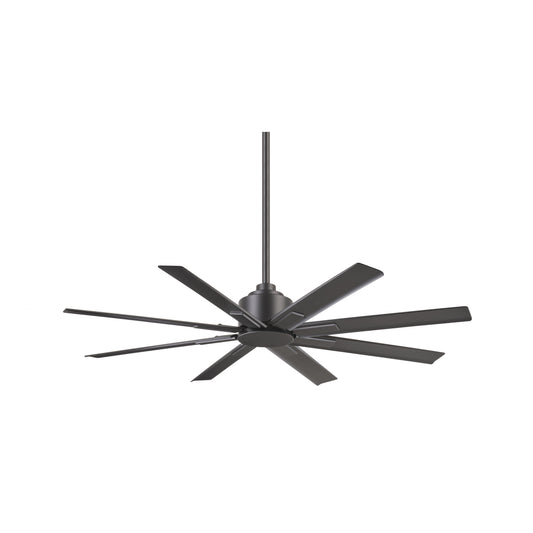
A common approach is to match the fan's finish to other hardware in the room, like your drawer pulls, curtain rods, or lamp bases. If you have matte black fixtures everywhere, a sleek black fan like the Torsion Ceiling Fan (around $400) creates a cohesive, intentional look that just feels right. Its clean lines and multiple finish options make it a go-to for modern spaces.
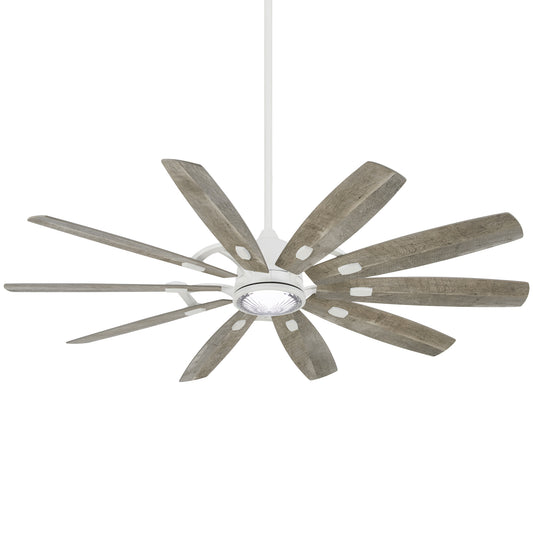
On the other hand, you can use the fan to bring in a new texture. I love how wood blades add a natural warmth that can soften a really contemporary room. The beautiful Spitfire Ceiling Fan (often $500+) is a perfect example, offering blades in finishes like Dark Walnut and Weathered Wood that can perfectly complement wood furniture or flooring.
Here's a key designer tip: If you want the fan to "disappear," choose a finish that blends in with your ceiling. A matte white fan on a white ceiling becomes much less obtrusive, letting your other decor pieces take center stage. The goal is a low-contrast, monochromatic look.
But if you want to make a statement, go for it! A fan like the Peregrine Industrial Ceiling Fan (starting at $450) with its dramatic Brushed Satin and Walnut combination is designed to draw the eye upward and become a true focal point.
The Impact of Blade Count on Style
Back in the day, more blades meant more air movement. Thanks to modern DC motors, performance is no longer tied to how many blades a fan has. Now, the number of blades has a huge impact on its visual weight and overall style.
- Three-Blade Fans: These almost always feel more contemporary and aerodynamic. Their minimalist design lends itself to modern, Scandinavian, and industrial-chic bedrooms. They create a clean, uncluttered look on the ceiling.
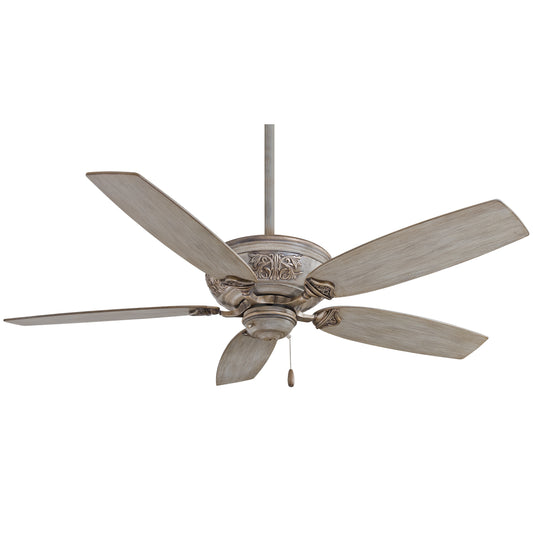
- Four and Five-Blade Fans: This is your classic, traditional look. A five-blade fan has a fuller, more substantial presence that works beautifully in transitional, farmhouse, or traditionally styled rooms.
Ultimately, this choice is purely about aesthetics. Don't get hung up on performance differences between a three-blade and five-blade model from a good brand. Instead, just focus on which silhouette best fits the design you're going for.
Finding Your Bedroom's Style Profile
Not sure where to start? Let's break down some common bedroom styles and the types of fans that look best in them.
| Bedroom Style | Recommended Fan Characteristics | Example Product |
|---|---|---|
| Modern Minimalist | Sleek three-blade design, matte finishes (black, white), no ornate details. | Minka Aire Roto Fan ($300+) |
| Rustic Farmhouse | Wood or wood-look blades, bronze or black housing, classic five-blade look. | Hunter Hepburn Fan ($300+) |
| Industrial Chic | Metal finishes, cage details, exposed hardware, larger blade span. | Peregrine Industrial Fan ($450+) |
| Coastal or Tropical | Woven or leaf-shaped blades, light wood tones like whitewash. | Spitfire Fan ($500+) |
Finding the right fan is all about that balance between function and beauty. By thinking through the finishes, blade count, and overall style, you can pick a fan that not only keeps you comfortable but also elevates your bedroom into a perfectly curated sanctuary.
Getting it Installed and Keeping it Smooth
You've done the hard work and picked the perfect fan. Now for the most important part: making sure it runs perfectly for years to come. Proper installation and a tiny bit of maintenance are the secret ingredients to protecting your investment and ensuring that quiet, reliable comfort you were after.

While calling in a pro is always the safest bet, it pays to know what a good installation looks like. The absolute number one, non-negotiable safety rule? Make sure the fan is mounted to a fan-rated electrical box. Your standard ceiling box for a light fixture just isn't built to handle the weight and constant motion of a fan. It's a serious safety risk to skip this step.
Making Sure It's Silent and Wobble-Free
Here’s a little secret from someone who's seen it all: even the highest-quality fans can wobble if they're not installed just right. Blade balancing is that final, critical step that gets rid of any annoying ticking or rattling right from the start. Most good fans come with a balancing kit for this exact purpose.
It’s a pretty simple process of adding small, adhesive weights to the tops of the blades to get them perfectly in sync. Taking that extra 15 minutes to balance everything correctly is what separates a fan you notice from one that's simply seen and not heard. For a full breakdown, our guide on how to install a ceiling fan walks you through all the details.
A Super Simple Maintenance Routine
A little bit of care really does go a long way. Keeping your fan looking great and performing its best takes almost no effort but makes a huge difference over its lifespan.
A well-maintained fan is a silent fan. Regular cleaning and quick checks prevent the common issues—like dust buildup and loose screws—that lead to wobbling and noise over time.
Just follow this easy schedule, and your fan will run like new for years:
- Monthly Dusting: Grab a microfiber cloth or an extendable duster and give the blades a gentle wipe. This stops dust from piling up, which can throw the blades off balance and mess with the airflow.
- Quarterly Check-up: Every few months, give the visible screws on the fan body, blades, and mounting bracket a quick check to make sure they're snug. The fan's vibration can slowly work them loose.
- Bi-Annual Deep Clean: Twice a year, a slightly damp cloth is all you need to wipe away any stubborn grime from the motor housing and blades. Just be sure to never spray cleaner directly onto the fan—moisture and motors do not mix
We get a lot of questions from homeowners trying to nail down the perfect fan for their bedroom. It makes sense—this is the room where comfort matters most. So, let's clear up a few of the most common things people ask before they make their final choice.
Is a DC Motor Really Worth the Extra Cost?
In a bedroom? Absolutely. And it really comes down to one thing: silence. The single biggest advantage of a DC motor is that it's practically silent. For light sleepers, that alone is a game-changer. You're investing in better sleep, and that's always worth it.
But there's more to it than just quiet operation. DC motors are also incredibly energy-efficient, using up to 70% less electricity than their old-school AC counterparts. Plus, they usually offer more speed settings, giving you total control to find that perfect gentle breeze.
How Many Blades Should a Bedroom Fan Have?
Honestly, this is less about performance than you might think. With modern, well-engineered fans, the real power comes from the motor quality and the pitch of the blades, not how many there are. That frees you up to choose based on looks.
Think of it this way:
- Three-blade fans give off a clean, minimalist vibe. They feel sleek and modern.
- Four or five-blade fans have a more traditional, substantial look.
At the end of the day, pick the style that fits your bedroom's decor. Pay attention to the fan's CFM rating and motor type to guarantee performance, but let your eyes decide on the blade count.
Can a Ceiling Fan Keep a Room Warm in Winter?
Yes, and you'd be missing out if you didn't use it this way! Nearly all quality fans have a reverse switch that changes the blade direction for exactly this reason.
Here's the trick: run the fan clockwise on a low speed during the winter. This creates a gentle updraft that pulls cool air up and pushes the warm air—which naturally rises and gets trapped at the ceiling—back down into the room. It’s a simple flip of a switch that makes your space feel cozier without you having to crank up the heat.
Ready to find a fan that ticks all your boxes? The curated collections at Fan Connection take the guesswork out of it. We've already sorted the best ceiling fans for bedrooms by style, size, and features.


