











Best ceiling fans for energy efficiency in the US: 2026 Buyer's Guide
If you're on the hunt for the most energy-efficient ceiling fans, you'll want to look for two things: a modern DC motor and an ENERGY STAR certification. These fans are the perfect blend of style and substance, moving a ton of air without guzzling electricity, which makes them one of the smartest investments you can make for your home. It’s a fun and exciting upgrade that pays you back!
Why an Energy-Efficient Fan Is Your Smartest Home Upgrade
Choosing an energy-efficient ceiling fan is more than just a simple home improvement—it's a move that pays you back year after year. The days of wobbly, noisy fans that barely moved the air are long gone. Today’s models are engineered to team up with your home's HVAC system, giving you a powerful one-two punch against high utility bills.
This isn't just a niche trend, either. Homeowners everywhere are getting smarter about energy, looking for sustainable upgrades that save money and reduce their carbon footprint.
Lower Your Bills and Boost Your Comfort
So, what’s the secret? It all comes down to the "wind chill" effect. That gentle breeze from a fan helps your skin feel several degrees cooler, even if the room temperature hasn't changed. This means you can nudge your thermostat up a few degrees in the summer and still feel perfectly comfortable. The impact on your wallet is huge.
The numbers don't lie. The U.S. residential ceiling fan market, valued at around $5.6 billion in 2025, is expected to jump to a staggering $8.5 billion by 2032. According to the U.S. Department of Energy, using a ceiling fan the right way can slash your summer cooling costs by up to 40%. Suddenly, running that fan instead of blasting the AC all day sounds pretty good, right?
A high-efficiency fan isn't just an appliance; it's a key component of a smarter, more comfortable home. It allows you to feel cooler while your air conditioner works less, a simple yet powerful combination for saving energy.
A Holistic Approach to Home Efficiency
A great ceiling fan is a fantastic start, but for serious energy savings, it's best to see it as one piece of a bigger puzzle. Thinking about your home as a complete system—from the roof down to the appliances—is how you'll get the best results. For example, upgrades like energy-efficient roofing play a huge role by blocking heat from getting into your home in the first place.
When every part of your home works together efficiently, the savings really start to add up, keeping you comfortable while your bills stay low. If you want to dive deeper into how this all works, you can learn more about energy efficiency and cost savings with ceiling fans in our detailed article.
Decoding the Numbers That Define Efficiency
When you’re trying to find the best ceiling fans for energy efficiency in the US, the spec sheet can look like a wall of confusing acronyms. Don't worry—once you know what to look for, cutting through the jargon is actually pretty simple. Let's break down the three numbers that really tell you how a fan performs: CFM, CFM/W, and blade pitch.
Think of these metrics as a fan's report card. They tell you everything you need to know about its power, its "fuel economy," and how well it actually moves air. Understanding them is your key to picking a fan that not only looks great but also works brilliantly to keep you comfortable while saving you money.
CFM: The Measure of Raw Airflow
First up is CFM, which stands for Cubic Feet per Minute. This number simply tells you the sheer volume of air a fan can move when it’s running at its highest speed. A higher CFM means more air is being circulated, which creates a stronger, more noticeable breeze.
Imagine you're comparing two fans: one has a CFM of 4,000, and the other has 6,000. That second fan has a lot more raw power and will do a much better job of making a large room feel cool. For most living rooms or master bedrooms, a fan with a CFM of 5,000 or more is a great target. This ensures you get that satisfying "wind chill" effect that lets you turn up the thermostat.

The main idea here is that one smart upgrade creates a ripple effect of good things, from direct cost savings to a more sustainable home.
CFM/W: The True Efficiency Score
While CFM is important for power, CFM/W (Cubic Feet per Minute per Watt) is the real star of the show. This is the ultimate measure of a fan's efficiency. It tells you how much airflow (CFM) you get for every single watt of electricity it uses.
Let's use a simple car analogy:
- CFM is like a car's horsepower—it measures raw power.
- CFM/W is like a car's MPG (miles per gallon)—it measures fuel economy.
A muscle car might have tons of horsepower, but it guzzles gas. A hybrid, on the other hand, gives you fantastic MPG. A high CFM/W rating means your fan is a hybrid; it provides powerful airflow while just sipping electricity. For a truly top-tier fan, look for a CFM/W rating well above 100.
Blade Pitch: The Angle of Attack
Finally, we have blade pitch. This is just the angle of the fan blades, measured in degrees, which determines how they "slice" through the air.
Think of a fan's blades like an airplane's propeller. A steeper angle, usually between 12 and 15 degrees, lets the blades grab and push more air downward with every single rotation.
But there's a catch. A steeper pitch needs a stronger, more efficient motor to handle the workload without getting strained. This is why you'll see premium fans with powerful DC motors supporting an aggressive blade pitch, which leads to fantastic airflow and efficiency. Cheaper fans with weaker motors often have a flatter pitch and, as a result, move a lot less air. If you want to dive deeper, you can explore our complete guide on what makes some ceiling fans more energy efficient than others.
The ENERGY STAR Stamp of Approval
So, how do you find a fan that aces all these metrics without pulling out a calculator in the store? Simple: look for the ENERGY STAR label. That little blue sticker is your trusted shortcut.
To earn this certification, a ceiling fan has to meet strict energy efficiency criteria set by the U.S. Environmental Protection Agency. An ENERGY STAR-certified fan is guaranteed to:
- Be about 60% more efficient than conventional fan and light units.
- Use advanced blade and motor designs for top-notch performance.
- Deliver high CFM and CFM/W ratings.
When you choose an ENERGY STAR fan, you’re not just buying another home appliance; you're investing in a piece of technology that's been proven to save you money and shrink your energy footprint.
The Engine Inside: Why a DC Motor is Your Fan's Secret Weapon
At the heart of every great ceiling fan is its motor. It’s the engine that powers everything from that gentle breeze to your energy savings. Think of it this way: comparing an old-school AC motor to a modern DC motor is like putting a classic gas-guzzler up against a silent, efficient electric car.
DC motors are the clear winners when it comes to efficiency. They are the EVs of the fan world, engineered from the ground up to give you more power while sipping electricity. This huge leap in technology is why they are a non-negotiable feature if you're serious about finding an energy-efficient fan.

The DC Motor Advantage: More Power, Less Cost
So, what's the secret sauce? It’s all in the engineering. While a traditional AC fan plugs straight into your home’s wall current, a DC fan has a clever transformer inside that converts that power. This allows the motor to use magnets and precision electronics to spin the blades, rather than just brute electrical force.
The result is a massive drop in energy use—a DC motor can use up to 70% less energy than its AC counterpart. We're talking real numbers here. A typical DC fan might only pull 28-35 watts on its highest setting, while an older AC fan could easily be drawing 70-80 watts for similar airflow.
If you run your fan for just 8 hours a day, making the switch to DC could slash that fan's running costs by over 60%. Over the life of the fan, that really starts to add up.
To make it even clearer, here’s a quick side-by-side look at how these two motor types stack up.
AC vs DC Motor Ceiling Fans at a Glance
| Feature | AC Motor (The Classic) | DC Motor (The Modern Performer) |
|---|---|---|
| Energy Use | Higher; typically 70-100 watts on high. | Up to 70% more efficient; 30-35 watts on high. |
| Speed Options | Limited; usually just 3 speeds (Low, Med, High). | More control; often 6 or more speed settings. |
| Noise Level | Can produce a noticeable electrical hum. | Virtually silent operation. |
| Reverse Function | Manual switch on the fan’s body. | Conveniently located on the remote control. |
| Size & Weight | Larger and heavier. | More compact and lightweight, allowing for sleeker designs. |
| Initial Cost | Generally lower upfront cost. | Higher upfront cost, but with long-term savings. |
As you can see, the DC motor isn't just a minor tweak—it's a complete upgrade in every meaningful category.
More Than Just Savings: A Better All-Around Experience
The perks of a DC motor go way beyond a lower electricity bill. They fundamentally change how you use and enjoy your ceiling fan every single day.
- Whisper-Quiet Operation: Because they run with less friction and electrical noise, DC motors are practically silent. This makes them a game-changer for bedrooms, nurseries, or any space where you want peace and quiet.
- More Speed Settings: Forget the basic three-speed pull chain. DC fans give you incredible control, usually with six or more speed settings that let you find the exact amount of airflow you want.
- Effortless Reverse Function: Remember climbing a wobbly ladder to flip a tiny switch for winter? With a DC fan, that's a thing of the past. The reverse button is built right into the remote, making year-round comfort a breeze.
An Investment in Long-Term Value
It’s true that a DC fan often has a higher price tag than an AC model. But it’s better to think of that premium as an investment in smarter technology and long-term performance. You can explore our complete guide on what to expect from a modern DC ceiling fan to see all the features that come with the upgrade.
Ultimately, choosing a DC motor is the single biggest step you can take toward getting a truly energy-efficient ceiling fan. The massive energy savings, silent operation, and bonus features make it the undisputed choice for anyone who values performance and quality.
How to Size and Place Your Fan for Maximum Impact
So, you've picked out a powerful, super-efficient fan. That's a great start, but the job isn't done yet. Where you install that fan is just as important as the model you chose.
Think of it this way: it’s like buying a top-of-the-line sound system and then shoving the speakers in a closet. You’re just not going to get the performance you paid for. The same goes for a ceiling fan—bad placement can completely undermine its ability to keep you comfortable and save energy.
Getting the size and location just right ensures your fan is more than just a pretty fixture. A fan that’s too small for a room will have to spin on its highest setting just to stir up a weak, unsatisfying breeze, which totally defeats the purpose of an energy-efficient motor. On the flip side, a massive fan in a tiny room can create an overwhelming, paper-scattering gust. The goal is to find that sweet spot.

Finding Your Fan's Perfect Size
The single most important factor here is the fan’s blade span—that’s the full diameter from one blade tip to the opposite one. This measurement should directly correspond to your room’s size. Matching these two is the golden rule for great airflow.
We’ve broken it down to make it easy. Just match your room's square footage to the ideal blade span below.
| Room Size (Square Feet) | Ideal Fan Blade Span | Example Room |
|---|---|---|
| Up to 75 sq. ft. | 36-44 inches | Small bedroom, home office, laundry room |
| 76 to 144 sq. ft. | 44-50 inches | Average bedroom, small kitchen |
| 145 to 225 sq. ft. | 50-54 inches | Master bedroom, family room, dining room |
| Over 225 sq. ft. | 56 inches or larger | Great room, open-concept living space |
Stick to this chart, and you’ll find a fan that moves air around the room effortlessly. If you want to get even more granular, you can check out our deep-dive guide on choosing the right ceiling fan size for maximum efficiency.
The Golden Rules of Fan Placement
Once you've got the size locked down, it's time to find the perfect spot on your ceiling. For the best performance and safety, a few simple rules of thumb make all the difference.
- Height from the Floor: For that perfect blend of airflow and safety, aim to hang your fan so the blades are between 8 and 9 feet off the ground. This height creates a column of air that spreads out nicely across the room without feeling like a wind tunnel.
- Clearance from Walls: Always mount the fan in the center of the room. Make sure the tips of the blades have at least 18-24 inches of clearance from any walls or tall furniture. This prevents the airflow from getting choppy and ensures smooth, even circulation.
- Ceiling Clearance: The blades also need room to breathe up top. Leave at least 10-12 inches between the ceiling and the blades so air can flow over them properly. Most fans include a standard downrod—the pipe connecting the motor to the ceiling—to get this just right.
A fan placed at the ideal 8-9 foot height acts like a gentle air shower, distributing a cooling breeze over the widest possible area. Too high, and you won't feel the breeze; too low, and it becomes an obstruction.
Special Considerations for Tricky Ceilings
What if your ceilings aren't a standard eight feet? Don't sweat it. There’s a solution for pretty much every room.
- For High or Vaulted Ceilings: If your ceiling is over 9 feet, you’ll just need a longer downrod. These are sold separately in various lengths to bring the fan down into that optimal 8-9 foot zone, no matter how high the ceiling is.
- For Low Ceilings (Under 8 Feet): When headroom is tight, look for a hugger or flush-mount fan. These are designed to mount directly to the ceiling without a downrod, giving you the maximum clearance possible while still moving air effectively.
This careful attention to placement is a game-changer, especially in hotter climates. In states like Texas, Florida, and Arizona, ceiling fans are practically standard issue—over 80% of new single-family homes built in 2023 included them, according to a recent report on the US ceiling fan market. In these regions, a perfectly placed fan isn’t a luxury; it’s a core part of a home’s cooling strategy.
By taking a few minutes to get the sizing and placement right, you’re guaranteeing your fan will perform at its absolute best, delivering comfort and efficiency for years to come.
Our Top Picks for Premium Energy Efficient Fans
Alright, let's put all that theory into practice. You know the difference between AC and DC motors, you understand what CFM/W really means, and you know how to size a fan for your space. Now for the fun part: picking out the perfect fan. We've gone through our collections and hand-picked a few standout models that really deliver on both stunning looks and serious energy savings.
These aren't your standard, off-the-shelf options. Each one is built around a powerhouse DC motor, has efficiency stats to back it up, and is priced at $300 or more—a true investment in your home's comfort and style. Let’s take a look at what sets these premium fans apart.
The Artemis XL5 A Sculptural Statement Piece
The Minka-Aire Artemis XL5, typically priced around $900, is less of a ceiling fan and more of a piece of functional art. With five dramatic, flowing blades that melt right into the motor housing, this fan is a natural conversation starter. It’s an amazing centerpiece for a modern living room or a great room with high ceilings where its bold shape can really own the space.
But it’s not just about looks. The Artemis XL5 is an efficiency workhorse, all thanks to its precision-engineered DC motor. It moves a massive amount of air while running so quietly you’ll forget it’s even on, keeping your room comfortable without any annoying background noise.
- Motor Type: High-efficiency DC Motor
- Ideal Room: Great rooms, large open-concept living areas, or master suites with vaulted ceilings.
- Aesthetic: Bold, contemporary, and sculptural. It’s a perfect match for modern or minimalist decor.
The real genius of the Artemis XL5 is how it pairs massive airflow with an elegant, almost silent presence. It delivers the performance you need for a big space while adding a touch of sophisticated design that elevates the entire room.
This fan is proof that you don't have to choose between style and efficiency. If you want your fan to be a focal point, the Artemis XL5 is tough to beat. You can explore this model and other striking designs in our Modern Fans collection.
The Aviation Propeller-Inspired Power
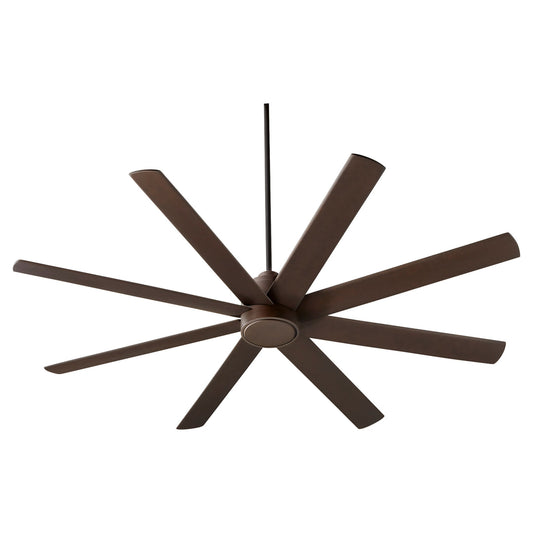
If you’re after a fan that mixes industrial charm with clean, aerodynamic lines, the Minka-Aire Aviation, priced around $700, is your answer. It's inspired by the vintage look of an airplane propeller, and its three-blade design makes a strong, confident statement. The clean silhouette is surprisingly versatile, looking just as good in a rustic farmhouse living room as it does in a chic urban loft.
Don’t let the simple three-blade design fool you. As we covered earlier, fewer blades can often lead to more efficient airflow. The Aviation fan puts this principle to work, matching its aggressive blade pitch with a robust DC motor to create a seriously powerful downdraft. This makes it one of the best ceiling fans for energy efficiency in the US when you need to cool a large, open area.
- Motor Type: Robust and silent DC Motor
- Ideal Room: Living rooms, lofts, or any space that can handle a larger fan and benefit from a strong breeze.
- Aesthetic: Industrial, minimalist, and transitional. It complements everything from rustic wood beams to exposed brick walls.
This fan proves that sometimes, less really is more. Its three carefully designed blades are more than capable of generating significant airflow, making it a stylish and practical choice. If this propeller-inspired look catches your eye, check out the full 3 Blade Fan Collection for more.
Why Premium Fans Are a Worthy Investment
It’s no secret that these fans have a higher price tag than what you’d find at a big-box store. So, why spend the extra money? When you choose a premium fan like the Artemis XL5 or the Aviation, you're paying for a superior blend of materials, engineering, and design.
Here’s what that investment really gets you:
- Superior Energy Savings: The high-efficiency DC motors in these fans use up to 70% less energy than old-school AC motors. Over the fan's lifetime, those energy savings can easily make up for the higher initial cost.
- Whisper-Quiet Operation: Premium fans are built for silence. This is a game-changer in bedrooms, nurseries, and home offices where any hum or click can be a huge distraction.
- Lasting Durability: These fans are constructed with better components, from the motor right down to the blade finish. That means they're far less likely to wobble, warp, or wear out, giving you years of dependable performance.
- Elevated Design: A premium fan is a design choice that can tie an entire room together. The unique look of models like these adds a layer of sophistication that standard fans just can’t replicate.
At the end of the day, picking one of the best ceiling fans for energy efficiency is about more than just moving air. It's an investment in a product that makes your home more comfortable, lowers your energy bills, and adds lasting style. When you're ready to make the upgrade, exploring our curated Collections is a great place to start your search.
Mastering Year-Round Savings with Your Fan
Once your new, energy-efficient ceiling fan is installed, you might think its job is just for those hot summer days. But the truth is, your fan is a year-round workhorse for comfort and savings. It’s not just about cooling down—it’s about creating a smarter, more comfortable home every single day of the year.
The secret to unlocking this potential is a simple feature most people miss: the reversible motor. With just the flick of a switch, you can completely change how your fan moves air in a room.
The Seasonal Switch for Maximum Comfort
During the summer, you want that direct, cooling breeze. To get it, your fan blades should spin counter-clockwise. This motion pushes air straight down, creating a "wind chill" effect that makes you feel instantly cooler.
But what about winter? This is where the magic really happens. Switch your fan to run clockwise, and the blades will start pulling the colder air from the floor upwards. This movement displaces the warm air that naturally rises and gets stuck at the ceiling, gently circulating it back down into your living space.
By simply reversing your fan, you’re helping your heating system work smarter, not harder. You’re recycling heat you’ve already paid for, which often means you can turn down the thermostat a degree or two without even noticing.
Want to dive deeper into how this works? Our guide explains everything you need to know about ceiling fan direction for summer vs. winter.
Unlocking Extra Savings with Rebates and Credits
Beyond the savings on your monthly bill, buying an energy-efficient fan can put cash back in your pocket right away. Many utility companies and state programs offer incentives to homeowners who choose energy-saving products.
Be on the lookout for local utility rebates or even federal tax credits for ENERGY STAR certified fans. These programs are designed to make upgrading more affordable. To get an idea of what's available, you can check out initiatives like the Mass Save Program, which offers programmatic incentives. A quick online search for "energy rebates" in your state is a great first step.
Frequently Asked Questions
Still have a few questions floating around about energy-efficient ceiling fans? You’re in good company. Let’s clear the air and tackle some of the most common things people wonder about so you can feel completely confident in your choice.
Do More Blades Mean a Better Fan?
It's a classic myth: the more blades, the better the fan. The truth is, it’s not that simple. The real power players in a fan's performance are the motor type and the pitch of the blades, not just how many there are.
A fan with three blades, like the striking Aviation fan from Minka-Aire, is often designed to slice through the air and create a more noticeable "wind chill" effect. On the other hand, fans with five or more blades tend to move air more gently, resulting in a quieter, steadier breeze. The takeaway here is that a well-designed fan with a great motor will always be efficient, no matter the blade count.
Are DC Motor Fans Really Worth the Extra Cost?
In one word: absolutely. It’s true that a DC motor fan can have a higher price tag upfront, but it’s an investment that pays you back, year after year. They use up to 70% less energy than their old-school AC counterparts, which adds up to real savings on your electricity bill.
But the benefits go way beyond just your wallet. DC fans are virtually silent, a game-changer for bedrooms and quiet spaces. They also give you more control, typically offering more speed settings and a handy reverse function on the remote. For modern homes, they’re the clear winner.
Think of it this way: the extra cost for a DC motor fan isn't just for the fan itself—it's for decades of lower energy bills, quieter nights, and better overall performance.
Ready to find a fan that perfectly marries top-tier performance with incredible design? The team here at Fan Connection has hand-picked a collection of the best energy-efficient models out there. Come explore what we have to offer and find the perfect fan to elevate your home's comfort and style at https://www.fanandlights.com.


