











Best Ceiling Fans for Small Rooms: The Ultimate Buying Guide
Let's be real: finding the perfect ceiling fan for a small room is like a high-stakes design puzzle. You need style, power, and smart engineering all packed into a compact frame. The magic formula usually involves a blade span between 29 to 44 inches and, more often than not, a sleek flush-mount design to save that precious headroom. But if you want to elevate the experience from just "moving air" to "creating an oasis," the secret is investing in a premium model over $300. These are the champs with whisper-quiet DC motors and impressive airflow (CFM) that make a world of difference in a cozy space.
Why a Premium Fan Is a Smart Investment for Your Small Room
Choosing a ceiling fan for a small room—your home office, cozy den, or sanctuary of a bedroom—isn't just a functional decision. It’s about curating the comfort and vibe of a space where every square foot is prime real estate. While grabbing a budget fan might seem like a quick win, splurging a bit on a premium model (we're talking $300 or more) is a luxury that pays you back every single day.
Think of it like buying headphones for your personal listening bubble. You wouldn't settle for tinny, crackly earbuds. You’d invest in a high-fidelity pair that delivers rich, immersive sound. A premium ceiling fan for a small room operates on the same principle. It's engineered for precision and elegance, not just brute force.
The Perks of Going Premium
So, what exactly do you get when you level up to a high-end fan? It’s all about the details that create a truly superior experience.
- Whisper-Quiet Operation: Let's face it, a noisy fan is a deal-breaker. Premium models almost exclusively feature advanced DC motors, which are so quiet you'll forget they're even on. This is a non-negotiable feature for a bedroom or office where silence is golden.
- Superior Energy Efficiency: Those fancy motors aren't just quiet—they're incredibly efficient, sipping up to 70% less energy than their clunky AC counterparts. Over the years, that adds up to real, noticeable savings on your electricity bill. It's the gift that keeps on giving!
- Built to Last: When you invest in a well-made fan, you’re getting a fixture crafted with top-tier materials and brilliant engineering. That means no annoying wobbling, rattling, or dying on you after a couple of years. It’s a workhorse that’s in it for the long haul.
A great ceiling fan should be a "set it and forget it" part of your home. The best ones for small rooms blend seamlessly into your decor while delivering silent, consistent comfort. They completely transform the feel of the space without screaming for attention.
Ultimately, a premium fan is both a powerhouse and a piece of art. It elevates your room's style while delivering perfectly calibrated airflow. This is especially crucial in rooms with lower ceilings. To get the scoop on making the most of your vertical space, check out our detailed guide explaining what a flush mount ceiling fan is and why it might be the hero your home needs.
Finding the Right Fan Size for Your Room
When it comes to picking a ceiling fan, size isn't just a detail—it's everything. It's the single most important decision you'll make. It’s like finding the perfect pair of shoes: too big and you’re tripping over yourself, too small and you’re just uncomfortable. A fan that’s too large for a small room will create an overpowering wind tunnel effect. On the other hand, a tiny fan will spin its blades off and barely stir the air.
Finding that "just right" Goldilocks zone is all about matching the fan's blade span (the full diameter from blade tip to blade tip) to your room's square footage. This simple step ensures the fan can circulate air effectively without making you feel like you're in a blender.
The Sweet Spot for Small Room Blade Spans
For most small rooms—that home office, guest bedroom, or cozy reading nook—the ideal blade span is between 29 and 44 inches. This range is perfectly tuned to deliver a gentle, consistent breeze that cools you down without blowing your papers off the desk. It’s the secret sauce for achieving that quiet, background comfort you crave.
To figure out what you need, just grab a tape measure. Measure your room's length and width, then multiply them to get the total square footage. That number is your treasure map.
A correctly sized fan doesn't just cool; it completes the room. The goal is to feel the effect of the fan—a refreshing, gentle breeze—without it becoming a loud, disruptive presence.
This little decision tree can help you narrow it down, pointing you toward a perfect, premium fit for your space.
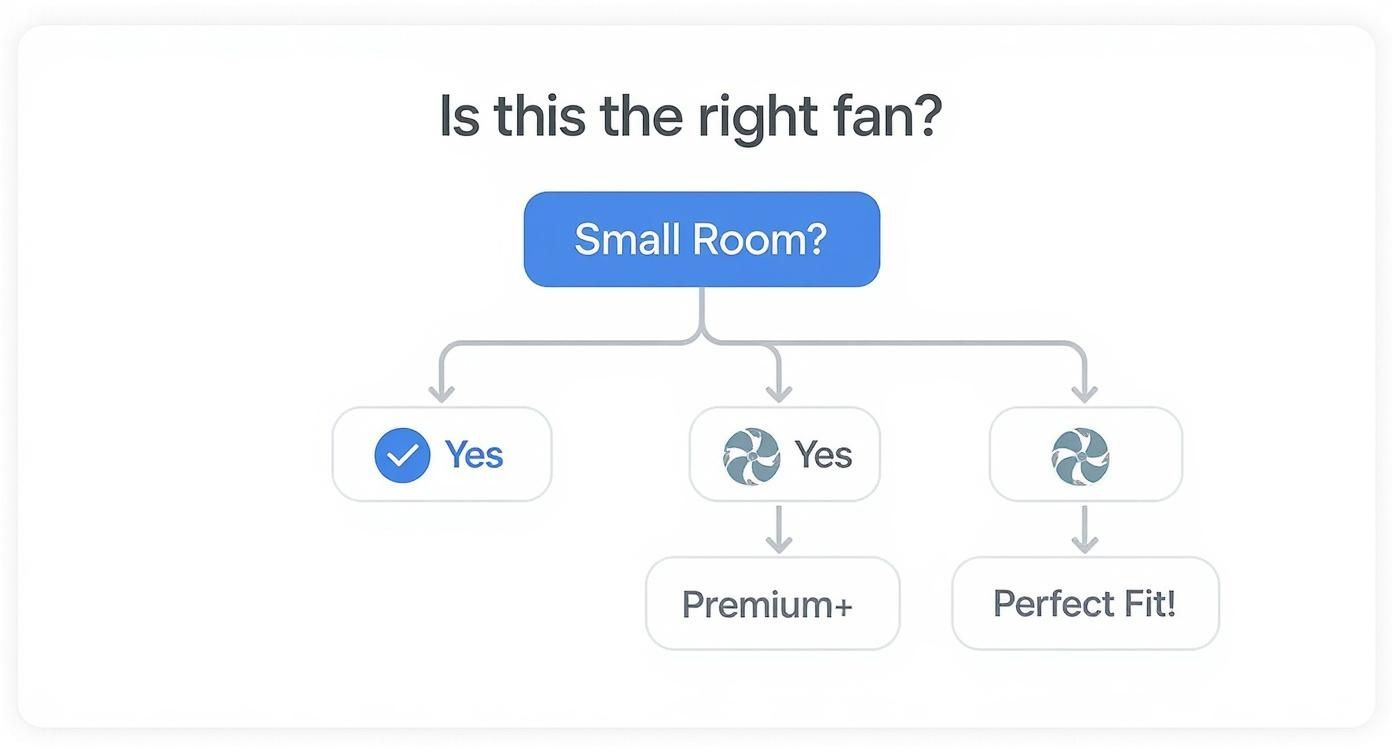
As you can see, pairing a small room with a high-quality fan over $300 is the winning formula. It’s how you guarantee you get both the right size and the best performance for years of bliss.
Matching Your Room to the Perfect Fan
To make things crystal clear, we've broken down how room size lines up with the ideal blade span. Use this simple chart to find your room's square footage and the corresponding fan size that will work best. It takes all the guesswork out of the game.
Ceiling Fan Size Guide for Small Rooms Match your room's square footage to the recommended fan blade span for optimal airflow and comfort.
| Room Size (Square Feet) | Ideal Blade Span (Inches) | Common Room Type |
|---|---|---|
| Up to 75 sq. ft. | 29 to 36 inches | Walk-in closet, laundry room |
| 76 to 144 sq. ft. | 36 to 44 inches | Home office, nursery, bedroom |
Armed with this knowledge, you can shop like a pro, confident you’re looking for a fan that’s perfectly matched to your room's dimensions.
For a deeper dive into the numbers, you can learn more about choosing the right ceiling fan size for maximum efficiency in our comprehensive guide. Nailing the size is the first—and most important—step toward creating a perfectly comfortable and stylish space.
Understanding Airflow and Why CFM Is Key
Now that you’ve sized up your fan, it’s time to talk about what really creates that refreshing breeze. The magic number here is CFM, which stands for Cubic Feet per Minute. While it’s tempting to just look at speed settings, CFM is the true measure of a fan's muscle—it tells you the sheer volume of air it can move.
Think of it this way: a high-speed blender whips things around quickly, but it won't circulate air in a room. A gentle but powerful river, however, moves a massive volume of water. For a ceiling fan, CFM is that powerful, room-filling flow.
In a small room, you’re not trying to create a hurricane. The goal is gentle, consistent air circulation that keeps you comfortable without turning your desk into a vortex of flying papers. For most small spaces, a fan with a CFM rating between 1,000 and 4,000 is the sweet spot.
Blade Pitch: The Secret Ingredient to Powerful Airflow
So, what gives a fan a high CFM rating? A huge piece of the puzzle is blade pitch. This is simply the angle of the fan blades. The steeper the angle, the more air the blades can “scoop” and push down with every single rotation. It's the difference between a flat paddle and a powerful oar.
You’ll find that high-quality fans often have a blade pitch between 12 and 15 degrees. This smart design allows them to generate a strong, satisfying breeze even when running at lower, quieter speeds. It’s a major reason why premium fans feel so much better than budget models that just spin their flat, inefficient blades really, really fast.
A well-designed fan moves air with purpose, not just speed. The right combination of blade pitch and motor power creates an effective breeze that feels natural and refreshing, making it one of the most important factors when choosing the best ceiling fans for small rooms.
This is why it's so important to look past flashy marketing claims about "high-speed" performance. A fan’s ability to move air is a delicate balance of smart engineering. While other factors like the number of blades come into play, understanding how blade pitch drives performance is key. If you want to dive deeper, you can check out our guide on the impact of fan blade count and fan efficiency.
By focusing on a strong CFM rating backed by thoughtful design, you can be confident your new fan will deliver on its promise of cool, quiet comfort.
The Engine Inside: Why a DC Motor Is Worth It
If a ceiling fan's blades are its hands, the motor is its heart—and not all hearts are created equal. The motor dictates everything, from how much noise the fan makes to how much it adds to your electric bill. When you're searching for the best ceiling fans for small rooms, the motor type is a detail you absolutely cannot afford to overlook.
Think of it like choosing an engine for a car. You could go with an old, clunky V8 that’s loud and guzzles gas. Or, you could opt for a modern, silent electric engine packed with smart tech. In the world of ceiling fans, the traditional AC (alternating current) motor is that V8, and the modern DC (direct current) motor is the high-tech electric marvel.
The Quiet Power of DC Motors
For small, intimate spaces like a bedroom or home office, silence isn't just golden—it's essential. This is where DC motors truly dominate. They operate with a level of quiet that traditional AC motors can only dream of. No more distracting hum or mechanical whirring while you're trying to focus or drift off to sleep.
But their advantages don't stop there. DC motors are also incredibly energy-efficient. They use a clever system of magnets to power the rotation, which means they need way less electricity to get the job done.
Investing in a fan with a premium DC motor is a hallmark of models priced over $300. This upgrade translates directly into long-term energy savings and a more peaceful, comfortable environment.
This push for efficiency is a huge trend in the industry. Energy-saving tech is seeing a major surge in popularity, and the market for these advanced fans is growing steadily, thanks to motors that can slash power consumption by up to 70%. That's a huge win for any homeowner looking to be both comfortable and eco-conscious. You can explore more on these market trends in this in-depth industry report.
More Speeds, More Control
Beyond the silence and savings, DC motors offer a level of precision that leads to far better comfort. A typical AC motor fan might give you three speed settings—low, medium, and high. A DC motor fan, on the other hand, often provides five, six, or even more. This gives you much finer control over your environment, letting you dial in the perfect, gentle breeze for any mood or moment.
Top Luxury Ceiling Fans for Small Rooms
Alright, we've navigated the technical jungle of sizing, CFM, and DC motors. Now for the really fun part: seeing these principles come to life in stunning designs. Let's be honest, choosing a fan isn't just about specs; it's about finding that perfect piece to complete your room's personality.
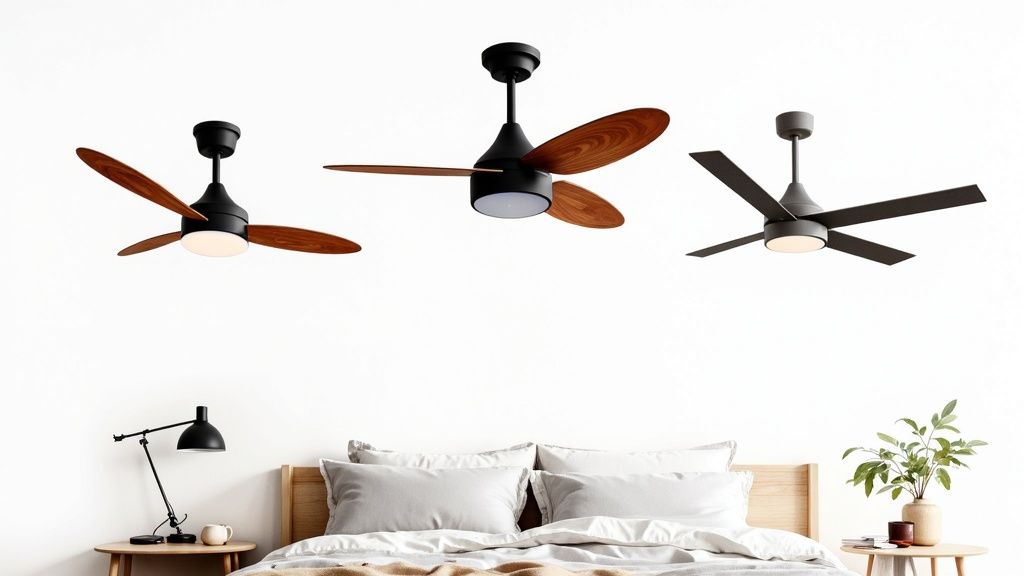
I’ve handpicked three fantastic, high-end ceiling fans, all priced over $300, that are a perfect marriage of performance and style for smaller spaces. These beauties prove you don't have to sacrifice powerful, quiet cooling just because you have a compact room. They show that the best ceiling fans are both hard-working appliances and stunning centerpieces.
The Minimalist Marvel: The Apex Fan
For those who live by the "less is more" philosophy, the Apex fan is a masterclass in clean design. Its sleek, three-blade build and understated lines allow it to blend seamlessly into modern or Scandinavian rooms. The whole idea is for the fan to almost disappear, giving you all the comfort with none of the visual clutter.
- Blade Span: A tidy 44 inches, making it an ideal fit for bedrooms and home offices up to 144 square feet.
- Motor: It features a high-efficiency DC motor that operates in virtual silence—an absolute must-have for rooms where you need to focus or relax.
- Standout Feature: Full smart home compatibility. You can control its six speeds, reverse the direction, and adjust the integrated LED light with a simple voice command or a tap on your phone.
The Rustic-Modern Hybrid: The Barn Fan
The Barn fan strikes that perfect balance between rustic charm and modern engineering. It often pairs warm, wood-finished blades with a clean metallic housing, making it incredibly versatile for transitional or modern farmhouse spaces. It brings in a touch of organic warmth without looking heavy or dated.
- Blade Span: At 42 inches, it's perfectly sized for creating a welcoming breeze in a cozy living area or guest room.
- CFM: This fan is engineered to move a serious amount of air, thanks to a finely tuned blade pitch that keeps the room comfortable without feeling gusty.
- Standout Feature: The hand-finished blades give it a unique, artisanal quality. It’s a decorative touch that adds real character and makes the space feel more curated.
A great fan doesn’t force you to choose between style and substance. It marries a distinct design personality with the quiet, efficient performance you expect from a luxury fixture.
The Bold Statement Maker: The Artemis IV Fan
For rooms that are just begging for a dramatic focal point, the Artemis IV is an absolute showstopper. Its sculptural, flowing blades create a sense of movement even when it’s standing still. This is the fan for eclectic or avant-garde interiors where you want your ceiling fan to be a piece of functional art.
- Blade Span: Its 43-inch span is cleverly designed to deliver impressive cooling power from a compact, artistic form.
- Motor: A robust DC motor provides powerful circulation with incredible energy efficiency and that whisper-quiet operation we love.
- Standout Feature: It’s all about those unique, fluid blades. They’re an architectural element that draws the eye upward and adds a dynamic, sophisticated flair to any small room.
These examples drive home the point that when you invest in a premium fan, you're getting more than just a motor and blades—you're getting a product designed for performance, style, and longevity.
Essential Smart Features for Modern Comfort
Let's be real, a modern ceiling fan is so much more than a motor with blades. It's a central hub of a comfortable, connected home, especially in a small room where every gadget counts. Smart features elevate a fan from a simple appliance to a fixture that actively works with your lifestyle.
Imagine this: you’re cozy in bed, the room gets a little stuffy, but you don’t want to get up and fumble for a remote. With a smart fan, you just say, "Alexa, turn on the fan." That's the power of smart home integration. The best ceiling fans for small rooms now hook up seamlessly with systems like Alexa or Google Assistant, giving you effortless control.
Beyond the Basics: What Smart Fan Tech Really Does
The leap to Wi-Fi-enabled fans has completely changed the game, especially in tight spaces. This trend isn't a gimmick; it’s a response to how we live now. With more people in smaller homes, multi-functional design is a huge win, and this is where technology shines, as highlighted in this detailed market analysis.
This integration brings features that make a real difference:
- Integrated LED Lighting: Most high-end fans today come with built-in, dimmable LED lights. This is a massive space-saver, combining two essential fixtures into one. You can go from bright, focused light to a soft, warm glow, all from the same unit.
- Advanced Remote Controls: Forget those clunky pull chains. Today’s premium fans come with intuitive remotes that give you precise control over multiple speed settings, light dimming, and even special modes like a timer or one that simulates a natural breeze.
A fan's intelligence isn't about how many buttons it has. It’s measured by how little you have to think about it. The goal is a perfectly comfortable room that feels almost automatic.
Why These Features Are Worth It
In a compact bedroom, home office, or den, these smart upgrades are practical features that make life easier. Scheduling your fan to turn on before you get home or adjusting the light from your phone adds a layer of comfort you’ll appreciate every single day. This level of control is exactly why it makes sense to invest in a high-quality, modern ceiling fan.
Got a Few More Questions?
You've got the basics down, but a few questions always pop up when picking out the perfect fan for a smaller room. Let's tackle them head-on so you can choose with total confidence.
Can I Put a Fan on a Low or Sloped Ceiling?
Absolutely! For low ceilings (under 8 feet), a "hugger" or "flush-mount" fan is your best friend. These models install right up against the ceiling, saving every precious inch of headroom.
For sloped ceilings, you'll want a fan that works with a downrod and an adaptable mounting kit. Just check the fan's specs to see the maximum angle it can handle. This ensures your fan hangs straight, steady, and safe.
What’s the Deal with Damp and Wet Ratings?
These ratings are all about moisture. A "damp-rated" fan can handle humidity, making it a great pick for a steamy bathroom or laundry room. A "wet-rated" fan can handle direct rain, so it’s perfect for a covered porch. For most small bedrooms or offices, though, a standard "dry-rated" fan is all you need.
A reversible motor isn't just a feature; it's a year-round energy-saving strategy. It transforms your fan from a summer cooling tool into a winter heating helper, making your small room more comfortable and efficient no matter the season.
Is a Reversible Motor Really a Big Deal for a Small Room?
You bet it is. A reversible motor is a game-changer for year-round comfort. In the summer, you set the blades to spin counter-clockwise, pushing cool air down. Come winter, you flip it to spin clockwise. This clever trick pulls cool air up and gently pushes the warm air that's hanging out by the ceiling back down into the room. It's a simple way to keep the space feeling cozy and can even trim your heating bill.
Ready to find that perfect blend of style, performance, and smart features? Dive into the hand-picked collections at Fan Connection and discover a fan that will take your small room's comfort and design to the next level.


