











Ceiling Fan Direction Summer vs Winter Explained

If there’s one simple trick every homeowner should know, it’s how to change their ceiling fan direction for summer vs winter. Get this right, and you’ll unlock year-round comfort and some serious energy savings. The golden rule is this: fans spin counter-clockwise in the summer to push cool air down and clockwise on a low speed in the winter to circulate warm air.
That’s it. A two-minute adjustment that makes a world of difference. It's the kind of home comfort hack that feels like you've discovered a secret cheat code for your house.
Your Quick Guide To Seasonal Fan Direction
It’s one of the most effective—and most overlooked—home comfort hacks out there. Switching your fan’s rotation helps your HVAC system work smarter, not harder, by using simple air movement to your advantage. It's all about creating either a refreshing breeze or gently redistributing the heat you’ve already paid for.
In the summer, a counter-clockwise spin creates a direct downdraft. This column of air moves over your skin and creates a “wind chill” effect, helping moisture evaporate and making you feel several degrees cooler. The best part? The room's actual temperature hasn't changed, but you feel more comfortable, allowing you to give your AC a much-needed break. It's your personal, budget-friendly breeze maker.
Come winter, you want the opposite. A gentle, clockwise rotation pulls the cooler air from the floor upwards. This motion pushes the warm air that naturally rises and gets trapped at the ceiling down along the walls and back into your living space. This process mixes the air beautifully, creating a more uniform temperature and getting rid of those annoying cold spots without a chilly draft. Think of it as your fan playing hero, rescuing all that cozy, wasted heat from the ceiling.
This diagram shows you exactly how the airflow works in each season.
As you can see, the direction directly controls whether you get a cooling downdraft or a warming updraft. It’s that simple.
To make it even easier to remember, here’s a quick-glance table with everything you need to know.
Quick Comparison Summer vs Winter Fan Settings
| Season | Fan Direction | Airflow Effect | Primary Goal |
|---|---|---|---|
| Summer | Counter-Clockwise | Downdraft | Create a cooling wind-chill effect |
| Winter | Clockwise | Updraft | Circulate warm air from the ceiling |
Once you master this seasonal switch, your ceiling fan goes from being a simple light fixture to a powerful tool for comfort and efficiency. It’s a small change that delivers surprisingly big results all year long.
The Science Behind Airflow and Comfort

It might feel like a little bit of magic, but the way a ceiling fan transforms a room's comfort level is pure science. The secret is all about how moving air interacts with our bodies and plays with the natural tendency of warm and cool air. A fan isn't actually changing the room's temperature; it's changing how you feel it.
The direction your fan blades are spinning is what dictates whether air is pushed down or pulled up. This simple tweak has a massive impact, which is why knowing the right ceiling fan direction for summer vs winter is your key to year-round comfort.
The Summer Wind Chill Effect
In the summer, you want your fan spinning counter-clockwise. This motion creates a direct column of air that flows straight down, known as a downdraft. When this breeze hits your skin, it speeds up the evaporation of moisture, creating what’s known as the wind chill effect.
This is the good stuff. It’s what makes you feel cooler even though the thermostat hasn't changed a bit. Your fan is essentially tricking your body into feeling refreshed, letting you raise your AC setting by a few degrees without breaking a sweat.
A well-placed ceiling fan can make a room feel up to 4°F cooler, giving you the same comfort level while taking a serious load off your air conditioner.
This simple bit of physics is the foundation of smart summer cooling. You create a personal breeze, relying less on expensive, energy-hungry AC and more on targeted airflow. Of course, the number of blades on your fan can also change how this airflow feels, something you can dig into by exploring the impact of fan blade count on efficiency.
Winter's Gentle Warmth Distribution
When winter rolls around, the science flips. Warm air is less dense, so it naturally rises and gets trapped up at the ceiling where it does you no good. Meanwhile, the colder, denser air settles right where you are—on the floor. A clockwise fan rotation on a low speed is the perfect solution.
This upward pull gently draws the cool air from the floor up towards the fan. The blades then push this air out across the ceiling, forcing all that cozy, trapped warm air down the walls and back into your living space. This circulation gently mixes the air, evening out the room’s temperature without creating a chilly draft. It's a simple, effective way to make your home feel warmer and more comfortable.
How Fan Direction Unlocks Major Energy Savings

It’s one thing to understand the science of airflow, but the real magic happens when you see how that translates into money back in your pocket. Getting the ceiling fan direction for summer vs winter right isn't just a neat trick for staying comfortable—it's a smart, strategic move to lower your energy bills. This simple adjustment puts you back in control of your thermostat without making you sweat (or shiver).
Think about this: your ceiling fan uses about the same amount of electricity as a 60-watt light bulb. Your central air conditioner, on the other hand, can guzzle over 3,500 watts. That massive difference is where your savings come from.
By using your fan to create that refreshing wind chill effect in the summer, you can comfortably nudge your thermostat up a few degrees. And every single degree you raise it cuts down on your cooling costs by letting your hardworking HVAC system take a break.
The Thermostat Strategy: Summer vs. Winter
Pairing your fan with your thermostat is a power combo for year-round efficiency. The goal is simple: let the fan handle the light work of moving air around so your HVAC system doesn't have to kick on as often.
- Summer Savings: Run your fan counter-clockwise to push cool air down. This lets you set your thermostat to a warmer temperature—say, 78°F instead of 74°F—and feel just as comfortable.
- Winter Savings: Switch the fan to a slow, clockwise rotation. The gentle updraft pulls cool air up and circulates the warm air trapped at the ceiling, keeping the room cozy even with a lower thermostat setting.
This approach transforms your fan from a seasonal appliance into a year-round energy-saving partner. It’s an active way to shrink your home's energy footprint. For a deeper dive, you can explore more about the energy efficiency of ceiling fans and their eco-friendly benefits.
The Financial Impact of Smart Fan Use
The numbers don't lie. Energy studies show that using ceiling fans with your HVAC system can slash summer energy consumption by 10-15%. That's all thanks to the fan's ability to make you feel cooler, letting you dial back the AC.
By strategically adjusting your thermostat by just a few degrees each season, a reversible ceiling fan can pay for itself over time through reduced utility bills.
Of course, smart fan use is just one piece of the puzzle. There are many other ways to reduce energy consumption that can lead to even bigger savings on your utility bills.
Investing in a premium, reversible model isn't just a style upgrade; it's a commitment to a more sustainable and cost-effective home. A fan with an efficient DC motor and optimized blades will maximize airflow, ensuring you get the most significant energy-saving impact from every single rotation, no matter the season.
How To Change Your Ceiling Fan Direction
Now that you know the why behind ceiling fan direction for summer vs winter, let's get to the easy part: actually making the switch. This isn't some complicated chore; it's a simple, two-minute task that unlocks all those comfort and energy-saving benefits we've been talking about. Whether your fan is brand new or a trusty older model, reversing its direction is almost always a breeze.
Most ceiling fans, especially the classics, have a small physical toggle switch right on the motor housing—that’s the central hub where the blades connect. Before you do anything, though, make sure the fan is completely off and the blades have stopped spinning. Safety first. Once it’s still, a quick flip of that switch is all it takes.
The Three Main Ways to Reverse Your Fan
The method you’ll use really just depends on your fan's age and technology. From a simple flick of a switch to a command from your phone, getting your fan ready for the season has never been easier.
- The Manual Switch: This is the old-school, tried-and-true method. Just look for a small horizontal or vertical toggle switch on the side of the motor housing. One position is for counter-clockwise (summer), and the other is for clockwise (winter).
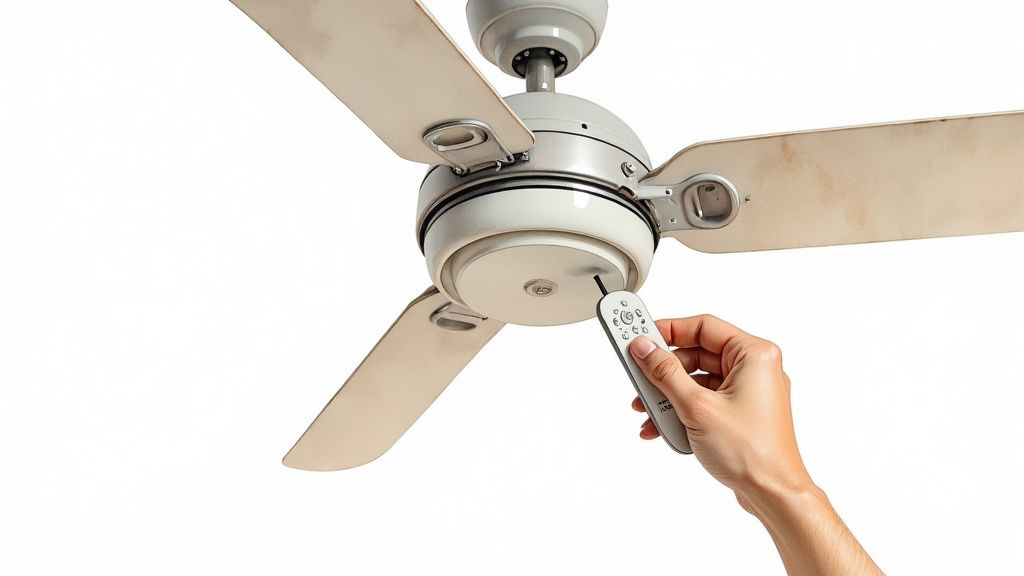
- The Remote Control: Many modern fans come with a handy remote. Find the button with a reverse icon on it—it usually looks like two curved arrows chasing each other. Just press it while the fan is on, and you’ll see the spin change.
- Smart Controls (App or Voice): The newest fans are all about smart home integration. Just open the fan’s app on your smartphone, find the direction setting, and tap. Or, if you're really feeling hands-off, just say something like, "Alexa, set the living room fan to winter mode."
A quick tip for those manual switches: If you’re not sure which direction is which, just turn the fan on low and stand under it. If you feel a cool downdraft, it’s set for summer. No breeze? You’re all set for winter.
Step-by-Step Instructions for Manual Switches
For anyone with a traditional fan, here’s exactly how to make the change safely:
- Step 1: Turn the fan completely off at the pull chain or wall switch.
- Step 2: Wait for the blades to come to a complete stop. Seriously, don’t rush this.
- Step 3: Grab a sturdy step stool or ladder to safely reach the motor housing.
- Step 4: Find that little toggle switch and flip it to the opposite position.
- Step 5: Step down, turn the fan back on, and check that it's spinning the way you want.
Of course, making sure your fan is installed properly is the first step to ensuring all its features work correctly. If you need some guidance on getting it right from the start, you can learn more about how to install a ceiling fan in our detailed guide. Once you do this little seasonal adjustment once or twice, it’ll quickly become second nature.
Debunking Common Ceiling Fan Myths
Ceiling fans have been spinning in our homes for ages, and naturally, a few stubborn myths have started to stick. To get the most out of your fan, you’ve got to separate the facts from the fiction. Once you do, you’ll be able to use your fan more efficiently and even save some money.
The biggest misconception out there? That ceiling fans can actually heat or cool a room. Nope, not true. Fans are masters of air movement, not temperature change. They create the sensation of feeling cooler or warmer simply by moving the air that’s already in the room.
This is exactly why getting the ceiling fan direction for summer vs winter right is so important—it’s all about managing airflow to make you feel comfortable.
Myth 1: Fans Actually Cool the Room
A fan's magic comes from the wind-chill effect. It makes you feel cooler, but it does absolutely nothing to lower the room's actual temperature. Because of this, running a fan in an empty room is just a waste of electricity.
Key Takeaway: Fans cool people, not rooms. Make it a habit to turn your fan off when you leave. This simple move ensures your fan is only using energy when it's actually making someone comfortable.
Myth 2: A Clockwise Spin Actively Heats the Room
Another popular belief is that the winter setting somehow adds heat. In reality, that clockwise spin is only redistributing the warm air that has already risen to the ceiling. It’s a simple trick of physics. Research confirms fans don't generate heat; they just bring that cozy warmth back down to where you can feel it. If you want to dive deeper, you can explore more about this ceiling fan direction myth and its impact.
Understanding this distinction is the key to using your fan as a smart partner for your furnace. When you bust these myths, you can make better decisions, fine-tune your home's climate, and make sure your fan is working for you all year long.
Choosing The Best All-Season Ceiling Fan
Knowing how to flip your ceiling fan direction for summer vs winter is a massive win for your home's comfort and your energy bills. But to really squeeze every drop of value out of that trick, you need a fan that’s actually built for year-round performance. When it's time to upgrade, investing in a quality all-season ceiling fan is one of the smartest moves you can make.
Today's fans are a far cry from the wobbly, noisy fixtures of the past. They're sophisticated pieces of engineering designed for quiet power, efficiency, and blending right into your life. The best ones deliver a powerful breeze when you're hot and a gentle updraft to circulate warmth when you're cold, all while looking great.
Key Features For A Year-Round Fan
When you're shopping for a fan that can pull its weight in every season, a few features are non-negotiable. These are the details that separate a basic air-mover from a true workhorse that delivers comfort for years.
- DC Motors: Let's get straight to it: Direct Current (DC) motors are the only way to go. They’re up to 70% more energy-efficient and worlds quieter than old-school AC motors. That whisper-quiet operation is a game-changer, especially for bedrooms.
- Optimal Blade Pitch and CFM: Airflow is measured in Cubic Feet per Minute (CFM), and a higher number means more air movement. This power comes from a combination of the motor and the blade pitch—the angle of the blades. For a fan that can create a solid downdraft in summer and an effective updraft in winter, look for a pitch between 12 and 15 degrees.
- Smart Home Integration: Being able to change direction and speed with a remote, your phone, or a voice command isn't just a gimmick. It’s the kind of convenience that makes seasonal adjustments effortless, so you actually do them.
A premium fan isn’t just an appliance; it's a long-term investment in your home’s comfort and efficiency. By choosing a model with a high-quality DC motor and smart controls, you’re ensuring you get the most out of every rotation.
Top-Tier Fan Recommendations
To give you a better idea of what to look for, here are a couple of stand-out models from our collection that really nail what an all-season fan should be. Both are priced over $300, which reflects their superior design, engineering, and performance.
1. The Artemis XL5
This fan is what happens when modern design and powerful function come together. Its sleek, aerodynamic blades are engineered for maximum airflow, making it perfect for big living rooms or spaces with high ceilings. It has an energy-efficient DC motor and comes with a remote, so switching from summer to winter mode is as simple as pressing a button.
- Best For: Large, open-concept spaces and modern interiors.
- Price: Starting at $790.00
2. The Aviation Fan
Inspired by the look of vintage aircraft propellers, the Aviation fan mixes rustic charm with modern tech. Its three-blade design and powerful DC motor deliver some serious airflow, while its unique look makes it a true conversation starter. This one also includes a full-function remote, giving you total control over its six speeds and reversible direction.
- Best For: Rooms with industrial, rustic, or eclectic decor.
- Price: Starting at $562.00
Choosing a high-quality fan with these features is the key. It guarantees you can easily adapt to the seasons, keeping your home comfortable and your energy bills in check all year long.
Still Have Questions About Fan Direction?
Okay, so you've got the basics down, but a few questions might still be swirling around. Getting these details right is what separates a good setup from a great one, fine-tuning your comfort and squeezing every last bit of energy savings out of your fan.
Let’s tackle some of the most common questions we hear. Answering these will give you the confidence to manage the airflow in any room of your house like a pro.
What's The Best Fan Speed for Summer vs. Winter?
This is a big one. The right speed is just as crucial as the right direction because the goal changes completely with the seasons.
- Summer (Counter-Clockwise): Go for medium to high speed. You want to feel that downdraft. It’s what creates the wind-chill effect that makes you feel instantly cooler.
- Winter (Clockwise): Stick to low speed, always. If you crank it up, the updraft will feel like a chilly, unpleasant draft. The goal is to gently and slowly pull cool air up to mix with the warm air at the ceiling, not to create a breeze you can feel.
Does Fan Direction Matter In Rooms With High Ceilings?
Yes, and it might matter even more! Those beautiful vaulted or high ceilings are notorious for air stratification. This is just a fancy term for when all your warm air rises and gets trapped up high, leaving you shivering down below.
In winter, running your fan clockwise is the single best tool you have to fight this. The gentle updraft breaks up that layer of trapped heat and circulates it back down into the room where you can actually feel it. It makes a huge difference in both comfort and your heating bill.
For ceilings over 9 feet, you'll probably want a downrod to lower the fan. This brings it closer to the living space, making sure it can actually move the air where it counts.
Can I Run My Ceiling Fan With The Window Open?
Absolutely, and you definitely should—especially in the summer. On those cooler days or evenings, running your fan counter-clockwise with the windows open is a fantastic way to pull in fresh air and circulate it throughout the room.
It’s a refreshing, energy-efficient strategy that can often help you put off turning on the air conditioner, or maybe even skip it altogether.
Ready to upgrade to a fan that makes these seasonal adjustments a breeze? Explore the premium collections at Fan Connection, where modern style meets year-round performance. Find the perfect model for your home at https://www.fanandlights.com and take control of your comfort.


