

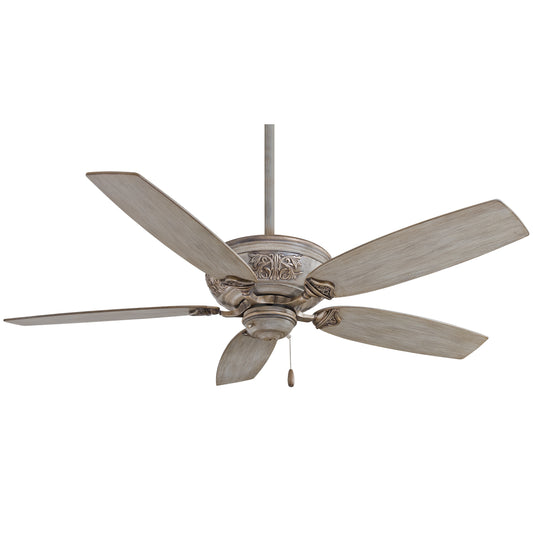


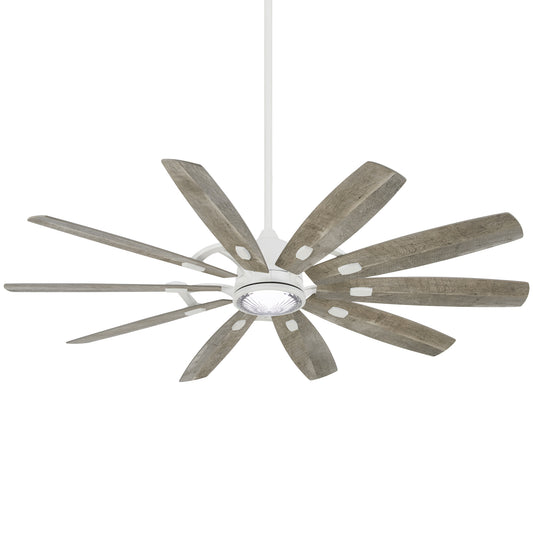

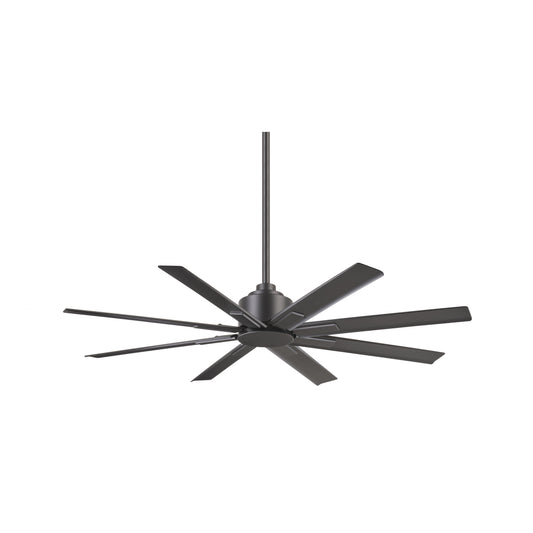

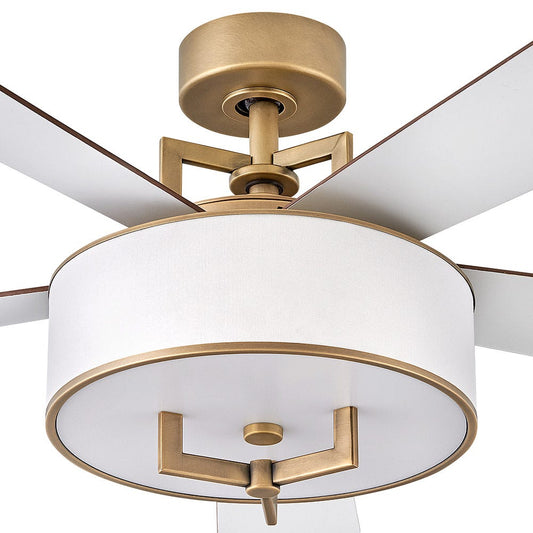






Choosing a Ceiling Fan for Your Large Living Room: The Ultimate Guide to Comfort and Style
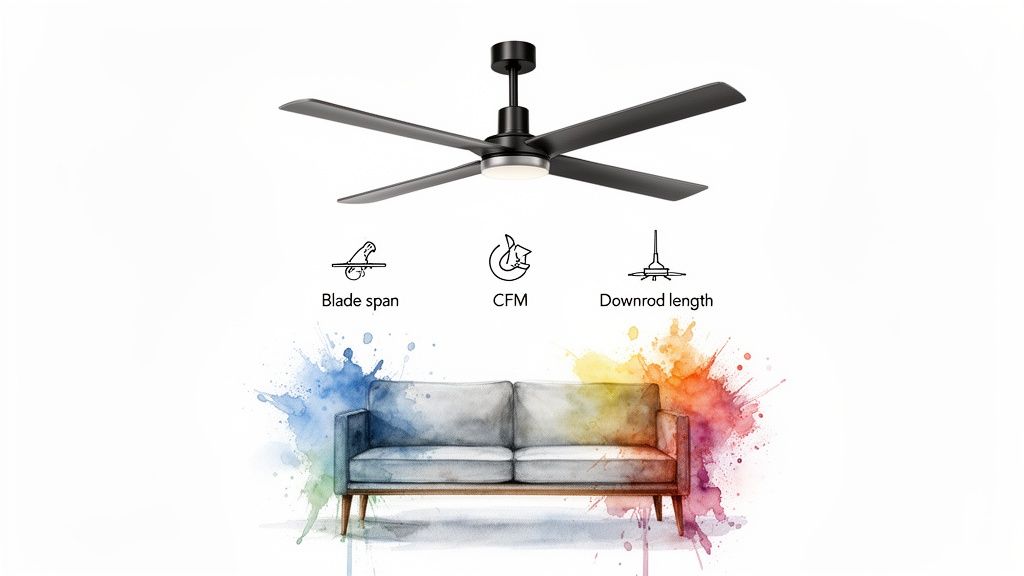
Let’s be honest, picking a ceiling fan for a big living room can feel like a guessing game. When you’re dealing with a space over 400 square feet, you can’t just grab any fan off the shelf and hope for the best. The real secret comes down to three things: blade span, airflow (CFM), and getting the height just right. It's about finding that perfect blend of beastly performance and beautiful design.
Finding Your Perfect Fan Without the Headache
Staring at a wall of fans is overwhelming. Let's cut through the noise and get straight to what matters, so you can tackle the biggest challenge first: cooling a large, open living space without killing your style. This is your chance to turn a practical necessity into a jaw-dropping centerpiece.
Think of it like choosing an engine for a big truck; you need enough power to do the job. A small fan in a grand room will just spin its heart out accomplishing nothing. But the right fan? It creates a gentle, consistent breeze that makes the whole room feel like a five-star resort.
The Three Non-Negotiables for Large Rooms
To make your search easier, just focus on these three critical factors. Get them right, and your fan will perform beautifully from day one.
-
Blade Span: This is the full wingspan of the fan. For a large living room, you need a wider reach to move a serious amount of air. Anything less than 52 inches is going to struggle.
-
CFM (Cubic Feet per Minute): If there’s one number to pay attention to, it’s this one. CFM measures how much air the fan actually moves. For a big room, you want a fan with a CFM rating of 5,000 or higher to feel a real difference.
-
Downrod Length: This little pole connects the fan to the ceiling. If your ceilings are taller than 9 feet, you’ll need a longer downrod to hang the fan at the sweet spot—about 8-9 feet off the floor—for the best possible airflow.
In today's modern homes with their sprawling living rooms, the right fan is a game-changer. A properly sized fan with 52- to 72-inch blades can move up to 6,000 CFM, making the room feel 8-10°F cooler without the sticker shock of running the AC constantly.
Key Takeaway: Don't get lost in the weeds just yet. If you can confirm a fan has the right blade span, a high CFM, and the correct downrod for your ceiling, you’re 90% of the way to finding the perfect model.
To make things even simpler, here's a quick chart to match your room size to the ideal fan diameter.
Quick Fan Sizing Chart for Large Living Rooms
This handy table gives you a confident starting point, matching your living room's square footage to the fan size you should be looking for.
| Living Room Size (Square Feet) | Recommended Fan Blade Span (Inches) |
|---|---|
| Up to 400 sq. ft. | 52" – 56" |
| 400 – 600 sq. ft. | 56" – 72" |
| Over 600 sq. ft. | 72" or larger (or consider two fans) |
With this in mind, you can explore the rest of this guide knowing exactly what to look for in a high-performance fan. For an even deeper dive, check out our detailed ceiling fan buying guide for more pro tips.
Understanding the Power Behind the Breeze
Beyond the beautiful blades and stylish finishes, the real workhorse of any good ceiling fan is its engine. To figure out what makes a fan powerful enough to cool a large living room, we need to peek under the hood at three key performance metrics.
Getting these right is the difference between a gentle, room-filling breeze and a fan that just spins for show.
What is CFM and Why Does It Matter?
First on the list is CFM, which stands for Cubic Feet per Minute. Think of CFM as the horsepower rating for your fan. It’s a direct measurement of how much air the fan actually moves, making it the single most important number to look at for performance.
A higher CFM means more air circulation, which is exactly what you need for a cooler, more comfortable room.
For a living room that's over 400 square feet, a high CFM isn't a luxury—it's a necessity. You should be aiming for a fan with a CFM rating of 6,000 or higher. This ensures it has the raw power to create a breeze you can actually feel across the entire space. Anything less will struggle to make an impact, leaving corners of the room feeling stuffy and stagnant.
The Motor Makes All the Difference
The engine driving that high CFM is the motor, and they’re definitely not all created equal. In the world of premium ceiling fans—especially those priced over $300—the DC (Direct Current) motor is the undisputed champion. It's a total game-changer compared to the older AC (Alternating Current) motors you’ll find in most standard fans.
A modern DC motor is up to 70% more energy-efficient than its AC counterpart. This means you get superior airflow without the shocking energy bill, making it a much smarter long-term investment.
Here's why a DC motor is a must-have for a large living room:
- Whisper-Quiet Operation: DC motors are virtually silent. This is a huge deal in a living room where you relax, watch movies, and hold conversations. Nobody wants to crank up the TV volume just to hear over a humming fan motor.
- More Speed Options: They usually offer more speed settings—often six or more—giving you precise control over the airflow to get your comfort level just right.
- Energy Savings: Their incredible efficiency translates directly into lower electricity costs over the fan's lifetime.
For both homeowners and designers trying to blend performance with style, choosing fans with high-end components is key. This means models like the 72-inch Bowie in Matte Black (Sale Price: $339.99) not only meet energy codes but also elevate the room's aesthetic. They turn a functional appliance into a statement piece that cools a 600-square-foot great room evenly and quietly, perfect for entertaining. For a broader look at market trends, you can explore ceiling fan technology at Mordor Intelligence.
The Secret Angle of Airflow
Finally, let's talk about blade pitch. This is simply the angle at which the fan blades are tilted. It might sound like a minor detail, but it plays a massive role in how effectively the blades "scoop" and push air down.
Imagine two airplane wings: one is flat, and the other is angled. The angled one will generate a lot more lift. It's the same idea with fan blades. A steeper pitch helps them grab more air with each rotation, creating a much stronger downdraft.
For a large living room, look for a fan with a blade pitch between 12 and 15 degrees. This steeper angle allows the blades to slice through the air and force a powerful column of it downwards, ensuring the breeze reaches you even in a big room with high ceilings. A fan with a flat, shallow pitch just doesn't have the aerodynamic muscle to get the job done right.
To see how pitch works with other design elements, you can learn more about the impact of fan blade count and efficiency in our detailed article. By understanding CFM, motor type, and blade pitch, you'll be able to read the specs like a pro and choose a fan based on proven performance.
Getting Your Fan Size and Placement Just Right
Even the best, most powerful ceiling fan on the market will be a huge letdown if it's the wrong size for your room or hung improperly. Let's walk through the blueprint for getting these critical details right the first time, so your investment pays off with perfect, room-filling airflow.
First up, blade span. Think of it as the fan's wingspan—the wider it is, the more air it can grab and move. Putting a small fan in a big living room is like trying to stir a swimming pool with a teaspoon. It just won't make a dent. For a large, open area, a generous blade span is non-negotiable.
If your room is over 400 square feet, you should be looking at fans with spans of 60 inches, 72 inches, or even a massive 84 inches. These larger diameters are what it takes to push a breeze into every corner and get rid of those frustratingly stuffy spots. Nailing the size is the first step to turning your living room into the comfortable retreat you want it to be.
Finding the Perfect Height with a Downrod
Once you've got the width figured out, the next piece of the puzzle is height. This is where the downrod—that metal pipe connecting the fan motor to the ceiling—becomes your best friend, especially in rooms with high or vaulted ceilings.
It’s just like hanging a pendant light over a dining table. Too high, and the effect is totally lost. Too low, and it's in the way. For a ceiling fan, the sweet spot for both performance and safety is getting the blades to hang about 8 to 9 feet from the floor. This height allows the fan to push a strong, wide column of air down where you can feel it, without creating a harsh, direct wind tunnel.
Figuring out the right downrod length is actually pretty simple. Here’s a quick cheat sheet to get you started:
- For a 9-foot ceiling, the standard 3-6 inch downrod that often comes in the box is perfect.
- For a 10-foot ceiling, you'll want a 12-inch downrod.
- For a 12-foot ceiling, step it up to a 24-inch downrod.
- For a 14-foot ceiling, a 36-inch downrod is what you'll need.
Getting this right ensures your fan doesn't just look good, it performs at its absolute best. For a more detailed breakdown, feel free to check out our complete ceiling fan size guide for total precision.
This decision tree helps visualize the key performance indicators of a great fan, starting with high CFM, followed by an efficient DC motor and an ideal blade pitch.
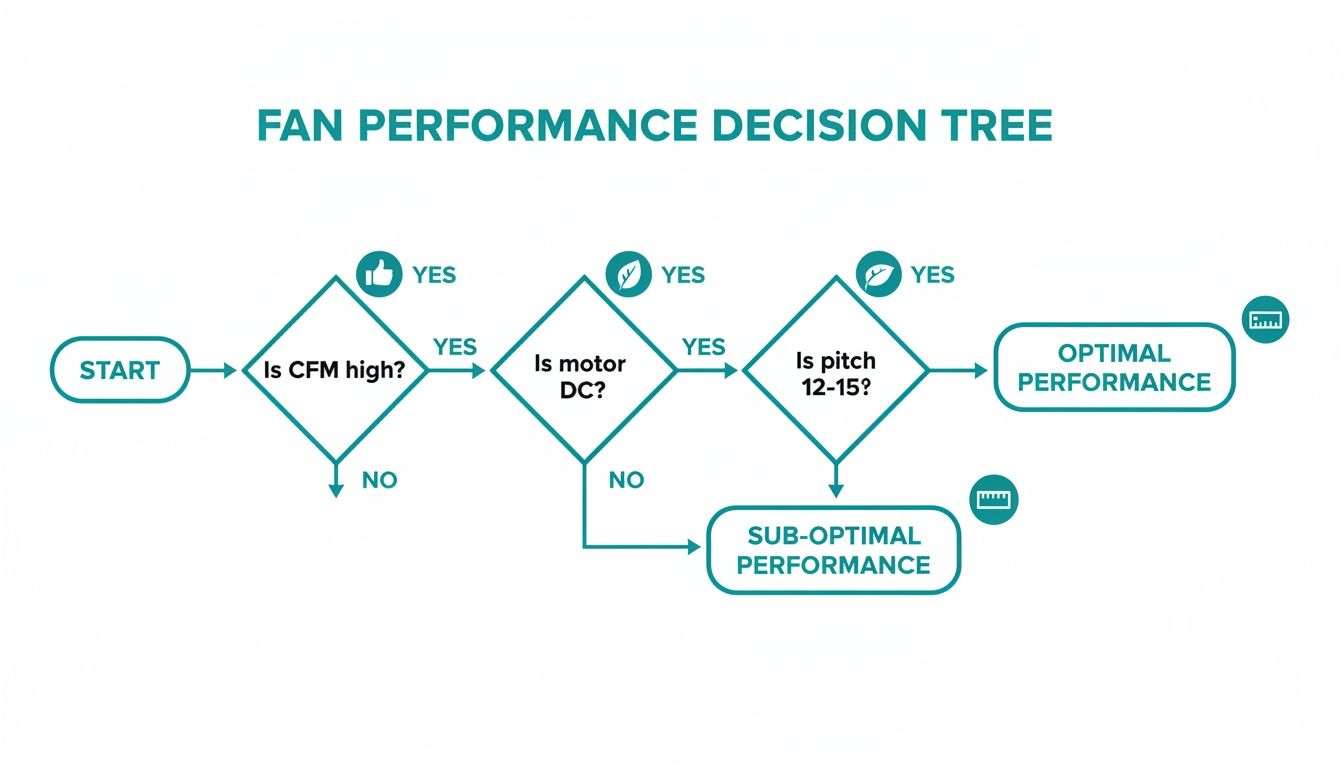
The best fans for big rooms nail all three of these: powerful airflow, a quiet and efficient motor, and blades angled just right to move air effectively.
Proper Placement for Balanced Airflow
Finally, where you actually hang the fan is just as important as its size and height. The golden rule for a single ceiling fan in a large living room is to mount it right in the center of the room. This gives you the most even, balanced air distribution, so you don't have one side of the room feeling breezy while the other is dead still.
Pro Tip: For those extra-long or L-shaped living rooms (think over 25 feet), don't hesitate to install two fans. This approach gives you far better coverage and comfort than a single, overworked fan ever could. Just make sure to space them out evenly to create their own distinct cooling zones.
By thinking through blade span, downrod length, and placement, you're setting yourself up for success. You can be confident that your new fan will deliver the powerful, room-filling breeze you're looking for.
Matching Your Fan to Your Style and Smart Home
Let's be honest, a ceiling fan is no longer just a utility. It's a statement piece, a central part of your living room's entire look and feel. The right fan is the perfect blend of form and function, an eye-catching fixture that complements your decor while moving some serious air. This is your chance to skip the boring, off-the-shelf models and choose something that truly elevates your space.
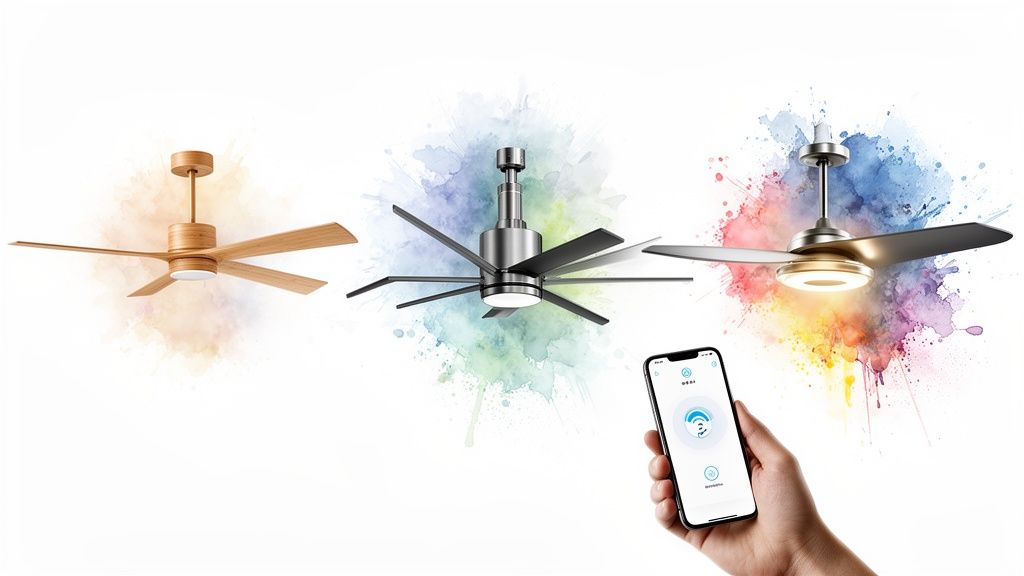
Think about the impact a great light fixture has over a dining table. A ceiling fan for a large living room carries that same weight. It can be the visual anchor that ties everything together, drawing the eye upward and making a real impression.
Finding a Fan That Fits Your Aesthetic
Your fan should feel like a natural extension of your personal style. Whether your home is modern and minimal, rustic and cozy, or somewhere in between, there’s a design out there that will feel like it was made for your room. The trick is to match the fan’s character to your existing decor.
Finding the right fan style can feel overwhelming, but it's really about matching the fan's personality to your room's. Here’s a quick guide to get you started on some of the most popular looks for spacious living areas.
Fan Style Guide for Large Living Rooms
| Fan Style (Example) | Key Characteristics | Best For This Decor Style |
|---|---|---|
| Modern/Minimalist (The Apex) | Sleek lines, fewer blades (often 3), neutral finishes like matte black, white, or brushed nickel. Understated and elegant. | Contemporary, Mid-Century Modern, Scandinavian, Industrial |
| Rustic/Farmhouse (The Andros) | Often features wood-look blades, cage-style lights, and finishes like bronze or galvanized metal. Feels warm and inviting. | Modern Farmhouse, Rustic, Coastal, Industrial Loft |
| Coastal/Tropical | Wider, leaf-shaped blades made from natural materials like palm or bamboo. Light and airy feel. | Coastal, Bohemian, Beach House, Transitional |
| Transitional | A blend of traditional and modern elements. Simple but sophisticated, with clean lines that aren't overly ornate. | A wide range of styles, from traditional to contemporary. A safe and versatile bet. |
This table is just a starting point. The best fan for you is one that you love looking at every day. You can also explore the latest ceiling fan design trends for even more ideas and inspiration.
Embrace Smart Home Integration
In a world where everything is connected, your ceiling fan shouldn't be left behind. High-end models, especially those over $300, have long moved past the classic pull chain. Smart features are now the gold standard for easy living.
Imagine adjusting the fan's speed and light from your couch with a remote—or better yet, with your phone. Many of our best fans come with dedicated apps that let you dial in every setting, create schedules, and even connect to voice assistants like Amazon Alexa or Google Assistant.
This isn't just a gimmick; it’s about creating a home that responds to you. Scheduling your fan to kick on just before you get home or telling Alexa to "turn the living room fan to medium" is the kind of everyday convenience that makes a real difference.
The Right Light for the Right Mood
Lighting is one of the most powerful tools for setting the atmosphere in your living room, and your fan can play a huge part. You'll generally choose between fans with built-in lights and those without. The right call really depends on your room's current lighting and the vibe you're going for.
-
Fans with Integrated Lights: These are a brilliant all-in-one solution, especially if your fan will be the main overhead light source. Look for models with dimmable LED kits. They’re incredibly energy-efficient and give you the flexibility to go from a soft, cozy glow for movie night to bright, clear light for entertaining.
-
Fans without Lights: If your living room already has plenty of light from recessed cans, lamps, and sconces, a fan without a light can offer a cleaner, more streamlined look. This minimalist approach puts all the focus on the fan’s design and lets your other light sources do the heavy lifting when it comes to mood.
At the end of the day, picking a fan is about inspiration. It's about finding that perfect model that’s as beautiful as it is powerful—one that doesn't just cool your large living room but truly completes its style.
Whisper-Quiet Comfort and Energy Savings
Okay, you've narrowed down the style. But let's talk about two factors that will make or break your long-term happiness with a new fan: how much it costs to run and how much noise it makes. A gorgeous fan is pretty useless if it's too loud to hear the TV over or it sends your energy bill through the roof.
The best ceiling fan for a large living room should add to your comfort, not take away from it. This is about more than just looks; it's about investing in a peaceful environment and making a smart financial choice. After all, a living room is for conversation, movie nights, and relaxing—a loud, whirring motor shouldn't be part of the soundtrack.
The Power of DC Motors
The secret to getting both silence and savings often comes down to the motor. Modern, high-end ceiling fans are powered by DC (Direct Current) motors, and they're a huge leap forward from the traditional AC (Alternating Current) motors in older, cheaper models.
Think of it as the difference between a loud, gas-guzzling engine and a sleek, silent electric car. A DC motor is a finely tuned machine built for top-tier performance and efficiency.
Key Insight: DC motors are up to 70% more energy-efficient than standard AC motors. That's a massive drop in power consumption, meaning a quality fan can actually pay for itself over time in lower electricity costs.
Beyond the incredible energy savings, DC motors are practically silent. They get rid of that annoying hum and mechanical noise that plagues lesser fans, so all you get is a gentle breeze in blissful quiet. You can learn more about their advantages in our guide to the best DC motor ceiling fans.
Look for the ENERGY STAR® Label
An easy shortcut to guarantee you're getting an efficient fan is to look for the ENERGY STAR® certification. This trusted, government-backed symbol means the fan meets strict energy efficiency guidelines set by the U.S. Environmental Protection Agency.
- Verified Performance: On average, ENERGY STAR® certified fans are 60% more efficient than conventional fan and light units.
- Superior Airflow: They're designed from the ground up to deliver exceptional airflow using minimal energy.
- Long-Term Savings: Choosing a certified model helps reduce greenhouse gas emissions and trims your utility bills month after month.
This label is your assurance that you're buying a product that's good for both your wallet and the planet.
While a powerful fan is your best friend for comfort and energy savings, it works even better as part of a whole-home strategy. For instance, it's also helpful to learn how to lower indoor heat and electric bills with things like proper window treatments. Combining strategies like these is what creates a truly efficient and comfortable living space.
By prioritizing a fan with a DC motor and an ENERGY STAR® rating, you’re not just buying another appliance. You're investing in a quiet, comfortable atmosphere and years of energy savings, making sure your living room remains the perfect retreat.
Installation and Maintenance Made Simple
You’ve found the perfect fan. Now it's time to get it up and running so you can start enjoying that wonderful breeze. A little bit of prep work and some simple, ongoing care will make all the difference, ensuring your fan runs smoothly and quietly for years to come.
Before you even think about opening the box, take a look at where the fan is going. The single most important check is making sure your ceiling's electrical box is fan-rated. A standard box made for a simple light fixture just can't handle the weight and constant motion of a fan. This isn't just a recommendation—it's a critical safety step.
Pre-Installation Checklist
Taking a few minutes to confirm these details will save you a ton of time and potential headaches later. It’s the key to making sure your ceiling fan for a large living room performs exactly as it should.
- Fan-Rated Electrical Box: Look for a stamp inside the junction box that says "Rated for Fan Support." If it's not there, you'll need to swap it out before you do anything else.
- Proper Wall Clearance: Make sure the fan blades will have at least 18-24 inches of breathing room from any walls or tall furniture.
- Sufficient Headroom: For safety and best airflow, the blades should be at least 7 feet off the floor. The sweet spot for performance is between 8 and 9 feet.
When to Call a Professional
While many fans are perfectly fine for a confident DIYer, some situations really are best left to a licensed electrician. Really big, heavy fans—especially those with blade spans over 72 inches—often require extra support and precision balancing that a pro can handle with ease.
The same goes for tricky installations on super high or steeply vaulted ceilings. If you're looking at a challenging setup, hiring an expert is the safest way to guarantee a stable, wobble-free fan. Often, installing a new fan is just one piece of a bigger project, like a simple living room remodel, where getting the details right is everything.
Simple Upkeep for Lasting Performance
Once your fan is installed, keeping it in great shape is a breeze. A few easy habits will keep it running quietly and efficiently through every season.
Maintenance Tip: Wiping down the fan blades does more than just get rid of dust. That buildup can actually throw the fan off balance over time, leading to those annoying wobbling or rattling noises.
Every so often, give the fan a quick once-over. Gently check the screws on the blades and housing to make sure nothing has loosened up from the vibration. And don't forget the winter switch! Reversing the fan to run clockwise on low speed during colder months is a game-changer. It gently pushes the warm air that's pooled at the ceiling back down into the room, making your living room feel cozier and helping you save a little on your heating bill.
Common Questions About Large Living Room Fans
Even after covering all the bases, a few questions always seem to come up. We've gathered the most common ones we hear from our customers to help clear up any lingering confusion and get you ready to pick the perfect fan.
Does a Fan with More Blades Move More Air?
Not always. While a fan with six or even eight blades can be a real showstopper, the real muscle behind airflow comes from the motor, blade pitch, and CFM rating. A well-engineered 3-blade fan with a powerful motor can easily outperform a 6-blade model that's all looks and no substance.
So, what's the point of more blades? It’s mostly about style and the feel of the breeze. More blades tend to create a quieter, more consistent airflow—a gentle hum of moving air. Fewer blades, on the other hand, can produce a more noticeable "chopping" sensation. The trick is to find the right balance between the performance you need and the look you love.
Can I Use an Outdoor Fan in My Living Room?
Absolutely! In fact, it's a fantastic idea. Outdoor-rated fans are built tough to handle moisture, wind, and whatever else Mother Nature throws at them. That extra durability makes them incredibly resilient and long-lasting when used indoors.
Plus, if your living room opens onto a patio or deck, using the same style of fan in both areas creates a beautifully seamless transition. It's a pro-level design move that really ties your indoor and outdoor spaces together.
What Should I Budget for a Quality Large Room Fan?
For a big living room—anything over 400 square feet—you can't afford to skimp on performance. We’ve seen it time and again: a cheaper fan just won't have the motor power or blade span to actually move air effectively across a large space. You end up with a fixture that looks the part but doesn't do the job.
We strongly recommend budgeting $300 or more for a quality fan. Once you hit that price point, you start seeing powerful and efficient DC motors, blade spans of 60 inches or more, premium finishes, and modern perks like remote controls and dimmable LED lights. It’s an investment in real comfort. For example, the stunning 84-inch Timber in a Koa finish (Sale Price: $399.99) combines massive airflow with a high-end designer look that becomes the centerpiece of any great room.
How Does a Fan Help Save Energy in Winter?
This is one of the best-kept secrets of ceiling fans. Most modern models have a reverse switch that makes them useful all year long. In the winter, just flip the switch to make the blades spin clockwise on a low speed.
Instead of creating a downdraft, this motion gently pulls cool air up. This pushes all that warm air that's naturally risen and pooled at the ceiling back down into the room where you can actually feel it. By circulating the heat you're already paying for, you can often turn your thermostat down a few degrees and trim your heating bills without even noticing a difference in warmth.
Ready to find the perfect fan that blends powerful performance with stunning design? At Fan Connection, we've curated a collection of premium ceiling fans designed to cool even the largest living rooms with style and efficiency. Explore our diverse range of high-CFM, whisper-quiet models today.


