











Your Ultimate Ceiling Fan Size Guide for Perfect Airflow
Getting the ceiling fan size right is easily the most important step in guaranteeing a comfortable breeze. It's a simple idea: a fan that’s too small will just spin its heart out without moving enough air, while a fan that's too big can turn your cozy bedroom into a wind tunnel of chaos. Don't worry, we're here to make sure you get it just right.
This guide kicks off with the number one rule: match the blade span to your room’s square footage. Let's make your home the cool sanctuary you deserve!
Find Your Perfect Fan Size in Seconds
That feeling of walking into a perfectly cool room isn't magic—it's just good planning. The first thing any ceiling fan guide will tell you is to connect the fan's blade span (the full diameter from the tip of one blade to the tip of the opposite one) to the size of your room. Nail this, and everything else, from airflow to energy savings, falls into place.
Getting this right from the start saves you a ton of frustration. We've all seen it: a tiny fan in a huge living room, working tirelessly but making zero difference. On the flip side, a massive fan in a small office can feel downright chaotic instead of calming. Think of this as your fan-finding cheat code.
Match Your Room to the Right Fan Span
The relationship between room size and fan diameter is a time-tested formula for great performance. Small spaces under 75 square feet, like a laundry room or home office, are perfectly suited for fans with 29 to 36-inch blade spans.
Move up to medium-sized rooms between 75 and 144 square feet—think bedrooms or kitchens—and you'll want a fan in the 36 to 42-inch range. For those big, open living rooms and great rooms over 144 square feet, a fan with a 52-inch span or larger is a must to get the air moving properly.
To make it even easier, we've put together a quick reference table.
Ceiling Fan Size Chart by Room Square Footage
Use this quick reference to match your room's dimensions with the recommended ceiling fan blade span for optimal air circulation and comfort.
| Room Size (Square Feet) | Recommended Fan Blade Span (Inches) |
|---|---|
| Up to 75 sq. ft. | 29" – 36" |
| 75 – 144 sq. ft. | 36" – 42" |
| 144 – 225 sq. ft. | 44" – 50" |
| 225 – 400 sq. ft. | 50" – 54" |
| Over 400 sq. ft. | 54" – 72" or larger |
This chart helps you instantly narrow down your choices to fans that will actually work for your space.
And if you're a visual person, this decision tree lays it all out for you, matching your room category to the ideal fan diameter.
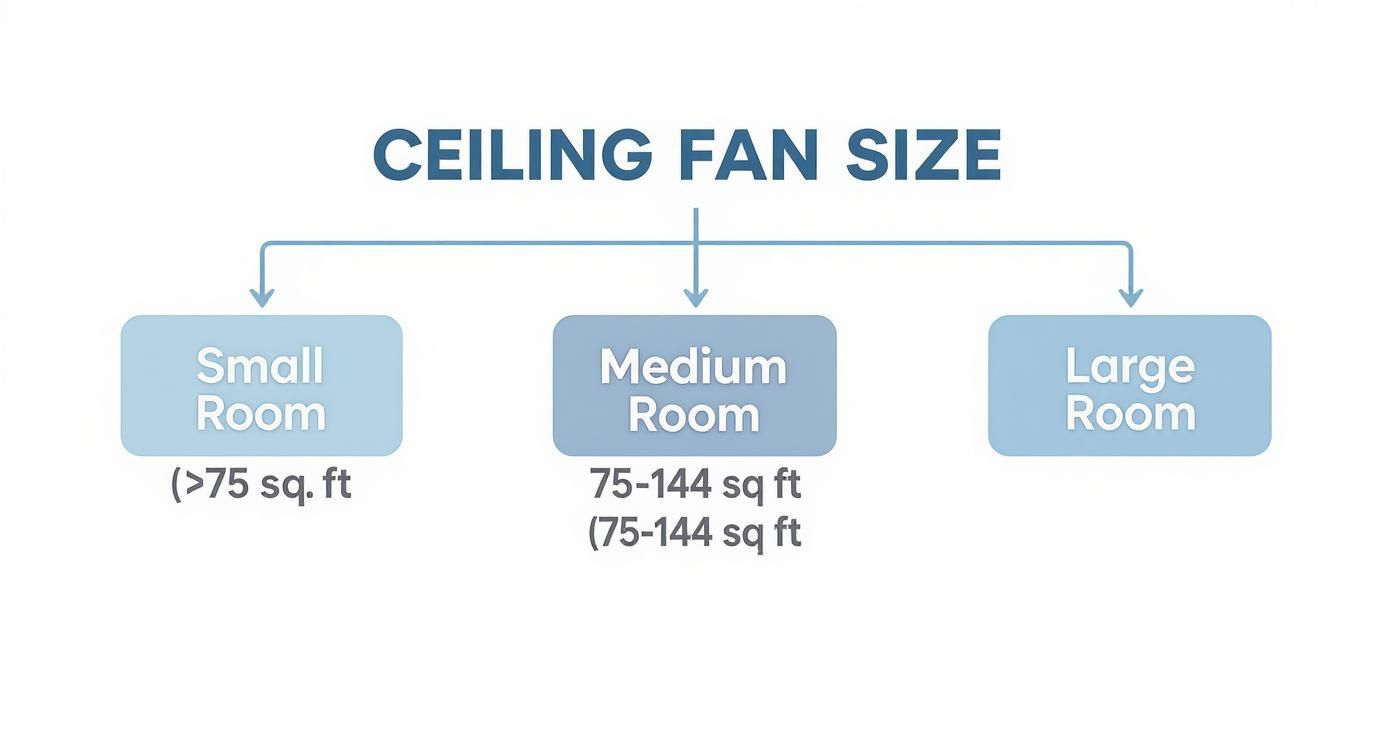
This simple chart confirms you're on the right track, making it easy to filter your search to the most effective and efficient options.
Key Takeaway: Blade span is your first and most important measurement. It sets the stage for comfort, efficiency, and style, ensuring the fan you choose is perfectly suited to its environment.
Now that you have a solid idea of the size you need, you’re ready to look at the other details that make a fan great. For a deeper dive into all the things you should consider, check out our complete ceiling fan buying guide. With the right foundation, you can confidently pick a fan that not only looks fantastic but also delivers that perfect breeze.
How to Properly Measure Your Space
Before you even start browsing for fans, you have to get to know your room. Think of it like a tailor taking measurements for a custom suit—getting the numbers right is the first step to a perfect fit. It's surprisingly simple, and it all boils down to two key dimensions: your room's square footage and its ceiling height.
These two numbers work together to create the perfect conditions for airflow. The square footage tells you how much ground the fan needs to cover, while the ceiling height determines the ideal hanging distance for proper air circulation. Nailing both ensures your fan won't just look good; it'll actually feel good, too.
Calculating Your Room's Square Footage
First up is square footage. For most rooms, this is a breeze. Just grab a tape measure and follow these simple steps:
- Measure the Length: Run your tape measure along the longest wall of the room, from one corner to the other. Let's say it's 18 feet.
- Measure the Width: Now, do the same for the shorter wall. We'll pretend this one is 12 feet.
- Multiply Length by Width: Simply multiply your two numbers together. In our example, that's 18 feet x 12 feet = 216 square feet.
Just like that, you know your room is 216 sq. ft. A quick look at a fan sizing guide shows this puts you squarely in the market for a fan with a 44" to 50" blade span.
What if your room is an odd L-shape? No problem. Just split the space into two separate rectangles, calculate the square footage for each one, and then add them together for your grand total.
Measuring Your Ceiling Height
The second critical measurement is your ceiling height. This one's even easier—just measure from the floor straight up to the ceiling. So, why does this matter so much? It’s all about safety and performance.
For optimal air circulation and safety, the fan blades should always hang between 7 and 9 feet above the floor. This is the "sweet spot" that gives you plenty of headroom while allowing the fan to move air effectively through the room, instead of just trapping it up high.
A standard 8-foot ceiling will work just fine with most fans using a standard mount. But if your ceilings are higher, you'll need a longer downrod to lower the fan into that ideal 7-9 foot zone. A fan hung way too high in a room with a vaulted ceiling is one of the most common mistakes we see; it might look great, but it does very little to actually cool the living space below.
For a room with standard 8-9 foot ceilings that needs a touch of modern elegance, the Minka-Aire Artemis IV is a stunning choice. Priced at over $600, its sleek, sculpted design and powerful motor make it a worthy centerpiece that delivers exceptional airflow right out of the box. Getting your measurements right ensures a premium fan like this can perform at its absolute peak.
Why Airflow CFM Is More Important Than Size
While picking a fan based on its blade span is a great place to start, it's only half the story. Think of blade span as the fan's footprint, but its real power—its engine—is measured in CFM, or Cubic Feet per Minute. This single number tells you how much air a fan actually moves, and it’s the secret behind that refreshing, room-cooling breeze.
Choosing a fan on size alone is a bit like buying a car just because it's long, without ever checking what's under the hood. You can have two 52-inch fans side-by-side, but they might perform in completely different leagues. One might create a gentle stir, while the other delivers a powerful gust. That difference is all about the CFM.
A higher CFM rating is what creates that "wind chill" effect, making a room feel several degrees cooler without actually changing the thermostat. This is where you can really feel the difference a high-quality fan makes. A well-built motor and aerodynamically designed blades work together to maximize airflow, turning raw power into quiet, efficient comfort.

Decoding Fan Performance The CFM Number
So, what does CFM mean for you in practice? A fan with a CFM of 5,000 will move 5,000 cubic feet of air every single minute it's running. Simply put, the higher the number, the more powerful the breeze. It's the truest indicator of a fan's ability to cool your space.
Let’s look at a real-world example. The Fanimation Chisel, a beautifully crafted fan priced over $450, delivers an impressive CFM rating. Its powerful motor and expertly pitched blades don't just spin—they grab air and push it downward with purpose. This is exactly why it can cool a large room far more effectively than a generic fan of the same size with a weak motor and flat, inefficient blades.
Key Insight: Don't get stuck on blade span. Always look for the CFM rating. For a medium to large room, a CFM of 4,000 to 6,000 is a great target for powerful, satisfying airflow.
When you invest in a premium fan, you're paying for that superior engineering—the kind that translates directly into a higher CFM and a more comfortable living space.
More Than Just Power Efficiency Matters Too
A high CFM is fantastic, but what about the energy it takes to generate that breeze? This is where another important metric comes in: airflow efficiency, measured in CFM per Watt. This number tells you how much airflow you get for every single watt of electricity used. A higher CFM per Watt means you're getting more breeze for your buck, leading to lower energy bills.
Think of it like a car's miles per gallon. Two cars might have powerful engines, but the one with better MPG is cheaper to run. It's the same with fans. A fan with high airflow efficiency delivers a strong breeze without a big hit to your electricity bill.
- High Power, Low Efficiency: Some fans deliver a high CFM but guzzle a lot of energy to do it.
- High Power, High Efficiency: This is the sweet spot. The ideal fan gives you a powerful breeze while sipping electricity, which is the hallmark of a well-designed motor and blade system.
As you explore your options, it's clear that the demand for fans that blend performance, energy savings, and smart features is growing. You can see how advanced models are driving this trend on industryresearch.biz.
Understanding the relationship between CFM and efficiency helps you make a smarter choice. To dig deeper into how design impacts performance, you can read our article about the impact of fan blade count and fan efficiency. This knowledge lets you look beyond simple dimensions to select a fan that will deliver whisper-quiet, powerful, and cost-effective comfort for years.
Matching Your Fan to Your Ceiling Height
Once you've figured out your room's square footage and have a fan size in mind, there's one more crucial piece to the puzzle: your ceiling height. Think of it this way: your fan is the star performer, and the ceiling is the stage. If the star is too high up, the audience below won't get the full experience. The height of your ceiling directly impacts how your fan needs to be mounted to give you that perfect, refreshing breeze.
The goal is always to hang the fan so the blades are between 7 and 9 feet from the floor. This is the sweet spot for both air circulation and safety. If a fan is hung too high, it just stirs the air way up by the ceiling, leaving you warm and wondering if it's even on. A fan hung too low is a safety hazard and can create an uncomfortably turbulent downdraft.
Solutions for Low Ceilings
Got a room with ceilings under 8 feet? It's a common challenge, but an easy one to solve. For these cozier spaces, you’ll want to look for a flush mount or "hugger" fan. These models are designed to install directly against the ceiling, getting rid of the gap you'd normally see with a downrod.
This sleek, low-profile design maximizes headroom, so you can enjoy a gentle breeze without ducking. And you don't have to compromise on style, either.
Take the Minka-Aire Concept II, for example. It’s a beautifully minimalist hugger fan, often priced over $400, that delivers excellent airflow in a compact package. It's proof that you can have both form and function, even when ceilings are on the lower side.
Standard Ceilings Made Simple
For the most common ceiling heights—those between 8 and 9 feet—things are refreshingly straightforward. The short downrod that comes with most fans, usually 3 to 6 inches long, is almost always the perfect length. This standard setup puts the fan right in that 7-to-9-foot sweet spot right out of the box.
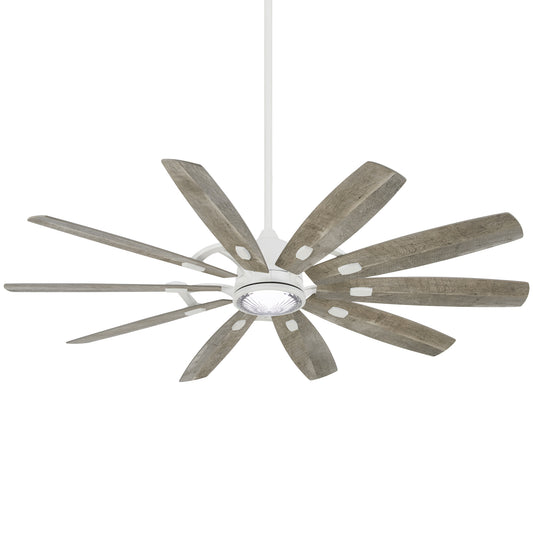
This is where you have the most freedom to play with style. You can go for the rustic charm of a fan like the Fanimation Barn or the modern, sculpted lines of the Minka-Aire Artemis IV. Both of these premium fans, priced well over $500, are ready to install in standard-height rooms and deliver immediate comfort with a serious design punch.
Mastering High and Vaulted Ceilings
Now, this is where the real magic happens. Soaring ceilings in a great room or a grand entryway demand a fan that can be brought down to where people actually live. A fan mounted flush to a 15-foot ceiling is practically useless. This is where the downrod becomes your most important accessory.
A longer downrod lowers the fan into that optimal airflow zone, ensuring the breeze reaches you on the sofa—not just the cobwebs in the corners. Picking the right length is just a matter of simple math.
The Rule of Thumb: For every foot of ceiling height over 9 feet, add one foot to your downrod length. A 12-foot ceiling, for instance, calls for a 3-foot (36-inch) downrod.
This simple formula ensures your fan hangs at the ideal 9-foot height from the floor. For a more detailed breakdown and a handy chart, our guide on how to choose the perfect downrod for your fan has everything you need to know.
For truly grand spaces, you need a fan that makes an equally grand statement. The Fanimation Andros, with its impressive blade span, is a stunning choice. When paired with the correct downrod, this fan (often priced over $800) becomes a breathtaking centerpiece that delivers powerful, room-filling circulation, turning a vast open space into a comfortable, inviting environment.
Sizing Fans for Great Rooms and Outdoor Patios
The usual rules of thumb for ceiling fans tend to go right out the window when you’re dealing with a grand, open-concept great room or a sprawling outdoor patio. In these big, airy spaces, a single, average-sized fan just doesn't have the muscle to get the job done. You need a better game plan, and it usually comes down to choosing between one massive, statement-making fan or a pair of perfectly placed smaller ones.
Think about it: trying to cool a 450-square-foot great room with a standard 52-inch fan is like trying to water an entire garden with a tiny watering can. It just won't reach every corner, leaving some spots feeling stuffy while others get all the breeze. This is where you have to think bigger.
One Large Fan Versus Two Smaller Fans
Your first big decision for a large space is whether to install a single, oversized fan or a multi-fan setup. There's no one "right" answer here—it really depends on your room's layout and how you actually live in it.
- The Single Giant: A huge fan with a blade span of 60 inches or more can be a stunning architectural centerpiece. This approach works best in large, square-shaped rooms where the fan can be centered to command the space and push down a massive, even column of air.
- The Dynamic Duo: For long, rectangular rooms or spaces with distinct zones—like a combined living and dining area—using two properly sized fans is often the smarter move. This creates overlapping zones of comfort, making sure no one gets left out of the breeze.
If you go with two fans, placement is everything. A good rule is to mentally divide the room's length in half and center one fan in each section. Just as important, make sure you leave at least 3 to 5 feet of space between the blade tips of the two fans. This prevents them from fighting each other and creating weird, disruptive air turbulence.
Taking Comfort Outdoors Patios and Porches
Bringing your living space outdoors to a patio or covered porch is one of life’s simple pleasures, but an indoor fan is absolutely not built for the job. Outdoor environments throw humidity, moisture, and wild temperature swings at a fan, which can corrode the motor and warp the blades of a standard model. It’s not just an expensive mistake; it’s a serious safety hazard.
This is exactly why outdoor fans come with specific UL ratings to certify they can handle the elements. Understanding the difference is non-negotiable for a safe, long-lasting installation.
Critical Distinction: Always, always check the UL rating. A fan must be labeled as either "Damp-Rated" or "Wet-Rated" to be installed outdoors. Using an indoor-rated fan outside is a surefire way to void its warranty and risk electrical failure.
- Damp-Rated Fans: These are your go-to for covered outdoor spaces, like a screened-in porch or a patio with a solid roof. They’re built to withstand humidity and ambient moisture but aren't designed to be hit directly by rain.
- Wet-Rated Fans: If your fan is going into an open pergola, a gazebo, or any area where it could get soaked by rain or snow, it must be Wet-Rated. These fans are the real workhorses, with waterproof motor casings and all-weather blades made to endure direct contact with the elements.
The growing desire for high-quality outdoor cooling solutions is a huge driver in the ceiling fan market's expansion, which was valued at around USD 11.39 billion in 2024 and is projected to keep growing. It’s all part of a larger trend of homeowners investing in energy-efficient products to make their living spaces better, both inside and out. You can read more about these market trends on fortunebusinessinsights.com.
For a truly stunning outdoor solution that will last, take a look at the Fanimation Odyn. Often priced over $900, this Wet-Rated fan has an epic 84-inch blade span and a tough DC motor to match. It's designed to deliver a powerful, refreshing breeze while standing up to whatever Mother Nature throws at it, turning your patio into the comfortable, stylish oasis it was meant to be.
Common Ceiling Fan Sizing Questions Answered
Even after you've measured your room and crunched the airflow numbers, a few last-minute questions always seem to pop up. We get it. Making that final decision can feel like a big step, so we've gathered the most common questions our experts hear every day.
Think of this as your final checklist. We're here to clear up any lingering doubts so you can choose your new fan with total confidence, knowing you've found the perfect blend of style and comfort for your home.

Does the Number of Blades Really Matter?
It’s an easy assumption to make: more blades must equal more air, right? Surprisingly, that’s not really the case. A fan’s cooling power has much more to do with its motor and the pitch of its blades than the sheer number of them. A well-engineered three-blade fan with a powerful motor can easily outperform a generic five-blade model with flat blades and a weak motor.
These days, the number of blades is mostly about aesthetics.
- Fewer Blades (3-4): This often gives a room a sleek, modern, or even industrial vibe. With less drag on the motor, they can sometimes be a bit more efficient, too.
- More Blades (5+): Fans with five or more blades tend to look more traditional or classic. They can also create a smoother, less "choppy" airflow that many people find more pleasant and quiet.
The most important number to focus on is always the CFM rating. It's the true measure of performance. Our premium collections feature stunning designs with various blade counts, all optimized for superior airflow.
Should I Use Two Fans in a Large Room?
For very large, long, or L-shaped rooms—anything over 400 square feet—two fans are almost always a better solution than one giant one. It’s all about creating dedicated “comfort zones” and ensuring consistent air circulation throughout the entire space. Think of an open-concept room with a seating area and a dining area; placing a fan over each zone just makes sense.
To get it right, mentally divide the room’s length in half and center a fan in each new section. Just be sure to choose fans that are sized for their zone, not for the entire room. It’s also critical to leave at least 3-5 feet of clearance between the blade tips of the two fans. This prevents them from creating weird air turbulence and working against each other.
What Does a Dual Mount Fan Mean?
When you see a fan labeled as "dual mount," you’re looking at a super versatile design that gives you two installation options right in the box. It means you can install the fan in one of two ways:
- With the included downrod for standard or high ceilings.
- As a "hugger" or flush mount directly against the ceiling, which is perfect for rooms with lower ceilings (around 8 feet).
This adaptability makes a dual-mount fan a smart, future-proof choice. If you move, the fan can easily be re-installed in a new room with a different ceiling height. Many of our premium fans, like the elegant Minka-Aire Light Wave, are dual-mount models often priced over $350. They offer that perfect combination of high-end style and practical flexibility to fit just about anywhere.
How Much Space Do I Need From the Wall?
For a fan to work quietly and efficiently, its blades need room to breathe. The industry standard is to have at least 18 to 24 inches of space between the tip of a blade and the nearest wall or obstruction.
This clearance is non-negotiable. It allows the fan to pull in air from all sides to create a smooth, powerful downdraft. If it’s too close to a wall, the airflow becomes choppy and turbulent, and you’ll likely hear an annoying thumping sound as the blades pass by. While centering the fan usually takes care of this, it’s a critical measurement to double-check, especially in narrow rooms.
A quick way to check is to make sure the distance from the center of the fan to the nearest wall is at least 18 inches more than the length of a single blade (which is just half the fan's total blade span).
Ready to find the perfect fan for your space? Explore our curated collections at Fan Connection and discover a wide range of stylish, high-performance ceiling fans designed to deliver comfort and elegance to any room. Visit our store to find your perfect match today at https://www.fanandlights.com.


