











Choosing the Right Downrod For Fan
You’ve probably never given it much thought, but that simple metal pipe connecting your ceiling fan to the ceiling is one of the most important parts of the whole setup. That pipe is called a downrod, and getting its length right is the secret to unlocking your fan's best performance. Think of it as the unsung hero of your home's comfort!
This isn't just about looks, though a well-placed fan is a beautiful thing. The right downrod ensures your fan hangs at the perfect height for powerful, efficient airflow and rock-solid stability. Get this simple component wrong, and you're left with a wobbly, ineffective fan that barely stirs the air. Get it right, and you completely transform your room’s comfort from "meh" to "ahhh."
Why Your Fan's Downrod Is More Than Just a Pole
Think of a downrod as the command center for your fan's performance. A proper downrod for fan installation ensures that air is pulled from above and pushed down and out, creating that cooling breeze you're looking for. It’s not just about feeling cooler; it’s about making sure your fan can actually do the job it was engineered for, turning your investment into a true powerhouse of comfort.
The Unsung Hero of Air Circulation
When a fan is mounted too close to a tall ceiling, its airflow can get trapped up high and dissipate before ever reaching you. It's a sad, lonely existence for a fan that was born to move air! A downrod solves this problem by bringing the fan down into the "living space" of the room—usually 8 to 9 feet from the floor—where it can move air effectively. This one adjustment can be the difference between a gentle stir and a truly refreshing breeze.
For more tips on getting the most out of your fan, check out our guide on creative ceiling fan placement ideas.
The global ceiling fan market is booming, valued at around USD 14.24 billion in 2023 and expected to hit nearly USD 19.92 billion by 2030. A huge chunk of these fans—69.56% to be exact—are installed in homes, where ceiling heights vary dramatically. That’s a lot of fans needing the right downrod to work properly.
Elevating Premium Fan Performance
For higher-end fans, especially those statement pieces costing over $300, the downrod is absolutely non-negotiable. These are high-performance machines, and a proper downrod is essential to unleashing their full potential. It gives them the stability needed for larger blades and more powerful motors to operate smoothly and without a hint of wobble.
A correctly chosen downrod does more than just hang a fan; it secures your investment, ensures safety, and guarantees that your high-end fan delivers the powerful, silent performance it was designed for.
Ultimately, this often-overlooked accessory is the unsung hero of your room's climate. It turns a functional appliance into a centerpiece of both style and comfort.
Calculating the Perfect Downrod Length
Alright, let's get down to the nitty-gritty. Figuring out the right downrod for fan installation isn’t just a guessing game. There’s a bit of simple math involved, but it’s what separates a perfectly placed, effective fan from one that’s just… there. Getting it right ensures your fan is safe, looks great, and actually moves air the way it’s supposed to.
Think of this as the golden rule of ceiling fans: the blades need to hang at least 7 feet from the floor. That’s a non-negotiable safety standard to keep heads and hands clear. But for pure comfort, the sweet spot is getting those blades between 8 to 9 feet off the ground. That’s the ideal zone for creating a gentle, room-filling breeze instead of an annoying downdraft.
The Simple Formula for Downrod Sizing
So, how do you hit that 8 to 9-foot sweet spot? All you need is a tape measure and some basic subtraction. First, measure your ceiling height from the floor up.
Got that number? Now just follow these quick steps:
- Start with your ceiling height. Let’s say you have a 12-foot ceiling.
- Subtract your ideal fan height. We'll aim for 9 feet to maximize airflow (12 ft - 9 ft = 3 ft).
- Subtract the fan's motor housing height. This is the part of the fan from the very top to where the blades attach. Most are about a foot tall. So, 3 ft - 1 ft = 2 ft.
Boom. In this case, you’d need a 2-foot, or 24-inch, downrod. This simple calculation guarantees your fan is positioned perfectly to do its job and looks like it truly belongs in the space.
This handy visual breaks down whether you need a short or long downrod based on your ceiling height.
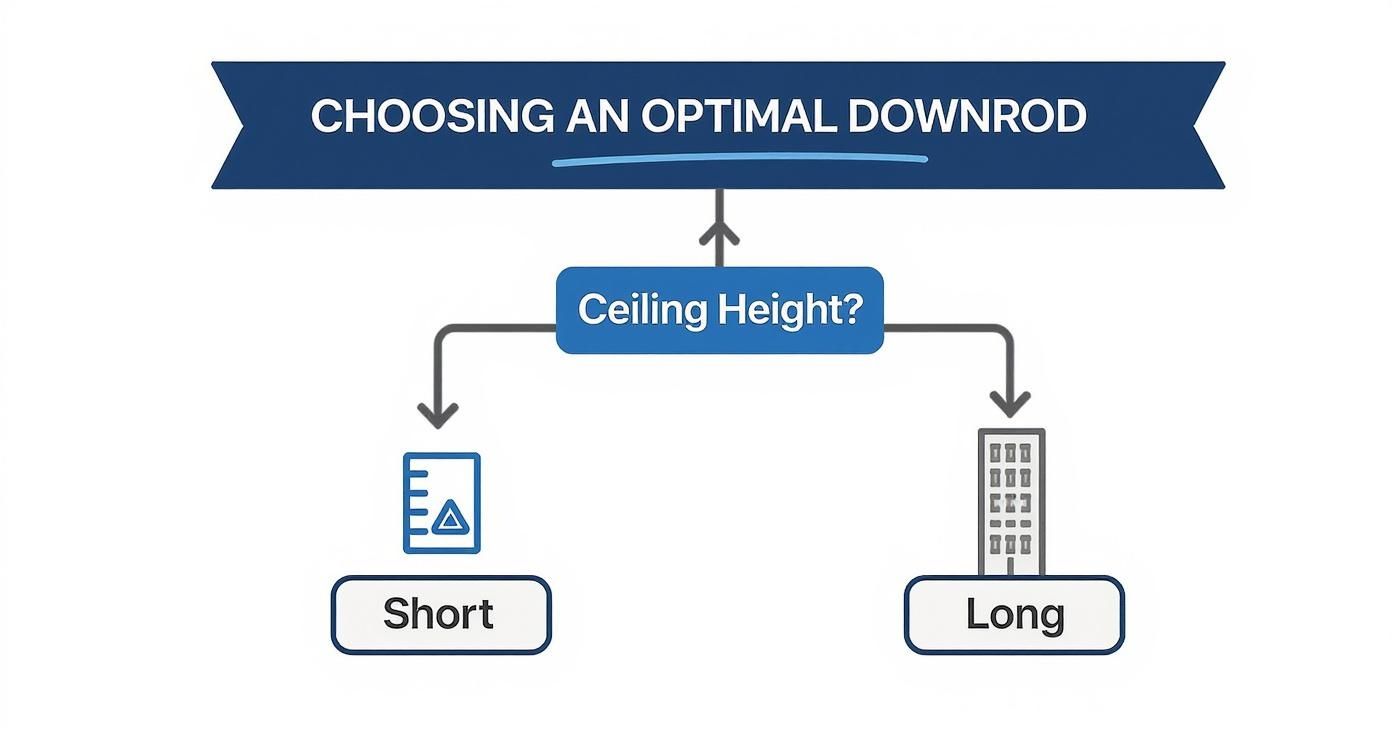
As you can see, once you get above a standard 9-foot ceiling, a longer downrod becomes essential to drop the fan down into that optimal airflow zone.
Downrod Selection for Different Ceiling Heights
To make things even easier, we've put together a quick reference table. Just find your ceiling height, and you'll see our recommended downrod length to get those blades right where they need to be.
| Ceiling Height | Ideal Fan Blade Height from Floor | Required Downrod Length (Inches) | Example Room Type |
|---|---|---|---|
| 9 ft | 8 ft | 6" | Standard Bedroom |
| 10 ft | 8-9 ft | 12" | Living Room |
| 11 ft | 9 ft | 18" | Great Room |
| 12 ft | 9 ft | 24" | Loft Space |
| 13 ft | 9-10 ft | 36" | Vaulted Ceiling |
| 14 ft | 10 ft | 48" | Two-Story Entryway |
| 15 ft | 10-11 ft | 60" | Commercial Space |
| 16 ft | 11-12 ft | 72" | Grand Foyer |
This table covers most common scenarios, helping you pick the right downrod with confidence, from a cozy bedroom to a soaring great room.
Aesthetics and High-End Fans
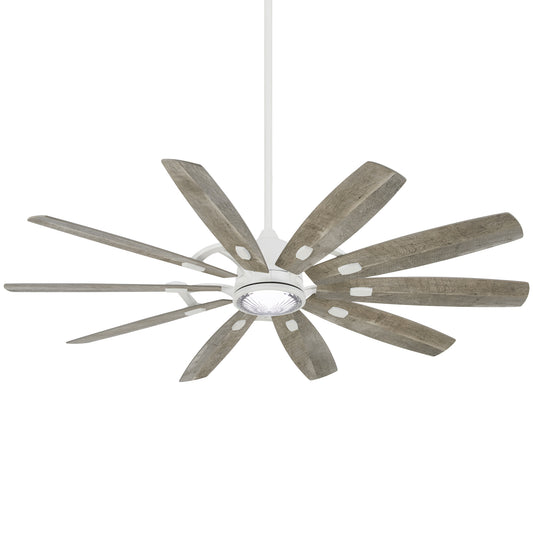
Beyond pure function, the right downrod length plays a huge role in the room's visual harmony. Think about it—for a premium fan like the stunning Kichler Terna, a unique vortex-inspired design that retails for over $500, the downrod isn't just a piece of hardware. It frames the fixture, turning it into a deliberate centerpiece.
A fan hung too high on a tall ceiling looks lost and disconnected. One that’s too low feels awkward and oppressive.
The perfect downrod length creates a sense of balance, making your fan look like it was designed specifically for your space. It’s the final touch that elevates the entire room's design.
When you invest in a quality fan, you're buying a piece of functional art. Hanging it correctly with the proper downrod is how you protect that investment and ensure it performs as beautifully as it looks. For more tips on the installation itself, check out our guide on how to install a ceiling fan.
Getting to Know Your Downrod: Materials and Finishes
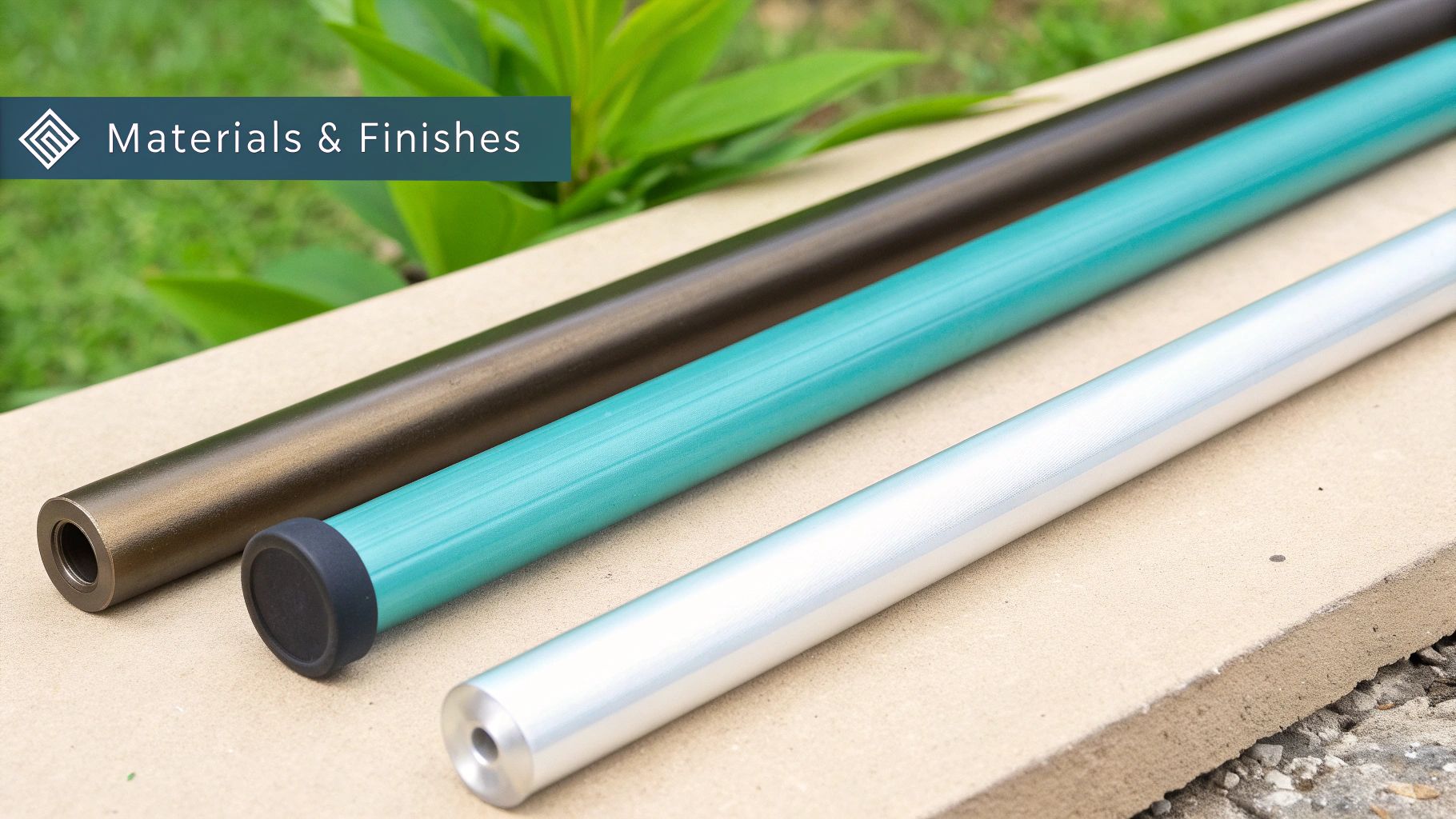
Okay, you've figured out the perfect length. Now comes the fun part—the details that take a simple downrod for fan from a piece of hardware to a polished design feature. A downrod isn't just about getting the height right; its material, diameter, and finish are what guarantee stability, longevity, and a look that clicks with your space.
Think of it like choosing the right frame for a beautiful painting. It has to be sturdy enough to support the art but also has to complement it. Picking the right materials and finish ensures your fan works perfectly and looks like it was made for the room.
Material Strength and Stability
The unsung hero of a solid, wobble-free fan is the downrod’s material. You’ll mostly run into two options: steel and aluminum. Each has its own strengths.
- Steel: This is the heavyweight champ. Known for its incredible strength and stiffness, a steel downrod is the only real choice for bigger, heavier fans. It can handle the torque from powerful motors and the weight of long blades without a hint of bending or vibrating.
- Aluminum: Lightweight but still surprisingly strong, aluminum is perfect for most standard-sized fans. It’s also naturally rust-resistant, making it a great pick for damp locations or covered patios where moisture is a factor.
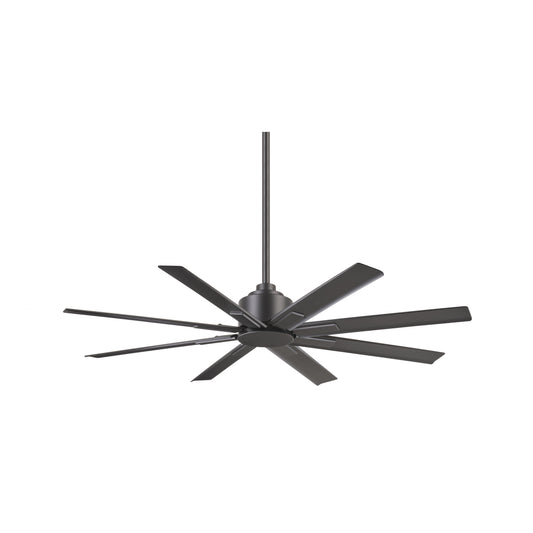
For a premium fan like the sleek and powerful Fanimation Zonix, which sells for well over $400, a heavy-duty steel downrod is non-negotiable. That extra strength is what ensures the fan stays perfectly balanced, delivering smooth, silent power.
Why Downrod Diameter Matters
It’s not just about what it’s made of—the diameter of the downrod is a huge deal. You’ll typically see two standard sizes: 1/2-inch and 3/4-inch. That quarter-inch difference might not sound like much, but trust me, it’s critical.
The 3/4-inch diameter is pretty much the industry standard for most quality modern fans. This wider gauge gives it far more rigidity, which is essential for longer downrods (anything over 24 inches) and heavier fans. It’s what stops that annoying swaying and wobbling that can happen when you have a longer drop. The 1/2-inch downrods, on the other hand, are usually for smaller, lighter, or older fan models.
Always, always check your fan’s specs. Using an undersized downrod is a classic mistake that leads to a wobbly fan and puts a ton of stress on the motor and mounting hardware.
The Art of the Perfect Finish
Finally, let’s talk looks. Nothing ruins the vibe of a beautiful fan faster than a mismatched downrod. It just makes the whole thing look like an afterthought.
Thankfully, manufacturers offer downrods in a whole spectrum of finishes—Brushed Nickel, Matte Black, Polished Brass, Oil-Rubbed Bronze, you name it—all designed to perfectly match their fan housings. Getting this right is about more than just matching the color; it's about the texture and sheen, too.
A perfectly coordinated downrod for fan creates a clean, unbroken line from the ceiling to the fan, making the entire fixture feel more elegant and intentional. It’s that little bit of attention to detail that turns your fan from a simple appliance into a sophisticated part of your room’s design.
Solutions for Sloped Ceilings and High Vaults
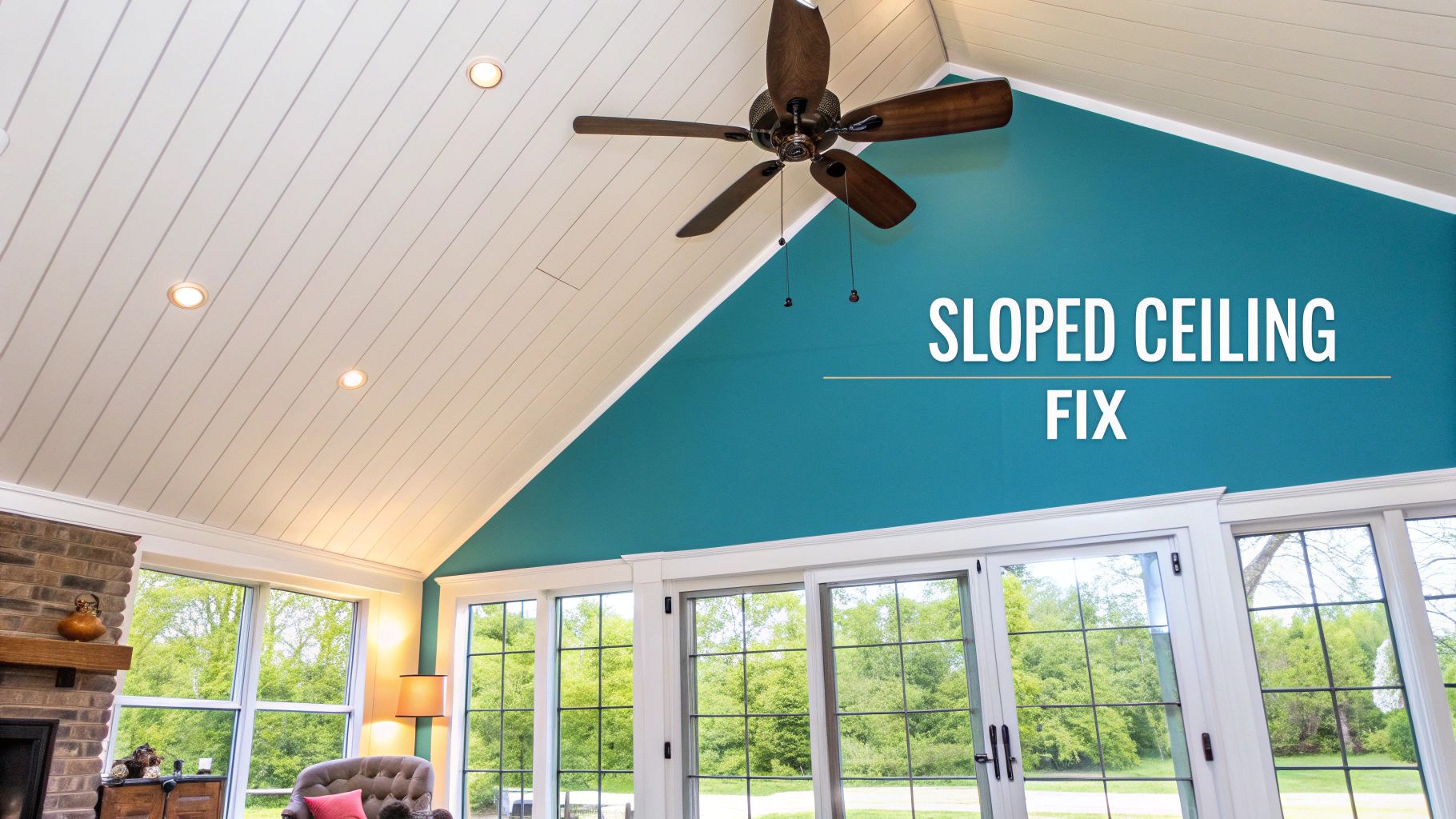
So, what happens when your ceiling decides to throw you a curveball? Not every room is a perfect box. Architectural features like vaulted or sloped ceilings add incredible character but can make installing a fan a real head-scratcher. A standard mount just won't cut it here.
This is where a downrod for fan becomes your most valuable player, working alongside specialized hardware to tame those tricky angles. If you try to mount a fan directly on a slope, the blades risk smacking the ceiling on their upward swing—a noisy and dangerous problem. The solution is a sloped ceiling adapter.
The Sloped Ceiling Adapter
This clever piece of hardware, sometimes called an angled mount adapter, attaches to the outlet box and allows the downrod to hang perfectly straight, even when the ceiling itself is tilted.
Most high-quality fans and their included mounting gear can handle a slight slope on their own, usually up to 15-20 degrees. But for steeper pitches, a dedicated adapter is non-negotiable. It creates a stable, level pivot point for the fan to hang from, ensuring it operates smoothly and safely.
Of course, the downrod's length is also a huge factor here. A longer downrod gives you more breathing room between the blades and the angled ceiling.
- Prevents Blade-Strike: It drops the fan far enough down that the blades can rotate freely without hitting the higher side of the slope.
- Ensures Stability: By allowing the fan to hang level, it stops the off-balance motion that causes wobble and puts extra strain on the motor.
- Improves Airflow: It gets the fan down into the room's living space, not trapped up in the peak of the vault where it can't do much good.
Tackling Exceptionally High Ceilings
For those soaring two-story great rooms or grand entryways, even the longest single downrod might not be enough. In these cases, a downrod coupler is the part you need. It’s a small but strong threaded connector designed to securely join two downrods together, letting you achieve the perfect hanging height.
A word of caution is necessary here. When you start connecting multiple downrods, you’re dealing with significant length and leverage.
Using manufacturer-approved accessories is non-negotiable, especially with premium fans. A mismatched coupler or adapter can compromise the entire installation, leading to instability, voided warranties, or even catastrophic failure.
For a high-performance model like the Minka-Aire Aviation, which often retails for over $400, sticking to branded accessories guarantees a perfect fit and a secure installation. It's just not worth risking a high-end investment with a generic part from the hardware store. Always protect your fan by using the parts designed specifically for it.
Matching the Downrod to Your Fan Model
Think of a downrod like a key for a lock—if it’s not the right one, it simply won’t work. A generic, “universal” downrod might seem like a good idea, but it's often a recipe for disaster, especially when you've invested in a quality fan.
When you've got a premium fan costing over $300, like the sleek Minka-Aire Chisel model, using anything but a perfectly compatible downrod is just asking for trouble. It's not just a recommendation; it's essential for protecting your fan and ensuring it runs smoothly for years.
Using a mismatched part can kick off a whole host of problems. You might find the threading doesn't quite line up, the pinholes are off by a millimeter, or the wiring channel is too tight. Any one of these issues can lead to an unstable, wobbly installation, dangerous electrical shorts, or an instantly voided warranty.
The Technical Details That Matter
Every fan manufacturer has specific engineering standards for their products. These details are what guarantee a secure, balanced, and safe fan. It's not just about looks—it's about function.
Here’s what you need to pay close attention to when choosing a downrod for fan installation:
- Threading Type: The screw threads at the top of the downrod have to match the threads in the fan's motor housing perfectly. A poor fit is the number one cause of wobbling and puts unnecessary strain on the motor.
- Diameter and Pin Holes: The downrod's diameter must fit snugly into the fan's yoke. The pre-drilled holes for the set pin and cotter pin have to align flawlessly to create a secure, locked-in connection.
- Wiring Pathways: High-quality, manufacturer-specific downrods are designed with plenty of room to safely pass the fan's wiring through. You don't want pinched or damaged wires.
A mismatched downrod is the most common cause of a wobbly fan. Always choose a downrod from the same manufacturer as your fan to guarantee a flawless fit, secure installation, and a cohesive finish.
With the residential sector making up about 65% of all ceiling fan demand, there's a huge focus on getting these details right. We're seeing a big trend toward models with integrated LED lights, which often rely on specific downrod mounts to position the light just right for both airflow and illumination.
Need to go even longer? For those exceptionally high ceilings, it's vital to use accessories designed specifically for your fan. If you need to connect two downrods, our approved Minka downrod couplers are engineered to ensure a safe and stable extension. Sticking with branded components is the only way to be certain every part works together just as the manufacturer intended.
Answering Your Top Downrod Questions
Even after you've got the basics down, a few tricky questions always seem to pop up when it's time to actually pick out and install a downrod for fan setups. We've heard them all, so we rounded up the most common ones to give you clear, straightforward answers.
Think of this as your go-to guide for dodging those last-minute hiccups. Getting these final details right is what separates a good fan installation from a great one—safe, steady, and perfectly centered in your room.
Can I Cut a Fan Downrod If It Is Too Long?
This is probably the number one question we get, and the answer is a hard no. It might seem like a simple shortcut, but cutting a downrod is a really bad idea for a few critical reasons.
For starters, you can kiss your manufacturer's warranty goodbye the second you cut it. But more importantly, it's a huge safety risk. The cut end will have sharp, rough edges that can easily slice into the fan's internal wiring as you feed it through, creating a serious electrical hazard.
And trying to re-drill the tiny pinhole that holds the entire motor? That’s asking for trouble. You could easily compromise the structural integrity of the metal, leading to a dangerously wobbly fan or, worst-case scenario, a complete failure where the fan could fall. The only safe and smart move is to buy the correct, precision-engineered length you need.
Do I Need a Downrod for a Standard 8-Foot Ceiling?
Nope, you shouldn't need to buy an extra one. For a standard 8-foot ceiling, the short downrod that comes in the box with your fan—usually somewhere between 3 to 6 inches—is almost always the perfect fit.
That included downrod is designed specifically to hang the fan at the ideal height. It gives you just enough clearance to meet the legally required 7-foot distance from the floor while making sure the blades have enough room to circulate air effectively. Using a longer downrod here would hang the fan way too low, making it a hazard for taller people and messing up the airflow.
What Is the Longest Downrod I Can Safely Use?
Most brands offer solid, one-piece downrods up to 72 inches (or 6 feet) long. These are built to provide a stable, secure drop for ceilings up to about 16 feet high. If you're working with a soaring vaulted ceiling that needs an even longer drop, you can use a downrod coupler to safely connect two downrods together.
A correctly sized and installed downrod is your best defense against fan wobble. An incompatible or poorly fitted downrod is a primary culprit for instability.
Just keep in mind that the longer the downrod, the more leverage it creates, which can increase the potential for wobble. If you're going with a very long setup, make sure you start with a high-quality, well-balanced fan and double-check that your ceiling's junction box is properly braced to handle the extra weight and movement.
How Does a Downrod Affect Fan Wobble?
A downrod is a massive player in the fight against fan wobble. In fact, if your fan is shaking, an improperly sized or poorly installed downrod is one of the first things you should check.
Wobble is just a symptom of an imbalance, and a downrod that doesn't fit snugly between the motor and the ceiling mount is a classic cause. A high-quality, manufacturer-specific downrod for fan installation provides that rock-solid, tight connection you need for smooth, quiet operation. On a sloped ceiling, a downrod that’s too short can also cause wobble by letting the blades push air against the ceiling, creating turbulence.
Ready to find the perfect fan and accessories for your space? The Fan Connection has a curated collection of high-performance, stylish fans and all the compatible downrods you need for a flawless installation. Explore our collections and elevate your home's comfort and style today at https://www.fanandlights.com.


