

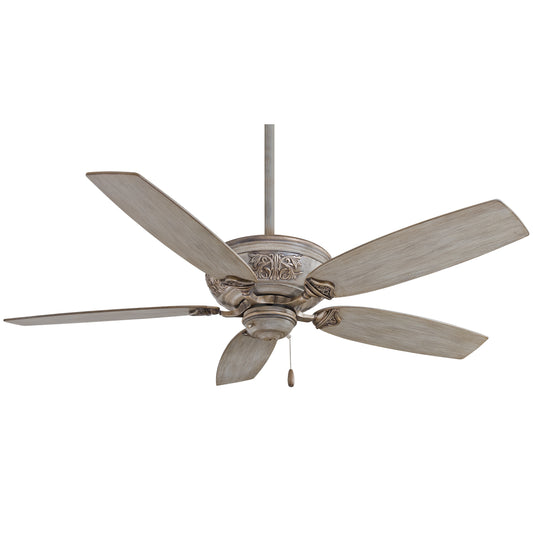


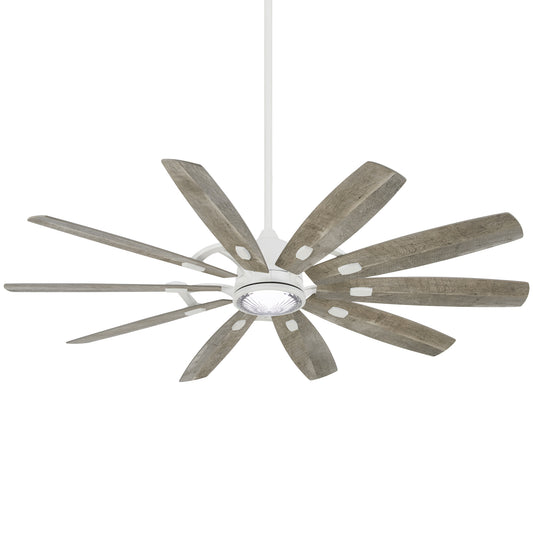

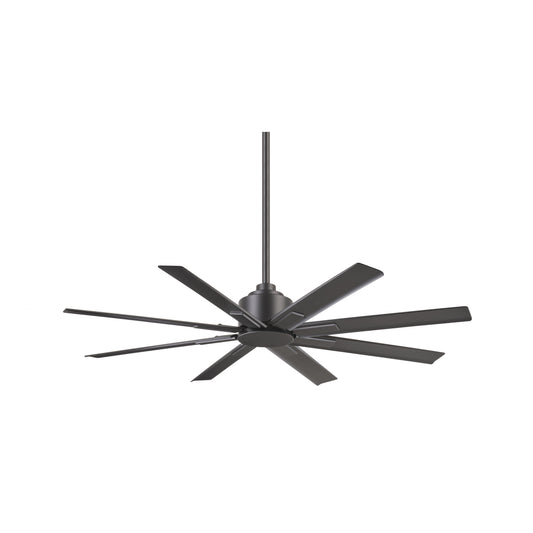

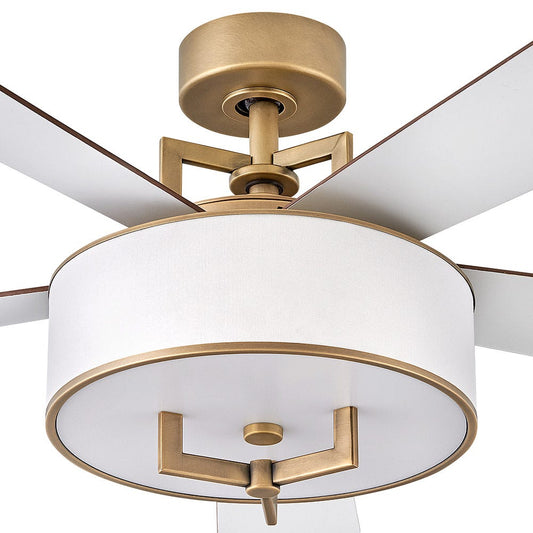






Choosing Your Outdoor 60 Inch Ceiling Fan
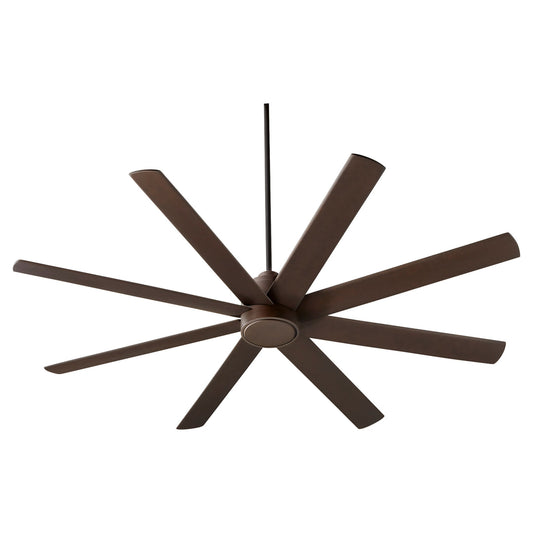
When you're looking to turn a large patio, pergola, or covered deck into a truly livable space, a 60-inch outdoor ceiling fan is what you need. We're not just talking about moving a little air around—these fans are workhorses, built to send a powerful, cooling breeze across areas from 225 to 400 square feet. They have the muscle to make even the hottest days feel genuinely enjoyable, blending serious performance with designs that elevate your entire outdoor setup.
Why Your Outdoor Space Deserves a 60 Inch Fan
Think of an outdoor ceiling fan as more than just an appliance. It’s the anchor piece that sets the tone for comfort and style in your open-air living room. A smaller fan just can't keep up in a big, open space; it'll struggle to make any noticeable difference. A 60-inch model, on the other hand, has the scale and power to create a true oasis.
It's like the difference between a little desk fan in your living room and central air conditioning. One just stirs the air, while the other completely transforms the atmosphere.
The biggest win here is creating a space you actually want to spend time in. A well-placed fan can make your patio feel a good 8-15 degrees cooler, turning a sweltering afternoon into the perfect spot for a cold drink. This isn't just about feeling good; it extends the hours you can actually use your outdoor space. Suddenly, you're hosting dinner parties, dining al fresco, or just relaxing with a book when you'd normally be hiding inside.
More Than Just a Breeze
Beyond that powerful cooling effect, a large fan brings a few other practical perks to the table that really improve your outdoor lifestyle.
- Keeps the Bugs Away: The constant airflow creates a no-fly zone for mosquitoes, gnats, and other flying pests. It's a simple, surprisingly effective way to make your evenings more peaceful.
- Fights Off Dampness: By keeping the air moving, a fan helps dry up moisture on surfaces. This cuts down on that damp, humid feeling and can even help prevent mildew on your outdoor furniture.
- Sets the Mood: Let's be honest, style matters. Many of the best models, often in the $300+ range, come with beautiful, integrated LED lighting that adds a warm, ambient glow for evening entertaining.
It's no surprise that more and more homeowners are investing in bigger, better outdoor fans. The global market has been growing steadily as people look to create more luxurious and functional outdoor areas. This isn't just a trend; it's a shift toward treating our patios and decks as true extensions of our homes. If you're curious about the numbers, you can find more market insights on Infinity Market Research.
Getting Technical: Weather Ratings and Motor Power
Looks can be deceiving. While the style of your 60-inch outdoor fan is important, the real workhorse components are hidden inside. To make sure your fan not only looks great but also survives the elements and performs like a champ, you need to understand two key things: its weather rating and its motor.
Think of a weather rating like picking the right coat for the weather. You wouldn’t wear a light fleece in a rainstorm, right? The same idea applies to your fan. Getting this part right is non-negotiable for safety and making sure your investment lasts.
Damp-Rated vs. Wet-Rated Fans
A damp-rated fan is your go-to for covered outdoor spaces. We're talking about screened-in porches, covered patios, and verandas—anywhere the fan is shielded from direct rain. These fans are built tough with moisture-resistant motors and specially treated materials that can handle high humidity and condensation without rusting or giving up.
But what if your fan is going to be more exposed? For pergolas, gazebos, or totally uncovered decks, you absolutely need a wet-rated fan. These are the heavy-duty raincoats of the fan world. They are completely sealed and built with all-weather blades and hardware that can take a direct hit from rain, snow, and even a cleaning with the garden hose.

Here's a quick reference to help you decide.
Outdoor Ceiling Fan Ratings at a Glance
This quick comparison will help you choose the correct weather rating for your outdoor space, ensuring longevity and safety.
| Rating Type | Ideal Location | Exposure Level | Example Use Case |
|---|---|---|---|
| Damp-Rated | Covered, protected outdoor areas | Can handle moisture, humidity, and condensation, but not direct rain or water. | A screened-in porch or a fully covered patio. |
| Wet-Rated | Exposed outdoor areas | Can withstand direct exposure to rain, snow, and even being hosed down. | An open-air pergola, gazebo, or uncovered deck. |
The bottom line is simple: matching the fan's rating to its environment is the best way to prevent damage and keep it running safely for years to come.
The Powerhouse: Your Fan's Motor and CFM
The engine that drives your fan's breeze is its motor. While you'll still find traditional AC (Alternating Current) motors out there, the gold standard for a premium outdoor 60 inch ceiling fan is a DC (Direct Current) motor. For fans in the $300 and up price range, DC motors are what you should expect, and for good reason. They are up to 70% more energy-efficient and run so quietly you'll barely know they're on.
That incredible efficiency also unlocks another huge perk: more precise speed control. Instead of the old-school three-speed pull chain, DC motors often give you six or more speeds to fine-tune your comfort.
A powerful motor has a direct impact on airflow, which we measure in CFM (Cubic Feet per Minute). For a big 60-inch fan, a high CFM rating is everything. It’s the number that tells you exactly how much air that fan can move.
Think of CFM as the fan's horsepower. A low CFM rating on a large fan is like putting a tiny engine in a huge truck—it just won’t have the muscle to do the job. For a spacious outdoor area, you'll want to see a CFM of 6,000 or higher to guarantee a strong, cooling breeze that can reach every corner.
If you’re ready to see what’s out there, we’ve put together a list of the best outdoor ceiling fans right here on our blog.
Why a 60 Inch Fan Is Your Ideal Size
Picking the right ceiling fan size isn't just about what looks good—it's about pure physics. A fan that’s too small for your patio will just chop at the air, doing little more than spinning in place. Go too big, and you'll create a wind tunnel that sends napkins flying. It's a classic Goldilocks problem.
This is where the outdoor 60 inch ceiling fan really shines. It hits that perfect sweet spot, expertly proportioned to move a serious amount of air across larger outdoor spaces—think anywhere between 225 and 400 square feet. This is the go-to size for creating that perfect, consistent breeze over a spacious covered patio, a big gazebo, or a functional outdoor kitchen.
Measuring for the Perfect Fit
Before you pull the trigger, let's make sure a 60-inch fan is the right call for your space. Don't worry, you don't need a degree in engineering for this. A quick tape measure is all it takes.
Just measure the length and width of your covered outdoor area and multiply them together.
The simple formula: Length (in feet) x Width (in feet) = Total Square Feet
So, if you have a patio that's 15 feet long and 20 feet wide, you’re looking at 300 square feet (15 x 20 = 300). That number lands squarely in the ideal range for a 60-inch fan, meaning you'll feel that refreshing airflow from one end to the other. For a deeper dive, feel free to check out our complete guide on choosing the right ceiling fan size for maximum efficiency.
Getting the size right is the first, and most important, step. It ensures the fan can actually do its job—keeping you cool—making your investment in a quality model truly pay off.
Why Placement and Height Matter
Once you've got the size nailed down, the next big question is where to hang it. The fan's location is just as critical as its blade span for getting the most out of it. Good positioning maximizes air circulation while keeping things safe and comfortable for everyone underneath.
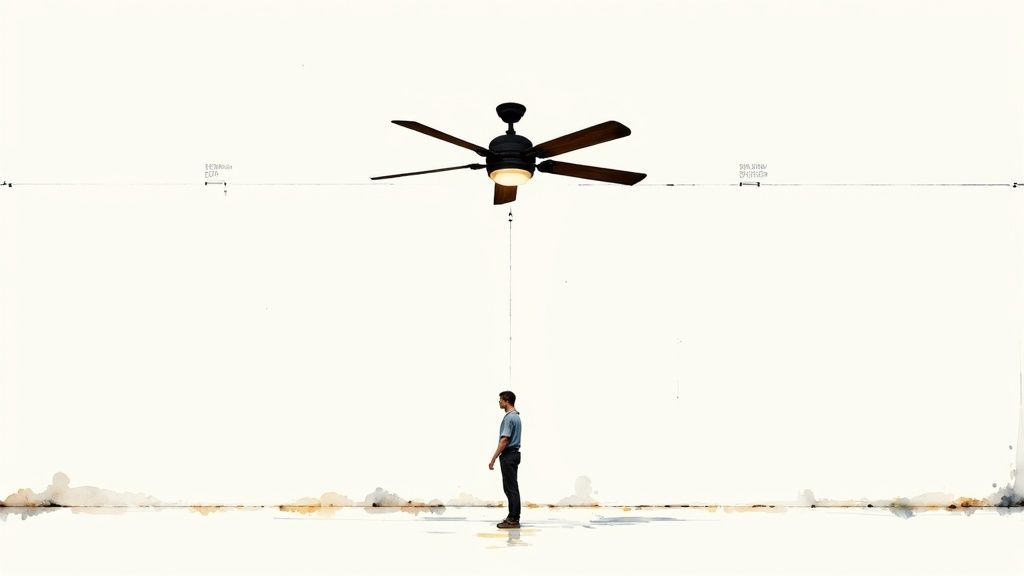
For the best possible performance, your outdoor 60 inch ceiling fan should be installed so its blades are 8 to 9 feet above the floor. This height is the magic number. It gives the fan enough room to push a large column of air down and out without feeling like an overwhelming gust of wind.
- Too Low (Below 8 feet): Hanging a fan too low can be a safety hazard, especially for taller guests. The airflow can also feel way too intense if you're sitting directly below it.
- Too High (Above 9 feet): Mount the fan too high up, and that lovely breeze will lose a lot of its punch before it ever reaches you. You'll lose out on its cooling power.
By getting the sizing and placement just right, you're setting the stage for a comfortable, inviting outdoor oasis you'll want to use all season long.
Exploring High-End Fan Features and Smart Controls
When you step up to a premium outdoor 60-inch ceiling fan, especially one in the $300 and up range, you’re buying more than just a motor and blades. You're bringing home a serious piece of tech designed for pure convenience and creating the perfect outdoor vibe. These high-end models are loaded with features that completely change how you use your patio or porch.
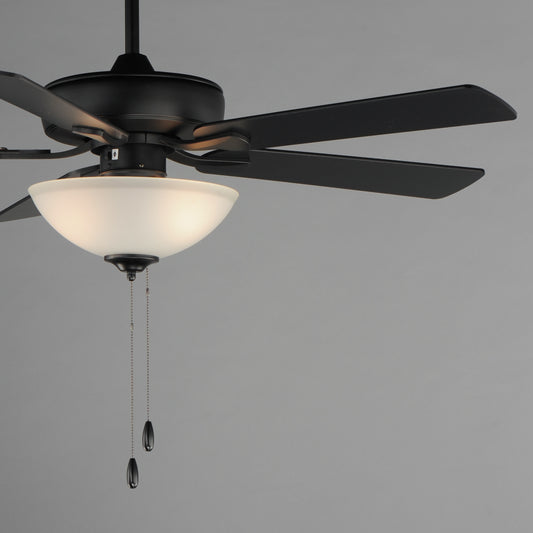
Gone are the days of a single, harsh light bulb. Modern fans come with integrated, dimmable LED lighting kits built right in. This means you can go from bright, functional light for grilling dinner to a soft, warm glow for late-night conversations, all with the press of a button.
Smart Home Integration and Voice Control
One of the coolest advancements is how these fans now play nicely with your smart home. Many premium models connect to your Wi-Fi, letting you control them from an app on your phone or, even better, with your voice. Just imagine kicking back in your chair and saying, "Alexa, turn the patio fan to medium." No getting up, no fumbling for a remote.
This kind of control adds a layer of luxury and ease that’s a total game-changer. It’s not just about cooling anymore; it’s about making your outdoor space as responsive and intelligent as the rest of your home. It's a huge reason why these bigger, feature-rich fans have become so popular.
The whole market for 60-inch outdoor ceiling fans has really taken off thanks to better energy efficiency and smart technology. People want the whole package: LED lighting, remote controls, and Wi-Fi connectivity, especially those who love their gadgets. As a result, manufacturers are focusing on making fans quieter, more efficient, and fully compatible with home automation systems. You can read more about these ceiling fan market trends to see where things are headed.
Smart functionality isn't just a gimmick; it's about seamless integration into your lifestyle. It means your outdoor fan becomes as easy to manage as your indoor smart lights or thermostat.
Advanced Motor Functions and Remote Controls
Beyond the smarts, the motors themselves have gotten a major upgrade. Multi-speed, reversible DC motors are now the gold standard in this price range. And that reversible feature is fantastic all year long. In the summer, the fan spins counter-clockwise to push down a cooling breeze. But in the cooler months, you can flip the direction to clockwise. This pulls cool air up and circulates the warmer air that gets trapped near the ceiling—perfect for taking the chill off a crisp autumn evening.
Of course, a dedicated remote control usually comes standard, giving you instant access to everything.
- Multi-Speed Settings: Fine-tune your comfort with up to six different fan speeds.
- Light Control: Dim the lights or switch them on and off, completely separate from the fan.
- Directional Control: Easily reverse the blade direction to switch between summer and winter modes.
These thoughtful features are what elevate an outdoor fan from a simple utility to a must-have for any well-designed, comfortable, and truly functional outdoor living area.
Matching Your Fan to Your Home's Aesthetic
Let's be honest, your outdoor 60-inch ceiling fan is more than just a piece of machinery—it's a massive design statement that anchors your entire outdoor living space. The right fan should feel like it was always part of the plan, a natural extension of your home’s architecture and style. It’s about finding a fan that doesn't just work well but looks like it belongs.
Think of it as the finishing touch that pulls the whole patio together. You wouldn't throw ultra-modern furniture into a rustic cabin, and the same logic applies here. Getting this right is what transforms a simple outdoor area into a polished, thoughtfully designed retreat.
Finding Your Fan's Style Personality
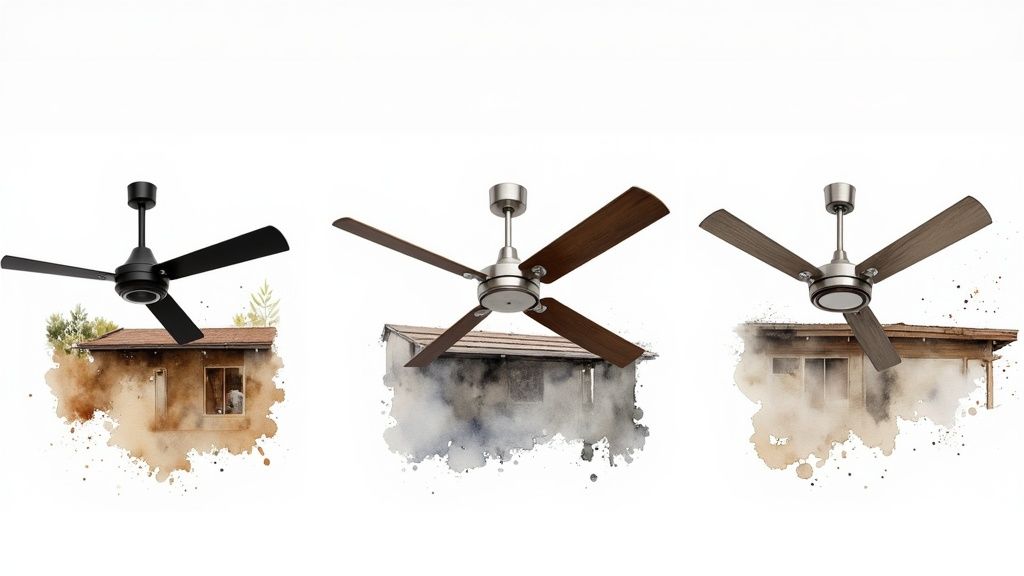
The great thing about today’s premium fans is the sheer variety. You can find a high-quality outdoor 60-inch ceiling fan for just about any architectural style, especially once you start looking at models in the $300+ range.
-
Modern and Minimalist: If you have a contemporary home with clean lines and a neutral palette, look for fans with sleek, uncomplicated designs. Models with just three blades, sharp angles, and metallic or matte black finishes deliver that sophisticated, uncluttered vibe. The Hunter Cassius collection, for instance, nails this aesthetic with its streamlined designs, often available for around $350.
-
Rustic Farmhouse: For homes with that cozy, farmhouse-inspired charm, a fan with weathered wood-look blades and an oil-rubbed bronze or aged pewter finish feels right at home. Look for styles like the Kichler Sola, which blends textures and lantern-style light kits to add rustic elegance, typically priced over $400.
-
Coastal and Tropical: To get that breezy, vacation-like atmosphere, go for a fan with broad, leaf-shaped blades that bring palm fronds to mind. Models like the Casablanca Wailea offer natural wood tones or a crisp white finish perfect for coastal decor, making your patio feel like a true seaside escape, usually retailing for more than $500.
The Power of the Perfect Finish
The fan's finish is your secret weapon for creating a cohesive look. It should coordinate with your home’s existing hardware—things like your outdoor light fixtures, door handles, and window trim.
Choosing the right finish is what makes your new fan look like a custom, built-in feature instead of an afterthought. It’s what makes everything just click.
Here are a few popular choices that are hard to get wrong:
- Matte Black: This one is timeless and incredibly versatile. It works with nearly any style, from modern industrial to classic farmhouse.
- Brushed Nickel: A fantastic choice for a soft, contemporary feel that perfectly complements stainless steel grills and modern patio furniture.
- Oil-Rubbed Bronze: This finish gives you a rich, warm tone that pairs beautifully with traditional, rustic, and even Mediterranean-style homes.
By putting a little thought into both the style and the finish, you can choose an outdoor 60 inch ceiling fan that does more than move air—it truly elevates your home's entire look.
Getting Your Fan Installed for Safety and Performance
Getting your new outdoor 60 inch ceiling fan installed correctly is about way more than just making it spin. It's the bedrock of its performance, its lifespan, and most importantly, your family's safety. While we love a good weekend DIY project, this is one area where calling in a professional is a really smart move.
A licensed electrician knows exactly how to handle the unique demands of a large, heavy outdoor fan. They'll make sure every wire is secure and properly weatherproofed, which protects your investment from the elements and keeps it running smoothly for years.
Your Pro Installation Checklist
When your electrician gets to work, they'll have a few critical safety and performance points on their mind. Think of these as the non-negotiables for a rock-solid installation.
- A Fan-Rated Junction Box: The standard plastic box used for a ceiling light just can't handle the weight and motion of a 60-inch fan. Your electrician will make sure you have a metal, fan-rated junction box that’s mounted securely to a ceiling joist. It needs to be rated to support at least 70 pounds.
- GFCI Circuit Protection: Any electrical installation outdoors needs a Ground Fault Circuit Interrupter (GFCI). This is a life-saving feature that instantly cuts the power if it detects any moisture, which is key to preventing electric shock in damp environments.
- Secure Mounting and Balancing: It’s vital to attach the mounting bracket and downrod perfectly. Once the fan is assembled, the blades need to be balanced to prevent any wobbling. A wobbly fan isn't just noisy—it puts unnecessary strain on the motor.
With more people investing in high-quality outdoor living spaces, the ceiling fan market has taken off. In 2023, the global market was valued at a whopping USD 14.24 billion and is expected to keep growing, with large models like the 60-inch fan helping to lead the way. You can read more about the global ceiling fans market growth on Grand View Research.
A Pro Tip on Maintenance: A little bit of care goes a long way. Once a season, take a few minutes to wipe down the blades with a damp cloth to get rid of dust and pollen. This simple step helps keep the fan perfectly balanced and running efficiently. It's also a good idea to check that all the screws on the blades and mounting bracket are still tight.
Following these simple installation and maintenance tips will ensure your beautiful new fan remains a source of comfort and style for many seasons to come. For a more detailed guide, check out our article on how to install a ceiling fan safely and easily.
Still Have Questions About Outdoor Fans?
Even after digging into the details, you might still have a few questions floating around. That’s perfectly normal. Getting straight answers to these common queries is the final step to choosing your outdoor 60 inch ceiling fan with complete confidence.
Let's tackle some of the most common ones we hear from customers.
By far, the biggest question is whether an indoor fan can be used outside. The answer is a hard no. It’s not just a suggestion; it's a safety and durability issue. Outdoor-rated fans are built tough, with moisture-resistant motors and all-weather blades that won’t rust, warp, or fail when exposed to the elements. An indoor fan just can't handle the humidity.
Performance and Practicalities
Another thing people wonder about is the number of blades. Does more equal better? Not really. A fan's cooling power is all about the motor, the angle of the blades (pitch), and the overall engineering—not just how many blades are attached. A well-designed three-blade fan can move a surprising amount of air, often just as much as a five or six-blade model.
The number of blades is mostly about style. Fewer blades tend to give off a modern, minimalist vibe, while more blades can feel a bit more traditional or even tropical. Go with the look that complements your outdoor decor.
Finally, what about the cost to run it? This is where modern outdoor fans really shine. Thanks to super-efficient DC motors, a premium outdoor 60 inch ceiling fan is incredibly cheap to operate. We're talking pennies per hour for many models, which makes them a much more budget-friendly cooling solution than other options. You can leave it running all season long without dreading your next electricity bill.
At Fan Connection, we've handpicked a collection of fans that nail the balance between style, performance, and all-weather durability. Find the perfect 60-inch outdoor fan to transform your patio or porch by exploring our curated collections.


