







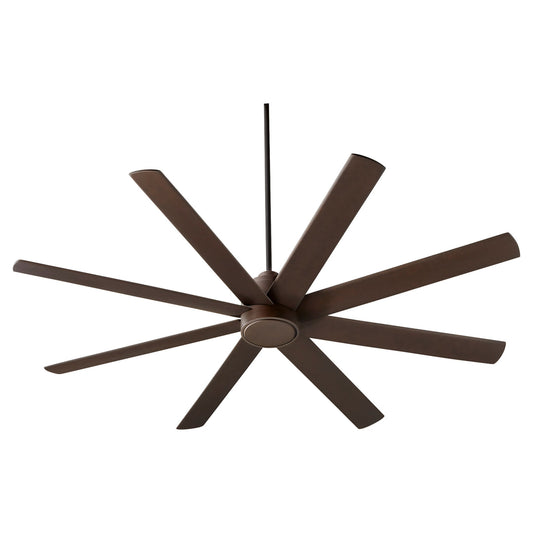


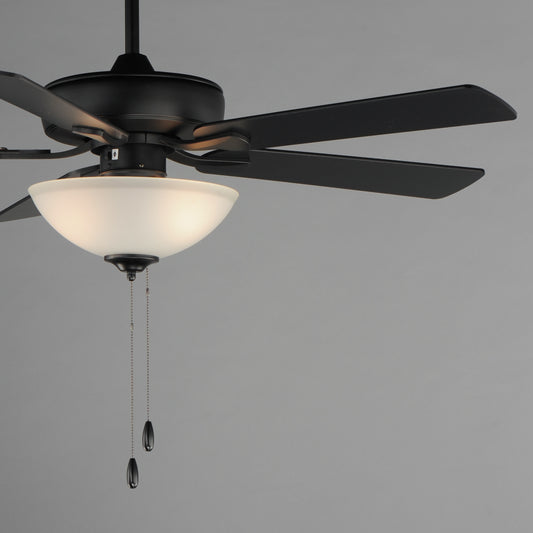


Your Guide to the Hugger Ceiling Fan
Ever walked into a room and felt like the ceiling was just a little too close for comfort? If that sounds familiar, a hugger ceiling fan is the high-style, space-saving solution you've been searching for. It's the ultimate upgrade for creating a breezy oasis in rooms that traditional fans just can't handle.
Think of it like recessed lighting, but for air circulation. It mounts directly against the ceiling, completely getting rid of the downrod you see on standard fans. This design is a total game-changer for rooms with ceilings under 8 feet, giving you safe, effective airflow without making anyone feel like they need to duck. It's the perfect blend of form and function.
Decoding the Hugger Ceiling Fan
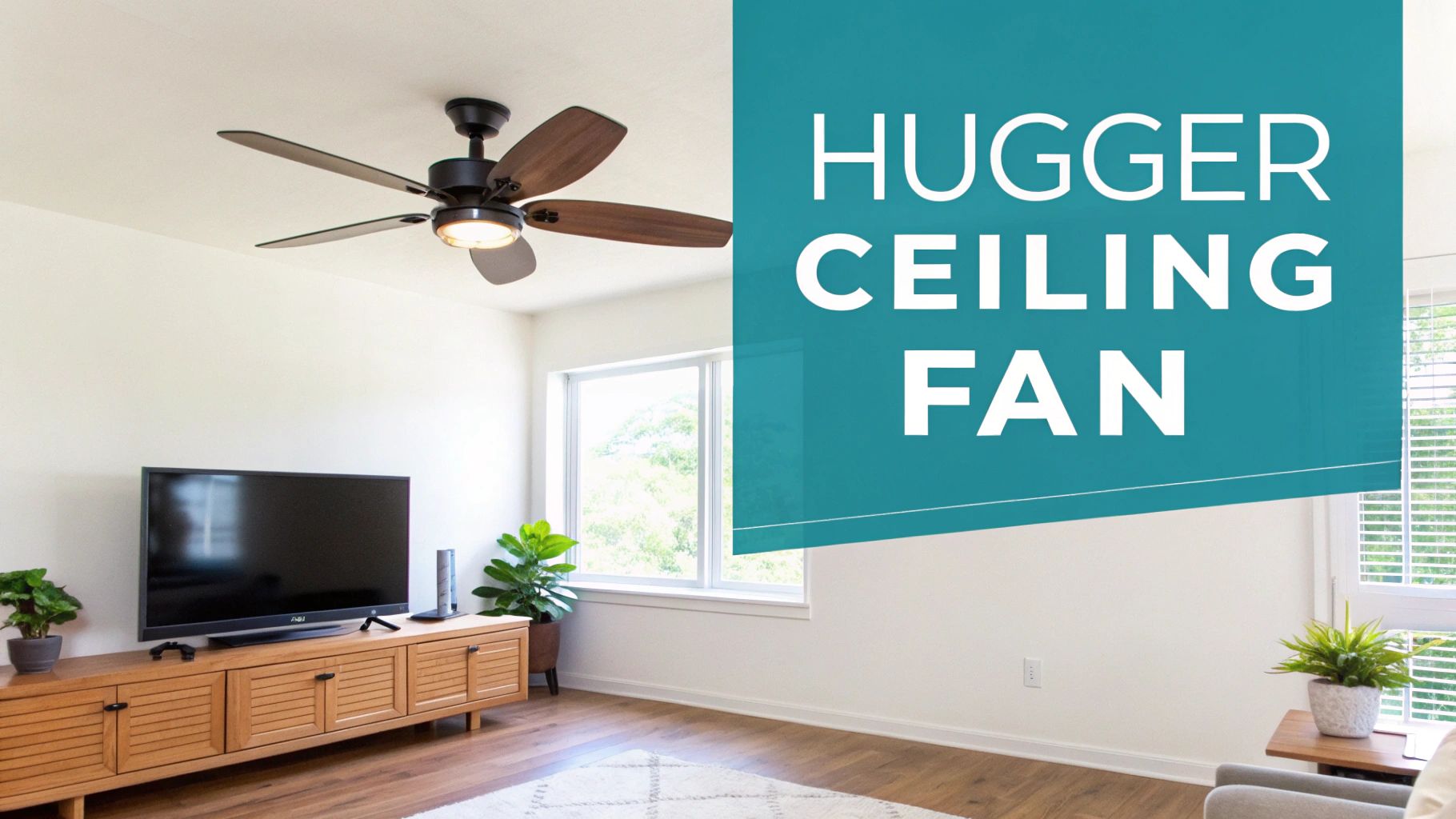
A hugger ceiling fan—also called a low-profile or flush-mount fan—is engineered specifically for spaces where every inch of vertical height matters. Unlike standard fans that hang down from the ceiling, a hugger’s motor housing attaches directly to the mounting bracket. This creates a super compact, space-saving profile that's essential for both safety and comfort in rooms with lower ceilings.
The real benefit here is maximizing headroom. For safety, building codes require standard fans to have at least 7 feet of clearance between the floor and the blades. In a room with a 7.5 or 8-foot ceiling, a regular downrod fan can quickly become a head-knocking hazard. A hugger fan solves this by keeping the blades tucked up as close to the ceiling as possible.
Why Is This Design So Popular?
It's no surprise that the demand for these low-profile fans has shot up. It perfectly mirrors the rise in home renovations where people are trying to make the most of every single inch of space. The global ceiling fan market, which includes a huge number of hugger models, was valued at USD 12.89 billion in 2026 and is on track to hit USD 15.60 billion by 2031. That growth tells you just how many homeowners are turning to smart, space-saving solutions like the hugger fan.
This low-profile hero is especially critical in a few common situations:
- Older Homes: So many charming character homes were built with lower ceilings than what's standard today.
- Modern Apartments and Condos: Compact urban living often means you're working with lower ceiling heights.
- Basements and Bonus Rooms: Converted attics or finished basements are notorious for having clearance issues.
By mounting flush against the ceiling, a hugger fan not only keeps everyone safe but also creates a clean, unobtrusive look that feels right at home with modern, minimalist decor. It’s a seriously stylish solution to a very practical problem.
Choosing a premium model like the sleek Veloce Flush Mount Ceiling Fan proves you don’t have to sacrifice powerful performance or stunning design for a space-saving fit. Our complete guide to flush mount ceiling fans offers even more insights on how these fans get the job done.
Weighing the Benefits and Drawbacks
When you’re looking at a hugger ceiling fan, it’s really all about understanding what it can—and can’t—do for your space. Let’s get real about the pros and cons to figure out if this low-profile powerhouse is the right call for your home.
The biggest win here is, without a doubt, safety and space. In rooms with low ceilings—think anything under eight feet—a hugger fan isn't just a style choice; it's a flat-out necessity. It helps you meet building codes, which usually require at least seven feet of clearance from the floor to the fan blades. That simple design choice keeps taller folks from getting an unwelcome haircut.
Beyond just being safe, the look is a major draw. Their sleek, integrated design is a dream for anyone going for a minimalist or contemporary vibe. The fan just melts into the ceiling instead of becoming a clunky, intrusive fixture.
Airflow and Engineering
But what about performance? There’s a common myth that hugger fans can’t move much air because they’re so close to the ceiling. It's true they might circulate a bit less air than a comparable fan on a long downrod, but this is where modern engineering completely changes the game.
High-end models are not just about looks; they are built with powerful, precision-engineered motors designed to maximize air circulation even in a compact form. This proves that a space-saving design can still pack a serious punch when it comes to cooling.
For instance, premium fans in our Flush Mount Ceiling Fan Collection deliver surprisingly robust, room-filling circulation without giving up an inch of style or headroom. These fans, which often come in at $300 or more, use advanced motors that are both powerful and whisper-quiet, so you get all the comfort without any of the noise. You can dive deeper into the breezy benefits of having a ceiling fan in our detailed guide.
Installation and Maintenance
When it comes to installation, hugger fans have their own set of rules. Since the motor housing bolts directly to the ceiling bracket, getting a perfectly secure and level mount is absolutely critical for a quiet, wobble-free spin. Without a downrod to absorb tiny vibrations, any little imbalance can become much more obvious.
Here’s a quick breakdown of what to keep in mind:
- Secure Mounting: The electrical box in your ceiling must be fan-rated. A standard box made for a light fixture just won't cut it—it's not built to handle the weight and movement.
- Level Surface: A flat, even ceiling is your best friend. Bumpy plaster or uneven drywall can make mounting a real headache and lead to an annoying wobble down the road.
- Regular Upkeep: To keep your fan running smoothly, a little TLC goes a long way. Lubricating the motor bearings every 6–12 months can prevent squeaks and help your fan live a long, happy life.
At the end of the day, a hugger ceiling fan offers an unbeatable mix of safety, style, and effective cooling for rooms where every inch of height counts. By picking a well-engineered model, you get a fixture that solves a real problem without skimping on performance.
Choosing the Perfect Size for Your Room
Let's be honest, one of the biggest mistakes people make is picking a hugger fan that's too small for their space. Getting the size just right is the most important step for getting that cool, comfortable airflow you're after, and luckily, it's easier than you'd think. This is about more than just aesthetics; it's about making sure your fan actually does its job.
The first thing to check is your ceiling height. As we've discussed, any room with a ceiling under 8 feet is prime territory for a hugger fan. This isn't just a suggestion—it's about ensuring safe clearance, which is a must for both your family's safety and meeting building codes.
Matching Blade Span to Room Size
Once you've confirmed you have a low ceiling, the next step is to match the fan's blade span to your room's square footage. The blade span is simply the measurement from the tip of one blade to the tip of the opposite one.
Picking one that's too small is a recipe for disappointment. It will struggle to move air across the whole room, leaving you with annoying "dead zones" where you can't feel a breeze. On the flip side, a fan that's way too big for a small room can create a turbulent, overwhelming wind tunnel effect. Nobody wants that.
The same logic applies to other cooling systems. For instance, getting the right size is also critical for an air conditioner's efficiency. You can find a helpful AC room size calculator to see how the principle of matching size to space works across the board.
To help you nail the right fit, we put together this simple decision tree to walk you through the process, starting with your ceiling height.
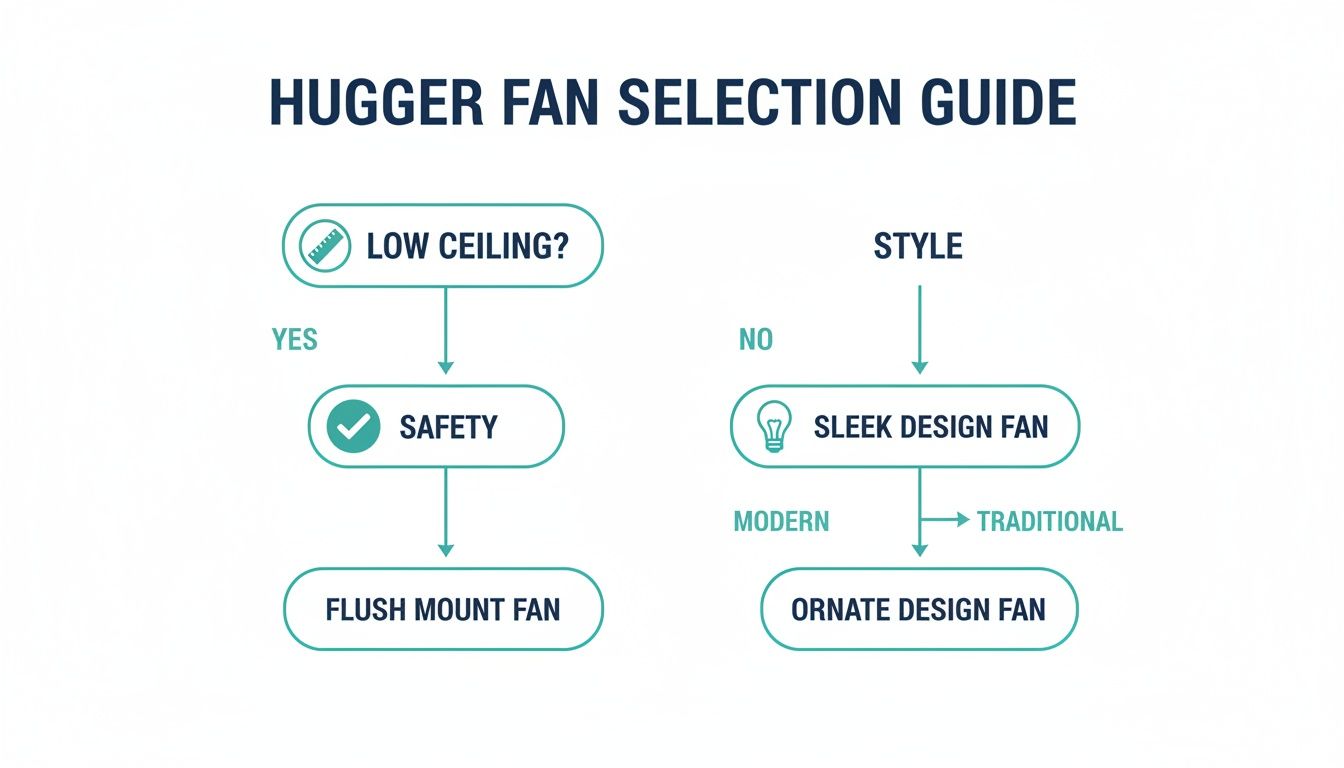
As the guide shows, for low ceilings, a hugger fan is all about safety first. In rooms with higher ceilings, it becomes more of a style choice.
Recommended Hugger Fan Size by Room Dimensions
To make things even simpler, we've broken down the ideal fan sizes based on common room dimensions. This table will help you quickly find the perfect blade span for your space, ensuring you get the best possible airflow.
| Room Size (Square Feet) | Recommended Blade Span (Inches) | Ideal Room Type |
|---|---|---|
| Up to 100 sq. ft. | 36 – 44 | Home Office, Small Bedroom, Laundry Room |
| 100 – 225 sq. ft. | 48 – 52 | Master Bedroom, Family Room, Medium Kitchen |
| Over 225 sq. ft. | 54 – 62+ | Great Room, Open-Concept Living Area, Sunroom |
By matching these numbers to your room, you can confidently choose a fan that will deliver the performance you expect without any guesswork.
Finding the Sweet Spot for Airflow
So, what does this look like in the real world?
For a small home office or guest bedroom (up to 100 square feet), a fan with a blade span between 36 to 44 inches will do the trick perfectly. For those medium-sized spaces like a master bedroom or family room ranging from 100 to 225 square feet, you'll want to step up to a fan in the 48 to 52-inch range.
In those larger, open-concept spaces with low ceilings—like a great room or a sprawling living area over 225 square feet—you're going to need a fan that can really move some serious air. This is where the bigger, more powerful models truly shine.
For these expansive areas, a large-span model like the stunning 60-inch Modern Forms Woody Smart Fan ($799.95) is an investment in ultimate comfort. It is engineered to deliver maximum airflow while still maintaining that all-important low profile.
If you'd like an even more detailed breakdown, you can check out our complete guide on how to choose the right ceiling fan size for any type of room. At the end of the day, carefully matching the fan size to your room is the key to ensuring your new hugger fan works exactly as it should.
What Really Powers a Modern Hugger Fan?
Looks are important, but when you're choosing a hugger ceiling fan, what’s under the hood matters just as much. To tell the difference between a good fan and a great one, you have to look at its performance specs and modern features. This is where investing in a quality fan really pays off in comfort, quiet, and convenience down the road. It’s the difference between a simple appliance and a central feature of your home’s comfort system.
The single most important number to look for is CFM, which stands for Cubic Feet per Minute. This tells you exactly how much air the fan can move. A higher CFM means more powerful airflow and better circulation—which, let's be honest, is the whole reason you're buying a fan in the first place.
When you're browsing top-tier models, the CFM rating is always listed right in the product specs. This lets you compare fans based on real-world performance, not just looks. For example, a big, powerful fan like the Modern Forms Andros ($1,099.95) is designed to move a serious amount of air, making its high CFM rating a key feature for large spaces with low ceilings.
The Powerhouse DC Motor
So, what's the secret behind today's best-performing fans? It's the DC (Direct Current) motor. For decades, traditional AC (Alternating Current) motors were the standard, but DC motors are a huge leap forward in fan technology.
A premium hugger fan with a DC motor can be up to 70% more energy-efficient than an old-school AC fan. That translates directly into lower energy bills month after month, making it a smart investment that pretty much pays for itself over time.
Beyond just saving you money, DC motors bring a few other game-changing benefits to the table:
- Practically Silent: They produce far less noise, creating a quiet, peaceful vibe in any room. No more distracting hum.
- More Speed Control: DC fans typically offer five or six speeds, giving you precise control over your comfort. That’s a big step up from the usual three speeds on most AC fans.
- Sleeker Designs: Because DC motors are lighter and more compact, they allow for more modern and streamlined fan designs without sacrificing an ounce of power.
This move toward more efficient tech isn't just a niche trend. The demand for hugger ceiling fans reflects a bigger shift toward energy-smart cooling solutions. The global household ceiling fan market hit USD 8.2 billion in 2024 and is projected to grow to USD 11.5 billion by 2033. Hugger models are a huge part of this growth, especially as more and more renovation projects focus on sustainability.
Smart Home Integration
Another feature that sets a modern hugger fan apart is smart home integration. The best models are now designed to connect seamlessly with your smart home setup, offering a whole new level of convenience.
Imagine telling your smart speaker to turn on the fan or adjusting the speed from an app on your phone without ever getting up. It's a game-changer for anyone who loves a connected, convenient home. Sleek fans like the Modern Forms Axis ($599.95) come with these smart capabilities built-in, adding a touch of modern luxury to their practical function.
Ultimately, knowing what these performance features mean helps you make a much better decision. When you prioritize a high CFM, a DC motor, and smart capabilities, you’re not just buying a fan—you’re investing in long-term comfort, quiet, and efficiency. To learn more about the latest fan innovations, check out our complete guide to modern ceiling fans.
Pro Tips for a Flawless Installation
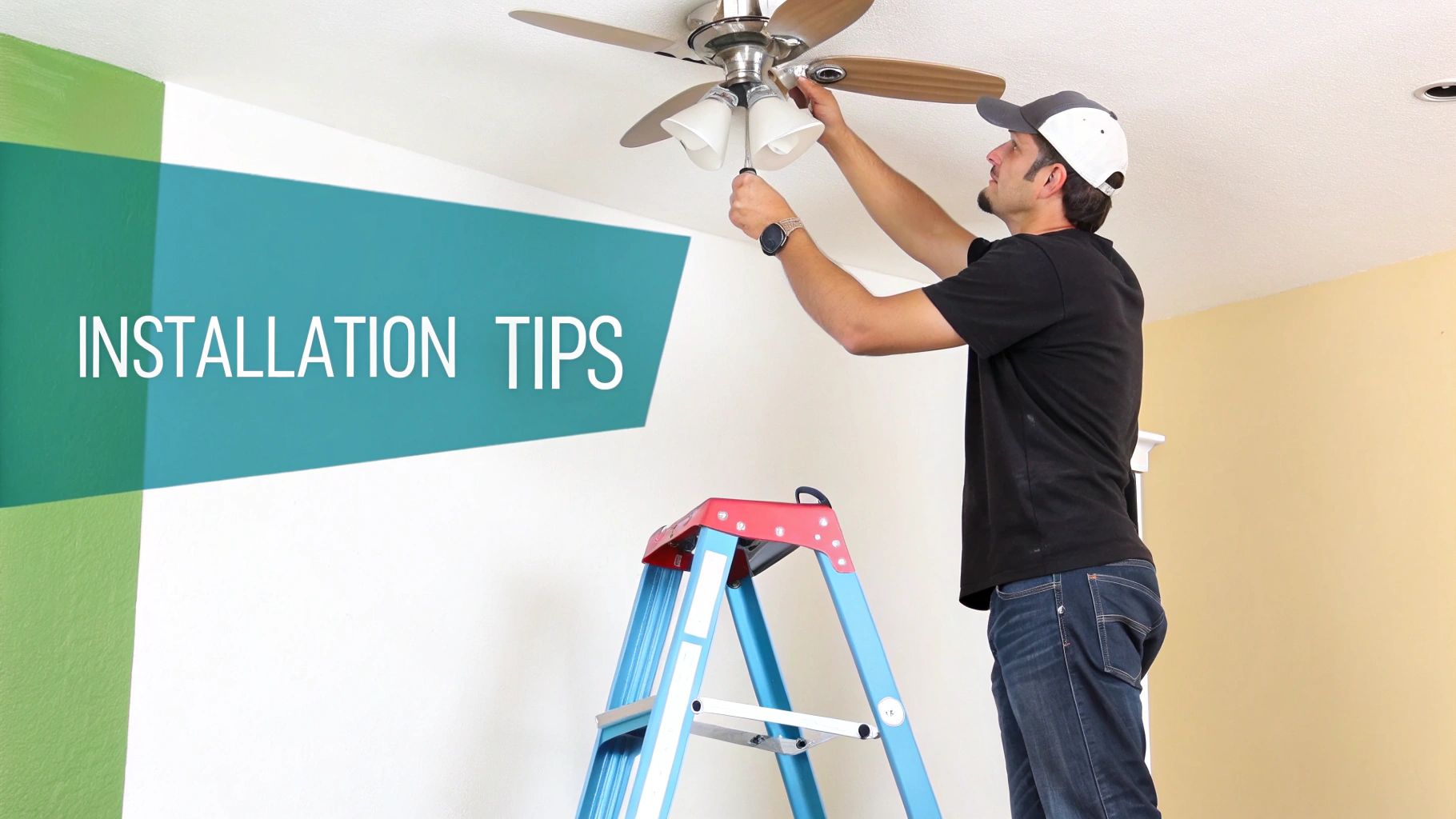
While this is no substitute for your fan's instruction manual, a few pro tips can make the difference between a frustrating afternoon and a secure, quiet, and perfectly balanced fan. Getting these steps right from the start ensures your new hugger fan runs smoothly from day one. This is your chance to set yourself up for years of silent, breezy enjoyment.
Before you even think about opening the box, the very first thing to do is check the electrical box in your ceiling. A standard box made for a simple light fixture is not strong enough to handle the weight and constant motion of a ceiling fan.
Seriously, this is the most important safety check. You need a fan-rated electrical box to prevent the fan from falling. If you have any doubt, it's always worth calling a qualified electrician to inspect it and swap it out if needed.
Prepare Your Workspace
Once you've confirmed the electrical box is good to go, it's time to prep. A little work on the ground now will save your arms and back a world of hurt when you're up on that ladder.
Go ahead and assemble as much of the fan as you can on the floor. This usually means attaching the blades to their brackets and getting the motor housing ready. It’s a whole lot easier and safer than fumbling with parts while trying to keep your balance.
A secure, wobble-free installation starts before the fan ever reaches the ceiling. Taking the time to properly prepare the components on the ground ensures a smoother, safer final assembly.
The ceiling fan market is booming—it was valued at USD 14.24 billion in 2023, which shows just how essential these fixtures have become. Hugger fans are a big part of that, making up roughly 20% of the U.S. market thanks to their space-saving design that's perfect for city living and modern renovations.
Check for a Level Ceiling
Your best friend for a silent, wobble-free fan is a perfectly level ceiling. If the surface is uneven, the fan's housing can sit at a slight angle, which eventually leads to annoying vibrations and noise.
Here’s an easy way to check:
- Grab a long, straight board or a level and place it across the spot where you'll mount the fan.
- Look for any gaps between the board and the ceiling.
- If it's noticeably uneven, you may need to slide a few shims under the mounting bracket to create a level surface.
Every hugger fan is a little different, so always follow the guide that came with your specific model. For a more detailed guide that covers the whole process, check out our post on how to install a ceiling fan safely and easily step-by-step. Combining these pro tips with your manual is the best way to get it right the first time.
A Few Final Questions About Hugger Fans
Even after you've narrowed down the options, a few practical questions always seem to pop up right before you make a decision. To make sure you're totally confident in your choice, let's run through some of the most common questions we hear about hugger fans.
Think of this as a final checklist to tackle those last little details every homeowner thinks about. From lighting to sloped ceilings, these quick answers will help you get it right.
Do Hugger Fans Come with Lights?
Yes, absolutely! While some people prefer the clean, minimalist look of a fan without a light, most hugger ceiling fan models come with integrated light kits. This is a huge win for rooms with just one electrical box in the ceiling, since you don't have to choose between airflow and your main light source.
Modern designs have come a long way from the clunky, afterthought light fixtures of the past. Today’s hugger fans often feature sleek, energy-efficient LED lights that are built seamlessly into the fan’s body. This keeps the fan’s low-profile aesthetic intact while still giving you plenty of light. So when you're shopping, you'll have plenty of options with or without lights to fit your room perfectly.
Can I Install a Hugger Fan on a Sloped Ceiling?
That's a great question, but the short answer is almost always no. A hugger ceiling fan is specifically engineered to mount completely flush against a flat, level ceiling. Its direct-mount design doesn’t have the flexible ball-and-socket joint you’d find in a standard downrod fan, which is what allows a fan to hang straight on an angle.
If you tried to mount a hugger fan on a sloped ceiling, the fan itself would sit at an angle. This would throw it completely off-balance, causing major wobbling and putting a lot of strain on the motor. For any kind of angled ceiling, you’ll need a standard fan with a downrod and a special sloped ceiling adapter to ensure it operates safely and correctly.
How Do I Control a Hugger Fan?
The days of fumbling for a pull chain are pretty much over. While some very basic models might still have them, most modern hugger fans have much more convenient ways to control them. The most common setup these days is a handheld remote, which lets you change the fan speed, switch its direction, and control the light without ever leaving your seat.
Many newer models are also stepping up their game with smart home integration. This means you can control your fan with a smartphone app or even voice commands through systems like Amazon Alexa or Google Home. It’s a simple, modern touch that makes life just a little bit easier.
The ability to fine-tune your comfort without leaving the couch is a key feature of today's best hugger ceiling fan models. This shift toward remote and smart controls reflects a demand for both performance and convenience.
Are Hugger Fans Harder to Clean?
Cleaning a hugger fan isn't any harder than cleaning a standard one, but the approach is a little different. Since the blades are much closer to the ceiling, you just don’t have as much room to work with from the top side.
The process is still straightforward:
- First things first: turn off the power at the circuit breaker for safety.
- Get a sturdy stepladder so you can easily and safely reach the fan.
- Use a microfiber duster or a damp cloth to wipe down the top and bottom of each blade.
Because that top-side space is tight, an extendable duster with a flexible head can be a real lifesaver here. It helps you reach the tops of the blades without any awkward stretching or balancing acts.
Ready to find the perfect low-profile solution for your space? We offer a curated collection of stylish and powerful hugger ceiling fans designed for modern homes. Explore our Flush Mount Ceiling Fans Collection today to find a fan that delivers comfort without compromise. https://www.fanandlights.com


