











Finding the Best Place to Buy Ceiling Fans Near Me
The exhilarating hunt for the "best place to buy ceiling fans near me" can often feel like a dizzying choice between endless online scrolling and just grabbing whatever the big-box store has in stock. But what if the journey could be as cool as the breeze you're after?
Here’s the secret: the 'best' place really depends on what you’re looking for. We'll walk you through a fun, savvy approach to get the best of both worlds—using local showrooms to get a feel for things and then turning to specialized online retailers for an incredible selection of premium fans that make a statement.
Your Search for the Perfect Ceiling Fan Starts Here
Finding the right ceiling fan is a real investment in your home’s comfort and style. Gone are the days of settling for a wobbly, generic fan that just gets the job done. Today’s market is bursting with stunning, high-performance models that are designed to be a centerpiece, not just a utility. These aren't your grandma's ceiling fans (unless your grandma has impeccable taste!). So, where do you even start this adventure?
The way we shop for home goods has totally changed. It's no secret that 60–70% of shoppers now do their homework online before ever stepping into a store. This means that finding the "best place to buy ceiling fans near me" isn't just about what's down the street anymore.
Globally, the ceiling fan market is expected to hit USD 14.6 billion by 2025, mostly because people want fans that are both energy-efficient and look absolutely fabulous. Online stores are the fastest-growing way people are buying them, which is turning the idea of a "local" store into a trusted nationwide retailer that ships right to your door.
Blending Local Expertise with Online Selection
The smartest way to shop is to mix and match the strengths of local stores and online options. It’s a simple, two-step process that gives you confidence in your final choice and makes the process way more enjoyable.
Here’s how to do it:
-
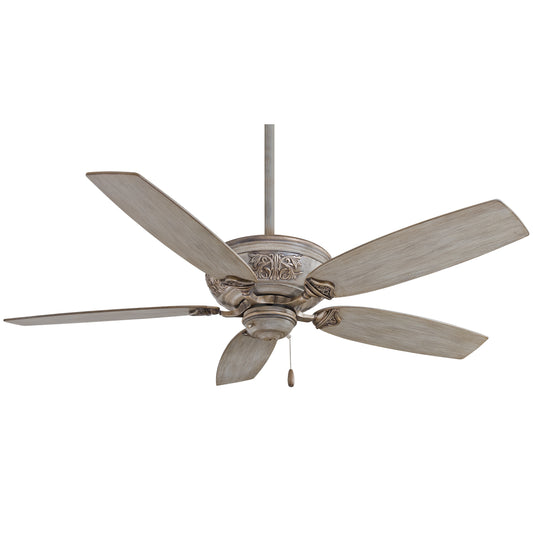
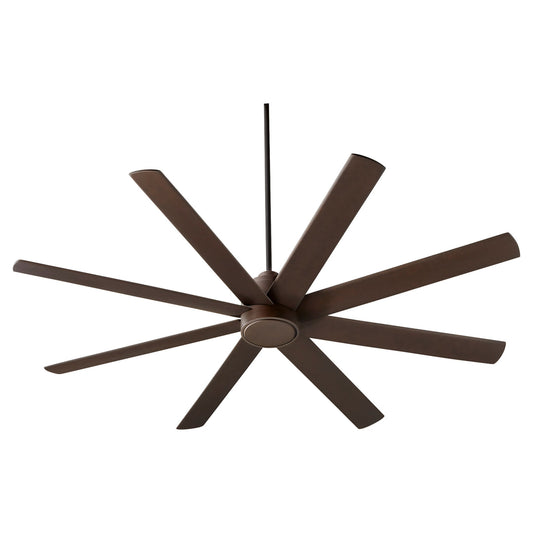
Visit a Local Showroom: Start by finding a good lighting or fan showroom in your area. This lets you get your hands on the fans and really see the build quality, finishes, and size. Seeing a sculptural model like the Minka-Aire Artemis XL5 in person is a completely different experience than looking at a picture online. You can truly appreciate the craftsmanship that commands its $700+ price tag.
-
Gather Expert Advice: While you're there, pick the salesperson's brain. A good one can give you priceless advice on sizing, what kind of motor to look for, and any installation quirks.
-
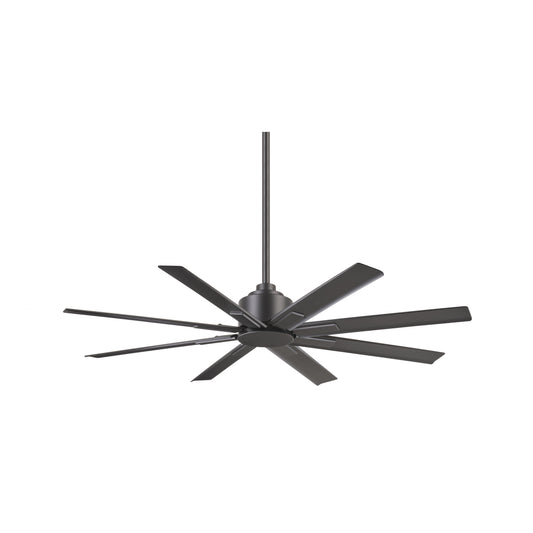
Expand Your Search Online: Once you have that real-world knowledge, head online to a specialized retailer. You’ll find a much bigger selection of unique designs, like the sleek Modern Forms Aerovon, a high-end smart fan often priced over $500 that most local stores just don't have the space to stock.
This hybrid approach empowers you to make a solid, informed decision. If you want to get into the nitty-gritty of the technical stuff, our comprehensive ceiling fan buying guide covers everything from CFM to blade pitch. By understanding all your options, both in-person and online, you can be sure the fan you pick is the perfect one for your home.
Evaluating Your Local Ceiling Fan Showroom
While scrolling through endless options online has its perks, there’s nothing quite like seeing a ceiling fan in person. A trip to a local showroom lets you step away from the screen and get a real feel for what you’re buying. It's your chance to see how the light hits that bronze finish or feel the solid construction of a premium model before you commit.
Think of it this way: a high-quality fan is basically furniture for your ceiling. You wouldn't buy a new sofa without sitting on it, would you? The same logic applies here. Seeing a beefy model like the Fanimation Andros or the beautifully crafted Craftmade Chisel up close helps you understand what makes a $300+ fan worth the investment.
What to Look for Beyond the Price Tag
When you walk into a potential store, your first mission is to figure out if it's a genuine specialty showroom or just a hardware store with a few fans hanging around. A true expert offers value that lasts long after you've made the purchase. This little infographic can help you map out your priorities as you search.
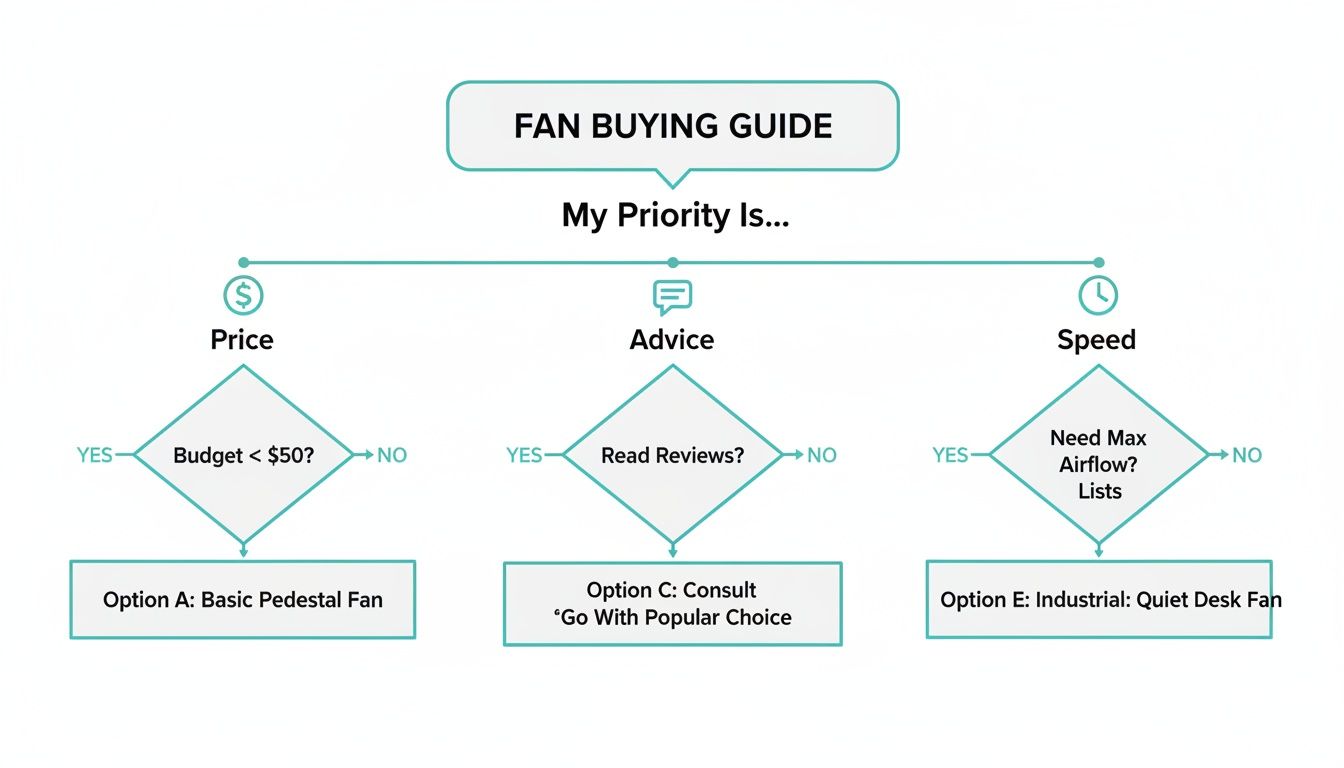
As the flowchart shows, price is just one piece of the puzzle. Expert advice is just as important, especially when you're investing in a fan you expect to last. Here are the key questions to ask yourself while you're scoping out a local retailer:
- Staff Expertise: Do the employees know their stuff? Can they talk about blade pitch, motor types, and CFM ratings, or are they just reading off the box? A truly knowledgeable salesperson can steer you toward the perfect fan for your room's unique needs.
- Installation Services: Do they offer professional installation or have a list of trusted local electricians they work with? Getting the installation right is a big deal for both safety and performance, and a good showroom should have solid recommendations.
- Warranty and Support: What happens after you buy? Ask about the manufacturer's warranty and what the store’s role is in handling any future issues or claims.
- Return Policy: Make sure you understand their return policy. It should be clear and fair, giving you options in case the fan just doesn't work in your space once you get it home.
A great local showroom is more than just a store—it's a resource. Their team makes sure your choice isn't just stylish, but also a perfect fit for your home's airflow and structure, saving you from costly mistakes later on.
Distinguishing a Showroom from a Big-Box Store
The real difference boils down to two things: the depth of their collection and the focus of their service. A dedicated showroom will have a hand-picked selection of higher-end, design-focused brands you just won’t find at a big-box store. If you want to see how the two compare, check out some reviews of ceiling fans available at local hardware stores.
When you prioritize real expertise and service, your purchase becomes a confident investment instead of just another transaction.
The Power of Specialized Online Fan Retailers
While nothing beats seeing a fan in person at a local showroom, the digital world is where your search for the perfect ceiling fan really opens up. Specialized online retailers are a game-changer, acting as a practically limitless showroom you can browse from your couch. You’re no longer limited to what a local store can physically fit on its floor.
Imagine you’re looking for something specific, like the industrial-chic Hunter Bowie (often priced around $400) or the tropically inspired Quorum Cabana fan, a model that can easily exceed $350. Instead of driving all over town hoping to get lucky, you can have hundreds of incredible options right at your fingertips. That’s the real advantage of shopping with a curated online expert.
Unlocking an Unbeatable Selection
The biggest draw of dedicated online fan stores is the sheer variety. The top five global manufacturers only make up about 25% of the market, which leaves a huge 75% to smaller, more design-focused brands you’ll almost exclusively find online. A local store might stock a few dozen fans, but a good online retailer brings together hundreds of models, giving you access to everything from minimalist 3-blade designs to grand 6+ blade statement pieces.
Considering that residential homes account for over 60-80% of all ceiling fan usage, this huge demand for different styles is best met online. In a way, these stores become the "nearest" option for anyone looking for that perfect design.
Online retailers put all the information you need in one place. You get detailed specs, customer-submitted photos, and honest reviews, giving you a complete picture of a product before you even think about buying. It's about making a confident decision.
Smart Tools for a Smarter Choice
Navigating a massive selection could feel overwhelming, but specialized online stores have excellent filtering tools that actually make it fun. You can instantly sort all your options by:
- Style: From modern farmhouse to sleek industrial.
- Finish: Find the perfect match, whether it's matte black, brushed nickel, or warm walnut.
- Blade Count: Dial in the exact look and performance you need.
- Features: Filter for models with integrated LED lights, remote controls, or smart home compatibility.
This level of control saves you hours of aimless scrolling. It’s a smart approach that works for lots of home decor items—for instance, many people use similar filtering when searching for the best places to buy curtains online to nail their interior design. It puts you in the driver’s seat, making sure you find a premium fan that perfectly fits your space and budget.
If you're still weighing your options, our guide can help you compare prices of ceiling fans at nearby retailers versus what you'll find online.
How to Find the Best Local Stores Worth Visiting
Let's get smart about finding a great local spot to buy your next ceiling fan. A quick search for "ceiling fans near me" will flood you with results for the big-box stores, but the real gems—those specialty showrooms with expert staff and high-end models—are often hiding just beneath the surface. Uncovering them just takes a little strategy.
Instead of a generic search, you need to think more like a designer. Using specific, targeted phrases can completely change your results, pointing you toward stores that prioritize quality and craftsmanship over just moving boxes.

Upgrade Your Search Terms
To find shops that stock premium fans, you have to use the right language. Think beyond just "ceiling fans" and search for the types of places that would carry them.
- "Lighting showroom with fan displays near me": This is a great one. It targets businesses that specialize in high-quality fixtures and are way more likely to have a dedicated fan section you can actually browse.
- "Home design center near me": These centers often feature curated selections of home goods, including the kind of stylish ceiling fans that interior designers spec for their projects.
- "[Brand Name] ceiling fan dealer near me": Already have a high-end brand in mind? Searching for an authorized dealer is the most direct route to finding exactly what you want.
These refined searches help filter out all the noise, leading you straight to the experts. You might also consider looking up local cooling services providers who sometimes offer fan installation or can give you solid advice as part of their broader work.
Use Map Filters to Your Advantage
Once your smarter search gives you a list of potential stores, it's time to vet them without leaving your couch. Google Maps is a surprisingly powerful tool if you know how to dig into its filters and features.
Think of a map listing as a digital storefront. The photos, reviews, and business details are your first chance to peek inside and decide if a store is worth a real-life visit. It’s a quick, easy way to pre-qualify your options.
Before you grab your keys, take a few minutes to do this quick digital recon:
- Check Customer Photos: Don't just look at the slick marketing shots. Scroll through photos uploaded by actual customers to see what the showroom really looks like and the kind of inventory they have on display.
- Read the Reviews (with a filter): Search the reviews for keywords like "ceiling fans," "knowledgeable staff," or specific brands. This gives you real insight into other customers' experiences with the exact products you're interested in.
- Confirm the Hours: This sounds obvious, but always double-check their operating hours before you head out. Specialty showrooms often keep different hours than big retail chains.
This simple approach saves you a ton of time and gas, ensuring that every store you decide to visit is one that’s likely to have the high-quality, stylish fan you’re looking for.
Your Pre-Purchase Checklist for the Perfect Fan
Before you head to the store or click "buy now," a little prep work can save you a world of headache. Seriously, running through a quick checklist is the best way to avoid that sinking feeling of buyer's remorse. This isn't just about finding a fan that looks good; it's about making sure it’s the right fan for your space in every way.
Think of this as your game plan. It’ll help you walk away with a fan that’s a perfect match for your room.
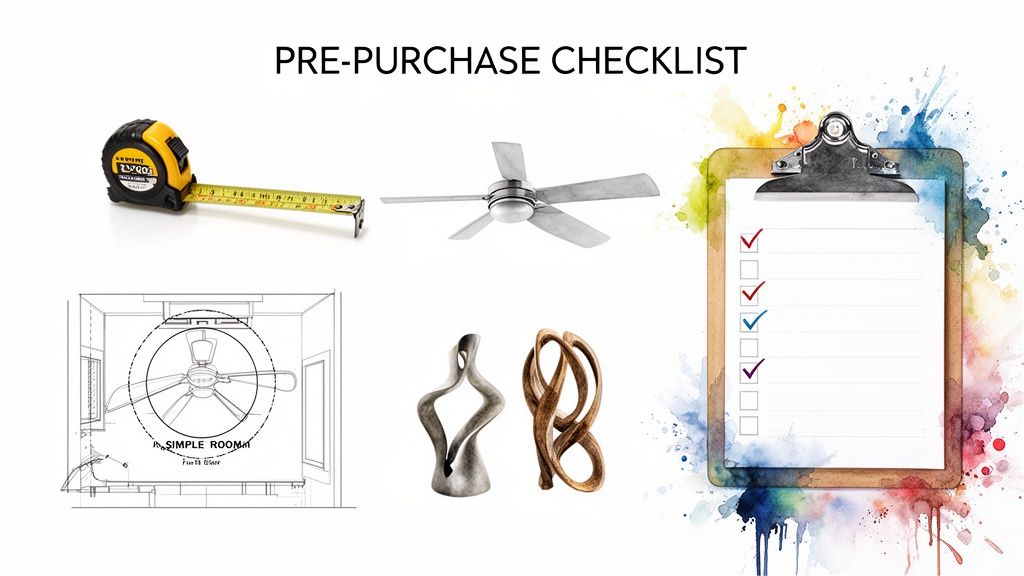
The whole process starts with a tape measure. These numbers aren't suggestions—they're the rules that will dictate which fans are even an option. Getting this right from the start is the key to good airflow and, more importantly, safety.
Nail Down the Measurements
First thing's first: figure out your room's square footage by multiplying its length and width. This number is directly tied to the ideal blade span, which is just the fan's total diameter from blade tip to blade tip.
Next, measure the distance from the floor to the ceiling. This is super important for choosing the right downrod—that’s the pipe connecting the fan motor to the ceiling mount. For safety, fan blades should always be at least 7 feet from the floor. But if your ceilings are taller than 9 feet, you’ll need a longer downrod to bring the fan down to a height where it can actually move some air.
Here are a few common scenarios:
- 9-foot ceiling: A 6-inch downrod is usually all you need.
- 10-foot ceiling: A 12-inch downrod typically works great.
- 12-foot ceiling: You'll probably be looking at an 18-inch downrod.
A properly sized fan and downrod will make all the difference in performance. To help you get it just right, we've put together this handy guide.
Ceiling Fan Sizing and Placement Guide
| Room Size (Sq. Ft.) | Recommended Fan Diameter | Ceiling Height | Recommended Downrod Length |
|---|---|---|---|
| Up to 75 | 29" - 36" | 8' | Flush-mount or 3"-5" |
| 76 - 144 | 36" - 42" | 9' | 6" |
| 145 - 225 | 44" - 50" | 10' | 12" |
| 226 - 400 | 50" - 54" | 11' | 18" |
| Over 400 | 54" or larger | 12' | 24" |
This table is a great starting point, but always double-check the manufacturer's recommendations for the specific model you're considering.
The most common mistake people make is buying a fan that's too small for the room or hangs way too high. The result is a fan that looks nice but does absolutely nothing to move the air.
Match the Fan to Your Style
Once you have the technical specs figured out, it's time for the fun part—finding a style that fits your home. A ceiling fan should feel like a natural part of your decor, not something that sticks out like a sore thumb.
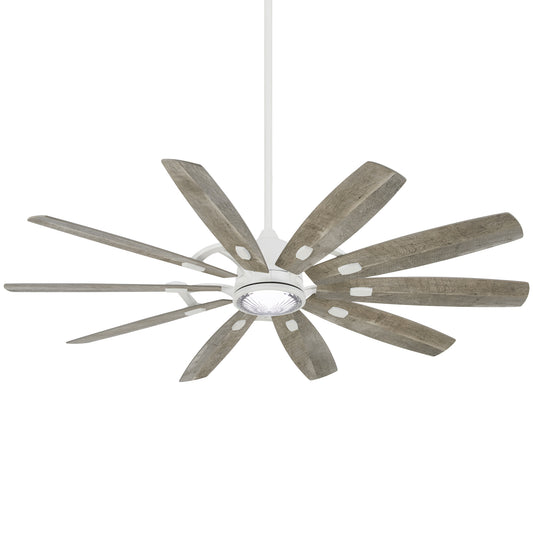
If your home has a rustic or farmhouse vibe, a fan like the Savoy House Barn with its warm wooden blades and classic finish would fit right in. On the other hand, if your space is sleek and minimalist, the sharp lines and metallic finish of the Monte Carlo Apex fan would be a much better complement. Take a look at your room's color palette, furniture, and overall feel before you make a final decision.
Finalize the Functional Features
Last but not least, think about how you'll actually use the fan every day. Will it be your room's main light source? If so, pay close attention to the light's color temperature—a warm 2700K gives off a cozy, inviting glow, while cooler temperatures can feel a bit stark and clinical.
Don't forget about convenience, either. Modern fans often come with remote controls, which are a huge upgrade from those old pull chains. And if you really want to make life easy, look for a smart fan that can connect to your phone or a home assistant. Controlling your fan's speed and lighting with a quick voice command is a game-changer.
Why a Curated Collection is a Game Changer
When you start searching for a "ceiling fan store near me," the number of options can be dizzying. A lot of stores seem to think more is always better, burying you in a mountain of generic, forgettable models. But the best retailers know that's not the case. They take a different route: a curated collection.
This isn't about giving you fewer choices; it's about giving you better ones. A curated approach means someone with a good eye has already handpicked every single fan for its design, performance, and durability. It’s like the difference between a sprawling, all-you-can-eat buffet and a chef's tasting menu—one gives you sheer volume, the other guarantees that every single item is exceptional.
The Value of an Expert's Eye
Instead of making you wade through a sea of low-budget fans that might start wobbling in a couple of years, a curated seller presents a focused lineup of standout models. This saves you an incredible amount of time and mental energy. You can shop with total confidence, knowing that whatever you pick is a solid investment that’s already been vetted by an expert.
This is especially true when you're looking to invest in a premium fan that costs $300 or more. These aren't just appliances; they're major design features in your home.
A retailer with a curated collection is more like a design partner. They've done the tedious work of filtering out the duds, so you can focus on the fun part: finding a fantastic centerpiece that elevates your entire space.
Finding Your Perfect Centerpiece
When a collection is thoughtfully put together, it's so much easier to find a fan that clicks with your home's style. You get to browse stunning, conversation-starting models like the elegant Kichler Artiste (a beautiful fan that often retails for $400+) or the powerful, minimalist Casablanca Aviation. These are the kinds of fans you simply won't find tucked away between budget models at a big-box store.
A curated selection guarantees you’re not just buying a fan; you’re choosing a piece of functional art. It makes the whole experience more enjoyable and leads to a final result that adds real, lasting style to your home.
A Few Final Questions on Buying a Ceiling Fan
You're almost there, but a few questions might still be swirling around. To make sure you feel totally confident in your choice, here are the answers to some of the most common things shoppers ask when they're about to buy.
How Much Should I Really Spend on a Good Ceiling Fan?
Sure, you can find a fan for under $100, but from our experience, stepping up to the $300 mark and beyond makes a massive difference in quality, performance, and how long that fan will last.
Premium fans just have better guts—quieter, more efficient motors, blades made from materials that won't warp or wobble, and designs that actually look like a deliberate style choice. Think of it as an investment in your home. You'll feel the difference every day.
Can I Install a Ceiling Fan Myself?
If you've done some basic electrical work before and don't mind spending time on a ladder, a DIY installation is totally doable. Most fans come with step-by-step instructions that walk you right through it.
But—and this is a big but—if you're looking up at a two-story ceiling, wrestling with a particularly heavy fan, or just have a healthy fear of wiring, call a licensed electrician. It's the safest route. They'll make sure it's mounted securely and wired correctly, so you can sleep easy.
One critical detail people often miss is the electrical box in the ceiling. It has to be fan-rated. A regular box for a light fixture just isn't built to handle the weight and constant motion, and you don't want to risk it coming down.
Do I Actually Need a Light on My Ceiling Fan?
This really comes down to the lighting you already have in the room. If the fan is going to be your main light source, then getting a model with an integrated LED light kit is a no-brainer. Look for the light's color temperature, which is measured in Kelvins (K). For that warm, inviting glow you want in a living room or bedroom, something around 2700K is perfect.
On the other hand, if your room is already well-lit with lamps or recessed lighting, a fan without a light can look incredibly clean and sleek. It keeps the design simple and puts all the focus on airflow and style.
At Fan Connection, we've done the hard work for you. Our curated collection is all about helping you find that perfect, high-quality fan without the endless searching. We handpick the best models so you know you're getting a fan that's both beautiful and built to last.


