











Reviews of Ceiling Fans Available at Local Hardware Stores: A Fun Buyer's Guide
Walking into a big-box hardware store for a ceiling fan can feel like a quick win, but what are you really getting out of that box? Sure, for basic needs, those fans might do the job. But if you’re looking for lasting style, superior performance, and operation so quiet you'll forget it's on, you need to level up and consider models priced over $300. Let’s be honest, you deserve a fan that's more than just a placeholder on your ceiling.
Why Hardware Store Fans Are Just the Appetizer
The familiar aisle of ceiling fans at your local hardware store offers convenience, but it's often a sea of sameness. These models are built for mass appeal, which means prioritizing a low price tag over long-term value. As a result, they often come with built-in limits on both performance and style. They’re the appetizer, not the main course.
The global ceiling fan market is exploding, on track to hit USD 15.23 billion by 2030. While standard fans still hold the biggest market share, customer reviews are telling a different story. People are starting to demand more—specifically, energy-efficient BLDC motors and smarter features, which is pushing the market toward higher-quality models. You can discover more about these market trends on Mordor Intelligence.
The Convenience Trap
It’s easy to grab a box off the shelf and head to the checkout, but that convenience usually comes at a hidden cost. Most hardware store fans are built with standard AC motors, which are simply less efficient and far noisier than the DC motors you’ll find in premium fans. They might look decent on the display, but their real-world performance can leave you feeling pretty underwhelmed. A great fan doesn't just look good; it performs flawlessly.
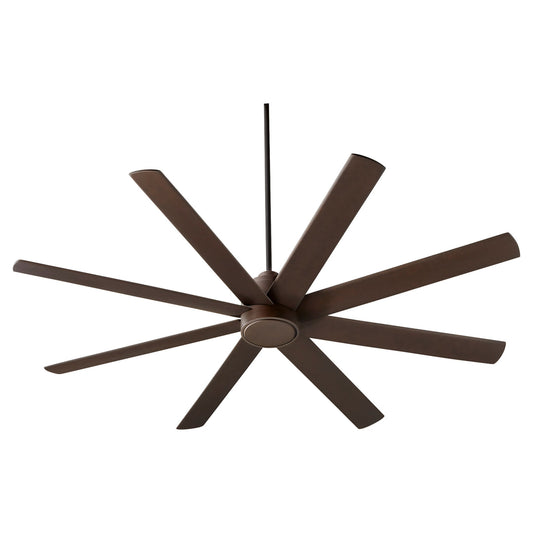
Use the hardware store as your research lab. See the basic models, touch the materials, and then use that knowledge as a baseline to find something truly exceptional—like the Minka-Aire F844-DK, a stunning 52" fan that combines a sleek koa finish with powerful airflow for around $400.
Setting a Higher Standard
Think of the hardware store as the first step in your fan-buying journey, not the final destination. It’s a great place to get a feel for basic sizes and styles, but for a fan that becomes a true centerpiece of a room, you'll want to explore specialized retailers. This is where you find fans that actually deliver:
- Superior Airflow: Engineered for maximum efficiency and power.
- Whisper-Quiet Operation: DC motors that eliminate that annoying hum.
- Designer Aesthetics: Unique styles that genuinely elevate your home's decor.
- Long-Term Value: Better warranties and durable construction that will last for years.
By understanding what the big-box options lack, you can make a much more informed decision. While you're starting your search, our guide on the best ceiling fan stores near you can help you explore a wider variety of high-performance options. This approach lets you move beyond a simple purchase and make a lasting investment in your home's comfort and style.
Decoding The Box: An In-Store Fan Shopper's Checklist
Walking down the hardware store aisle, you're hit with a wall of ceiling fan boxes. Each one has a flashy design and a promise of the perfect breeze. But to make a smart choice, especially when you're looking at models over $300, you need to ignore the marketing fluff and get straight to the technical specs printed on the packaging.
Think of the box as the fan's resume. It’s your job to read between the lines and see if it’s actually qualified for the job before you even think about buying it. This simple checklist will walk you through the most important performance details to find a fan that truly delivers.
This process is all about doing your homework in the store so you can make a smarter final purchase, whether it's there or online.
Here's what you need to be looking for.
Airflow Is King: CFM Over Everything
The single most important number you'll find on any ceiling fan box is its CFM (Cubic Feet per Minute) rating. This isn't just jargon—it's the real-world measure of how much air the fan can actually move. A higher CFM means stronger air circulation and a much more effective breeze. Plain and simple.
Don't let the number of blades fool you. I've seen beautifully engineered three-blade fans with a high CFM that can run circles around a clunky five-blade fan with a weak rating. For example, the Hunter Apex 54" fan, priced around $350, boasts an impressive CFM that puts many larger fans to shame. When you're comparing models, the CFM is your north star. If you want to dive deeper into what this metric really means for your home's air movement, check out this guide on What Is CFM In Hvac And Why It Is Critical For Your Home.
As a rule of thumb, a fan with a CFM below 4,000 is going to feel pretty underwhelming in an average-sized room. For a breeze you can actually feel, you should be looking for a fan with a CFM of 5,000 or higher.
The Motor: The Heart Of The Fan
The motor is what separates a good fan from a great one. It dictates how efficient, quiet, and long-lasting your fan will be. On the box, you'll generally find two types:
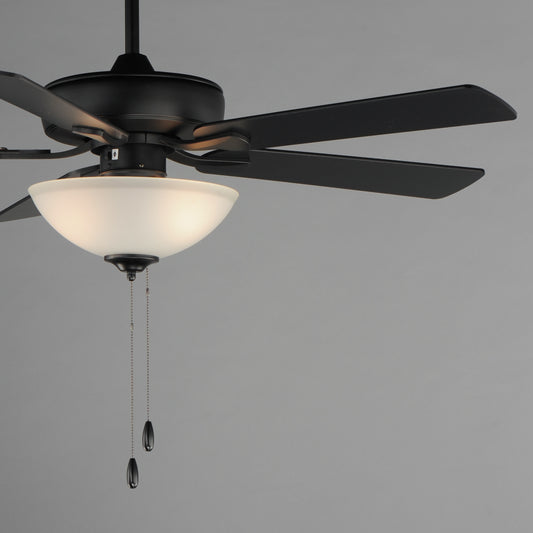
- AC (Alternating Current): This is the old-school, standard technology you'll find in most budget fans. AC motors get the job done, but they're less efficient and are known for producing that familiar, low-grade motor hum.
- DC (Direct Current): This is what you'll find in modern, premium fans. DC motors are a huge step up. They can use up to 70% less energy, run almost silently, and usually come with more speed options and handy features, like reversing the blade direction right from the remote.
If you care about long-term value and peace and quiet, a DC motor is a must-have.
Blades: Why Material And Pitch Matter
Beyond just how they look, the blade material and their pitch—the angle they're set at—directly impact how well the fan works. A lot of hardware store fans use basic MDF or plywood blades, which are fine, but premium fans often use solid wood or molded ABS plastic. These higher-quality materials are less likely to warp over time and are better balanced from the factory, which means less wobbling.
Blade pitch, which is measured in degrees, determines how much air the blades can scoop and push down. A steeper pitch, usually between 12 and 15 degrees, is going to move a lot more air and contribute to a higher CFM. A fan with flat-looking blades might have a sleek profile, but it's going to struggle to create a breeze you can actually feel.
Of course, the size of the fan matters, too. For more on that, you can check out our guide on choosing the right ceiling fan size for maximum efficiency.
In-Store Ceiling Fan Evaluation Checklist
When you're standing in the aisle, it's easy to get overwhelmed. Use this quick reference table to cut through the noise and compare fans like a pro. It breaks down what to look for, what to avoid, and why each feature is so important for the fan's performance.
| Feature To Check | What To Look For (Good) | What To Avoid (Red Flag) | Why It Matters For Performance |
|---|---|---|---|
| Airflow (CFM) | 5,000+ CFM for most rooms | Below 4,000 CFM | Higher CFM equals better air circulation and a stronger cooling effect. |
| Motor Type | DC Motor | AC Motor (unless on a tight budget) | DC motors are quieter, up to 70% more energy-efficient, and offer more speeds. |
| Blade Pitch | 12–15 degrees | Less than 12 degrees | A steeper pitch allows blades to "scoop" and move more air effectively. |
| Blade Material | Solid wood, ABS plastic | MDF, plywood, cheap plastic | Higher quality materials prevent warping, reduce wobble, and last longer. |
| Controls | Remote or wall control with 6+ speeds and reverse function | Pull chains, 3-speed only | More control options offer better comfort customization and convenience. |
| Energy Efficiency | ENERGY STAR certified; high CFM/watt ratio | No efficiency rating listed | Indicates lower operating costs and a smaller environmental footprint. |
Having this checklist in mind will help you quickly identify the high-performers on the shelf and steer clear of the ones that just look good on the box. It’s all about finding a fan that will keep you comfortable for years to come.
The Showroom Illusion: What In-Store Demos Hide
Walking down the ceiling fan aisle at a big-box hardware store is like stepping into a perfectly staged performance. Fans spin gracefully overhead, looking quiet, powerful, and ready to solve all your stuffy-room problems. But that showroom perfection? It's mostly an illusion, designed to hide how these fans will really act once you get them home.
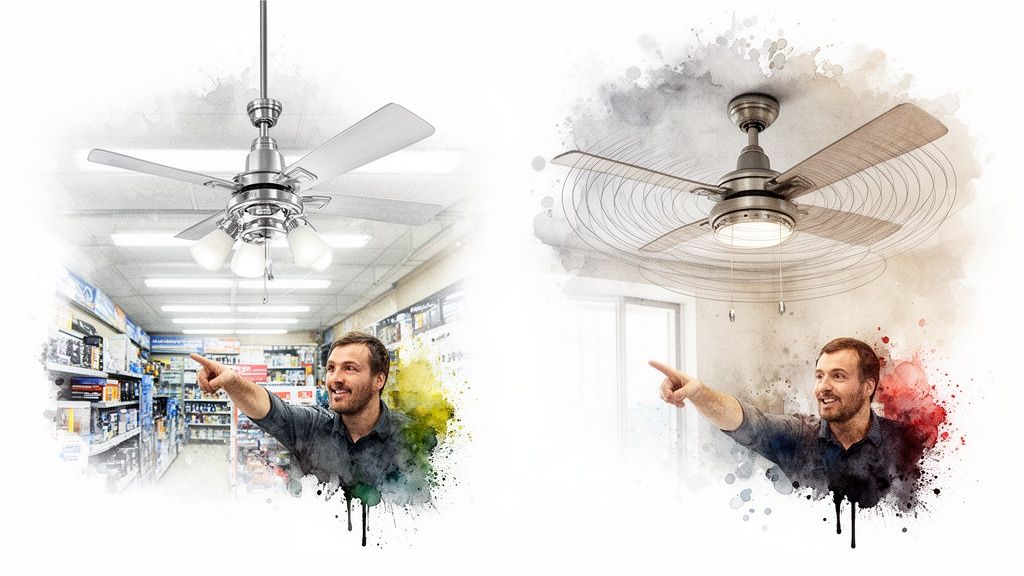
This carefully controlled environment is great for sales but terrible for real-world testing. The huge, open space and soaring ceilings of a retail store make any fan seem more effective because there are no walls to get in the way of airflow. Plus, the constant background hum of a busy store easily masks the faint clicks, whirs, and motor noises that would drive you crazy in the quiet of your bedroom at 2 AM.
Seeing Past the Display
To get a true sense of a fan's quality, you have to be a skeptic. Don't just stand back and admire it—get up close. Try to listen past the store's ambient noise for the sound of the motor itself. Can you hear a faint buzz or a high-pitched whine? Those sounds will only get louder in your house.
Next, watch the fan running at its highest speed. If you see even a tiny wobble in the store, that’s a massive red flag. That slight shake will almost certainly become a significant, noisy wobble once it's mounted on a standard ceiling in your home. An unstable fan isn't just an annoyance; it's a sign of cheap construction and poor balance that can lead to a shorter lifespan for the motor.
The pristine, perfectly steady fan you see on display was installed by a pro under ideal conditions. It’s not a true reflection of how it will perform day-to-day in a real home, where motor noise and wobbles quickly become impossible to ignore.
What the Demo Doesn't Tell You
The single biggest thing an in-store demo can't show you is long-term reliability. A fan might run just fine for a few hours on the showroom floor, but what happens after a few years of daily use? This is where many big-box store models, especially those with basic AC motors, start to show their weaknesses.
To really understand what you're buying, a quick visual inspection isn't enough. It's why so many savvy shoppers are now looking to specialized online retailers that offer premium models often priced over $300. Here’s what you get that a store demo will never reveal:
- Detailed Performance Data: You get access to exact CFM ratings, energy efficiency metrics (CFM per watt), and clear motor specs, letting you make a true apples-to-apples comparison.
- Verified Customer Reviews: Nothing beats honest feedback from actual homeowners. These reviews give you the inside scoop on real-world noise levels, installation headaches, and how the fan holds up over time.
- Better Warranties: Premium brands back their products. They offer comprehensive warranties that cover the motor for a decade, or even a lifetime—a level of confidence you just don't find on a hardware store shelf.
By looking beyond the polished showroom floor, you can make an informed investment based on proven performance and quality that lasts, not just a fleeting first impression.
Analyzing The True Cost Of A Hardware Store Fan
That low price tag on a fan at the local hardware store is hard to ignore, but what’s the real story behind that "bargain"? Anyone who's been around the block knows the sticker price is just the beginning. To get the full picture, you have to look at what that fan will really cost you over its entire life.
When you put a standard big-box store fan up against a premium, energy-efficient model that costs $300 or more, the math starts to tell a very different story. The money you save on day one can get chewed up surprisingly fast by higher electricity bills and the very real possibility you'll be replacing it in just a few years.
Beyond The Initial Price Tag
Let’s dig into the hidden costs. Most of those budget-friendly fans are running on old-school AC motor technology, which is a notorious energy hog. A premium fan with a modern DC motor, on the other hand, is built from the ground up for efficiency. It can use up to 70% less energy to move the same amount of air—or even more.
Over five years, that difference really adds up. Suddenly, the extra you spent upfront on a quality fan gets paid back through lower monthly energy bills. It stops being an expense and becomes a smart investment that literally pays for itself. This is where concepts like value engineering come into play—it's all about looking at the bigger picture of performance versus price.
Calculating Lifetime Value
Total cost of ownership isn't just about what you pay the electric company. It’s also about maintenance, repairs, and how long the fan will actually last. A cheap fan that starts wobbling or making noise after a year or two isn't a bargain—it's a headache that will have you spending money all over again.
A premium fan like the Casablanca Wisp, available for around $330, isn’t an expense; it’s an investment in your home's comfort, style, and efficiency. The upfront cost is higher, but the long-term savings and superior performance deliver far greater value over time.
Energy efficiency is a huge deal in both reviews of ceiling fans available at local hardware stores and online. Shoppers are getting smarter, and they’re looking for models that can slash electricity use by 50-70% compared to older fans. The smart ceiling fan market is on track to hit USD 993.6 million by 2025, and residential homes make up over 80% of that demand, thanks to features like app controls and smart home tie-ins.
The Aesthetic Impact
Finally, let’s not forget how a fan looks. A generic, off-the-shelf fan can drag down the whole vibe of a thoughtfully designed room. When you invest in a stylish, well-made fan that actually complements your decor, it adds real value to your home. It goes from being a simple appliance to a functional centerpiece.
If you're weighing your options, our guide can help you compare prices of ceiling fans at nearby retailers to make the right call. Once you look at the complete picture, the true cost of that "bargain" fan becomes crystal clear.
When to Upgrade From a Big-Box Basic to a Premium Fan
So, how do you know when that standard, off-the-shelf fan from your local hardware store just won’t cut it? It all comes down to the unique demands of your space. A generic fan is a one-size-fits-all attempt, but great design and real comfort come from choosing a fan that’s perfectly matched to its environment.

There are clear tipping points where upgrading to a specialized, premium model over $300 isn't just an aesthetic choice—it's a practical necessity for performance and durability. Knowing when you've hit one of those points is key to making a smart investment.
For Spaces With Architectural Drama
Rooms with high or vaulted ceilings are notorious for trapping warm air, making them feel stuffy and uncomfortable. A standard hardware store fan often just doesn't have the motor power or blade design to effectively circulate air in such a large volume of space.
This is where a purpose-built fan really shines. Models designed for great rooms often feature:
- Longer downrods to position the fan at the optimal height for air movement.
- Powerful DC motors that generate high CFM without sounding like a helicopter.
- Larger blade spans (60"+) to move a massive column of air efficiently.
Without these features, a basic fan will just spin ineffectively far above your head, doing very little to actually improve the room’s comfort.
A ceiling fan should never be an afterthought. In a well-designed room, it's a functional centerpiece. Investing in a fan that complements your architecture is the difference between a functional appliance and a statement piece.
When Durability Is Non-Negotiable
Outdoor living spaces like patios, pergolas, and lanais present a whole different challenge. These areas are exposed to humidity, moisture, and temperature swings that can absolutely destroy an indoor-rated fan in a single season. This is where a fan's UL rating becomes critically important.
- Damp-Rated Fans: These are built for covered outdoor areas, like a screened-in porch, where they won't get hit directly by rain but will still be exposed to moisture in the air.
- Wet-Rated Fans: This is the heavy-duty option. These fans are engineered with weather-resistant materials and sealed motors to withstand direct exposure to rain, snow, and even salt air.
A generic indoor fan will quickly rust, warp, and become a safety hazard outdoors. Investing in a properly rated outdoor model like the Fanimation Studio Collection Vintere, priced over $500, isn't just a suggestion—it's essential for both longevity and safety.
Elevating Your Interior Design
Sometimes, a fan needs to do more than just move air; it needs to complete the look of a room. In a carefully curated living room or master bedroom, a bland, generic fan can stick out like a sore thumb, undermining your entire design scheme.
In fact, while reviews of ceiling fans available at local hardware stores often praise standard 3-5 blade fans for their reliability, a major complaint is the lack of stylistic variety. This often pushes buyers to seek out specialized options like tropical or rustic designs elsewhere. Fan Connection directly addresses this gap by offering curated collections that provide the reliability people trust with an elevated, modern style. You can discover more insights about these consumer trends from MarkNtel Advisors.
Answering Your Top Questions About Choosing a Ceiling Fan
Deciding to skip the big-box store and look for something better online can bring up a few questions. That's totally normal. To help you feel confident you're making the right call, we've pulled together the most common questions shoppers ask when they're comparing a basic fan to a premium one. Here are the straight answers you need to make a smart investment in your home.
Are Expensive Ceiling Fans Really Worth It?
Yes, they are—especially when you think about long-term value instead of just the price on the box. A basic hardware store fan has a tempting low price, but a premium fan (think $300 and up) is an investment in better engineering, better materials, and a much better experience.
Most of our fans feature high-efficiency DC motors that are up to 70% more energy-efficient than the AC motors in cheaper fans. That translates directly into savings on your electricity bill. You're also paying for whisper-quiet operation, durable parts that won't warp or wobble, and solid warranties. You're not just buying a brand; you're getting lasting performance that elevates your space.
What Is CFM And Why Is It So Important?
CFM stands for Cubic Feet per Minute. It’s the single most important number to look at because it tells you exactly how much air the fan actually moves. It’s the true measure of a fan’s cooling power.
It's easy to get distracted by things like the number of blades, but a well-designed 3-blade fan can easily outperform a clunky, poorly engineered 5-blade model.
A fan's ability to create a real breeze comes from a smart combination of blade pitch, motor power, and aerodynamics—not just blade count. Always, always look for a high CFM rating. A bigger number means better air circulation, period.
Can I Install A Premium Fan Myself?
Absolutely. If you’ve ever put up a fan from a hardware store, you’ll find the process for a premium model feels very familiar. Honestly, it's often a much smoother experience.
Premium fans usually come with:
- Clearer instructions that actually make sense and guide you step-by-step.
- Higher-quality mounting hardware designed for a secure, wobble-free fit.
- Parts that are engineered to fit together perfectly, without any of that frustrating guesswork.
The wiring is generally just as straightforward, even for models with remote controls. That said, if you're ever unsure about your home's wiring, calling a licensed electrician is always the safest move.
How Do I Choose The Right Size Fan?
Getting the fan size right for your room is non-negotiable for good airflow. This is one of the most common mistakes people make, and a fan that's too small will leave you with a weak, disappointing breeze.
Here’s a simple guide to get you started:
- Small Rooms (Up to 75 sq. ft.): Stick with a blade span under 36 inches.
- Medium Rooms (76 to 144 sq. ft.): A 42- to 50-inch fan is the sweet spot for most bedrooms.
- Large Rooms (145 to 400 sq. ft.): You'll need a 52-inch fan or larger to properly cool the space.
- Great Rooms (Over 400 sq. ft.): Go big with an oversized fan (60+ inches). For extra-large spaces or rooms with high ceilings, using two fans is often the best way to get balanced circulation.
At Fan Connection, we've already done the hard work of curating a collection of stylish, high-performance fans. Instead of settling for a generic model that just gets the job done, find the perfect fan that combines powerful airflow with a design you'll love for years to come. Check out our curated ceiling fan collections.


