







Choosing Ceiling Fan Mounting Bracket Types for Any Room
Picking the right ceiling fan mounting bracket isn't just a step in the installation process—it's the secret handshake to a fan that's safe, sturdy, and won't wobble like it's auditioning for a dance competition. It all boils down to three main contenders: flush mounts for low ceilings, downrod mounts for standard or high ceilings, and angled mounts for those tricky sloped surfaces. Getting this choice right from the get-go guarantees your fan will be a breezy, beautiful, and safe addition to your home.
Matching Your Fan Bracket to Your Ceiling
That little piece of metal—the ceiling fan mounting bracket—isn't just some random bit of hardware. It’s the critical link, the trusty sidekick, between that gorgeous fan you picked out and the very structure of your home. This one component influences everything from how well the air circulates to the final, jaw-dropping look of your room. Nail this decision, and you'll save yourself from future headaches, annoying wobbles, and some seriously scary safety risks.
Think of it as the foundation of a house. A shaky or mismatched foundation compromises the whole building, and the same goes for your ceiling fan. The bracket has to be a perfect match for your ceiling's height and angle, not to mention the fan's weight, to create a secure anchor that won't let you down.
The Foundation: A Fan-Rated Electrical Box
Before you even start daydreaming about bracket types, there’s one non-negotiable piece of the puzzle: a UL-listed, fan-rated electrical box. A standard plastic electrical box, the kind used for a simple light fixture, just can’t handle the dynamic load and constant shimmy of a ceiling fan, which can weigh 50 pounds or more.
Fan-rated boxes are made of metal and are bolted directly to a ceiling joist, giving you the raw structural support needed to hang a fan without a single worry.
This handy little flowchart breaks down how to choose a bracket based on your ceiling.
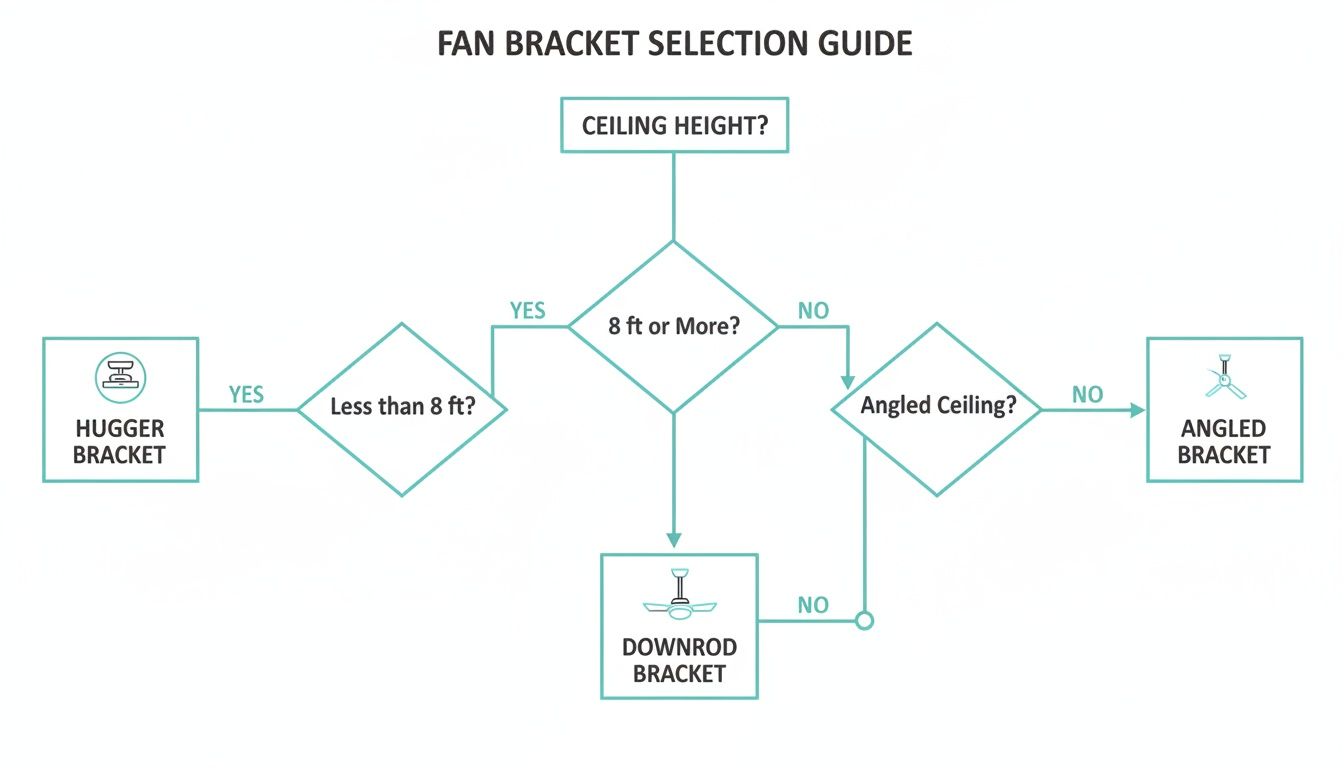
As you can see, your ceiling height is the first thing to consider. It immediately narrows down your options and sets you on the right path to fan nirvana.
Why Bracket Choice Matters So Much
Choosing the right mounting bracket goes beyond just safety. It also has a huge impact on your fan's performance and how it looks in the room.
- Airflow Efficiency: A fan hung too high on a vaulted ceiling or squished too close in a low-ceiling room just won't move air properly. The right bracket gets the blades to the sweet spot—usually 7 to 9 feet from the floor—for the best possible breeze.
- Visual Harmony: The bracket really dictates how the fan fits into your space. A flush mount gives a clean, low-profile look, while a long downrod can turn a fan into a dramatic centerpiece in a room with soaring ceilings. Making sure your fan choice works with your home's look is one of the key interior design principles.
Once you get these fundamentals down, you can move forward with confidence, knowing you're making a smart choice that ensures both style and security.
The Unsung Hero for Low Ceilings: Flush Mount Brackets
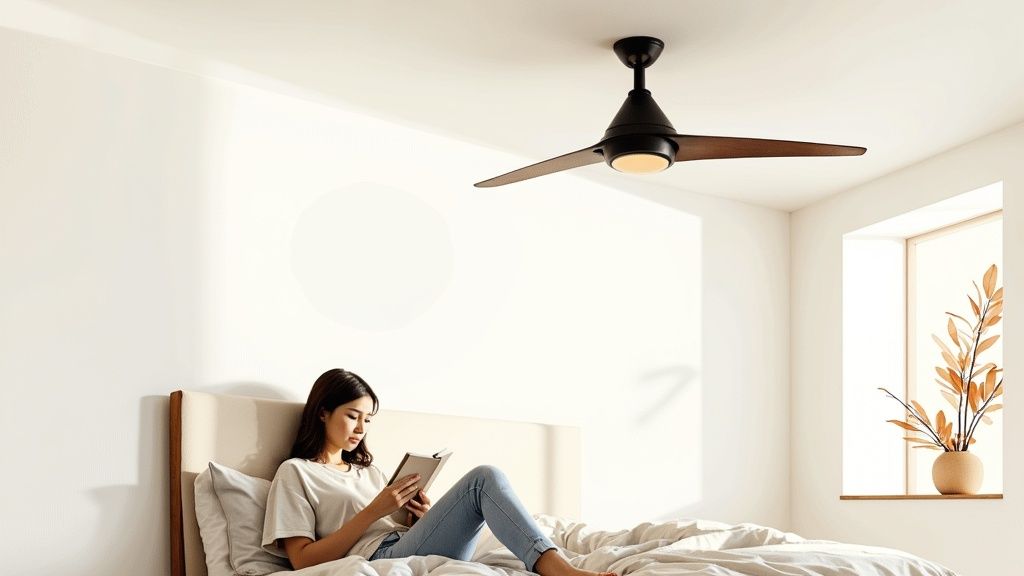
If your room has ceilings under 8 feet, the flush mount bracket isn't just an option—it’s your essential partner in crime-fighting against stuffiness. Often called a "hugger" mount, this bracket does exactly what its name suggests: it lets the fan hug the ceiling, maximizing every last inch of precious headroom so your taller friends don't have to duck.
Think of it like recessed lighting. Instead of dropping down into your space, the fan sits snug against the ceiling for a clean, unobtrusive look. This is the perfect fix for bedrooms, hallways, basements, or kitchens where a standard fan would hang too low and become an awkward, even unsafe, obstruction. The goal is to always keep fan blades at least 7 feet from the floor, and a flush mount makes that happen in rooms with limited height.
Why a Flush Mount Is the Smart Choice
Flush mount brackets are engineered for safety and a seamless look in rooms where height is a premium. Their popularity isn’t just about function; it’s about smart design solving a common problem. It’s no surprise that flush mount styles command the largest share of the ceiling fan market. In North America, where residential renovations drive demand, these brackets are the go-to choice. With over 69.56% of global fan sales being residential, the need for space-saving solutions like hugger fans is massive.
The beauty of a flush mount is how straightforward it is. The bracket secures directly to a fan-rated ceiling box, and the fan's motor housing attaches right to it, completely eliminating the need for a downrod. This direct connection gives you a stable, wobble-free performance when installed correctly.
Don't Sacrifice Style for Space
There’s a common myth that choosing a flush mount fan means settling for a boring, basic design. That couldn't be further from the truth. Modern engineering has allowed manufacturers to pack incredible performance and stunning style into these low-profile packages. You no longer have to choose between headroom and high design. For a deeper look into these sleek fixtures, check out our guide on what is a flush mount ceiling fan.
High-end brands have absolutely perfected the art of the hugger fan, proving that compact can be captivating.
- The Minka-Aire Concept II: Priced at $399.95, this fan is a minimalist masterpiece. Its sleek, three-blade design and integrated LED light offer powerful airflow without overwhelming the space, making it a perfect example of how a flush mount can blend into a modern bedroom or office.
- The Fanimation Ascension: At $374.98, the Ascension combines industrial flair with a compact form. Its five blades and clean lines make it a versatile pick for contemporary living rooms that need a breeze without the bulk.
These premium models prove a key principle of modern design: functionality should never compromise form. A low ceiling is a constraint, but the right flush mount fan turns that constraint into an opportunity for a clean, integrated aesthetic.
Choosing one of these models means you get the best of both worlds—the headroom you need and the sophisticated style you want. They prove that the right ceiling fan mounting bracket type can make all the difference, turning a design challenge into a sleek, functional focal point.
Achieving Optimal Airflow with Downrod Mounts
When your ceilings start reaching 8 feet or higher, a downrod mount isn't just an accessory—it's the secret to unlocking your fan's true potential. Its job is simple but absolutely critical: lower the fan to the ideal height for moving air, which is right around 7 to 9 feet off the floor. This sweet spot ensures the fan can effectively push air down and out, creating that comfortable breeze you're after.
Think of it like a pendant light over a dining table. You wouldn't install it flush against a 12-foot ceiling; the light would be too far away to do its job. A downrod does the exact same thing for a ceiling fan, bringing it down into the room's living space where it can work its magic.

Why Downrod Length Is So Important
Picking the right downrod length is a crucial step that makes or breaks your fan's performance and look. If it's too short on a high ceiling, the fan will be spinning uselessly way up high, unable to move air where you can actually feel it. Go too long in a standard room, and the fan can feel overwhelming or hang dangerously low.
Luckily, the math is pretty simple. The goal is to get the fan's blades into that optimal 7-to-9-foot zone from the floor. Follow this guideline, and you'll get it right every time.
Downrod Selection Guide Based on Ceiling Height:
- 9-foot ceiling: A 6-inch downrod is usually all you need.
- 10-foot ceiling: A 12-inch downrod is the standard go-to.
- 12-foot ceiling: A 24-inch downrod gets the fan into the perfect zone.
- 14-foot ceiling: A 36-inch downrod is needed to bridge that extra height.
For ceilings that soar even higher, downrods can extend up to 72 inches or more. This ensures even the most dramatic great rooms and entryways get proper air circulation. For a deeper dive, you can learn more about how to select the perfect downrod for your fan in our dedicated guide.
The Anatomy of a Downrod Mount System
The downrod mount is more than just a pipe; it's a complete system built for stability and quiet operation. Each part works together to deliver a secure, wobble-free installation, making it one of the most reliable ceiling fan mounting bracket types out there.
- Canopy: This is the decorative cover that attaches to the ceiling. It’s designed to cleverly hide all the electrical wiring and hardware for a clean, professional finish.
- Hanger Bracket: This is the anchor for the whole fan. It gets secured directly to the fan-rated electrical box in your ceiling.
- Hanger Ball: Here’s the clever part. This half-sphere at the top of the downrod sits in a grooved cradle inside the hanger bracket. It allows the fan to hang perfectly level and absorb tiny vibrations, which is key to preventing wobbles.
- Downrod: This is the threaded pipe itself, which comes in different lengths and finishes to match your fan and room decor.
The hanger ball and bracket combo is a masterpiece of simple engineering. It lets the fan self-level and run smoothly even if the ceiling isn't perfectly flat, making it a robust and forgiving system for most standard homes.
Elevating Style in High-Ceiling Spaces
Downrod mounts are a must for large, open-concept spaces, two-story great rooms, and vaulted areas where a fan needs to be both a workhorse and a statement piece. The best fan manufacturers design their most impressive models specifically for these spaces, knowing a downrod will showcase their work perfectly.
Just look at these stunning examples that are built to command attention:
- The Big Ass Fans Haiku: Starting at $1,944, the Haiku is a true marvel of engineering and design. With its minimalist look, silent DC motor, and aircraft-grade aluminum blades, it’s an architectural element in its own right. Hung from a long downrod in a two-story living room, it becomes a breathtaking focal point.
- Monte Carlo Maverick Max: With a price tag of $929.99, this oversized 70-inch fan features gorgeous, hand-carved balsa wood blades. Its grand scale is made for big spaces, and using a downrod allows its elegant form to be fully appreciated while delivering a powerful, sweeping breeze.
These premium fans prove that when you have the ceiling height, a downrod mount doesn't just improve function—it elevates the fan into a true piece of aerial art.
How to Conquer Sloped and Angled Ceilings
Vaulted, cathedral, or angled ceilings are gorgeous, but they throw a real wrench in the works when it's time to install a ceiling fan. A standard, flat-mount bracket just won't cut it here. Trying to force a regular mount onto a slope is a recipe for an irritating hum, a wobbly fan, and eventually, a serious safety hazard.
Think about it like trying to hang a picture on a curved wall with a straight nail—it’s never going to sit right. For a fan to run smoothly and quietly, it has to hang perfectly level. Forcing it to hang at an angle puts a ton of stress on the motor and all the mounting hardware, which they simply aren't built to handle.

Dual-Mount Systems and Angled Adapters
Luckily, this is a super common problem with a couple of great solutions. There are specialized ceiling fan mounting bracket types engineered specifically for the unique geometry of a sloped ceiling, guaranteeing your fan hangs securely and perfectly balanced.
- Dual-Mount Fans: Many modern fans are sold as "dual-mount" systems right out of the box. Their hanger ball and bracket are designed with a clever pivot that can handle a modest slope, usually up to about 20 degrees.
- Sloped-Ceiling Adapters: For ceilings with a steeper pitch, you'll need to grab a dedicated sloped-ceiling adapter. These are heavy-duty, purpose-built kits that replace the fan's standard canopy and bracket, allowing for a much greater angle—often up to 45 degrees or more.
The secret to both of these systems is a pivoting ball joint. This nifty bit of engineering lets the downrod hang straight down, perfectly plumb, while the mounting bracket and canopy sit flush against the angled ceiling. It’s what keeps the fan from looking crooked and, more importantly, from wobbling itself apart.
Measuring Your Ceiling's Pitch
So, how do you know which route to take? First, you've got to figure out the pitch, or angle, of your ceiling. Don't worry, you don't need to break out your old trigonometry textbook. A simple angle finder app on your phone or a bevel protractor will give you an accurate reading in a few seconds.
Once you have that number, your path forward is clear:
- Slope up to 20°: You're in luck! Most standard downrod fans will work just fine. Just be sure to double-check the fan's specs to confirm its maximum slope rating before you buy.
- Slope between 20° and 45°: You will almost certainly need to buy a separate sloped-ceiling adapter. Make sure the one you choose is compatible with your fan's brand and model.
A critical mistake is assuming any adapter fits any fan. Manufacturers often use their own proprietary designs. Always buy an adapter made by the same brand as your fan to guarantee a perfect—and safe—fit.
Designer Fans for Dramatic Architecture
A room with a vaulted ceiling is a statement piece, and it deserves a fan that's just as impressive. High-end designer fans really shine in these spaces because they're often built with dramatic architecture in mind from the get-go. They don't just come with robust mounting options; they feature stunning designs that actually complement the room's unique lines.
For a space that commands attention, consider these premium options built for sloped ceilings:
- The Fanimation Studio Collection Vintere: At $524.98, this fan is a true showstopper. Its unique twin-motor design and adjustable arms make it a piece of functional art, perfectly suited to hang from the peak of a high, vaulted ceiling.
- The Minka-Aire Artemis IV: Priced at $599.95, the Artemis IV features beautifully sculpted blades that create a fluid, organic look. It’s a fantastic match for modern homes with angled ceilings, and the included remote makes controlling it from way down below a breeze.
Choosing a model like this ensures your fan isn't just a functional afterthought, but a stunning focal point that enhances the grandeur of your space.
When You Need More Than a Standard Bracket
Not every ceiling is a simple, flat surface in a climate-controlled room. What about the breezy patio, the workshop with soaring ceilings, or that big outdoor gazebo? These situations throw unique challenges at a ceiling fan installation, and your standard mounting hardware just won't cut it. For these special jobs, you need to bring in the heavy hitters: specialized brackets built for serious weight, harsh weather, and demanding structures.
Think of it this way: a standard fan-rated electrical box is strong enough to hold a heavy punching bag. A heavy-duty joist-mounted bracket, on the other hand, is like the steel I-beam holding up the entire gym. It’s a completely different level of support, made for fans that are more like industrial machines than simple home fixtures.
Heavy-Duty Brackets for Industrial-Sized Fans
When you're installing an oversized or industrial-style fan—we're talking beasts weighing 70 pounds or more—a standard fan-rated box is out of the question. These powerhouse fans generate a massive amount of torque and need a mounting solution that anchors them directly to the bones of your house. This is where a heavy-duty or joist-mounted bracket is essential.
Made from reinforced steel, these brackets are designed to saddle or bolt directly onto a ceiling joist. This creates a direct connection that transfers the fan's entire weight and operational force into the building's frame, completely bypassing the electrical box. It is the only safe way to install a large-scale fan, giving it an unshakable foundation that prevents vibrations, sagging, or a catastrophic failure.
Weather-Rated Brackets for Outdoor Living
Bringing the comfort of a ceiling fan to your patio, porch, or gazebo is a total game-changer. But the great outdoors brings its own set of enemies: humidity, rain, and salty air will quickly corrode an indoor-rated fan and its bracket. That’s why weather-rated brackets are an absolute must for any exterior installation.
These brackets are built from corrosion-resistant materials like galvanized steel, stainless steel, or tough powder-coated finishes. They’re specifically engineered to stand up to the elements and stop rust in its tracks—rust that could weaken the bracket and create a serious electrical hazard.
You’ll see two main ratings for outdoor gear:
- Damp-Rated: Perfect for covered outdoor spots like a screened-in porch. The fan is shielded from direct rain but still has to handle humidity.
- Wet-Rated: This is what you need for pergolas, gazebos, or any location where the fan might get hit directly with rain. These fans and their hardware are built to be completely weatherproof.
It is critical to match your bracket's rating to your fan's rating. Installing a damp-rated fan with a wet-rated bracket (or vice-versa) can create a safety hazard and will void the manufacturer's warranty.
Premium Fans That Demand a Better Mount
It’s true that standard ceiling fans are the most common choice, but that’s because they’re used in typical residential rooms. The numbers don't lie: standard fans using basic mounts command a massive 63.66% revenue share in a market valued at over USD 14 billion. But this statistic really just highlights how different the needs are for specialized situations where a basic bracket simply isn’t enough. You can explore more data on the global ceiling fan market to see how these segments stack up.
For those installations that need robust, all-weather performance, you need a fan built for the job.
- The Kichler Gentry XL: At $999.00, this massive 85-inch wet-rated fan is an absolute beast. Its nine-blade design is meant to move a huge volume of air in large outdoor pavilions, and it requires a heavy-duty mounting system to handle its scale and power.
- The Minka-Aire Xtreme H2O: Priced at $599.95, this sleek 88-inch fan is also wet-rated, making it a perfect statement piece for a modern outdoor living area. Its industrial-inspired design is matched by the robust mounting it needs for durable, long-lasting performance in any weather.
A Guide to Safe Installation and Troubleshooting
Getting your ceiling fan up and running is exciting, but doing it safely is what really matters. A smooth, quiet fan starts with a rock-solid installation, and we'll walk you through the key points to get it right the first time.
The entire installation hinges on one critical piece of hardware: a UL-listed, fan-rated electrical box. This isn't just a suggestion—it's an absolute must. A spinning ceiling fan puts a ton of dynamic stress on its mounting point, and a standard plastic box built for a simple light fixture just can't handle it. We're talking about something that can easily weigh over 50 pounds and is constantly in motion. Trying to hang a fan on the wrong box is one of the most dangerous shortcuts you can take.
Troubleshooting Common Bracket-Related Issues
Even with the right bracket, you might run into a few little quirks. Don't worry. Annoying wobbles, clicks, or hums can almost always be traced back to the mounting hardware and are usually easy to fix.
- The Dreaded Wobble: This is the #1 complaint we hear, and nine times out of ten, it’s just loose screws. Take a moment to systematically check every connection. Make sure the screws holding the blades to the motor are tight, the downrod is secure, and most importantly, that the mounting bracket is firmly fastened to that fan-rated ceiling box.
- Annoying Clicks or Hums: These sounds often mean the hanger ball isn't seated quite right in the bracket's groove. If you're using a downrod, give it a little jiggle to make sure it's settled in properly. It's also worth checking for any stray wires inside the canopy that might be tapping against moving parts as the fan spins.
For a full, detailed guide on nailing the installation process from start to finish, check out our article on how to install a ceiling fan safely and easily.
Your Pre-Installation Safety Checklist
Before you even think about climbing that ladder, let’s talk safety. Your first and most important step is to kill the power to the room at the circuit breaker. Once you've flipped the breaker, double-check by testing the light switch in the room.
Safety First: Don't just rely on the wall switch. It only interrupts one wire. The only way to guarantee you won't get a nasty shock is to turn the power off at the source—the circuit breaker.
Gathering your tools ahead of time makes the whole process go smoother and keeps you from making risky trips up and down the ladder. You'll generally need:
- A sturdy stepladder
- Screwdrivers (both Phillips and flathead)
- Pliers and wire strippers
- A voltage tester (to be absolutely sure the power is off)
- An adjustable wrench
While many fan installations are a great project for a confident DIY-er, it's just as important to know when to call for backup. If you open up the ceiling and find old, frayed wiring, or if you're tackling a tricky install on a very high or sloped ceiling, it’s always smarter to call a pro. For peace of mind and a guaranteed safe setup, consider using residential lighting electrician services to handle the job.
Common Questions About Ceiling Fan Brackets
Even when you think you have everything figured out, a few questions always seem to pop up right when you’re ready to install. Getting these last details straight is what separates a safe, wobble-free installation from a weekend headache. Here are some straightforward answers to the things we hear most often from homeowners, so you can finish your project with complete confidence.
Can I Reuse an Old Bracket with My New Fan?
It's tempting, I get it—you want to save a step. But you should always use the new mounting bracket that comes in the box with your new fan. It’s not just a suggestion; it’s a critical safety rule.
That new bracket was specifically engineered and tested for the exact weight, torque, and design of the fan you just bought. Using an old one creates an unsafe setup that can lead to serious wobbling or worse. Plus, it will almost certainly void your new fan's warranty. The only time you might even consider it is if you're replacing the fan with the exact same model, but even then, starting with fresh, new hardware is always the safest move.
What Makes an Electrical Box "Fan-Rated"?
A fan-rated electrical box is a different beast entirely from the standard plastic boxes used for lightweight light fixtures. It's a reinforced metal box purpose-built to handle the dynamic load and constant motion of a spinning ceiling fan, which can weigh up to 70 pounds.
The real secret is how it’s installed. Fan-rated boxes are bolted directly to a ceiling joist or a heavy-duty brace that spans between two joists. This direct structural support is what keeps a heavy, moving fan from falling. Always look for markings on the box that explicitly state it is "suitable for fan support."
What if My Ceiling Slope Is Steeper Than 45 Degrees?
When you’re dealing with a dramatically steep ceiling, a standard angled adapter just won't cut it. For these kinds of architectural situations, you’ll need a more specialized solution. Some manufacturers offer custom canopy kits and extra-long downrods designed for exactly this purpose.
Another pro-level solution is to build a small, horizontal mounting platform—often called a "down-box"—that extends from the ceiling joists. This creates a perfectly level surface for the fan to hang from, no matter how sharp the angle. For any installation this complex, it’s best to consult with a qualified electrician or a professional fan installer. They'll know exactly how to make it safe, secure, and look great.
At Fan Connection, we believe the right fan transforms a room. The Minka-Aire Artemis IV, priced at $599.95, is a masterpiece of design and engineering, perfect for making a statement on angled ceilings. Its beautifully sculpted blades create a fluid, organic look that complements modern architecture while delivering powerful, quiet airflow. Explore this and other premium models at Fan Connection's online store.


