

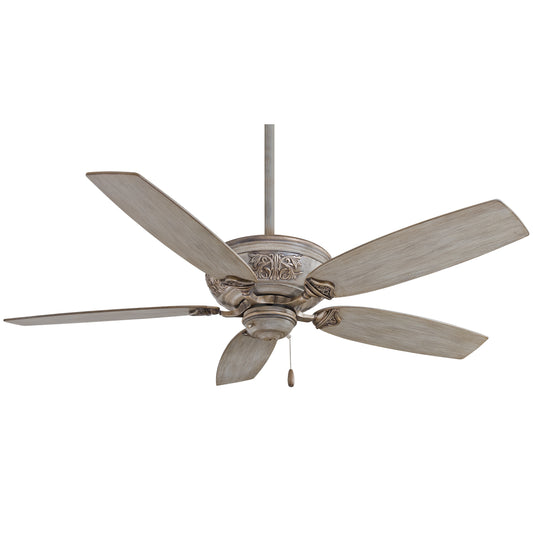


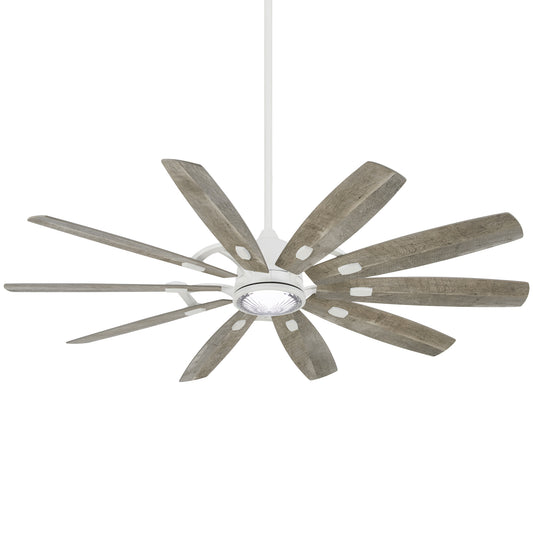

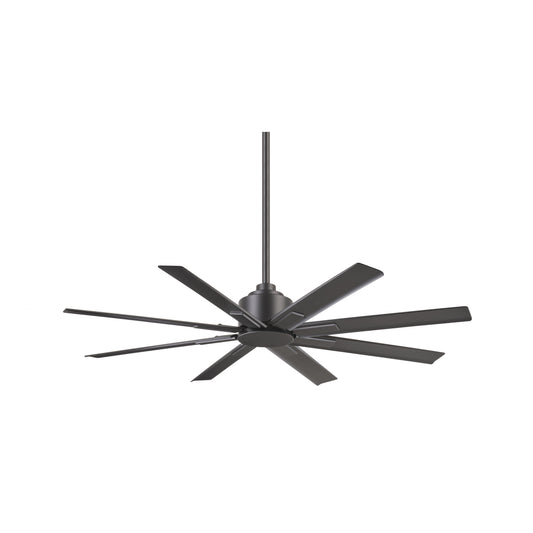







Choosing a Ceiling Fan No Light for Modern Homes
Sometimes, less really is more. A ceiling fan no light isn't a compromise—it's a deliberate, and dare we say, genius design choice that puts clean aesthetics and powerful airflow first. Homeowners and designers are increasingly choosing these models for rooms that already have a solid, layered lighting plan. This lets the fan do its main job—being awesome at moving air—without adding any visual clutter.
Why a Ceiling Fan Without a Light is a Smart Design Choice
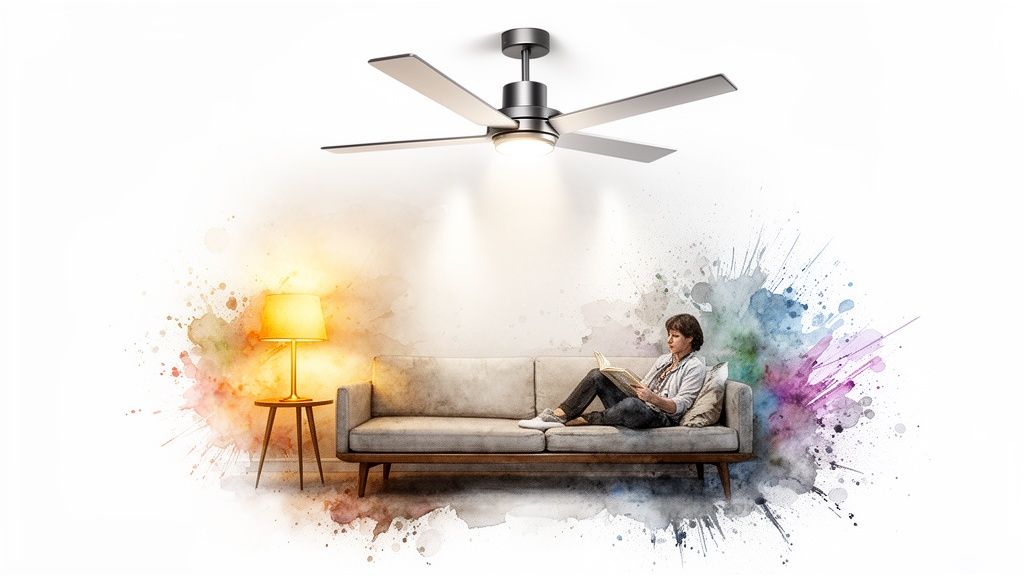
Opting for a ceiling fan without a light isn't about giving something up. It's about gaining total control over your home's atmosphere. Think of it as part of a bigger shift toward intentional interior design, where every piece in the room has a clear, starring role.
Instead of relying on a single, often harsh, light source plunked in the middle of the ceiling, a ceiling fan no light encourages a more thoughtful, sophisticated way to illuminate your space. It really shines in rooms with existing layered lighting, like a living room with recessed cans for ambient light and a few floor lamps for cozy reading nooks. In that scenario, a fan with a light kit is just redundant, like wearing a belt and suspenders.
By going with a lightless model, you can fine-tune your room's illumination and truly put your living room in the best light using fixtures that are actually designed for the job.
A Focus on Form and Function
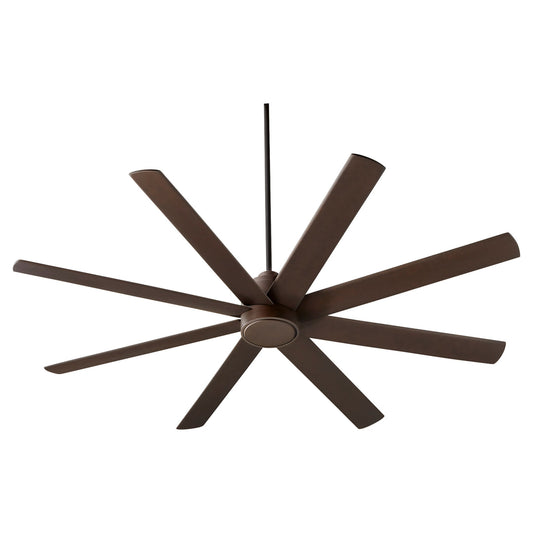
When you remove the light fixture from the equation, the fan itself gets to be a sculptural element. Designers have more freedom to create aerodynamic and visually striking blade designs when they aren't forced to work around a bulky light kit. The result? Fans that are not just functional but genuine statement pieces that make your guests look up and say, "Wow, where did you get that?"
Think about these common situations where a no-light fan is easily the better call:
- Dining Rooms: The star of the show should be a beautiful chandelier over the table. A simple, lightless fan can add a comfortable breeze without competing for the spotlight.
- Bedrooms: To create a relaxing sanctuary, you want soft, ambient light from bedside lamps or wall sconces, not a bright overhead glare that feels like an interrogation lamp. A fan without a light helps maintain that restful vibe.
- Great Rooms with Vaulted Ceilings: These large spaces often have complex lighting schemes already in place. A powerful, minimalist fan can deliver that much-needed air circulation while keeping the aesthetic clean and open.
The Growing Market for Minimalist Design
This move toward streamlined fixtures is more than a fleeting trend; it's a real shift in the market. As we've seen in our guide to ceiling fan design trends, fans without integrated lights have carved out a serious niche, especially for people who value uncluttered design.
The entire ceiling fan market is on track to grow from USD 14.6 billion in 2025 to a whopping USD 31.6 billion by 2035. In the USA, no-light models are especially popular in kitchens and hallways where good lighting is already installed.
By decoupling airflow from illumination, you empower your fan to do its job perfectly while your lighting scheme creates the exact mood you desire. It’s a design win-win.
The Practical Benefits of Going Lightless
Beyond just a clean, minimalist look, choosing a ceiling fan no light brings some serious practical advantages to your home—starting with your electricity bill. Who doesn't love saving a little cash?
It’s a pretty straightforward equation: no light bulbs means no energy consumed by them. This simple change can immediately save you up to 50W per fan, which really starts to add up when you have them spinning in multiple rooms.
This decision also opens up more opportunities for comfort and savings. A no-light fan is a great addition to other passive cooling strategies that help maintain a pleasant indoor temperature without constantly running your expensive air conditioner.
This focus on efficiency isn't just a niche idea; it's a major driver in the market. The rise of no-light ceiling fans is directly tied to the growing demand for smarter energy use. According to the U.S. Department of Energy, ceiling fans can help cut AC usage by a whopping 30-40%. No-light versions push those savings even further by completely eliminating the energy draw from bulbs.
It's a global trend, too. In booming markets like India and China, no-light fans now make up an incredible 70% of entry-level sales, a clear sign that consumers everywhere are prioritizing efficiency.
The Power of Advanced Motor Technology
The savings don't stop at the lightbulb. Many modern ceiling fans without lights come equipped with ultra-efficient motors that compound the benefits. The biggest game-changer here is the Brushless DC (BLDC) motor.
While traditional AC motors have been reliable workhorses for years, DC motors are the undisputed champions of efficiency. Here’s a quick breakdown of why they're so much better:
- Massive Energy Reduction: A DC motor can use up to 60% less energy than a standard AC motor while producing the same powerful airflow.
- Whisper-Quiet Operation: Because they use magnets and sensors instead of brushes, DC motors are nearly silent. This makes them perfect for bedrooms, home offices, and any other quiet space.
- More Speed Options: They typically offer more speed settings—often six or more—giving you precise control over your comfort level.
For a homeowner in a hot climate or a contractor outfitting multiple properties, these features are more than just nice-to-haves. Opting for a model with a DC motor translates into real, tangible savings on utility bills every single month.
The combination of a no-light design and an efficient DC motor creates a powerhouse of savings. It's a smart investment that benefits your wallet and the environment at the same time.
To give you a clearer picture of the cost differences, let's compare the upfront and long-term expenses of fans with and without lights.
No-Light vs. Integrated Light Fan Cost Comparison
| Feature | Ceiling Fan No Light | Ceiling Fan with Light |
|---|---|---|
| Upfront Cost | Generally lower, as there's no integrated light kit. | Often higher due to the added light fixture and components. |
| Installation | Simpler wiring, potentially reducing installation time and cost. | Slightly more complex wiring for both fan and light functions. |
| Energy Usage | Lower overall, as it only powers the motor. | Higher due to the combined power draw of the motor and bulbs. |
| Long-Term Savings | Significant savings on electricity bills over the fan's lifespan. | Lower savings due to ongoing energy use from the light. |
| Maintenance | No bulbs to replace, reducing maintenance costs and hassle. | Requires occasional bulb replacement, adding to long-term costs. |
While a fan with a light offers convenience, a no-light model is the clear winner for anyone focused on maximizing energy efficiency and minimizing long-term costs.
For more information on how ceiling fans can contribute to a greener home, you might be interested in our article on energy efficiency and cost savings. The choice is clear: going lightless is a practical step toward a more comfortable and cost-effective home.
Finding the Perfect Fan for Your Home's Style
Let's be honest, a ceiling fan no light is way more than just a tool for moving air. It’s a design statement. The right one can pull an entire room together, turning a purely functional appliance into a stunning focal point. This isn't just about feeling cooler—it’s about elevating the whole look of your space.
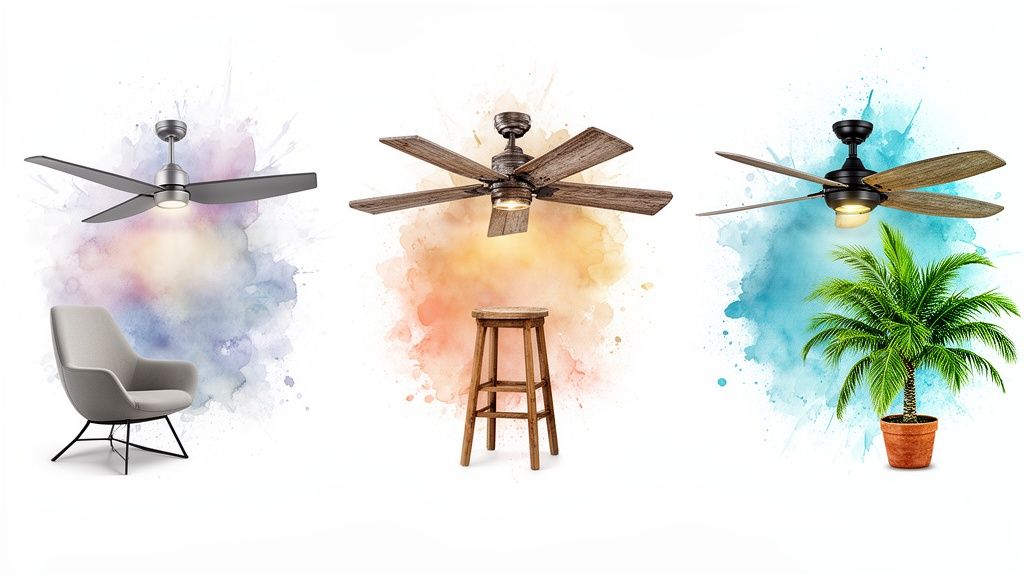
The perfect fan is dictated by your home's unique style. Going for a clean, uncluttered modern vibe? A fan with sleek lines and a minimalist profile will fit right in. But if your space leans more rustic or industrial, a fan with reclaimed wood blades or a burnished metal finish can inject a ton of character and warmth.
The trend toward style-conscious fans is huge. Residential homes make up over 80% of the ceiling fan market, and a growing number of homeowners are specifically choosing lightless models for aesthetic and practical reasons. For instance, 75% of buyers in some markets pick a ceiling fan no light to kill unwanted glare in media rooms or over kitchen islands. It also happens to make the installation a little less complicated.
Matching Your Fan to Your Decor
So, how do you find the one? It’s all about matching the fan's materials, shape, and finish to what you’ve already got going on in the room.
For a modern and minimalist space, think sharp angles and simple, elegant forms. A fan like the Artemis IV is a perfect example, with its fluid, sculptural blades that look like they're in motion even when standing still. It’s clean, sophisticated, and ideal for contemporary living rooms where less is more.
If your home has more of a rustic or industrial feel, you'll want a fan that feels a bit more rugged and substantial. Models like the Barn or Chisel are great for this, bringing in natural wood and heavy-duty metal elements that add texture and a tough, grounded look. They work wonders in lofts, modern farmhouses, or any room with exposed brick and beams.
Your ceiling fan shouldn't just blend in—it should actively enhance your room's style. Think of it as that final touch that completes the look, drawing the eye upward and adding a layer of dynamic visual interest.
Coastal and Tropical Aesthetics
Trying to capture that breezy, beach-house vibe? A fan can absolutely help set the mood. The Tropical Cabana X 3 is designed to feel like a seaside escape, with its wide, leaf-shaped blades and natural-looking finishes. It’s the perfect finishing touch for a sunroom, covered patio, or any spot where you want to kick back and relax.
Key Design Details to Consider
Beyond the overall style, a few specific details can make or break the look. The number of blades, for one, has a surprisingly big impact on a fan's visual feel.
- Three-Blade Fans: These tend to look more modern and aerodynamic. They’re a go-to for minimalist and contemporary designs.
- Five-Blade Fans: This is the classic, more traditional choice. It offers a balanced, familiar look that fits well in a huge range of decor styles.
The finish is just as critical. A matte black or brushed nickel finish can create a bold, modern statement, while wood or bronze tones add warmth for a more traditional feel. For a deeper look at all the options, check out our guide on how to choose a ceiling fan. When you take the time to consider these smaller details, you can find a fan that feels like it was made just for your home.
Premium No-Light Fans Worth the Investment
When you move beyond the basics, you start to see that a ceiling fan no light can be more than just a functional appliance. It can be a true centerpiece, a piece of kinetic art for your ceiling. This is where a fan becomes a long-term investment in your home's comfort and style. For those ready to go beyond the entry-level options, models priced at $300 and up offer a serious leap in motor technology, material quality, and pure design artistry.
These aren't your run-of-the-mill fans. They are meticulously engineered pieces of decor built to perform for years, delivering powerful, whisper-quiet airflow without clashing with your aesthetic. When you invest in a premium model, you get a fan that not only looks incredible but also runs so silently you might just forget it’s even on.
The Artemis XL5: A Statement for Grand Spaces
Picture a great room with soaring vaulted ceilings. A standard-sized fan would just look lost and couldn't possibly move enough air to make a difference. This is exactly the kind of space where the Artemis XL5 (priced around $800) commands attention. With its impressive 80-inch wingspan and dynamic, sculptural blades, it's designed to be a focal point in large, open-concept areas.
The price tag reflects its superior engineering and scale, but the Artemis XL5 is more than just big—it's a beast when it comes to performance. It’s built to circulate a massive volume of air, making even the most expansive rooms feel comfortable.
- Ideal Application: Absolutely perfect for great rooms, large living areas, or even commercial spaces with ceilings over 12 feet high.
- Design Impact: Its bold, flowing design adds a touch of modern artistry, turning it into a conversation starter that complements ambitious architecture.
- Performance: Delivers exceptional airflow (CFM), ensuring that every corner of your large space feels that gentle breeze.
This fan is for homeowners who refuse to compromise on either form or function in the most important spaces of their home.
A premium fan isn't an expense; it's an upgrade. You're investing in a quieter motor, more durable materials, and a design that enhances your home's value and your daily comfort.
The Aviation: A Nod to Timeless Industrial Design
For those spaces that call for a touch of vintage, industrial charm—think a home office, a cozy study, or a sophisticated den—the Aviation model (retailing for over $400) is a perfect fit. It's clearly inspired by the sleek, powerful look of vintage aircraft propellers, blending that raw mechanical appeal with modern elegance.
The real beauty of the Aviation fan is in its details: the solid wood blades, the robust motor housing, and the clean, functional lines. It’s a piece that tells a story, adding character and a sense of history to a room without ever feeling dated.
This model is a prime example of why a premium ceiling fan no light is worth the price. Its powerful motor is designed for optimal performance, moving air efficiently and quietly. If you're looking for fans with this level of motor tech, you might want to check out our guide to the best DC motor ceiling fans for more great options.
Why Investing More Pays Off in the Long Run
When you choose a fan from a premium collection, you're buying more than just a brand name. You're paying for tangible benefits you'll notice and appreciate every single day. The difference between a budget fan and a high-end model becomes crystal clear the first time you turn it on.
Here's what that extra investment really gets you:
- Whisper-Quiet Motors: Premium fans often use high-quality DC motors, which are not only up to 70% more energy-efficient but are also virtually silent. This is a complete game-changer for bedrooms and home offices where any noise can be a major distraction.
- Superior Materials: Instead of basic plastics and laminates, you’ll find real wood blades, die-cast metals, and high-end finishes that are built to resist warping, wobbling, and fading over time.
- Advanced Engineering: Top-tier fans are simply better balanced and feature more aerodynamic blade designs. The result is superior air movement (CFM) without that annoying wobble you so often see in cheaper models.
Choosing a fan like the Artemis XL5 or the Aviation isn't just about cooling a room. It's about making a deliberate choice for quality, design, and lasting performance that will genuinely enhance your home for years to come.
A Practical Guide to Installation and Placement
Installing a ceiling fan without a light is often more straightforward than you might think. Without a light kit, the wiring is simpler, making it a great project for a confident DIYer. But whether you're tackling it yourself or calling in a pro, getting the placement and installation right is key to a quiet, effective fan.
First thing's first: safety. Before you even think about touching a wire, head to your circuit breaker and shut off the power to the room. It’s the single most important step you’ll take.
Finding the Sweet Spot for Your Fan
Placement is everything when it comes to airflow. You'll want to mount your fan right in the center of the room, which gives it the best chance to circulate air evenly across the whole space.
Just as important is giving the fan enough room to operate. Blades need space to breathe, both for safety and performance. Here are the magic numbers to remember:
- Ceiling Clearance: Make sure the blades are at least 10-12 inches down from the ceiling. Any closer, and the air gets trapped.
- Wall Clearance: You need a minimum of 18 inches between the tip of the fan blades and any walls or tall furniture.
- Floor Clearance: The blades must be at least 7 feet off the floor. This one’s non-negotiable for safety.
Getting these clearances right isn't just a suggestion—it's the key to efficient, wobble-free operation. A fan that's too close to the ceiling or walls will struggle to move air effectively.
Have a room with high or vaulted ceilings? You'll absolutely need a downrod. This simple extension pole lowers the fan to the right height, ensuring it’s actually creating a breeze you can feel instead of just spinning uselessly far above your head.
The Installation Process Overview
This graphic breaks down the whole process into three core stages. It’s a great visual reminder of what matters most.
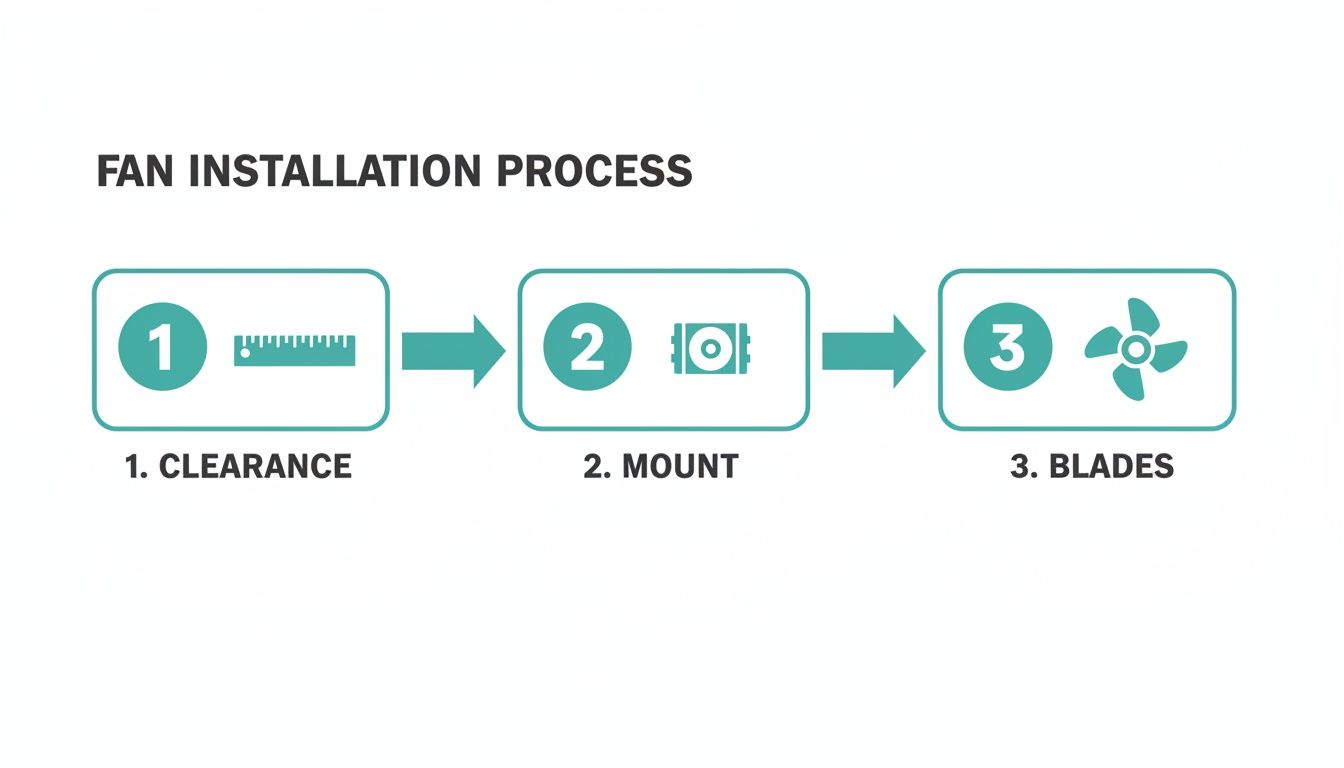
As the visual shows, a solid installation boils down to three things: checking your clearances, getting the mounting bracket anchored securely, and then attaching the blades.
Once you’ve picked your spot, the real work begins. The mounting bracket has to be screwed directly into a ceiling joist. Drywall alone will never support the weight and constant motion of a fan, so don't even try it. After the bracket is solid, you'll hang the motor, connect the wiring (which is much simpler without a light), and attach the blades one by one.
For a deeper dive into getting the most out of your fan, check out our guide on creative ceiling fan placement ideas. With a little planning, you'll have your new fan up and running in no time.
Common Questions About No-Light Ceiling Fans
Got a few lingering questions? You're not the only one. Let's tackle some of the most common things people ask when considering a ceiling fan without a light.
Think of this as your final sanity check before you find the perfect fan for your space.
Can I Add a Light Kit to a No-Light Fan Later On?
It’s a definite maybe, but you have to plan for it. Some ceiling fans are specifically designed to be "light kit adaptable." This means the manufacturer makes and sells a compatible kit you can easily install down the road.
However, a lot of the sleek, minimalist fans out there are intentionally designed without this option. It's all about maintaining that clean profile. If you even think you might want a light in the future, your best bet is to check the fan’s specs for that "light kit adaptable" phrase before you buy.
Are Fans Without Lights Better for Bedrooms?
A lot of people swear by them, and for good reason! A ceiling fan with no light is often a top choice for bedrooms because it lets you create a softer, more relaxing mood with lighting from other sources, like bedside lamps or wall sconces.
You get the gentle, cooling breeze you need for a good night's sleep without the risk of a harsh, central overhead light blasting you awake. It's a simple change that can make a huge difference.
Separating your airflow from your illumination is all about creating a relaxing sanctuary. It gives you total control over the room's ambiance, which is exactly what you want in a space meant for rest.
Do No-Light Fans Move More Air?
Not on their own, no. A fan's real power comes down to its CFM (Cubic Feet per Minute) rating, which is all about the motor's strength and how well the blades are designed to slice through the air. The light kit itself doesn't really factor into the performance.
That said, since designers don't have to work around a bulky light fixture, they sometimes have more creative freedom to engineer highly efficient—and visually stunning—blade shapes. The only way to know for sure is to compare the CFM ratings on the product specs.
How Do I Choose the Right Size Fan for My Room?
This is absolutely crucial. A fan that’s too small for your room just won't move enough air to make a difference. On the flip side, one that's too big can feel like a wind tunnel.
Here’s a quick sizing guide to get you started:
- Small Rooms (up to 75 sq. ft.): Stick with fans under a 36-inch blade span.
- Medium Rooms (76-144 sq. ft.): A 36- to 42-inch fan is your sweet spot.
- Large Rooms (145-225 sq. ft.): You'll want to look at 44- to 50-inch models.
- Great Rooms (up to 400 sq. ft.): Go big with a fan that’s 52 to 60 inches to really get the air circulating.
Just measure your room's length and width, multiply them to get the square footage, and you'll know exactly what size you need.
Ready to find a fan that perfectly complements your home's style and comfort? Explore the curated collections and discover premium designs that make a statement. Visit https://www.fanandlights.com to browse our selection today.


