











Finding a Ceiling Fan Showroom Near Me A Buyer's Guide
Let's be honest, searching for a "ceiling fan showroom near me" usually comes from one simple place: the fear of buyer's remorse. Online shopping gives you endless options, but nothing beats seeing, hearing, and getting a real feel for a fan in person. It’s the only way to be absolutely sure that spectacular, jaw-dropping fan you've been eyeing is the right one for your home.
Why Bother Visiting a Showroom in a Digital World?
In an age where you can buy almost anything with a click, it might seem old-fashioned to visit a physical showroom. But for a piece of functional decor like a ceiling fan, that in-person experience is a crucial final step. It’s not just about looking—it’s about making a smart investment in your home's comfort and style. A premium fan is a centerpiece, and you want to be certain it's perfect.
Smart retailers know this, and it's why they focus on blending their online and in-store experiences. It's all part of creating an effective omnichannel commerce solution that puts the customer first.
Get a True Feel for Size and Finish
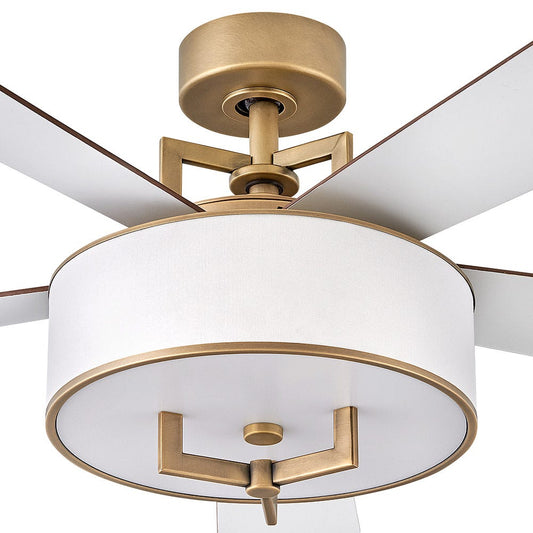
A picture of a 60" fan on a website can be really deceiving. Walking into a showroom and seeing a statement piece like the Aviation fan (starting at $798) hanging from a ceiling gives you an immediate, accurate sense of its scale. You can finally understand how its presence will fill a room in a way a computer screen just can't show you.
It's the same with finishes. A brushed nickel or distressed koa wood can look completely different depending on the light. In a showroom, you can see how the light hits the materials, feel the texture of hand-carved blades, and make sure it truly complements your style.
The biggest win of a showroom visit? It completely eliminates the guesswork. You can confirm the fan's size, finish, and overall vibe fit your vision before you commit.
Test Out the Tech and Hear the Difference
Think of the showroom as your personal test lab. It's the only place you can really understand the difference between motor types. Ask one of the experts to show you a standard AC motor running next to an ultra-quiet, energy-efficient DC motor. The difference is often surprising.
Crank it up to the highest speed. Is it whisper-quiet or does it have a noticeable hum? This is a huge deal for a fan destined for a bedroom or a quiet office. Getting this hands-on experience gives you the confidence that you’re choosing a fan that works as great as it looks, turning a potentially risky online purchase into a solid, long-term investment.
How to Prepare for a Productive Showroom Visit
Walking into a showroom cold is a recipe for overwhelm. Let's be real—the sheer number of options can feel paralyzing. But a little prep work can turn a casual (and potentially confusing) browse into a targeted mission to find the perfect fan for your home.
Before you even search for a "ceiling fan showroom near me," start with the basics. Grab a tape measure and get three key numbers: your room's length, width, and ceiling height. These are non-negotiable. They dictate the ideal fan diameter for proper airflow and the right downrod length to keep it safe and effective.
Gather Your Design Essentials
Next, think like an interior designer. Snap a few photos of the space from different angles and have them ready on your phone. This simple step is a game-changer; it helps the showroom staff truly visualize your room and make recommendations that actually fit your style.
It also helps to bring along any physical samples that define your room's look and feel. Think things like:
- Paint Chips: The exact shade of your walls.
- Fabric Swatches: A small piece of your curtain or sofa fabric.
- Flooring Samples: A leftover piece of your wood flooring or a carpet sample.
These little details make all the difference in ensuring the fan's finish—whether it's matte black, brushed nickel, or a warm wood tone—complements your existing decor instead of clashing with it.
To keep everything organized, we put together a quick checklist. Having this info on hand makes the whole process smoother.
Your Showroom Visit Prep Sheet
| Item to Bring/Measure | Why It's Important | Example/Tip |
|---|---|---|
| Room Dimensions | Determines the fan's diameter and downrod length. | A 15' x 20' room with a 9' ceiling. |
| Photos of the Room | Helps staff visualize your style and layout. | Take wide shots and close-ups of key furniture. |
| Paint/Fabric Samples | Ensures a perfect match for the fan's finish. | A swatch of your beige sofa fabric or a chip of your gray wall paint. |
| List of "Must-Haves" | Narrows down options to fans that meet your needs. | "Needs a bright LED light" or "Must be silent for a bedroom." |
| Your Budget | Keeps recommendations realistic and focused. | "I'm looking for something in the $400-$600 range." |
With these details, you’re not just shopping; you’re making an informed decision.
Define Your Fan Priorities
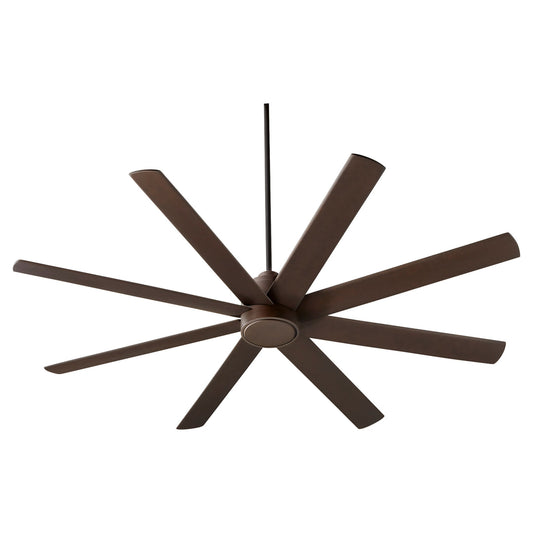
Finally, get clear on what you need this fan to do. Is it for a master bedroom where silence is golden? You'll want to look at whisper-quiet DC motor models, like the elegant Artemis XL5 (priced at $898).
Or maybe it's for a covered patio that has to handle a little humidity. In that case, you'll be looking for a damp-rated powerhouse. Knowing these functional needs upfront helps you and the sales staff cut through the noise and focus on the right models from the very start. For a deeper dive into all these factors, our comprehensive Ceiling Fan Buying Guide is a great resource.
Key Takeaway: Arriving with your room dimensions, photos, and a clear list of priorities empowers you to lead the conversation. You’ll get more specific, helpful advice and leave feeling confident instead of confused.
What to Look for When Testing Fans in Person
You’ve done your homework and now you’re in the showroom, surrounded by options. This is the fun part. It’s your chance to put these fans through their paces and see which ones really deliver. Trust me, a few minutes of hands-on testing now can save you from years of annoying hums, wobbles, and disappointing airflow later.
First thing’s first: listen. Ask a staff member to fire up a fan you’re eyeing and cycle it through all its speeds. Crank it to the highest setting and just listen. Can you hear a motor hum? A quality fan should move a serious amount of air without making a racket. Then, have them drop it to the lowest speed. Check for any faint electronic whines or clicks—the kind of subtle sound that would drive you crazy in a quiet bedroom.
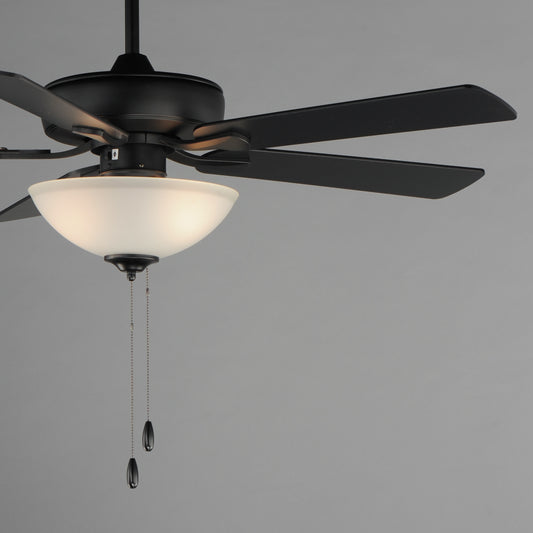
This is the perfect time to get a feel for a model like the versatile Basic Max (priced from $328). You can see its airflow in action and check out how well its integrated light kit brightens up the space.
Digging Deeper Than Just Looks
While the fan is running at top speed, keep your eyes locked on the blades. Are they perfectly still or do you notice any wobble? Even a tiny wobble in the showroom can turn into a major, ceiling-shaking annoyance once it's installed at home. It’s often a sign of poor construction or an imbalance that’s a real pain to fix. A well-built fan should be rock-solid.
Next, let's talk about the light kit. Brightness, measured in lumens, is key. Is the light actually bright enough to be the main light source for your room, or is it more of a soft, ambient glow? Don’t forget about the color temperature, measured in kelvins. A warm, yellowish light (around 2700K) creates a cozy vibe, while a cooler, bluish-white light (4000K+) is much better for task-oriented spaces like a kitchen or home office.
Having a plan makes this whole process way less overwhelming. This little guide breaks down the key things to focus on during your visit.
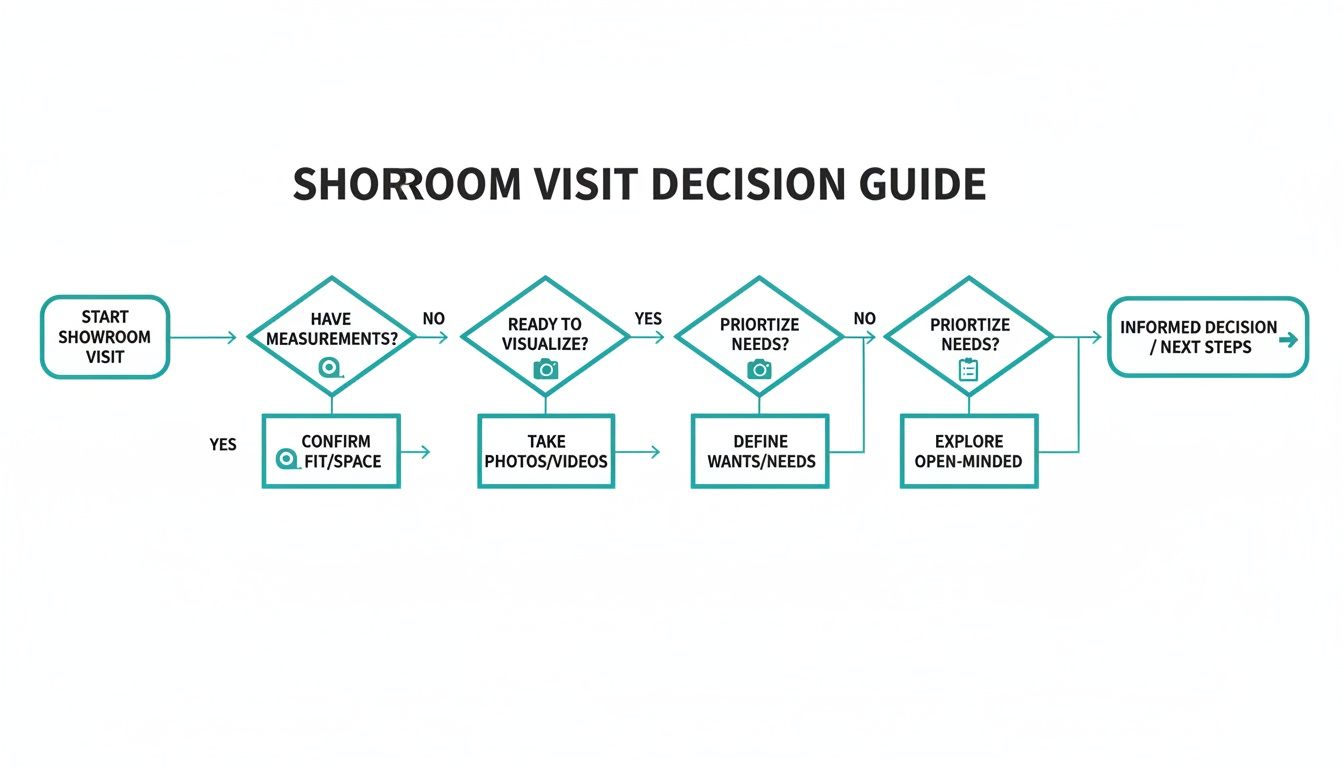
The flowchart really just reinforces one thing: a successful trip is all about mixing your prep work with focused, in-person testing.
Questioning the Technology
Finally, be sure to ask the staff about the motor. Is it a traditional AC motor or a more modern DC motor? DC motors are really the gold standard for efficiency these days, and they often use significantly less energy to run. For a full rundown on why they're a great choice, check out our guide on energy-efficient ceiling fans.
The market for these smarter, more efficient fans is blowing up. The global smart ceiling fan segment is projected to hit $12.9 billion by 2025. This huge growth is being driven by homeowners choosing fans with efficient BLDC motors that can slash energy bills by 50-60%—a trend highlighted in this market analysis from Grand View Research.
Turning Your Showroom Visit into Online Savings
Alright, you've done the legwork. Your trip to the local showroom was a success, and you've seen a few fans that really caught your eye. You know how they look, how they feel, and you have your shortlist ready. Now it’s time to take that valuable in-person knowledge and pair it with some savvy online shopping to make sure you get the best deal possible.
Let's be honest, showrooms have a lot of overhead—rent, lights, staff—and all of that gets baked into their prices. This is where your showroom visit gives you a strategic edge. While you're still on the showroom floor, pull out your phone and look up the models you love on Fan Connection, like that sleek Apex fan (starting at $428).

Comparing the Real Total Cost
The price tag you see in the store is rarely the final number. To do a true apples-to-apples comparison, you need to look at the total cost of getting that fan into your home.
- Product Price: How does the online price stack up against the showroom's? Specialized online retailers can often be more competitive.
- Shipping Costs: We (and many other online stores) offer free shipping on premium fans. That can be a pretty significant saving right there.
- Sales Tax: See how the local sales tax compares to what you'd pay online.
- Promotions: Keep an eye out for online-only discount codes or sales events that a physical store might not be running.
A quick check on these points can reveal some serious savings. For a deeper dive, our guide on how to compare prices of ceiling fans at nearby retailers breaks it all down perfectly.
Think of it this way: you’re not taking advantage of the showroom, you’re maximizing its value. You use their space to confirm your choice, then use your phone to lock in the best deal without compromising on quality.
The ceiling fan market is huge—we're talking USD 12.97 billion in 2024—and it's only getting bigger. Online sales are a major driver of that growth, expanding at a quick 6% CAGR as more people discover the wider selection and better value available from their couch. This shift makes it easier than ever to get your hands on top-tier collections.
To bridge the gap between seeing a fan in person and buying it online, smart showrooms could adopt tools that create a seamless, pre-filled checkout process. This would make it incredibly easy for customers to finalize their purchase after they’ve gone home to think it over. It’s all about connecting that hands-on confidence with the convenience of digital shopping.
Alright, you've done the legwork. You’ve walked the showrooms, felt the breeze from a dozen different models, and maybe even jotted down a few favorites. Now for the satisfying part: making a decision and bringing that perfect fan home.
This is where all that hands-on research pays off, especially when you combine it with the selection and value you find online with a specialist like us at Fan Connection.
Maybe you spotted a fan you loved in person. Chances are, you can find that exact model—or an even better alternative—right in our catalog. Whether you’re leaning toward a clean, 3-blade minimalist design like the Aerovon (from $358) or something with more of a lush, tropical feel, we’ve made it simple to find a match for your style.
A Checkout That’s as Smooth as Our Fans
We get it. Confidence in your purchase has to carry all the way through to the checkout. That’s why we keep things simple and secure, offering payment options that work for you.
You can wrap up your purchase using:
- All Major Credit Cards: Visa, Mastercard, American Express, and Discover.
- Digital Wallets: Apple Pay, Google Pay, and Shop Pay for that quick, one-click checkout.
- Trusted Payment Services: PayPal and Venmo for an extra layer of convenience and security.
For designers and contractors out there, this straightforward process is a real time-saver. Sourcing multiple high-end fans for a big project is incredibly efficient on our platform, cutting down on logistical headaches.
You’re getting the best of both worlds: the absolute certainty that comes from showroom research, combined with the superior selection, value, and convenience of buying from a dedicated online specialist like Fan Connection.
It’s no surprise the global ceiling fan market is taking off, projected to grow from USD 14.6 billion in 2025 to a staggering USD 31.6 billion by 2035. People want stylish, energy-efficient cooling, and that’s exactly what we specialize in. With our wide range of designs, from sleek Chisel models to classic 5-blade fans, we're right at the heart of this trend. Discover more insights about the booming ceiling fan market.
Common Questions We Get About Buying Ceiling Fans
Stepping into the world of ceiling fans can feel a little overwhelming. Whether you're in a showroom or browsing online, you're bound to have a few questions. We hear them all the time, so let's clear up some of the most common ones to help you feel confident in your choice.
Are the More Expensive Ceiling Fans Really Worth the Money?
In a word: absolutely. When you step up to a premium fan—usually anything over $300—you're not just paying for a brand name. You're investing in a whole different class of materials and engineering.
These fans almost always feature whisper-quiet DC motors, which are up to 70% more energy-efficient than the old-school AC motors. That means real savings on your electricity bill and an almost silent operation. You're also getting perfectly balanced blades made from solid wood or aircraft-grade aluminum that won't wobble, plus much better warranties. It’s a true investment in performance and durability that pays off for years.
What’s a Better Measure of Power: CFM or Blade Pitch?
This is a great question, but the answer is simple: CFM (Cubic Feet per Minute) is the number that matters most. It’s the certified, final measurement of exactly how much air the fan moves.
Blade pitch—the angle of the blades—is one of the ingredients that helps create good airflow. But the CFM rating is the whole recipe. It's the ultimate test of how powerful and effective a fan will be in your room.
Our Pro Tip: When you're trying to cool down a large room or a space that gets stuffy, always look for the fan with the highest CFM rating. It's the most reliable indicator of how that fan will actually perform once it's installed.
Can I Just Put a Regular Indoor Fan on My Covered Patio?
Never. This is a common mistake, and it's a dangerous one. Any outdoor space, even if it's fully covered, needs a fan with a specific UL rating to handle the environment.
Here’s what you need to know:
- Damp-Rated Fans: These are your go-to for covered porches and patios. They're built to handle humidity and moisture in the air without the blades warping or the electronics getting fried.
- Wet-Rated Fans: These are the heavy-duty option, built tough enough to handle direct exposure to rain, snow, and whatever else nature throws at them.
Putting an indoor-only fan outside isn't just a bad idea that will ruin the fan—it’s a serious safety risk that will instantly void the warranty. Always, always check for the correct UL rating.
At Fan Connection, we make sure you have all the details needed to pick the perfect fan with zero guesswork. Come explore our collections and find the ideal mix of style, power, and durability for your home. Visit us today at https://www.fanandlights.com.


