











Ceiling Fans Near Me: Find the Best Options for Your Space
Typing "ceiling fans near me" into a search bar is the easy part. The real work is finding the right fan for your home—one that’s as stylish as it is functional. And that all starts before you even leave the house.
To avoid wandering aimlessly through a showroom, you need to define your needs first. A few key measurements and style choices will turn your search from a random guess into a targeted mission for the perfect fan, transforming a room from stuffy to spectacular.
What to Know Before You Start Your Search
Before you head to a local store, take a few minutes to get prepared. It's the difference between feeling overwhelmed by endless aisles of options and walking in with the confidence of knowing exactly what you're looking for. It's the fun part where you get to dream a little!
This little bit of prep work boils down to three simple things: measuring your space, clarifying your style, and deciding which features actually matter to you.
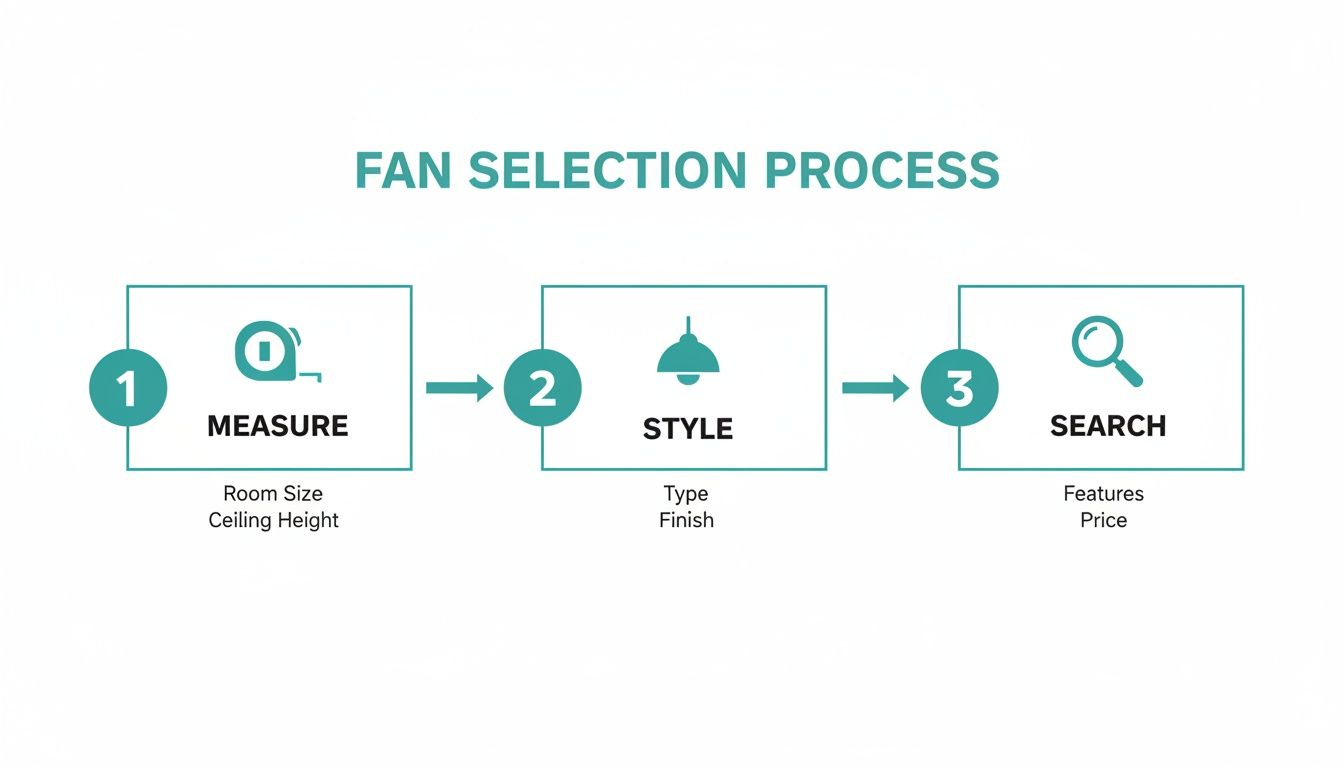
Think of it this way: measuring ensures the fan will fit and function correctly, while defining your style and feature preferences narrows down the sea of options to a manageable handful.
Measure Twice, Buy Once
The single most critical factor for a fan's performance is getting the size right. A fan that’s too small for the room simply won't move enough air to make a difference. On the flip side, a fan that's too large can make a small space feel like you're in a wind tunnel.
Grab a tape measure and get two key numbers:
- Room Dimensions: Measure the length and width of your room to calculate the total square footage. A cozy bedroom under 75 sq. ft. might only need a fan with a blade span under 36 inches. But for a sprawling great room over 300 sq. ft., you'll need something more substantial, like the impressive 60-inch Artemis XL5, to circulate air effectively.
- Ceiling Height: Measure from the floor to the ceiling. Standard 8-foot ceilings work with most fans, but anything lower will likely require a flush-mount model to maintain proper clearance. If you’re blessed with soaring ceilings over 9 feet, you'll need a longer downrod to bring the fan down to an optimal height for air movement.
To make this even easier, here’s a quick reference table.
Quick Fan Sizing Guide For Your Room
Use this table to quickly match your room's size with the recommended ceiling fan blade span for optimal air circulation.
| Room Size (Square Feet) | Recommended Blade Span (Inches) | Example Fan Connection Models |
|---|---|---|
| Up to 75 | 29" – 36" | Concept II, Timber |
| 76 – 144 | 36" – 44" | Light Wave, Torsion |
| 145 – 225 | 44" – 54" | Aerovon, Kute |
| 225 – 400 | 54" – 62" | Artemis XL5, Aviation |
| Over 400 | 62" or larger | Xtreme H2O, Odyn |
With these measurements, you can confidently shop for a fan that will deliver the performance you need.
Define Your Style and Features
Next, think about the fan's role in your room's decor. Is it meant to be a subtle, functional piece, or are you looking for a dramatic centerpiece? A sleek, modern fan like the Aerovon brings a clean, minimalist aesthetic, while a more traditional design might be a better fit for a classic space. This is your chance to add a little personality to the ceiling!
Today’s market is a far cry from the basic fans of the past. The industry has shifted dramatically toward design-led, energy-efficient, and smart models. This trend has really picked up in the last decade, completely changing what people expect when they search for "ceiling fans near me."
In fact, back in 2018, more than 80% of smart ceiling fan sales were for residential use, which just goes to show how quickly app-controlled fans became a mainstream home upgrade. You can learn more about this shift by exploring the latest ceiling fan market trends and projections.
Remember, a ceiling fan is a long-term fixture. Investing in a high-quality model priced over $300 often gets you a quieter, more powerful DC motor, better materials, and a longer warranty—details that make a huge difference in daily use.
With these details figured out, your search for "ceiling fans near me" will be far more productive. You'll be ready to ask the right questions and quickly zero in on the perfect model for your home.
Finding the Best Local Showrooms and Experts
A quick Google search for "ceiling fans near me" is going to point you straight to the big-box hardware stores. That’s fine if you just need something basic, but if you’re looking for real expertise and a high-quality fan that will last, you need to dig a little deeper. Let's talk about how to find the hidden gems where the pros are—the places where the magic happens.
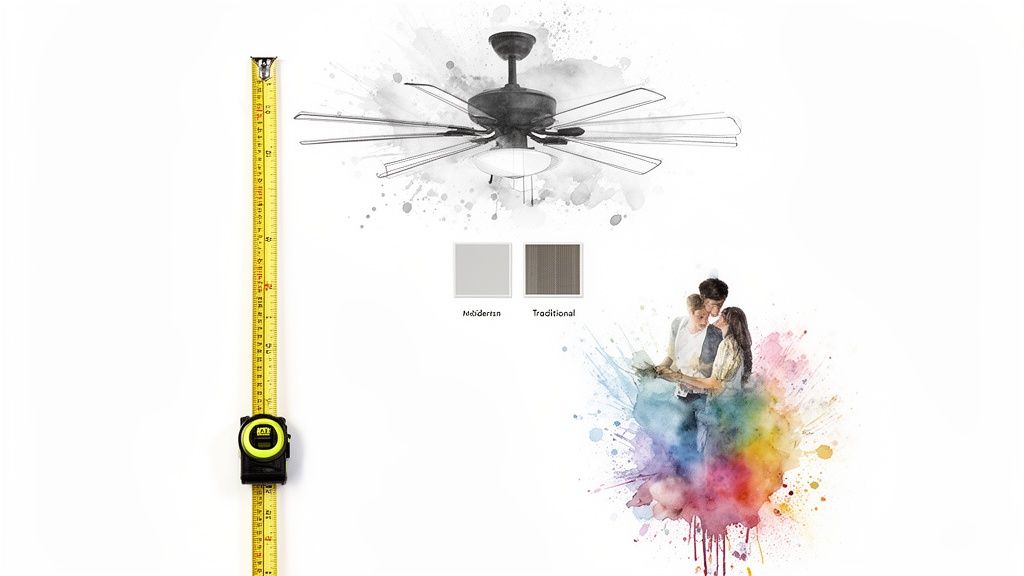
Instead of a generic search, get more specific. Try searching for phrases like "lighting showroom near me" or even "local fan specialist." This little trick often uncovers smaller, dedicated stores. These are the places where the staff actually lives and breathes ventilation and design, not just someone pointing you to aisle 12.
Look Beyond the Star Rating
Online reviews are a great starting point, but you have to learn to read between the lines. A store might have a five-star rating from hundreds of people buying lightbulbs, but the comments are where you’ll find the real story about their fan expertise.
Keep an eye out for reviews that mention specifics like:
- Helpful, knowledgeable staff who took the time to explain motor types.
- A great selection of display models that allowed customers to actually see the fans in action.
- Patient customer service that helped someone figure out the right downrod for their vaulted ceiling.
These details are gold. They signal a business that’s built on expertise, not just on moving boxes. A store that takes the time to help you is also far more likely to carry quality products worth your investment. This same principle applies to finding any local professional; you can benefit from general advice on actionable steps to find and vet local home renovation specialists.
Pro Tip: Before you drive anywhere, do a quick check of the store’s website or just give them a call. Ask if they carry premium brands and, more importantly, if they have working models on display. There’s nothing worse than getting excited about a fan only to arrive and find it’s just sitting in a sealed box.
Why Seeing Fans in Person Really Matters
Seeing a fan online is one thing, but experiencing it in a showroom is a completely different ballgame. This is where you can assess the crucial details that photos and videos just can't convey. You can judge the true scale of a larger fan in a room, see how the finish looks under actual lighting, and—most importantly—hear how quiet the motor is.
For premium fans that cost $300 or more, this in-person check is non-negotiable. It’s your chance to feel the craftsmanship and confirm the silent operation that justifies the price tag before you commit. If you want to learn more about identifying the best local spots, our guide on finding the best ceiling fan stores near me offers some extra insights. Taking this one extra step is what ensures you’ll be happy with your new fan for years to come.
Your In-Store Checklist for Choosing a Quality Fan
Walking into a local showroom takes your search for "ceiling fans near me" from a digital scroll to a real, hands-on experience. This is where you can move beyond pictures and specs to truly feel the quality of your potential investment. Armed with the right checklist, you'll be able to spot the difference between a fan that just looks good and one that’s built to last.
The Heart of the Matter: The Motor
The most critical component is tucked away inside the housing: the motor. Think of it as the fan's engine. Most standard fans run on an AC (Alternating Current) motor, which is a reliable workhorse but not the most efficient. Premium models, on the other hand, almost always feature a DC (Direct Current) motor—the new gold standard.
DC motors aren't just a small step up; they're a giant leap. They can be up to 70% more energy-efficient and are virtually silent. This is what gives a fan like the incredible Odyn its luxury feel—it moves a ton of air without you ever hearing it work.

Key Questions to Ask the Sales Staff
Once you’ve found a few fans that catch your eye, it’s time to dig a little deeper. A knowledgeable salesperson should handle these questions with ease, and their answers will tell you everything you need to know about the fan’s quality.
- What’s the motor warranty? A top-tier fan with a DC motor should come with a Limited Lifetime Motor Warranty. This is one of the biggest clues about the manufacturer's confidence in their product.
- What is the airflow rating in CFM? CFM stands for Cubic Feet per Minute, and a higher number means more powerful air movement. For a larger room, you'll want a fan with a CFM rating well over 5,000.
- Is this fan damp- or wet-rated? If you're shopping for a covered porch, patio, or even a steamy bathroom, the fan must be at least damp-rated. A standard indoor fan will quickly warp and rust in that kind of environment.
- Can you show me the smart features? If a fan is advertised as "smart," ask for a quick demo. See for yourself how easily it pairs with an app or responds to voice commands.
Don't be shy about asking. When you're investing $300 or more into a permanent fixture, you deserve to know exactly what you’re getting. For a deeper dive into the specs, our comprehensive ceiling fan buying guide has all the details.
Inspecting the Details Up Close
Beyond the technical stuff, use your own eyes and hands to judge the craftsmanship. Take a close look at the blade material. Are they solid wood, durable ABS plastic, or cheap-feeling particleboard? High-quality materials don't just look better; they're also balanced more precisely, which is key to preventing that annoying wobble.
Pay attention to the little things. Check the finish on the fan housing and blades. Does it look rich and even, or does it seem like it could easily scratch or chip? A quality finish is designed to look good for years, not just on the showroom floor.
Finally, ask the salesperson to crank a display model up to its highest speed. Just listen. A well-engineered fan should only produce the sound of moving air—no mechanical humming, rattling, or clicking. This simple test is often the most powerful way to understand why a premium, quiet motor is worth every penny.
Exploring Premium Fans and Justifying the Investment
When your hunt for "ceiling fans near me" takes you past the big-box store aisles, you’ll find that some fans are more than just appliances—they’re design statements. Stepping up into the premium category, which usually kicks in around $300, isn’t just about a higher price tag. It's an investment in a fixture that delivers on comfort, style, and a much, much longer lifespan. It’s the difference between just moving air and elevating your entire space.

These higher-end models really set themselves apart with better tech, top-notch materials, and the kind of thoughtful design you just don't get with budget options.
What Your Investment Gets You
The biggest difference is hiding inside: the motor. Premium fans almost always feature powerful, whisper-quiet DC motors. These are the engines that can move a ton of air without you ever hearing them work, and they do it while using up to 70% less energy than older AC motors. That efficiency adds up to real savings on your electricity bill over the years.
But it’s not just the motor. You’re also paying for quality you can see and feel. Instead of flimsy plastic, you get blades made from solid, furniture-grade wood or tough, all-weather composites. You can see this craftsmanship in models like the sleek, propeller-inspired Aviation fan or the magnificent Artemis XL5, where every single part is built to look good and perform flawlessly.
A premium fan is an investment in your home's daily comfort. The silent operation, powerful airflow, and smart home convenience create an environment that feels more refined and relaxing, making the initial cost a worthwhile long-term upgrade.
Smart Features and Lasting Value
Another huge reason for the price jump is the smart technology baked right in. Many fans in this range connect seamlessly with your smart home setup. Imagine telling Alexa to turn the fan up or scheduling it to turn on before you get home, all from an app. It’s a level of convenience that completely changes how you manage your home's climate.
The demand for better ceiling fans has exploded, turning them into one of the most popular home comfort upgrades around the world. Global sales were valued between USD 12.4 billion and USD 14.6 billion in 2025, and some projections show that number could nearly double by 2035. For shoppers, this growth is great news—it means more innovative, stylish, and efficient fans are hitting the market all the time. You can learn more about the growing ceiling fan market at Future Market Insights.
Ultimately, buying a premium fan is a long-term play. You're getting a product with a solid warranty, incredible performance, and a timeless design that actually elevates your decor. It’s a purchase you make for years of quiet, reliable comfort, not just a quick fix for a stuffy room.
Alright, you’ve done the hard work. You’ve walked the showrooms, compared the specs, and finally picked out the perfect ceiling fan. Now for the last mile: getting that box from the store to your ceiling, safe and sound.
Let's talk logistics. Most good specialty fan stores will offer local delivery for a small fee. This is a lifesaver if you've gone for a larger model, like a big 84-inch Xtreme H2O, which won't exactly fit in the back of a sedan. If you've got a truck or SUV, you can always take it home yourself—just make sure you handle it gently. Those motors and blades are finely balanced, and you don't want to knock anything out of alignment before it's even installed.
Finding a Qualified Local Electrician
This next part is crucial: the installation. I know it’s tempting to try and DIY it, but for any decent fan costing $300 or more, this is a job for a professional. Seriously.
A licensed electrician isn't just there to hang the fan. They’re making sure the electrical box in your ceiling can actually support the weight and that all the wiring is done safely and up to code. A sloppy installation is a recipe for a wobbly, noisy fan, and at worst, a serious safety hazard. A quick search for a "ceiling fan installer near me" is a fine start, but you need to do a little homework before you hire someone.
Questions to Ask Your Installer
Before you book anyone, get them on the phone and ask a few pointed questions. This little five-minute interview can save you a world of headaches and ensure your investment is in good hands.
- Are you licensed and insured? This is a deal-breaker. No license, no job. Insurance protects you if anything goes wrong.
- Do you have experience with high-end or heavy fans? Hanging a heavy, solid wood fan is a completely different ballgame than a cheap, lightweight model from a big-box store. You want someone who knows the difference.
- Does your quote include balancing the fan blades? This is the secret to a silent, wobble-free fan. A real pro will always perform this final, critical step as part of the job.
- What is your warranty on the installation work? Any reputable installer will stand behind their work for at least a few months, if not longer.
A professional installation is the final piece of the puzzle. It ensures your fan operates at peak performance, stays whisper-quiet, and remains securely attached to your ceiling for years to come. Don't cut corners on this last, crucial step.
Finding the right person for the job is all about protecting your investment. For some extra guidance, check out our article on finding top-rated ceiling fan installation services close to you.
Once you've got your installer scheduled, you're just one appointment away from enjoying that cool breeze and the new look of your room.
Common Questions About Buying Ceiling Fans Locally
Shopping for the right ceiling fan can bring up a lot of questions, especially when you're trying to find the perfect fit at a local store. It’s a big decision! Let's clear up some of the most common things people ask so you can shop like a pro.
Can I Install a Ceiling Fan Myself?
It’s tempting to save a few bucks and go the DIY route, and for a simple, lightweight fan, that might be fine. But when you’re investing in a premium fan—think anything over $300—we always recommend calling in a licensed electrician.
These higher-end models are often heavier and come with more complex wiring, especially with things like smart controls and quiet DC motors. A pro will make sure your ceiling's electrical box can actually handle the weight and that every connection is solid and up to code. Trust me, it’s worth it for the peace of mind and to guarantee that perfectly silent, wobble-free performance you paid for.
How Much Should I Expect to Pay for a Good Ceiling Fan?
You can definitely grab a basic fan for under a hundred dollars, but if you want a fixture that’s going to perform well and look great for years, you should plan on a budget starting around $300. This is the price point where you really start to see a jump in quality.
So, what does that extra money get you?
- Superior Motors: This is where ultra-quiet, super-efficient DC motors become the norm. They'll save you a surprising amount on your electricity bills over the fan's lifetime.
- Better Materials: Instead of basic particleboard, you'll find blades made from solid wood or high-grade ABS composites. They not only look better but are precision-balanced at the factory to eliminate wobbling from day one.
- Longer Warranties: Brands stand behind these better-built products. It’s common to see a Limited Lifetime Motor Warranty, which tells you everything you need to know about its durability.
- Advanced Features: Things like smart home integration, multi-speed remote controls, and high-quality dimmable LED lighting are pretty standard in this range.
Think of it less as a purchase and more as an investment in your home’s comfort and style.
Do I Need a Different Fan for Outdoors?
Yes, absolutely. Putting an indoor-rated fan on a porch or patio is a recipe for disaster. The moisture in the air will quickly cause the blades to warp and sag, and it won't take long for the internal parts to rust and fail.
When you're shopping, you need to look for fans specifically rated for where you plan to install them:
- Damp-Rated Fans: These are perfect for covered outdoor spots like porches and patios. They’re built to handle humidity but aren’t meant to be in direct contact with rain.
- Wet-Rated Fans: If your fan will be in an uncovered area like a pergola or gazebo where it might get hit with rain, you need a wet-rated model. They’re constructed with waterproof seals and all-weather materials to handle the elements.
Your local search for "ceiling fans near me" is actually part of a massive global trend. While your needs are specific, regional data shows why this search looks different in Mumbai versus Miami. The Asia-Pacific region, for instance, drives the market with about 52% or more of all ceiling fan revenue due to rapid urbanization. In contrast, North America and Europe are premium markets where energy regulations and smart-home adoption steer buyers toward higher-performance models. You can learn more about these fascinating global ceiling fan market dynamics and regional trends.
Making the right choice here is critical. It ensures your fan will not only survive but thrive outside for years to come.
At Fan Connection, we've curated a collection of high-quality, stylish fans to make your search easier. From the sleek Aerovon to the statement-making Artemis XL5, find the perfect fixture to elevate your space.


