











The Ultimate Guide to Ceiling Fans with Smart Home Integration Options
Welcome to the future of home comfort, where the humble ceiling fan has evolved into a centerpiece of intelligent living. Ceiling fans with smart home integration options are more than just a cool gadget; they’re a complete rethink of what a home environment can be. Forget clunky pull chains and misplaced remotes. We're talking about fans that blend intelligent automation with efficient cooling, letting you control everything from airflow to lighting with a quick voice command or a tap on your phone. It's time to have a little fun with your fixtures!
Why Smart Ceiling Fans Are the Future of Home Comfort

Imagine strolling through the door after a long day, and your ceiling fan knows to kick on a gentle breeze to welcome you home. Picture it automatically adjusting its speed as the room warms up in the afternoon sun. This isn't science fiction anymore. It's the new standard for a living space that works for you, turning a simple appliance into an active, responsive part of your smart home ecosystem.
This evolution is no surprise. We're seeing smart tech in home renovation trends pop up everywhere, from kitchens to bathrooms, and ceiling fans are a natural and brilliant fit for this shift toward smarter, more efficient homes.
More Than Just a Cool Breeze
A smart fan offers a level of control that goes way beyond a simple pull chain, mixing a little bit of luxury with a whole lot of practicality. You can, for instance, set up schedules that match your daily routine, so your bedroom is perfectly cool right at bedtime without you ever having to think about it. It's the kind of effortless comfort that feels like magic.
This is all about creating a responsive environment—one that fits your lifestyle, saves energy, and adds a touch of modern polish to your home.
And this isn't just a niche trend. The global market for smart ceiling fans was valued at USD 1.66 billion in 2025 and is expected to hit USD 2.27 billion by 2031. That growth is fueled by savvy homeowners like you who want energy-saving solutions that play nicely with popular systems like Amazon Alexa and Google Assistant.
A Worthwhile Investment in Comfort
Putting your money into a premium smart fan—like the sleek Aerovon Smart Fan or the powerful Artemis IV—is an investment that pays you back in multiple ways. These higher-quality models, typically starting at $300 or more, are built with superior materials and more advanced technology, which means they're designed for the long haul.
Here's what that upgrade really gets you:
- Serious Energy Savings: Most premium smart fans use modern DC motors, which are up to 70% more efficient than the old-school AC motors. That’s a difference you’ll actually see on your electricity bill.
- Ultimate Convenience: Control your fan from the couch, from the office, or even from bed using your smartphone or a simple voice command. "Hey Google, set the fan to 50%." Done. No more fumbling for a remote in the dark.
- A Better Lifestyle: Features like built-in temperature sensors and scheduling let you automate your comfort completely. You just set it and forget it, letting your fan do the thinking for you.
As you start looking at different options, it’s helpful to see just how closely these smart features are tied to efficiency. If you're curious, you can dig deeper into how smart fans contribute to energy savings. It’ll show you exactly why adding a smart fan is one of the best upgrades you can make to any room.
Choosing the Right Smart Home Ecosystem for Your Fan
Think of your smart home system—whether it’s Amazon Alexa, Google Assistant, or Apple HomeKit—like a private club. For all your gadgets to work together seamlessly, they all need to be members. When it comes to ceiling fans with smart home integration options, picking one that's already on the guest list is the secret to a headache-free setup.
Your best bet is to find a fan that works directly with the system you already use and love. If you’re an Alexa household, look for fans with "Works with Alexa" right on the box. If you're all-in on Google, prioritize models that play nice with Google Assistant. This simple decision saves you from the nightmare of juggling a half-dozen different apps or buying extra hubs just to get your fan to listen.
The Tech Behind the Talk
So, how do these fans actually connect? Under the hood, they use a couple of common technologies to chat with your network and your phone. You’ll mostly see two options: Wi-Fi and Bluetooth.
-
Wi-Fi: This is the go-to for full-on smart control. A Wi-Fi-enabled fan connects straight to your home’s wireless network. That means you can control it from anywhere you have an internet connection. Left for vacation and realized the fan is still running? No problem. Just open the app and turn it off from the airport.
-
Bluetooth: This method offers simple, direct control when you’re nearby, without needing an internet connection at all. It basically turns your phone into a super-powered remote control. Many top-tier fans actually include both, giving you reliable in-room control plus the freedom of remote access.
For a deeper dive into picking the perfect fan for your space, our complete ceiling fan buying guide is packed with pro tips to help you choose with confidence.
Smart Fan Communication Protocols Compared
To make it even clearer, let's break down the main technologies you'll encounter. Each has its place, and understanding the differences will help you pick the fan that best fits how you plan to use it.
| Protocol | Best For | Pros | Cons |
|---|---|---|---|
| Wi-Fi | Remote control from anywhere, full smart home integration, and voice commands. | Connects directly to your home network; allows for complex scheduling and routines; works with major ecosystems. | Requires a stable internet connection to function; can be more complex to set up. |
| Bluetooth | Simple, direct control from your phone when you are in the same room. | Doesn't need an internet connection; easy pairing process; acts as a reliable remote. | Limited range (typically around 30 feet); no control when you're away from home. |
| Hybrid (Wi-Fi + Bluetooth) | The most versatile and reliable experience, offering the best of both worlds. | You get remote access via Wi-Fi and a dependable local connection via Bluetooth. | Can be slightly more expensive, but offers maximum flexibility. |
Ultimately, a fan with both Wi-Fi and Bluetooth gives you the most robust and flexible experience, ensuring you're never left without a way to control your comfort.
The real magic isn't just about turning the fan on with your voice. It's about true integration—like setting a routine where your fan automatically turns on to a gentle breeze when your smart thermostat hits 75°F.
Finding a Flawless Fit for Your Home
When you step up to a high-end fan from a trusted brand, you're not just getting a beautiful fixture. You're getting guaranteed compatibility. These fans, which generally start around $300, are built from the ground up to integrate perfectly with major smart home systems.
Take a fan like the stunning Artemis IV, for instance. At over $800, it's a true luxury investment, but it comes ready to pair with Amazon Alexa, Google Assistant, and Samsung SmartThings right out of the box. There are no extra gadgets to buy and no clunky workarounds. You just connect it, and it works. That’s the kind of built-in, effortless control that defines a truly premium smart fan.
Integrated Smart Fans Versus Retrofit Kits
So you've decided to bring your ceiling fan into the smart home age. Great! Now you’re at a crossroads: do you buy a brand-new fan with all the smarts built right in, or do you try to upgrade your trusty old fan with a separate kit?
Think of it like buying a new car that comes fully loaded with a great navigation system versus trying to stick an aftermarket GPS onto the dashboard of your old one. Both can get you from A to B, but the experience is completely different.
For a truly seamless and reliable setup, our recommendation is almost always to go with a ceiling fan that has smart home integration built-in from the factory. These models are engineered from the ground up to perform flawlessly. The motor, the internal receiver, and all the wiring are designed to communicate perfectly, so you get every single feature promised on the box.
The All-In-One Advantage
When you invest in an integrated smart fan, you're getting a complete, cohesive system. There's no guesswork. You’ll see this in premium models like the gorgeous Chisel Smart Fan or the powerful Aerovon Smart Fan—fans typically priced over $300—which come ready for a top-tier smart experience right out of the box.
The manufacturer has already sorted out all the compatibility headaches for you. You get full warranty coverage, a dedicated app that just works, and the confidence that your investment is sound. The installation is cleaner, the performance is far more dependable, and you get to enjoy all the cool advanced features without a single compromise.
An integrated smart fan isn't just a regular fan with a smart chip tacked on. It’s a purposefully designed piece of tech where every component is optimized to work in perfect harmony.
The Retrofit Reality
The other option is to use a retrofit kit. This usually means buying a smart receiver that you have to wire into your existing fan’s canopy, or maybe a smart wall switch to replace the one you have now. On the surface, it seems like a cheaper way to get smart controls on a "dumb" fan. But this path is often paved with hidden frustrations.
Here’s an honest look at what you might run into:
- Compatibility Roulette: There’s no guarantee a kit will work with your fan, especially if it’s an older model or has unique controls. You could end up with a motor that hums, lights that flicker, or certain fan speeds that just won't work.
- Limited Features: A retrofit kit will usually just give you the basics—on/off and speed control. You'll almost certainly miss out on the advanced features like natural breeze modes, temperature sensing, or adaptive schedules that are standard in purpose-built smart fans.
- Tricky Installation: Trying to stuff a new receiver into the cramped space of a fan canopy can feel like solving a frustrating puzzle. It's often a job best left for an electrician.
While an add-on kit can be tempting, it's a bit of a gamble. If you just want a simple way to make an existing fan a little smarter, something like a universal Wi-Fi remote kit could be a solution. Just know that its performance will never quite match a true integrated system.
For long-term satisfaction and a genuinely great smart home experience, a dedicated smart fan is the clear winner.
Smart Features That Redefine Comfort and Efficiency
This is where the real fun begins. Sure, turning your fan on with your voice is cool, but the true magic of a smart fan is in the features that genuinely make your life easier and your home more comfortable. These aren't just party tricks; they’re thoughtful automations that completely change how you think about a ceiling fan.
Imagine waking up not to a jarring alarm, but to a fan that gradually spins up to gently rouse you. It's this level of detail and convenience that makes premium models over $300 feel less like an appliance and more like a part of your home.
Automated Comfort and Personalization
Modern smart fans are designed to do the thinking for you. They’ve moved way past a simple remote control and into a world where they can actually respond to your life and environment.
You’ll find some seriously impressive features in today’s top-tier fans:
- App-Based Scheduling: This is a game-changer. You can program your fan to fit your daily routine perfectly. Have it kick on a few minutes before you get home from work or dial down to a silent, gentle breeze in the middle of the night so your sleep is never disturbed.
- Adaptive Learning: Some of the most advanced fans actually learn your habits. They’ll notice you tend to turn up the speed around 3 PM and start doing it for you automatically. It’s a truly hands-off approach to personalized comfort.
- Voice Control: When your hands are full with groceries or laundry, the last thing you want to do is hunt for a remote. A simple "Hey Google, turn on the living room fan" is the ultimate in convenience.
This shift to smarter control is what people are asking for. A 2026 American Lighting Association survey found that a whopping 48% of shoppers now prefer fans with smart controls. The demand for these intelligent features is only going up, as you can see from these ceiling fan market insights.
More Than Just Airflow
The best smart fans do more than just spin—they help create a perfect atmosphere. Features that were once only found in the most expensive luxury models are now becoming more common, delivering an experience that’s well worth the investment.
It’s all about getting your fan to work with the rest of your home. Think about it: your fan can sync with your smart thermostat. When the AC turns on, the fan automatically starts circulating that cool air more efficiently, saving you real money on your energy bill.
This ability for different devices to communicate is a huge leap forward. The benefits of this kind of smart integration aren't just limited to fans, either. You can see similar advantages when you learn about the 7 Reasons Why You Should Motorize Your Window Treatments.
Other standout features to look for include:
- Natural Breeze Modes: This feature is fantastic. Instead of a constant, artificial-feeling wind, it varies the fan's speed to mimic a natural outdoor breeze. It’s a much more pleasant and organic way to stay cool.
- Temperature and Humidity Sensors: With built-in sensors, the fan can adjust its speed all on its own based on the room's conditions. If the living room gets stuffy and hot in the afternoon, the fan will automatically ramp up to keep you comfortable.
These features don't just add a layer of luxury; they directly contribute to efficiency. By automating your fan, you’re making sure it only runs when you need it and at the most effective speed. Over time, that translates into real savings. For a deeper dive on this, check out our guide to energy-efficient ceiling fans.
Our Top Smart Fan Picks for the Discerning Homeowner
Alright, let's get to the good stuff. If you're ready to find the perfect smart fan for your home, it’s easy to get lost in a sea of options. To make things a little easier, we’ve handpicked a few of our favorite premium models—all priced over $300—that are as smart as they are beautiful.
These aren't your run-of-the-mill ceiling fans. Think of them as statement pieces that just so happen to deliver incredible comfort and seamless smart control. Each one brings a unique style to the table, but they all live up to the promise of a top-tier product.
For the Bold and Modern Space: The Artemis IV
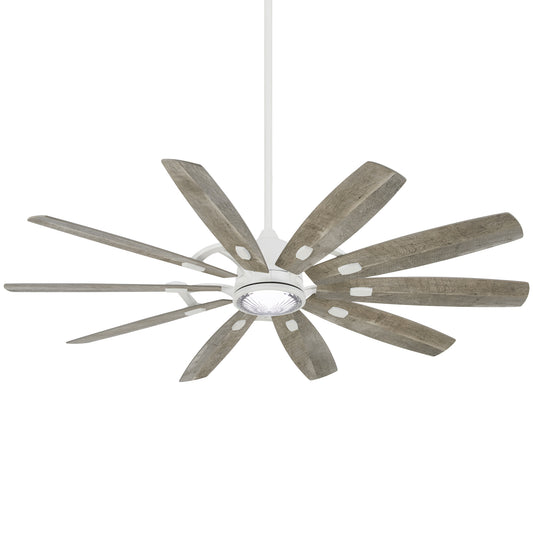
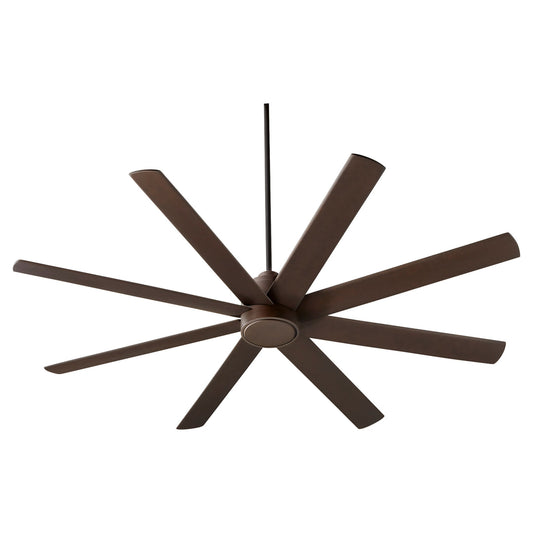
If you want a fan that truly makes a statement, you can't go wrong with the Artemis IV. With its distinctive, flowing blades, this fan is basically a piece of sculptural art that also happens to move a serious amount of air. It’s a showstopper, perfect for living rooms or master bedrooms where design is everything.
But it’s not just about looks. The Artemis IV is a smart-tech powerhouse, integrating smoothly with the major smart home systems you already use. That means you can control its speed, light, and direction with a simple voice command or a few taps in an app. This is the fan for anyone who refuses to compromise on style or substance.
The Artemis IV is proof that functional hardware can be absolutely beautiful. It’s the kind of fan that becomes the centerpiece of a room's design while still being a powerful, efficient appliance.
For Sophisticated and Sleek Interiors: The Chisel
Looking for something a little more understated but just as impressive? The Chisel Smart Fan is an amazing choice. Its clean lines and three-blade design have a minimalist vibe that fits perfectly with modern and transitional decor. It's the kind of fan that exudes quiet confidence and refined style.
Don't let the sleek profile fool you, though—the Chisel is packed with smarts. Its whisper-quiet DC motor is incredibly energy-efficient and fully controllable over Wi-Fi. You can set schedules, fine-tune the speed, and sync it up with your smart home for totally automated comfort.
Choosing a fan with a powerful yet efficient motor is one of the smartest decisions you can make. If you want to learn more, you might be interested in our guide on the best ceiling fans for energy efficiency.
For Unmatched Aerodynamic Performance: The Aerovon
When it’s all about maximum airflow and a cutting-edge look, the Aerovon Smart Fan is in a league of its own. Inspired by aerodynamic principles, its uniquely shaped blades are engineered to move a massive amount of air with remarkable efficiency. This makes it a fantastic fit for large, open-concept spaces or rooms with soaring ceilings.
The Aerovon is built for performance from the inside out. It comes with full smart integration, giving you precise control over its powerful airflow right from your phone or with voice commands. For homeowners who demand the absolute best in both cooling power and modern tech, this is it.
Your Guide to a Smooth Smart Fan Installation
So, you’ve picked out the perfect smart fan and you’re ready to get it spinning. A little prep work can make a world of difference, ensuring your installation is just as breezy as the air your new fan will be moving. Getting your ceiling fans with smart home integration options up and running is actually pretty straightforward.
Before you even break the seal on the box, let’s run through a quick checklist. Trust me, spending a few minutes on this now can save you a ton of headaches later.
- Check Your Wi-Fi Signal: Head over to the spot where your fan will live and take a look at the Wi-Fi bars on your phone. If you've got less than two, you might want to grab a Wi-Fi extender. A weak signal can cause your fan's smart features to drop out, which is just frustrating.
- Grab Your Wi-Fi Password: You're going to need your network name (SSID) and password when you set up the app. Have it written down nearby or ready to go on your phone to keep things moving.
Once the digital side is sorted, it's time for the physical installation. Always follow the manufacturer’s guide to the letter, but the golden rule is to turn off the power at the circuit breaker before touching a single wire. Safety first, always.
From App Download to Voice Command
With the fan securely mounted and the power back on, the fun part begins. Just download the fan's dedicated app from your phone's app store. Think of this app as the remote control for connecting the fan to your Wi-Fi and unlocking all its cool features.
The last piece of the puzzle is linking it to your smart home. Inside the fan's app, you’ll usually find a section called "Integrations" or "Works With." This is where you'll connect it to systems like Amazon Alexa or Google Home, which is what lets you say, "Alexa, turn on the fan."
This whole process is designed to be seamless, especially when you start with a quality fan.
As the infographic shows, models like the Apex, Andros, and Anywhere are built from the ground up for easy smart home integration. It's a clear trend—we're seeing AI and IoT technology transform everyday home devices. In fact, a recent survey found that 48% of consumers are looking for IoT-enabled fans that can do things like sense motion or adjust automatically to the room's temperature. You can read more about these developing market trends and see where smart home comfort is headed next.
Frequently Asked Smart Fan Questions
Alright, we've covered a lot of ground. But it's totally normal to still have a few questions floating around before you dive into the world of smart fans. Let's clear up some of the most common ones we hear from our customers.
Do Smart Ceiling Fans Use More Electricity?
This is probably the biggest misconception we see. People assume all that smart tech must guzzle electricity, but it's actually the other way around. Most premium smart fans—especially models over $300—are built with hyper-efficient DC motors.
These aren't the loud, clunky AC motors you might remember from older fans. A modern DC motor can use up to 70% less electricity to do the same job. When you factor in smart features like scheduling and temperature triggers, the fan only runs when it’s truly needed, saving you even more on your energy bill.
What Happens If My Wi-Fi Goes Down?
Don't sweat it—you won't be left high and dry without a breeze. Every single smart fan we carry is bundled with a physical remote control that works completely independently of your Wi-Fi.
Your fan's basic functions, like turning it on/off and changing the speed, will always work with the remote. The smart stuff—like voice commands or app control—will just patiently wait for your internet to come back online and reconnect automatically.
Can I Control Multiple Smart Fans With One App?
Absolutely. This is where the magic of a connected home really shines. Each brand’s app lets you see and control all of their fans from one simple screen. You can even group them by room (think "Living Room" or "Bedrooms") to manage them all at once or one by one.
If you want to take it a step further, tying your fans into a smart home system like Amazon Alexa or Google Home is the way to go. This lets you create powerful routines that control fans from different brands simultaneously. Imagine saying "Goodnight" and having every fan and light in the house turn off together.
At Fan and Lights, we believe a smart fan should be more than just functional—it should be a joy to use and a beautiful addition to your home. We're here to help you find a smart fan that just fits—your home, your style, and your life.
Ready to find your perfect match? Browse our full collection of smart ceiling fans today!


