

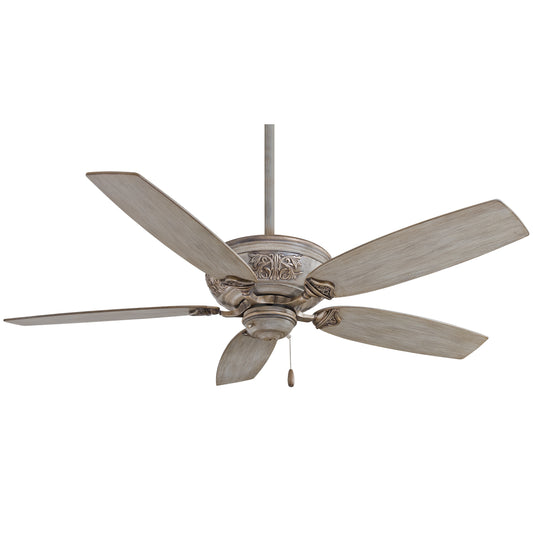


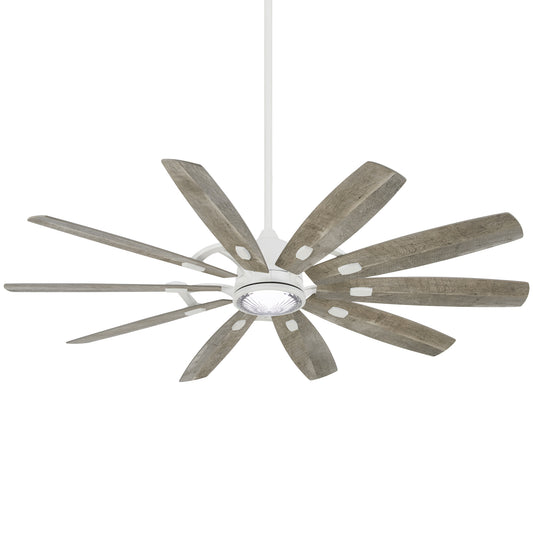

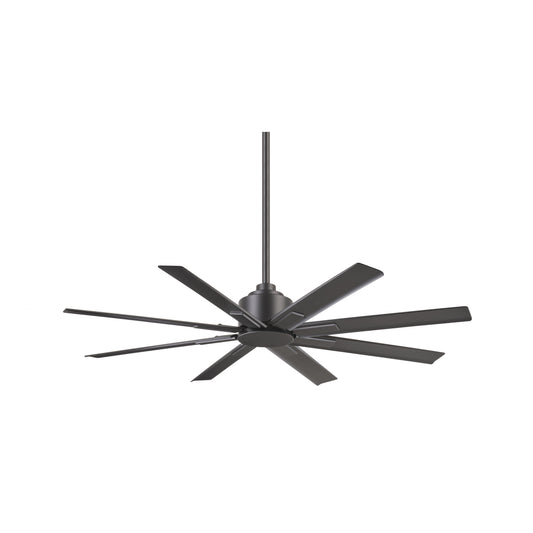

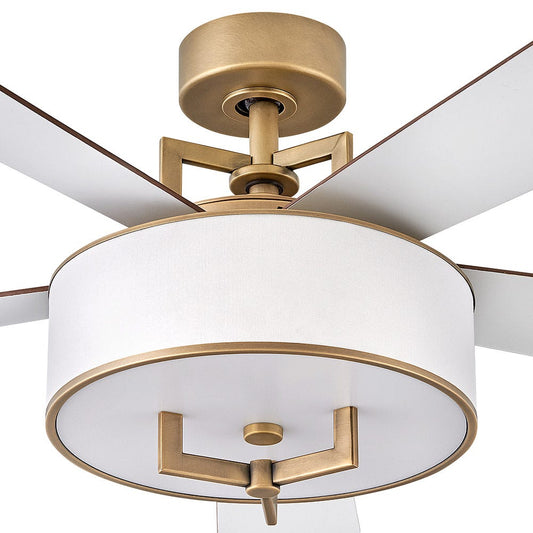






Crystal Ceiling Fans with Lights: Bring the Sparkle Home
Imagine getting the best of a breathtaking chandelier and a high-performance ceiling fan in a single, stunning package. That's the magic of a crystal ceiling fan with lights. It’s not just a fan, and it’s not just a light fixture—it’s a functional work of art that delivers a cool breeze and a dose of glamour all at once. The sparkling crystals catch and scatter the light, creating a beautiful ambiance, while a powerful, quiet motor keeps you comfortable.
It’s the ultimate two-for-one deal for your home, transforming any room into a space that feels both luxurious and livable.

Why Choose a Crystal Ceiling Fan With Lights?
It's no surprise that crystal ceiling fans have become a go-to for savvy homeowners and designers. They're the perfect blend of practical engineering and decorative flair, almost like a miniature chandelier that also happens to cool your room. Honestly, they just solve so many problems at once!
Let's break down the real-world benefits you get when you bring one of these beauties into your home.
- Upgraded Ambiance: The cut crystal pieces aren't just for show. They catch the light from the integrated LEDs and throw it around the room, turning a simple fixture into a luminous centerpiece. It's instant atmosphere!
- Serious Cooling Power: Don't let the good looks fool you. These fans are built to move air. Many high-end models are rated for up to 6,500 CFM (cubic feet per minute), delivering a strong breeze without any annoying noise.
- Built-In Lighting: No need to install a separate light. These come with integrated, dimmable LEDs, often with adjustable color temperatures to set the perfect mood for any time of day—from cozy evening glow to bright morning focus.
- A True Statement Piece: The intricate crystal designs create a natural focal point, much like a luxury chandelier would, but with the added bonus of airflow. It's the definition of functional elegance.
- Styles for Every Ceiling: Whether you have high, vaulted ceilings or standard 8-foot heights, there's a model for you—from flush mounts for low-clearance rooms to extended downrods for more dramatic spaces.
- Quiet as a Whisper: Modern engineering means these fans run at less than 40 dB, so you get all the comfort without any distracting motor hum. You'll feel it, not hear it.
“A crystal fan is like wearing a statement necklace in your room—it transforms the ordinary into something unforgettable.”
Market Growth and Trends
The demand for high-end, stylish ceiling fans is definitely on the rise. In 2025, the premium ceiling fan market (which includes these beautiful crystal models) was valued at a whopping USD 14.6 billion.
And it's not slowing down. Projections show the market is expected to more than double, hitting USD 31.6 billion by 2035. That's a steady growth rate of 8.1% every year. What’s driving this? People want it all: energy efficiency, smart home controls, and fixtures that look incredible. You can dive deeper into the ceiling fan market growth research to see the full picture.
The following table shows just how strong this trend is, with steady growth projected over the next decade.
Crystal Ceiling Fan Market Growth
| Year | Market Value (USD Billion) | CAGR |
|---|---|---|
| 2025 | 14.6 | 8.1% |
| 2030 | 22.8 | 8.1% |
| 2035 | 31.6 | 8.1% |
This steady climb shows that more and more homeowners are looking for fixtures that are both smart and stylish, making crystal ceiling fans a solid investment in a home's value and appeal.
Real Spaces Transformed
In a master bedroom, a crystal ceiling fan can be the only fixture you need, acting as a soft light source, a cooling breeze, and a piece of art all in one. In a living room, it becomes an instant focal point that ties the whole space together, from the furniture to the color on the walls.
With home renovations and smart technology becoming more common, these fans are the perfect mix of performance and personality. And while many of these fixtures retail for over $300, think of it less as an expense and more as an investment in your home’s style and comfort.
Understanding Fan Components And Design
Before you fall in love with a specific crystal ceiling fan, it helps to know what’s going on under the hood. You don't need to be an engineer, but understanding the key parts—the motor, blades, and light kit—will help you pick a fan that not only looks stunning but also performs beautifully.
Think of it this way: a crystal ceiling fan is a perfect blend of brawn and beauty. The motor is the powerhouse, the blades are the wings, the crystals are the jewelry, and the light kit is what truly sets the mood. Let's break down how these pieces come together.
To give you a quick overview, here’s a look at the major parts and what they do.
Key Components Of Crystal Ceiling Fans
| Component | Function | Key Consideration |
|---|---|---|
| Motor | The "engine" that powers the fan's rotation. | Choose between reliable AC or ultra-quiet, efficient BLDC motors. |
| Blades | Move the air to create a cooling breeze. | Blade pitch and overall fan size determine airflow (CFM). |
| Light Kit | Provides illumination and holds the crystals. | Look for brightness (lumens) and adjustable color temperature (Kelvin). |
| Crystals | Add decorative sparkle and refract light. | Crystal type (e.g., K9, Asfour) affects clarity and brilliance. |
| Mounting Hardware | Secures the fan to the ceiling. | Ensure it's compatible with your ceiling height and type (sloped or flat). |
Each component is engineered to work together, creating a centerpiece that’s both functional and breathtaking.
The Motor: The Unseen Powerhouse
The motor is the heart of your fan. It dictates everything from how much air it moves to how quietly it operates and how much energy it consumes. You’ll generally come across two main types.
- AC (Alternating Current) Motors: These are the traditional workhorses. They're dependable and usually more budget-friendly, but they can use more power and sometimes produce a slight hum.
- BLDC (Brushless Direct Current) Motors: This is the modern, high-performance option. BLDC motors are up to 70% more energy-efficient than AC motors, run almost silently, and typically offer more speed settings. For any fan over $300, a BLDC motor is a fantastic investment for its whisper-quiet operation and long-term energy savings.
Blades And Airflow, Demystified
The blades are what get the air moving, and their design has a huge impact on how cool the room feels. The two terms you’ll hear most are blade pitch and CFM.
Blade pitch is simply the angle of the blades, which is usually between 12 and 15 degrees. A steeper pitch can move more air, but it needs a stronger motor to do the job right. It’s a bit like angling the wings of an airplane—it's all about finding that perfect balance for optimal performance.
This diagram shows how the motor housing, blades, and mounting system are all designed to work in harmony for stable, effective cooling.
CFM (Cubic Feet per Minute) is a straightforward measurement of how much air the fan moves. The higher the CFM, the more powerful the breeze. For an average-sized living room, a fan with a CFM between 4,000 and 6,000 will feel fantastic.
The Light Kit: Setting The Scene
The light kit is where a crystal ceiling fan truly earns its "fandelier" nickname. It’s where all the magic happens! Understanding a few lighting specs will help you create the perfect vibe for your space. If you want to dive deeper into how light kits work, our guide on choosing a ceiling fan with light kit is a great resource.
Here’s what you need to know:
- Lumens: This tells you how bright the light is. More lumens means a brighter room.
- Color Temperature: Measured in Kelvin (K), this determines if the light feels warm and cozy or cool and energizing. A warm, yellowish glow is around 2700K, while a crisp, blue-white light is closer to 5000K. Many modern fans let you adjust the color temperature, so you can switch from a relaxing evening atmosphere to bright, clear daylight with the touch of a button.
Key Criteria To Choose The Right Fan
Picking the perfect crystal ceiling fan is a balancing act. You're looking for a fixture that not only moves air effectively but also enhances your decor without dominating the room. It’s about finding that sweet spot where size, power, lighting, and style all come together.
A great place to start is matching the fan's diameter to your room's size. Think of it like this: a fan that's too small will struggle to cool the space, while one that's too big can feel overwhelming. For most living areas between 200–400 sq ft, a 42–52 inch span is just right. In smaller spaces like bedrooms, a 36–44 inch model usually does the trick.
This whole process can feel a bit like a decision tree—one choice influences the next. The infographic below gives you a great visual of how the motor, blades, and lights all connect to create the fan's overall performance and look.
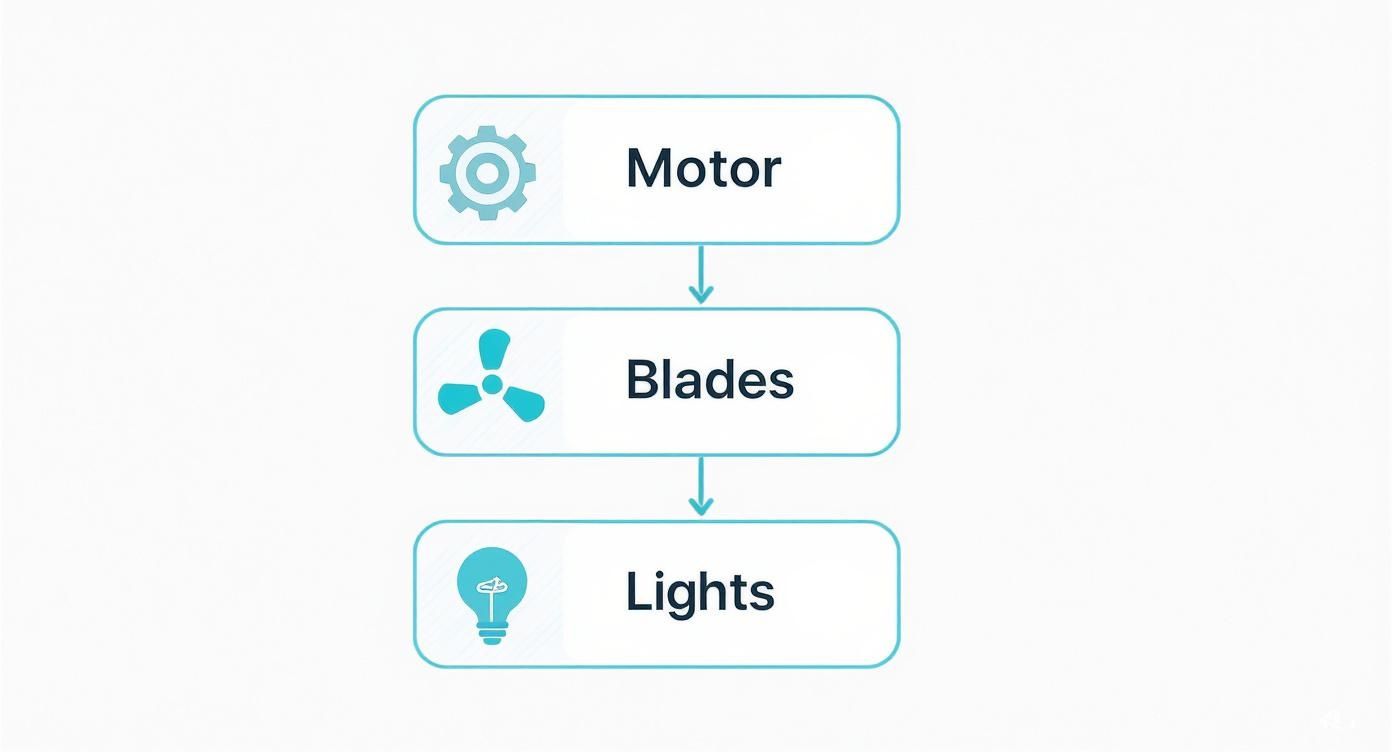
As you can see, opting for a BLDC motor gets you quieter operation and energy savings. A steeper blade pitch means more airflow (higher CFM), and modern LED light kits give you incredible longevity and control.
Motor Selection And Energy Efficiency
The motor is the heart of your ceiling fan, and these days, you have two main options: traditional AC (alternating current) and modern BLDC (brushless direct current). While you can't see the motor, you'll definitely feel—and hear—the difference.
BLDC motors are the newer, more advanced technology. They run up to 70% more efficiently than their AC counterparts, which is a huge deal for your energy bill over the long haul. They're also whisper-quiet because there are no brushes creating friction inside. This makes them a fantastic choice for bedrooms or home offices where peace and quiet are golden.
For any fan over $300, we really believe a BLDC motor is a smart investment. It might cost a bit more upfront, but the energy savings, quiet operation, and longer lifespan pay for themselves.
Let's break down the key differences between these two workhorses.
Comparison Of Fan Motor Types
This table gives a quick side-by-side look at what you can expect from AC and BLDC motors in the premium fan market.
| Motor Type | Energy Efficiency | Noise Level | Average Price |
|---|---|---|---|
| AC Motor | Moderate | 50+ dB | $300–$450 |
| BLDC Motor | High (up to 70%) | ≤40 dB | $400–$700 |
Ultimately, choosing a BLDC motor is an investment in a quieter, more efficient home for years to come.
Blade Design And Airflow Performance
The blades are what actually move the air, and their design makes a huge difference. Two terms you’ll see pop up are blade pitch and CFM (cubic feet per minute).
- Blade Pitch: This is simply the angle of the fan blades, usually somewhere between 12° and 15°. A steeper pitch pushes more air with each spin.
- CFM: This number tells you exactly how much air the fan moves. A higher CFM means a stronger breeze. For most living spaces, you'll want to aim for something in the 4,000–6,000 CFM range.
These two specs work together. A steeper blade pitch demands a stronger motor to keep up, and a high CFM rating is the result you feel on a warm day.
Light Kit Options And Ambiance Control
The light kit on a crystal fan isn't just for illumination—it's what creates that dazzling, ambient glow. LEDs are the standard today, and for good reason. They can last up to 50,000 hours (that's years of use!) and offer incredible dimming flexibility.
Many modern fans also let you adjust the color temperature, from a cozy, warm 2700K to a crisp, bright 5000K daylight. This lets you shift the room's mood from a relaxing evening vibe to bright, focused task lighting with the press of a button.
It's no surprise that the demand for stylish, efficient fans is growing. The premium ceiling fan market is projected to expand from USD 13.58 billion in 2025 to USD 19.61 billion by 2033, largely driven by beautiful and functional models like crystal fans with lights. You can dig into these growth trends over at Straits Research.
Smart Controls And Noise Considerations
Gone are the days of just a simple pull chain. Today's fans come with remote controls, wall switches, and even app integration for ultimate convenience. Look for models with multiple speed settings and dimming capabilities for both the fan and the light.
And don't forget about noise. A quiet fan is a happy fan. Look for a noise rating below 40 dB for truly peaceful operation—something you'll be grateful for in bedrooms and nurseries.
Here are a few smart features that are becoming standard on premium models over $350:
- App integration: Control everything from your smartphone, including scheduling.
- Voice commands: Sync your fan with Alexa or Google Home for hands-free control.
- Memory settings: The fan remembers your last speed and light level, so you don't have to.
Budget And Warranty Options
Premium crystal ceiling fans with lights typically start around $300, with most high-end models falling in the $400 to $800 range. When you're investing in a fixture like this, always check the warranty. A longer warranty period is a good sign that the manufacturer stands behind their product.
Most fans you'll find at Fan Connection come with a 5-year motor warranty and a 1-year parts warranty. We also offer extended service plans at checkout if you want that extra peace of mind.
“Investing in a fan with a robust warranty ensures long-term performance and protects your home investment,” notes a Fan Connection expert.
Checklist To Compare Fans
Feeling a little overwhelmed? Just use this quick checklist to compare models and make a confident choice:
- Room Size & Fan Span: Match the blade span to your room's square footage.
- Motor Efficiency: Go with BLDC for energy savings and quiet performance.
- Airflow Metrics: Look for a CFM over 4,000 for living areas.
- Light Performance: Check the lumens and color temperature range to match your needs.
- Control Features: Prioritize dimming, memory settings, and any smart features you'll actually use.
- Price & Warranty: Aim for models over $300 and look for solid, multi-year coverage.
With this breakdown of size, motor, blades, lighting, and controls, you have everything you need to find the perfect crystal ceiling fan. Keep this guide handy as you browse Fan Connection’s curated collections. Happy hunting
Installation And Maintenance Best Practices
You’ve picked out your stunning new crystal ceiling fan, and the excitement is real. But before you can enjoy that gentle breeze and sparkling light, there’s one crucial step: a flawless installation. Getting this right from the very beginning is the secret to preventing annoying wobbles, ensuring electrical safety, and setting the stage for years of quiet, efficient operation.
Think of it like laying the foundation for a house. If the base isn't solid, even the most beautiful structure is going to have issues. It's the same with a ceiling fan—a secure mount means it will spin smoothly, show off its sparkling crystals without a single rattle, and deliver the perfect amount of airflow.
Let's walk through what it takes to get a professional-grade installation and keep your fan looking and performing its best for the long haul.
Mastering The Installation
Before you even open the box, your first move is to look up and assess your ceiling. The height and angle will determine which type of mount you'll need. A proper installation ensures the fan blades are at the sweet spot for air circulation—usually 7 to 9 feet from the floor.
You'll typically run into three common mounting options with quality fans:
- Standard Mount: This is the go-to for most homes. It uses a short downrod (usually 3-6 inches) and is perfect for ceilings that are 8 to 9 feet high.
- Flush Mount: Got ceilings lower than 8 feet? A flush mount, or "hugger" style, is your best and safest bet. It attaches directly to the ceiling to give you maximum headroom.
- Angled Mount: For vaulted or sloped ceilings, you’ll need an angled mount adapter. Most fans can handle a slope up to 30 degrees, but it's always smart to double-check the manufacturer's specs.
“The most common DIY mistake we see is failing to anchor the fan to a ceiling joist. Drywall alone just can't support the weight and constant motion—it's a major safety hazard.”
Once you know which mount you’re using, the real work begins. Safety first: always turn off the power at the circuit breaker. The next step is absolutely critical—locating a ceiling joist. These wooden beams are the structural backbone of your ceiling and are the only thing strong enough to hold your fan. A stud finder is your best friend for this part.
For a more detailed, step-by-step walkthrough, our guide on how to install a ceiling fan covers the entire process with a checklist that pros swear by.
Long-Term Care For Lasting Sparkle
Your crystal ceiling fan is a centerpiece, and a little routine maintenance will keep it looking brand new. Over time, a thin layer of dust can dull the sparkle of the crystals and coat the blades, making the fan less beautiful and less efficient. Luckily, a simple cleaning routine is all it takes to keep it looking fabulous.
Think of it like caring for fine jewelry. Gentle, consistent cleaning is what preserves its brilliance. You definitely don't need harsh chemicals or abrasive tools; in fact, they can do more harm than good by scratching the crystal or damaging the metal finish.
Here’s a simple checklist to follow:
- Dust Gently (Monthly): Grab a microfiber duster or a soft, lint-free cloth to wipe down the fan blades and the metal housing.
- Clean Crystals (Quarterly): To really make them shine, mix a solution of one part isopropyl alcohol to four parts distilled water in a spray bottle. Lightly mist a clean microfiber cloth (never spray directly on the fixture!) and gently wipe each crystal.
- Polish Metal Accents (As Needed): Use a dry cloth to buff the metal parts and remove any fingerprints or smudges.
- Inspect and Tighten (Annually): Give the fan a quick once-over. Vibrations can loosen screws over time, so check that everything on the blades and mounting bracket is still snug.
Troubleshooting Common Issues
Even the best-made fans can occasionally develop a wobble, a flicker, or an odd noise. Don’t panic! Most of these little hiccups are surprisingly easy to fix yourself.
A wobbly fan is, by far, the most common complaint, and it's almost always caused by an imbalance in the blades. It’s just like a tire on your car—if one side is even slightly heavier, it will vibrate at high speeds. That's why most high-quality crystal ceiling fans come with a balancing kit.
The process involves attaching small weights to the tops of the fan blades to even things out. It can be a little bit of trial and error, but spending 15 minutes to balance your fan is well worth it for silent, stable operation.
Here’s a quick guide to solving other frequent issues:
| Issue | Common Cause | Solution |
|---|---|---|
| Flickering Lights | Loose bulb or an incompatible dimmer switch. | Make sure the LED module or bulbs are screwed in tightly. Check that your dimmer switch is rated for use with LED lights. |
| Noisy Operation | Loose screws, something rubbing, or just a new motor breaking in. | Tighten all visible screws. Let a new fan run for 24 hours to let the motor bearings settle. Listen for any wires hitting the motor housing. |
| Remote Not Working | Dead batteries or it needs to be re-paired. | Start by replacing the batteries. If that doesn't work, follow the manual’s instructions to re-sync the remote to the fan's receiver. |
By following these installation and maintenance tips, you can ensure your crystal ceiling fan with lights not only looks breathtaking but also works perfectly for years to come. A little effort upfront and some occasional care are all it takes to protect your investment.
Styling Fans In Your Home
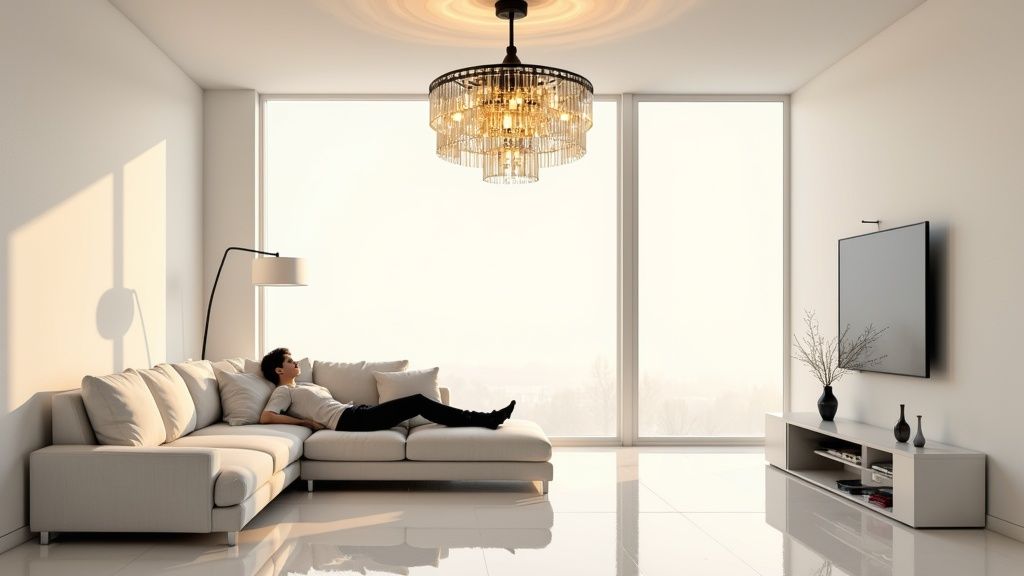
A crystal ceiling fan with lights is so much more than a functional appliance—it's a showstopper, a statement piece that can completely define a room's personality. When you get the pairing right with your existing décor, it becomes the anchor that ties your furniture, color schemes, and architectural details together. The real secret is to stop thinking of it as just a fan and start seeing it as a functional chandelier.
This shift in mindset changes everything. Suddenly, you're considering how the shape of the crystals and the finish of the metal will play off your home's style. Whether your vibe is modern minimalist, classic glam, or even industrial chic, there's a design that will feel like it was made just for your space.
Matching Finishes And Crystal Shapes To Your Decor
The first step is matching the fan's materials to your interior design theme. This is what creates that cohesive, intentional look that feels like a professional styled it. Trust us, it’s the small details that make the biggest difference.
- For Modern Minimalist Homes: Look for fans with sleek, geometric crystals and finishes like brushed nickel or matte black. Models like the Aerovon or Apex from Fan Connection have clean lines that won’t clutter up a simple, uncluttered room. Their understated elegance is the perfect complement to a "less is more" philosophy.
- For Classic Glam Interiors: This is where you can go all out with traditional, multi-faceted crystals. Pair them with polished chrome, brass, or gold finishes to nail that luxurious, old-world feel. A fan like the Chateaux instantly feels like an heirloom piece, adding a layer of warmth and sophistication.
- For Industrial Chic Spaces: It’s all about contrast here. Choose a fan with a dark bronze or iron finish and simpler, block-shaped crystals. That blend of raw, rugged metal with refined crystal creates a really compelling visual tension that is the hallmark of the industrial aesthetic.
Strategic Placement For Maximum Impact
Where you hang your crystal ceiling fan is just as important as which one you choose. The right location can turn it from a simple fixture into a dynamic focal point that elevates the room's entire function and flow.
"Think about the room's primary activity. Centering a fan over a dining table or main seating area not only provides targeted airflow but also creates a stunning visual anchor that draws the eye and defines the space."
A few ideal placements include:
- Over a Dining Table: This creates an intimate, almost restaurant-like atmosphere. Just make sure the fan is high enough (at least 7 feet from the floor) so it doesn’t get in the way of conversations across the table.
- In the Center of a Seating Area: In a living room, positioning the fan over the coffee table or the main conversation zone helps make the whole space feel more cohesive and inviting.
- In Vaulted or High Ceilings: Use a longer downrod to bring the fan down to an optimal height. This trick does double duty—it fills that empty vertical space and makes a grand architectural statement.
Layering Light For Depth And Ambiance
Relying on a single overhead light can often make a room feel flat and uninspired. The integrated light from your fan is a fantastic source of ambient lighting, but layering it with other types of light is what really creates depth and character.
Try adding task lighting (like reading lamps) and accent lighting (like wall sconces or spotlights on your favorite artwork) to build a rich, multi-dimensional environment. This layered approach gives you the flexibility to adjust the room's mood for any occasion, whether you need it bright and functional or soft and relaxing.
As home design continues to evolve, so does the demand for fixtures that do more than one job. In 2024, the ceiling fan market hit a value of USD 11.2 billion, with a huge push toward models that blend cooling with stunning decorative lighting. This trend is especially strong in growing urban areas where people are looking for stylish, affordable solutions for their homes. You can dig deeper into the global ceiling fan market trends to see how tastes are shifting.
Wrapping It Up: Your Expert Buying Advice
You've made it through the sparkling world of crystal ceiling fans, from understanding their powerful motors to picturing the perfect mood lighting for your space. Now, with all this knowledge, you're ready to make a great choice. This final step is all about tying everything together to make sure the fan you pick is a showstopper.
Think of this as our final chat before you buy. We'll quickly go over the must-haves, give you a realistic idea of what to budget, and share a few insider tips from our team here at Fan Connection. Our goal is to make sure your investment delivers on every level—style, comfort, and performance that lasts.
Your Final Buying Checklist
Feeling confident about your purchase really just comes down to checking a few key boxes. Before you click "add to cart," run through this simple checklist to compare your top choices. It’s a quick way to guarantee you’re getting a high-quality fixture that's built to perform.
- The Motor Matters: Make a BLDC motor a priority. They’re up to 70% more energy-efficient than old-school AC motors, run almost silently (under 40 dB), and give you way more speed options.
- Light It Right: Look for fans with integrated LED light kits that offer high lumen output and adjustable color temperatures. This gives you complete control over your room's brightness and overall vibe.
- A Secure Foundation: Always double-check that the fan comes with the right mounting hardware for your ceiling, whether it's standard, sloped, or needs a flush mount. A secure mount is the secret to a wobble-free fan.
A great crystal ceiling fan isn't just another purchase; it’s a genuine upgrade to your home's comfort and style. Nailing these three core features ensures you'll love your fan for years to come.
Let’s Talk Price and Warranty
For a high-quality crystal ceiling fan with lights, you should plan on a budget that starts at a minimum of $300. This is the price point where you really start to see better materials, more efficient motors, and craftsmanship you can count on.
- Entry-Luxe ($300 - $500): In this sweet spot, you’ll find fantastic models with reliable BLDC motors, beautiful K9 crystals, and all the remote-control features you need. Our Aerovon and Apex models are perfect examples of getting that premium feel without the premium price tag.
- Premium ($500+): When you step into this tier, you'll see fans like the elegant Chateaux. These often feature more intricate crystal work, advanced smart-home integrations, and even lifetime motor warranties.
Speaking of warranties, always check the coverage before you commit. A solid warranty is a great indicator that the manufacturer believes in their product. Here at Fan Connection, most of our fans come with a 5-year motor warranty, giving you that extra peace of mind. For a deeper dive into how an efficient fan impacts your wallet, you can learn more about energy efficiency and cost savings in our guide.
With these final tips in hand, you’re all set to pick a crystal ceiling fan that won't just cool your room—it'll become its dazzling centerpiece.
FAQ
Still pondering a few details before you commit to a crystal ceiling fan with integrated lights? You’re among friends—here’s our quick‐fire guide to the questions we hear most. Think of it as the last stop on your journey to the perfect fixture.
What Size Fan Do I Need For My Room?
Selecting the right blade span makes all the difference in airflow. It’s a bit like picking the perfect umbrella: too small and you’ll only catch a drizzle; too large and it feels cumbersome.
- 200–400 sq ft living rooms shine with a 42 to 52-inch fan.
- Cozy nooks—bedrooms or home offices—pair best with 36 to 44-inch models.
Grab your tape measure, jot down your room’s dimensions, and you’ll be rewarded with a steady, comfortable breeze.
LED Or Halogen Lights: Which Is Better?
When it comes to lifespan, efficiency, and versatility, LEDs leave halogens in the dust. Picture this: no bulb changes for years. That’s the power of an LED’s 50,000-hour run time.
- Energy Savings: LEDs sip a fraction of the power.
- Longevity: Forget ladder climbs for ages.
- Advanced Features: Dimming and color-tuning at your fingertips.
Halogens still offer a warm glow, but their shorter lifespan can quickly feel like busywork.
Can I Install On An Angled Ceiling?
Absolutely—you’re not limited to flat roofs. A slope ceiling adapter or angled mount kit lets your fan hang perfectly straight on vaulted or sloped ceilings.
Premium models—including ours—accommodate pitches up to 30 degrees without wobble. Always double-check the specs before you buy.
What Maintenance Does It Require?
Crystal fans don’t demand a complicated upkeep routine. Stick to this simple schedule:
- Monthly: Lightly dust blades and crystals with a microfiber cloth.
- Twice a Year: Deep clean blades, tighten screws, inspect mounts.
- As Needed: Replace LED modules only after years of steady use.
That’s it—no PhD required.
Ready to let your next fan do more than just cool? At Fan Connection, our curated lineup brings sparkle and performance in equal measure. Discover the model that suits your style—and your ceiling.


