











Direction ceiling fan: Master comfort with direction ceiling fan tips
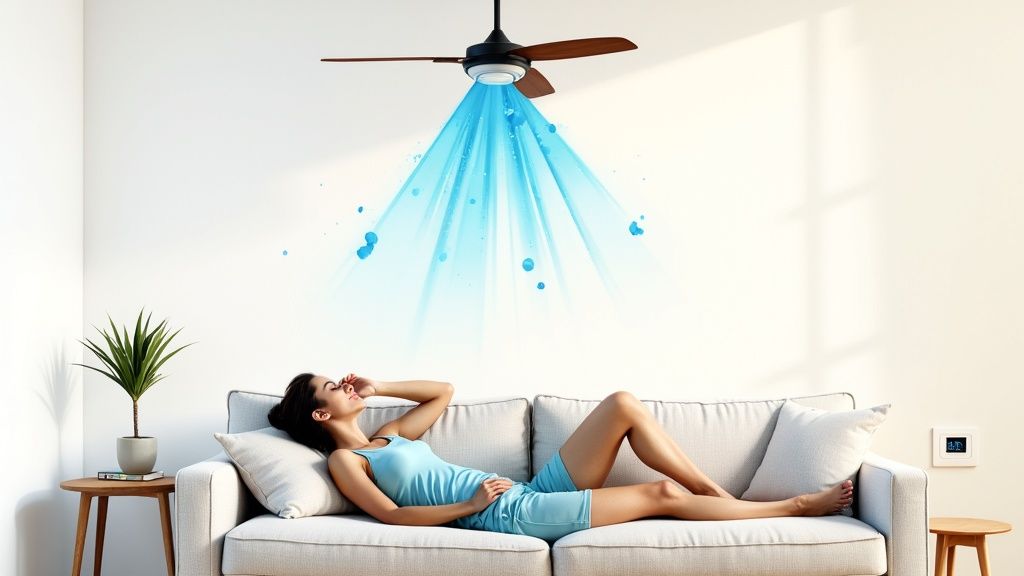
That little switch on your ceiling fan? It’s not just there to collect dust—it’s the secret to year-round comfort and a happier energy bill. It's the fun little party trick your fan has been hiding in plain sight.
The direction your ceiling fan blades spin is a small detail with a huge impact, determining whether you get a refreshing breeze or a gentle, warming circulation. For summer, you want a counter-clockwise spin to push cool air down. Come winter, a clockwise rotation works wonders to recirculate trapped warm air.
Unlocking Year-Round Comfort with Your Fan
Ever walked into a room and felt that stuffy layer of warm air hanging out near the ceiling? That’s just physics doing its thing—warm air rises. Your ceiling fan is cleverly designed to work with this principle. Its blades are angled, not flat, so they can either chop down through the air or pull it up, depending on which way they spin. It’s a simple concept that turns your fan into a climate-control superstar.
This simple adjustment transforms your fan from a summer-only appliance into a climate-control partner you can rely on all year.
We're not talking about a minor tweak here. Using both the summer and winter settings correctly can make a room feel completely different without you ever touching the thermostat. It’s also a great reminder that a room’s comfort is about more than just airflow; elements like well-placed modern living room ceiling lights also play a huge role in creating a welcoming space.
The Science of Spin: How It Actually Works
So, what’s really happening when you flip that switch? Let's break it down season by season in a fun way.
-
Summer Mode (Counter-Clockwise): Think of this as your personal breeze machine. The fan's blades are angled to slice through the air and push it straight down. This creates a direct column of air that feels like a cool breeze on your skin—what’s known as a wind-chill effect. The fan isn't actually lowering the room's temperature, but it feels cooler, which means you can give your AC a much-deserved break.
-
Winter Mode (Clockwise): When you reverse the fan for winter, it becomes a stealthy heat distributor. It gently pulls the cooler air from the floor level upward. This action displaces the warm air that's been trapped up at the ceiling, pushing it down along the walls and back into the living space. The result is a more evenly heated room, without creating a draft. It's like a gentle hug of warmth.
For a quick reference, here's how it all breaks down.
Seasonal Ceiling Fan Settings At a Glance
This table gives you a simple, at-a-glance guide to make sure your fan is always working for you, not against you.
| Season | Blade Direction | Airflow Effect | Primary Benefit |
|---|---|---|---|
| Summer | Counter-Clockwise | Pushes air straight down | Creates a "wind-chill" cooling effect |
| Winter | Clockwise | Pulls air up, then pushes warm air down the walls | Circulates trapped heat for even warmth |
Just a quick look at this chart before the seasons change is all you need to keep your home perfectly comfortable.
The impact on your energy bill can be pretty substantial. Using your fan correctly can lead to some serious savings—potentially cutting your heating costs by up to 15%.
It’s worth noting that a higher-quality fan—say, one in the over $300 range—often comes with a more powerful, quieter motor. These premium fans are engineered for superior airflow, so that seasonal switch makes an even bigger difference. To see how this all translates into real savings, you can check out our guide on the energy efficiency and cost savings of ceiling fans. Mastering this one simple feature ensures you get the most out of your investment all year long.
Harnessing a Cool Breeze in Summer
When summer temperatures start climbing, our first instinct is usually to crank up the air conditioning. But what if the secret to immediate relief is already hanging right above your head? For those sweltering months, you want your ceiling fan spinning counter-clockwise. This is your fan's "super cool" mode.
This counter-clockwise rotation creates a direct column of air that pushes straight down. It’s not magic—the fan doesn't actually lower the room's temperature. What it does do is create a fantastic wind-chill effect on your skin. This breeze helps moisture evaporate more quickly, making you feel significantly cooler and more comfortable.
Maximize Your Cooling Effect
To really get the most out of this summer setting, run your fan at a medium to high speed. The faster the blades spin, the stronger the dowdraft and the more intense that cooling sensation will be. It's a simple adjustment that can let you raise your thermostat by a few degrees without even noticing the difference, leading to some real savings on your energy bills.
The impact of getting the fan direction right is pretty profound. A proper summer rotation can generate a wind-chill effect that makes a room feel up to 8°F cooler. This could potentially trim your AC usage by 20-40%! It’s this kind of efficiency that drives the nearly USD 12 billion global ceiling fan market, where American homes play a huge part.
Investing in Superior Airflow
Sure, any fan helps, but the quality of your fan's motor and blade design makes a massive difference in how much air it can actually move. Premium models are engineered for peak performance, pushing more cubic feet of air per minute (CFM) without all the noise. They're the luxury sports cars of the fan world.
A well-designed fan isn't just a decorative piece; it's a functional tool for home climate control. Investing in a powerful, efficient model is an investment in your comfort and your wallet.
Think about brands like Fanimation or Minka-Aire, which specialize in fans with powerful motors and aerodynamically crafted blades. These high-performance models, often priced at $300 or more, are built to deliver a robust and refreshing breeze right when you need it most. They can turn a stuffy living space into a cool, comfortable oasis, making you the envy of all your friends.
Combining your fan with other cooling strategies is even better. For more ideas, check out our guide on how to cool a room without AC.
Circulating Gentle Warmth in Winter
When the cold weather rolls in, most of us have an instinct to switch our ceiling fans off and forget about them until spring. But what if I told you that your fan is actually one of your best tools for fighting the winter chill? It’s true—flipping your fan to the right direction can make your home feel noticeably warmer and more comfortable. It’s the fan’s cozy alter ego!
All you have to do is switch your fan's rotation to clockwise to put it in "winter mode." This simple change completely transforms its job. Instead of pushing air down, the blades will gently pull the cooler air that’s settled near the floor upward.
The Magic of an Updraft
This upward pull creates a gentle, continuous circulation loop. As that cool air rises, it displaces the pocket of warm air that naturally gets trapped up at the ceiling. All that precious, paid-for heat is then pushed down along the walls and back into the room where you can actually feel it.
The result is a much more balanced room temperature without any of those chilly, annoying drafts. This process also gives your heating system a break, since it doesn't have to work overtime to fight off cold spots. It’s a dead-simple, surprisingly effective way to make any room feel cozier.
Investing in Silent, Stylish Warmth
Now, for this winter strategy to really work, you need a fan that can run on its lowest setting without making a racket. You’re aiming for gentle air movement, not a distracting whir that reminds you a machine is running overhead.
This is where the premium brands really shine. Models from industry leaders like Hunter and Casablanca, which often start around $300, are engineered for this exact purpose. Their ultra-quiet motors and well-thought-out designs blend right into your decor while providing that subtle, continuous circulation you need. These aren't just fans; they're functional pieces of art.
Think of your fan in winter as a silent partner to your furnace. It’s not actually creating heat, but it’s making sure every bit of warmth gets used effectively, finally getting rid of that "cold floor, hot ceiling" feeling for good.
The financial upside of this simple switch is well-documented. According to ENERGY STAR, a fan running clockwise in the winter can save the average North American household $25-50 each year on utilities. One study even found a 65% efficiency uplift when fans were paired with smart thermostats that automatically change the direction based on the season. If you're curious to see how these savings add up on a larger scale, you can dig into some detailed reports on the prefeasibility of ceiling fan manufacturing plants and their real-world impact.
How to Change Your Fan's Rotation
Okay, so you’re sold on the idea. You get why you need to flip your fan's direction with the seasons, so let's get down to the how. The good news is that this is usually a pretty simple job, but the exact steps depend on the kind of fan you have hanging overhead.
First, a quick but crucial safety reminder: always turn the fan off and wait for the blades to stop spinning completely before you touch anything. This is non-negotiable, especially if your fan has a physical switch on the motor. You really don’t want to be reaching up toward moving blades.
Finding and Using the Reverse Switch
Your fan's reverse switch is hiding in one of a few common spots. The trick is to figure out what kind of controls your fan uses, and that will tell you exactly where to look.
-
The Classic Pull-Chain Fan: This is the old-school setup many of us grew up with. Take a look at the motor housing—the main body of the fan where the blades attach. You should find a small, horizontal toggle switch. One quick flip is all it takes to change direction.
-
The Remote Control Fan: Ah, modern convenience. If you run your fan with a remote, just scan the buttons for a reverse icon. It usually looks like a pair of circular arrows or a single arrow that doubles back on itself. A single press should do the trick.
-
The Wall Switch Fan: You don’t see these as often, but they’re out there. Some homes have a dedicated wall switch for the fan’s direction, usually a small toggle switch located right on the same wall plate as the fan’s speed controls.
-
The Smart Fan: For the fully connected home, a smart fan makes this almost too easy. Models from brands like Big Ass Fans (which can run well over $300) are controlled through an app on your phone or with voice commands. Just tell Alexa or Google to reverse the fan, and you're done. Talk about living in the future!
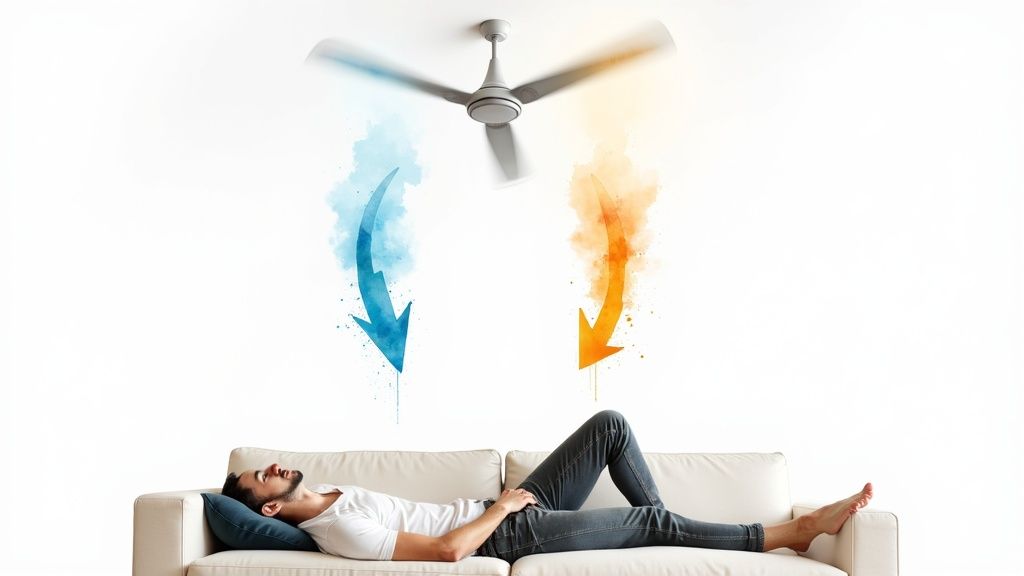
This diagram shows you exactly what’s happening up there when you switch your fan to its winter mode.
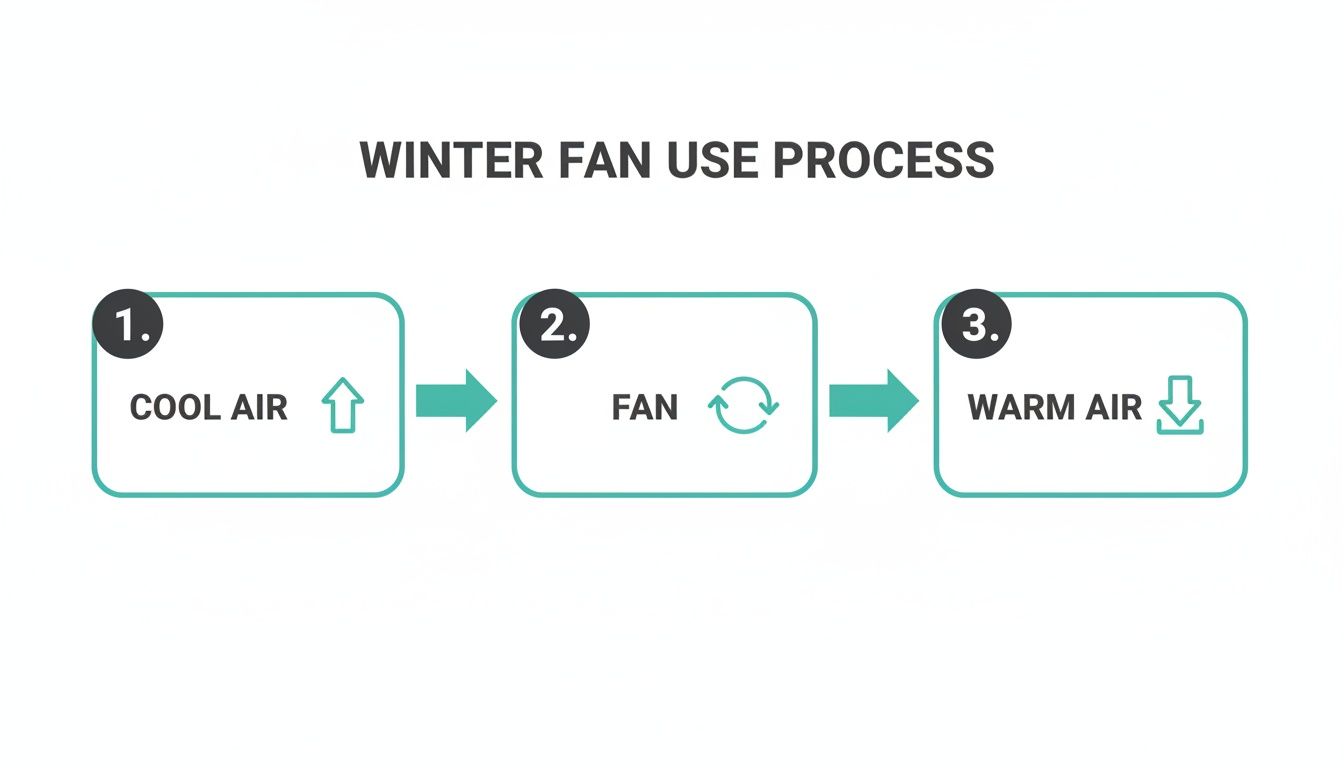
As you can see, that clockwise spin is the secret to gently pushing all that cozy, trapped heat from the ceiling back down into your living space where you can actually feel it.
Troubleshooting Common Direction Switch Issues
What happens if you flip the switch or press the button and... nothing? It’s a common headache, but the fix is usually simple. A fan that seems stuck in one direction might just have a stubborn switch, a dead remote battery, or maybe a loose wire.
If you’re running into trouble, this quick troubleshooting table can help you diagnose the issue.
| Problem | Possible Cause | Solution |
|---|---|---|
| Physical switch is stiff or won't move. | Dust and grime buildup inside the switch mechanism. | With the power off, gently but firmly toggle the switch back and forth a few times to loosen it up. A small puff of compressed air can also help clear out debris. |
| Pressing the remote's reverse button does nothing. | The remote's batteries are dead, or it has lost its pairing with the fan's receiver. | First, try a fresh set of batteries—this is the most common culprit. If that doesn't work, follow the manufacturer's instructions to re-sync the remote. |
| The fan wobbles or makes noise after changing direction. | The blades may have settled unevenly or a screw has come loose. | Turn the fan off and check that all blade screws are tight. If it still wobbles, you may need to use a blade balancing kit. |
| The fan doesn't change direction at all, no matter what. | Could be a faulty switch, a bad remote receiver, or an internal wiring issue. | If you've tried everything else, the problem might be electrical. This is a good time to call in a professional electrician. |
Most of the time, the fix is something you can handle in a few minutes.
Pro Tip: If a physical toggle switch on the fan body feels stuck, try working it back and forth a few times with the power cut at the breaker. Sometimes, a little bit of dust is all that’s jamming things up, and this can be enough to get it working again.
If your remote is giving you grief, start with the obvious: new batteries. If that doesn't solve it, you might need to re-pair the remote with the receiver, which is a little box usually tucked away in the fan's canopy. For trickier problems, especially if you think it's a wiring issue, it's always smartest to call an electrician. If you want to get into the nitty-gritty of how these systems work, our guide on the ceiling fan wiring diagram with remote control is a great place to start.
Pro Tips for Maximum Fan Efficiency
Getting the fan spinning in the right direction is the biggest first step, but real efficiency comes from fine-tuning how it runs. If you want to move beyond basic comfort and into smart, cost-effective climate control, you need to think about speed, location, and even a little bit of automation. It's time to become a fan guru.
Simply put, the speed setting you choose is just as important as the direction. One of the most common mistakes I see is people using the wrong speed for the season, which can completely undo the benefits of reversing the fan in the first place.
Match Fan Speed to the Season
Optimizing your fan’s speed is the key to maximizing its effect without wasting energy or making yourself uncomfortable. The goal is completely different in summer than it is in winter.
-
Summer Speed (Medium to High): When your fan is spinning counter-clockwise, you want to feel that air moving. A medium or high speed creates a stronger downdraft, which is what gives you that "wind-chill effect" that makes you feel cooler. This is what allows you to give your air conditioner a much-needed break.
-
Winter Speed (Lowest Setting Only): In winter, the mission is gentle circulation, not a breeze. With the fan spinning clockwise, the lowest possible speed is absolutely essential. This lets it gently pull cool air up from the floor and push the warm, trapped air down the walls without creating a draft that makes you shiver and reach for the thermostat.
This strategy is especially important in rooms with high or vaulted ceilings. In those big, open spaces, a huge amount of your furnace's expensive warm air gets trapped way up high, far from where you can actually feel it. Running the fan on low in a clockwise direction is the single most effective way to reclaim all that lost heat.
The Smart Fan Advantage
Modern smart fans, which you'll often find with a price tag of $300 or more, take efficiency to a whole new level. These higher-end models can automate the entire process, removing all the guesswork and adding a dash of "wow" factor to your home.
A smart fan isn't just a convenience; it's an intelligent climate tool. By sensing the room's temperature, it can automatically adjust its speed and direction to maintain optimal comfort and efficiency without you ever touching a switch.
Imagine a fan that just knows to switch to its cooling mode and ramp up the speed on a hot afternoon, then revert to a gentle winter circulation on a chilly evening. Brands like Big Ass Fans and others in the premium market offer this kind of hands-free efficiency, ensuring your fan is always working for you, not against you.
For more advanced climate control strategies that can work hand-in-hand with your ceiling fan, you can learn how reverse cycle air conditioning works to both heat and cool your home. Combining smart fan usage with an efficient HVAC system is really the ultimate way to manage your home's climate and energy bills all year long.
Your Top Ceiling Fan Direction Questions, Answered
Even after getting the basics down, a few common questions always seem to come up. Let's dig into some of the most frequent queries to help you get your fan working perfectly, no matter the situation. From extra-high ceilings to getting a good night's sleep, we've got you covered.
Does Fan Direction Matter in a Room with High Ceilings?
Absolutely—in fact, you could argue it matters even more. When you have vaulted or really high ceilings, a huge amount of heat from your furnace rises and gets trapped way up high, far from where you can feel it. This is where the winter (clockwise) setting is a complete game-changer.
By running your fan on its lowest clockwise speed, you create a gentle updraft that’s just strong enough to pull that lost heat off the ceiling. The fan pushes that cozy air down the walls and back into the room where you live, making the whole space feel warmer and giving your heating system a break. It’s the single best way to fight that classic "cold floor, hot ceiling" problem.
Should I Leave My Ceiling Fan on All the Time?
That really comes down to the season and whether you're actually in the room.
-
In Summer: Fans cool people, not rooms. The counter-clockwise spin creates a wind-chill effect on your skin, but it doesn't actually lower the room's temperature. If nobody is there to feel the breeze, you're just paying to spin the blades. Always turn it off when you leave the room.
-
In Winter: It can definitely be a good idea to leave the fan running on its lowest clockwise speed, especially when your heat is on. This ensures warm air is constantly being recirculated, preventing those chilly spots from forming.
What if My Ceiling Fan Has No Reverse Switch?
If you've checked everywhere—the motor housing, the remote, the wall control—and can't find a reverse function, you probably have an older or more basic model. Some fans were simply built to spin in one direction, which is almost always the downdraft (summer) mode.
In this situation, your best move is to think about an upgrade. Investing in a modern, reversible fan is a fantastic way to unlock year-round comfort and real energy savings.
A high-quality, reversible fan is more than just an appliance; it's a long-term investment in your home's efficiency. Premium models over $300 often feature powerful, quiet motors that make seasonal circulation even more effective.
What Is the Best Fan Setting for Sleeping?
Getting the perfect fan setting for a good night's sleep is all about gentle, consistent airflow—not a wind tunnel.
On warm summer nights, a counter-clockwise rotation on a low speed is usually perfect. It creates just enough of a cooling breeze to keep you comfortable without the noise or high cost of running the AC all night.
During the winter, the clockwise direction on the absolute lowest setting is your best friend. It will subtly circulate warmth through the bedroom without creating a noticeable draft that might wake you up.
Ready to upgrade to a fan that offers year-round comfort and style? At Fan Connection, we offer a curated selection of high-quality ceiling fans designed for maximum efficiency and aesthetic appeal. Explore our collections and find the perfect model to elevate your space.
Find your perfect fan at https://www.fanandlights.com.


