











Industrial Ceiling Fans Near Me Your Ultimate Buying Guide
When you type "industrial ceiling fans near me" into a search bar, you’re usually looking for a heavy-duty solution, and you probably need it now. It feels natural to want to pick something up locally, but here's a little industry insight: for something as specialized as an industrial fan, your best bet is almost always a dedicated online retailer.
Let's break down why that is and how to make the smartest choice for your business. It's time to turn a frustrating search into a triumphant find!
Finding The Right Industrial Fan: Local vs. Online
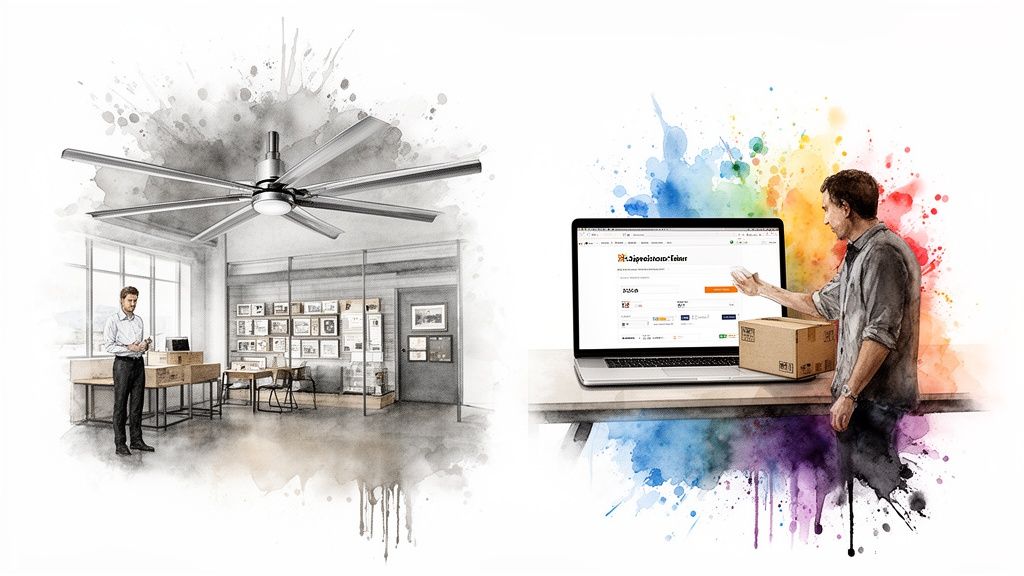
The urge to find "industrial ceiling fans near me" is completely understandable. You want to see it, touch it, and get it installed without waiting for shipping. But the world of true industrial-grade air movers is a niche one, and what you might gain in speed, you often sacrifice in performance, selection, and long-term value.
Your local big-box store is great for many things, but high-performance industrial fans usually aren't one of them. They tend to stock residential fans or "commercial-style" models that look tough but just aren't engineered for the constant, brutal demands of a warehouse, workshop, or busy commercial space. This is where a specialized online retailer really shines.
The Power of Specialized Online Retailers
Unlike a general hardware store, dedicated online fan suppliers live and breathe air circulation. It’s what they do, all day, every day. They offer a hand-picked selection of high-performance models built specifically for big, demanding environments.
Think of it like buying a race car—you wouldn’t head to your local family sedan dealership. You'd go to a performance specialist who actually understands the engineering.
An online specialist gives you access to a huge range of sizes, motor types, and blade designs. This means you can find the exact fan for your building’s unique needs, not just settle for what a local store happens to have on the shelf.
Shopping with a specialist grants you access to premium, built-to-last products. We’re talking about fans with powerful and hyper-efficient DC motors or blades forged from aircraft-grade aluminum. A heavy-duty model like the Aerovon, which comes in at over $500, delivers a level of performance and durability you’ll almost never find sitting in a local aisle.
If you're ready to look beyond the usual local options, our guide on the best ceiling fan stores near me can help you weigh the pros and cons of both online and brick-and-mortar retailers.
What To Look For in a Supplier
Whether you end up going local or working with an online expert, your goal should be finding the right product, not just the closest one.
Here’s a quick-glance table to help you vet potential suppliers.
Key Factors When Choosing Your Industrial Fan
| Factor | What To Look For | Why It Matters For Your Space |
|---|---|---|
| Expertise | Do they understand terms like CFM, air velocity, and destratification? Can they give you solid advice on sizing and placement for your specific building? | An expert can prevent you from buying a fan that’s too weak (useless) or too powerful (disruptive and wasteful). Their guidance is invaluable. |
| Selection | Do they offer a real variety of industrial-grade fans? This includes High-Volume, Low-Speed (HVLS) models designed for truly massive spaces. | A wide selection means you get a tailored solution, not a one-size-fits-all product that doesn't quite work. |
| Transparency | Are the product specs, warranty details, and pricing laid out clearly and easy to find? Is it simple to compare models? | Clear information helps you make an informed decision and avoid any surprises down the road. You should know exactly what you're getting. |
Ultimately, a good supplier doesn't just sell you a fan. They equip you with a powerful, efficient, and safe air circulation solution that will serve your business well for years to come.
Why Industrial Fans Are a Different Breed
Think about the difference between a family sedan and a commercial dump truck—that’s the kind of leap we’re talking about from a residential fan to an industrial one. When you start searching for "industrial ceiling fans near me," it’s important to know you’re not just looking for a bigger version of a home fan. You’re looking for a purpose-built machine engineered for a completely different set of challenges.
It really comes down to engineering from the ground up. These fans aren't just scaled-up models; their construction, materials, and how they operate are fundamentally different. A residential fan might run for a few hours a day, but an industrial fan is often expected to work 24/7 in tough places, from dusty warehouses to humid agricultural barns. That constant demand for performance shapes every single component.
The Heart of the Machine: Heavy-Duty Motors
At the core of any industrial fan is its motor. Unlike the smaller, less powerful motors in household fans, industrial models are packed with engines built for continuous, high-torque work. They're designed to get massive blades moving and keep them spinning for thousands of hours without overheating or giving up.
This is exactly why you won't find a true industrial fan for under $100. The money goes straight into a motor that can reliably perform day in and day out.
For example, models in our Aerovon collection, which start well over $300, use direct-drive motors. These units are not only powerful but also surprisingly efficient and quiet for their size—a true testament to their superior engineering.
Blades That Command the Air
The blades on an industrial fan are another area where the difference is night and day. Residential fans often use simple, flat blades made of wood or plastic. Industrial fans, on the other hand, have blades that are shaped more like aircraft wings than simple paddles.
These airfoil blades are carefully designed to slice through the air with minimal resistance while pushing a massive, controlled column of air down and out.
This sophisticated design is what allows them to circulate air over thousands of square feet. Instead of just creating a small, turbulent breeze directly underneath, they generate a gentle but far-reaching airflow that covers a huge area, effectively evening out temperatures and improving air quality.
Industrial fan blades don't just "push" air; they create a large, slow-moving air mass. This high-volume, low-speed (HVLS) principle is far more effective and energy-efficient for large spaces than the high-speed, low-volume approach of a standard fan.
Built to Last: Rugged Materials
Finally, the materials used in industrial fans are chosen for one main reason: durability. You simply can't use the same stuff as a residential fan and expect it to hold up in a commercial or industrial setting.
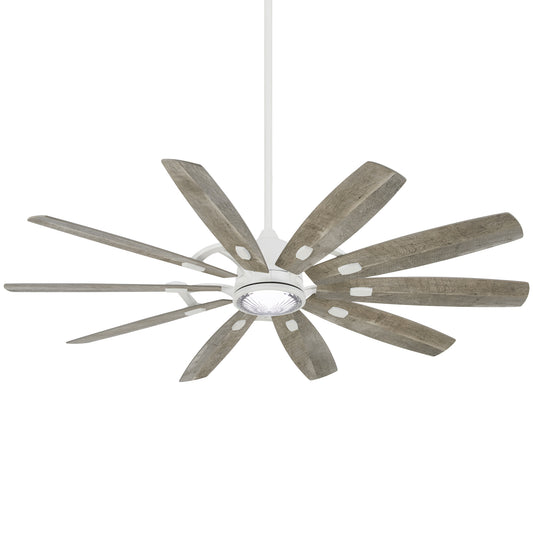
- Aircraft-Grade Aluminum: Many high-performance blades, like those on our rugged Barn series fans (priced over $400), are made from lightweight yet incredibly strong aluminum. This material resists corrosion and won't warp or sag over time, even with blades spanning over 10 feet.
- Industrial-Grade Steel: The mounting hardware, downrods, and motor housing are typically made from heavy-gauge steel. This ensures the fan can safely handle the immense weight and torque it generates, providing a secure and stable installation for years.
This commitment to tough construction is what gives these fans their longevity and reliability. When you invest in a proper industrial fan, you’re not just buying a cooling device; you're getting a durable workhorse designed to handle demanding environments for a long, long time. The difference isn't just in the size—it's in the engineering, the materials, and the sheer capability that sets them apart.
How To Correctly Size Your Industrial Fan
Picking the right industrial fan is a lot like choosing the right engine for a truck. If you go too small, you'll be running it ragged and still not getting the job done. Too big, and you're just burning fuel and creating a wind tunnel. But when you get it just right? You create a perfectly balanced, comfortable, and efficient workspace.
When you're searching for "industrial ceiling fans near me," getting the sizing right isn't a guessing game. It all comes down to a crucial metric: CFM, which stands for Cubic Feet per Minute. This number tells you exactly how much air a fan can move, and it's the key to matching the fan to your space.
Think of CFM as the fan's horsepower. A small workshop might only need around 5,000 CFM, but a massive distribution center could require 100,000 CFM or more to properly circulate the air. The goal is simple: pick a fan that can exchange all the air in your space multiple times an hour.
Decoding CFM for Your Space
To nail down the right CFM, you first have to figure out your room's volume. Thankfully, the math is straightforward:
Room Volume = Length (ft) x Width (ft) x Ceiling Height (ft)
So, if you have a warehouse that's 100 feet long by 50 feet wide with a 20-foot ceiling, your total volume is 100,000 cubic feet (100 x 50 x 20). That number is your starting point.
Next, think about how many "air changes per hour" (ACH) your facility needs. A quiet storage area might be fine with 2-3 ACH, but a busy manufacturing floor with heat-producing machines will need 10 or more to keep things comfortable and safe. A higher CFM rating means the fan moves air faster, which is exactly what you need in large, open environments.
The Critical Role of Ceiling Height and Downrods
Ceiling height isn't just part of the volume equation—it's a major factor in safety and performance. For any industrial fan, the blades need to be at least 10 feet off the ground. This prevents accidents and gives the airflow enough room to spread out effectively.
This is where the downrod comes into play. That's the metal pipe connecting the fan motor to the ceiling mount, and its length is everything.
- For lower ceilings (15-20 feet): A shorter downrod gets the fan into the sweet spot.
- For high ceilings (25 feet and up): You'll need a longer downrod to bring the fan down into the "action zone" where people are actually working.
Using the wrong downrod is like putting great tires on the wrong car—you'll severely limit the fan's effectiveness, no matter how powerful its motor is. For a deeper dive into matching fan size to different room dimensions, check out our comprehensive ceiling fan size guide.
This chart gives a quick visual on where to start, helping you see if your needs fall into the residential or the more heavy-duty industrial category.
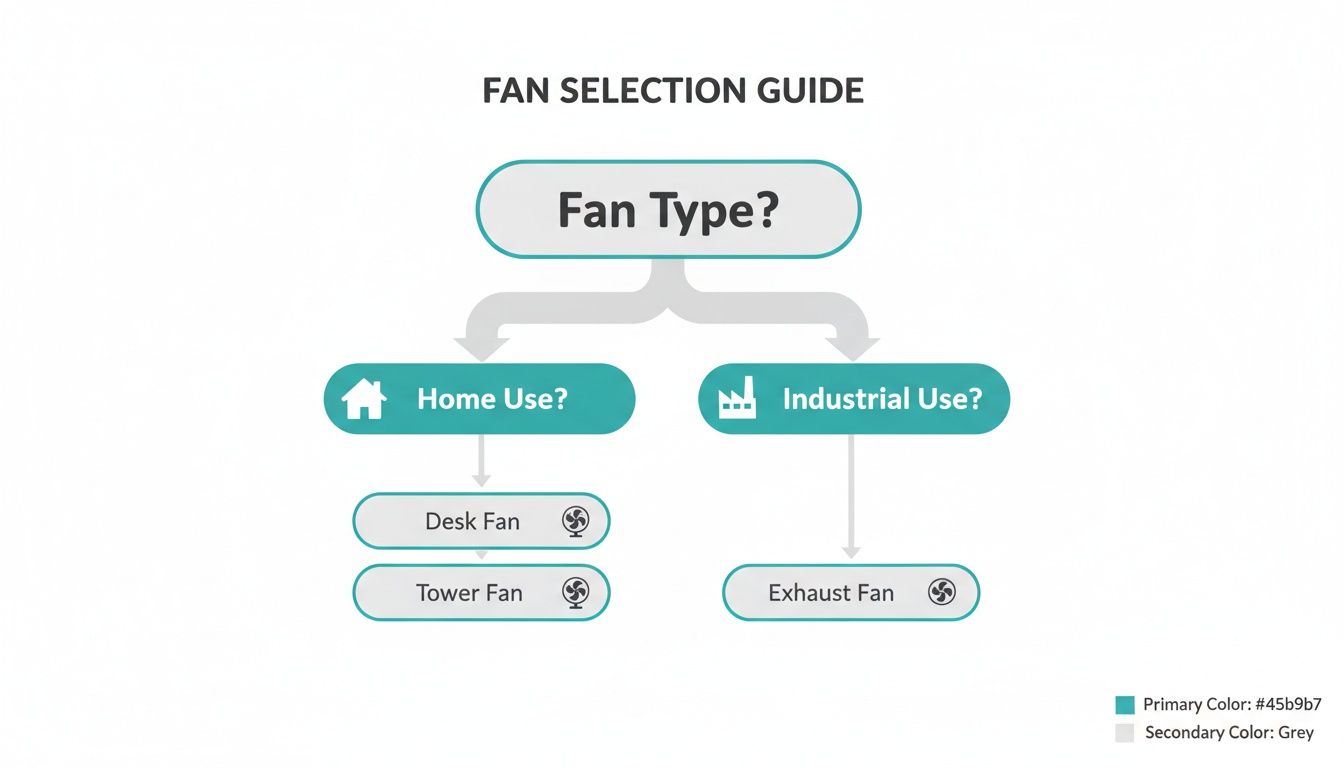
As the decision tree shows, industrial applications are in a league of their own, requiring specialized equipment built for serious durability and massive air movement.
Putting It All Together: A Sizing Guide
To make this even easier, here’s a quick reference table. Use it to match your space's dimensions with the recommended fan diameter and CFM rating for optimal performance.
Industrial Fan Sizing Reference Guide
| Space Square Footage | Ceiling Height | Recommended Fan Diameter (Inches) | Target CFM Rating |
|---|---|---|---|
| Up to 2,000 sq. ft. | 15-20 ft. | 60" - 72" | 5,000 - 10,000 |
| 2,000 - 5,000 sq. ft. | 20-25 ft. | 72" - 96" | 10,000 - 30,000 |
| 5,000 - 10,000 sq. ft. | 25-35 ft. | 96" - 144" (12 ft) | 30,000 - 75,000 |
| 10,000+ sq. ft. | 35+ ft. | 144" - 288" (12-24 ft) | 75,000 - 200,000+ |
Remember, this table is a starting point. High-heat environments or spaces with lots of obstructions might need a bit more power.
Let's walk through a real-world example. Say you're outfitting a 4,000 square foot commercial gym with 25-foot ceilings. Your total volume is a whopping 100,000 cubic feet. In a busy gym, you need excellent air circulation to keep everyone cool, so you’ll be aiming high on the CFM scale.
For a space like this, a single powerhouse fan like the Artemis XL5 would be a perfect fit. With its massive blade span and huge CFM output, it's designed to move a giant column of air and keep the entire area comfortable. Yes, it's an investment—priced well over $300—but it's an investment in performance that can single-handedly manage the climate of a large commercial space.
Navigating Installation Safety and Local Codes
Let's be clear: installing a massive, powerful industrial ceiling fan is absolutely not a weekend DIY project. This is a serious job that demands professional expertise to get right. We're talking about heavy, powerful machines, and a rock-solid installation is non-negotiable for the safety of your team and the protection of your property.
When you're searching for "industrial ceiling fans near me," remember that the installation is just as critical as the fan you choose. A fan that's improperly mounted isn't just a waste of money—it's a genuine safety hazard waiting to happen.
Structural Support: The Foundation of Safety
The single most important part of a safe installation is making sure the mounting point can handle the fan's weight and force. An industrial fan isn't just heavy; its motor creates some serious torque and vibration when it's running.
This means the ceiling joist or beam it’s attached to has to support more than just the fan's static weight, which can already be hundreds of pounds. It needs to handle the dynamic forces the fan creates while it's spinning day in and day out.
A true professional will always start by assessing the structural integrity of your ceiling. They'll verify that the support is sound and might even recommend adding braces or specialized mounting hardware to guarantee a totally secure anchor point.
Electrical Wiring and Compliance
Industrial fans are power-hungry and draw way more electricity than the fan in your living room. They need their own dedicated circuits and heavy-duty wiring that can handle the electrical load without overheating, which is a major fire risk. This is a job for a licensed electrician, period.
Proper installation also means following strict electrical safety rules. For a deep dive into protecting workers from electrical hazards, the NFPA 70E electrical safety guidelines are the industry standard. This ensures every connection is safe, properly grounded, and up to code, preventing electrical failures and keeping your team safe.
If you're curious about the basic steps, our guide on how to install a ceiling fan safely offers a good overview of the general principles, but for industrial models, professional help is a must.
Adhering to Local Building Codes and Clearances
Every town and county has building codes that spell out exactly how large equipment like industrial fans must be installed. These aren't just suggestions—they're legal requirements designed to keep everyone safe. Key regulations usually cover:
- Floor Clearance: To prevent anyone from accidentally touching the blades, they must be a minimum distance from the floor—usually 10 feet or more.
- Wall and Obstruction Clearance: You need enough space between the fan blades and any walls, support columns, or tall shelving. This ensures the air flows freely and the blades don't hit anything.
- Fire Suppression Systems: Fans have to be installed a specific distance away from sprinkler heads so they don’t mess up the water spray pattern during a fire. A professional will know these clearances by heart.
Your Installer Checklist: Questions to Ask
Before you hire anyone, you need to vet them. Arm yourself with the right questions to make sure they're actually qualified for an industrial-sized job.
-
"Do you have experience installing large, industrial-grade fans?"
- You want to hear about specific commercial or industrial projects they've handled before.
-
"Are you a licensed and insured electrician?"
- Ask to see proof. This is non-negotiable and protects you from liability.
-
"How will you verify that my ceiling structure can support the fan?"
- They should be able to give you a confident, detailed answer about how they assess the load-bearing capacity.
-
"Are you familiar with the local building codes for commercial fan installation?"
- A pro should be able to talk about clearance and electrical rules without hesitation.
By making a professional and code-compliant installation your top priority, you ensure your new fan isn't just a powerful tool for comfort, but a safe, long-term asset for your business.
Unlocking Energy Savings and Long-Term Value
A high-quality industrial fan isn't just another line item on an expense report—it's a savvy investment that actively works to lower your operating costs. When you look beyond the initial price tag, which often starts at $300 and up for a true workhorse, you find a powerful tool for slashing your energy bills all year long. This is where the search for "industrial ceiling fans near me" goes from a simple purchase to a smart financial decision.
The payback starts the moment it's installed, working behind the scenes in both hot and cold seasons to make your HVAC system dramatically more efficient.
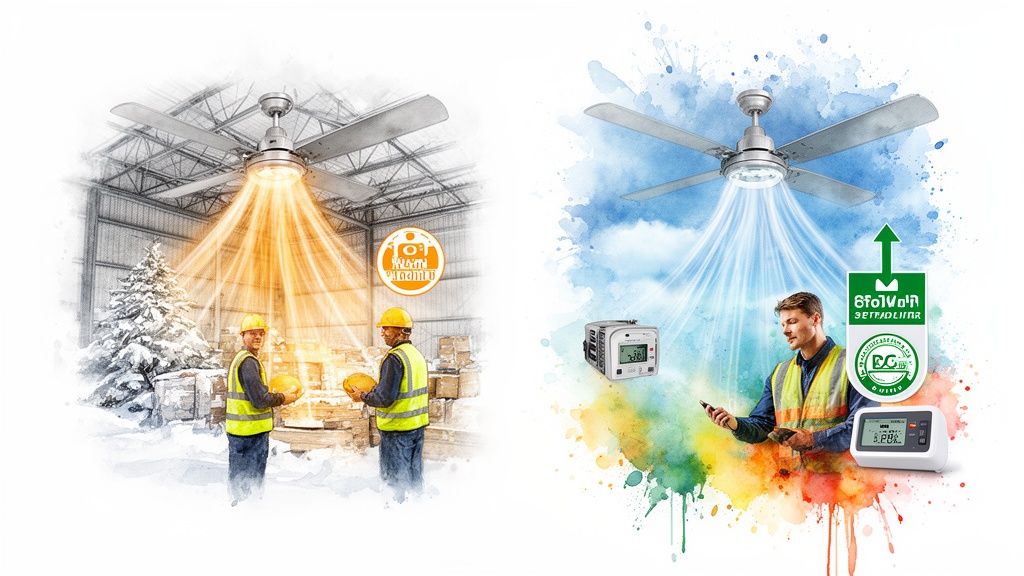
Winter Warmth Through Destratification
Ever noticed how it feels warmer near the ceiling of a large building than on the floor? That’s called thermal stratification, and it’s a massive energy waster. In the winter, all that expensive heat your furnace pumps out rises and gets trapped uselessly up high.
An industrial fan, running in reverse on a low speed, is the perfect solution. It gently pushes that trapped warm air down the walls and across the floor where your employees and customers actually are. This process, known as destratification, can slash your heating costs by up to 30% simply by recirculating the heat you’ve already paid for.
Summer Cooling and AC Savings
Come summer, that same fan becomes a cooling powerhouse. Running in a forward direction, it creates a gentle but widespread breeze across your facility. This airflow creates a “wind chill” effect, making the air feel up to 10°F cooler than it actually is.
This lets you raise your thermostat setting by several degrees without anyone feeling the difference. Since every degree you raise the thermostat can save you around 3-5% on cooling costs, the savings add up fast. Your AC unit runs less, saving energy and reducing wear and tear.
By tackling both summer cooling and winter heating, a single industrial fan delivers a powerful one-two punch to high energy bills, ensuring it pays for itself over time.
The DC Motor Advantage
Modern premium fans, like those in our Amped or Axis series, often feature advanced DC (Direct Current) motors. These motors are the gold standard for efficiency, using up to 70% less energy than their traditional AC counterparts while delivering serious power and nearly silent operation.
This kind of efficiency is driving a huge shift in the market. The global demand for these fans is growing fast, with the U.S. market expanding at a 4.9% CAGR. Businesses are replacing old, clunky systems with new, efficient models that can save 40% on energy right out of the box.
To really get the most long-term value from your fan system, it’s worth looking into proven VFD energy savings strategies. These systems give you even finer control over motor speed and energy use, turning your fan into an even smarter investment.
Alright, you searched for "industrial ceiling fans near me" and landed here. Perfect. Let's talk about turning that local search into a much smarter online strategy. Forget endless scrolling through generic results—the real trick is learning how to navigate a specialized retailer's website. It’s the difference between wandering a giant warehouse and having an expert guide you straight to what you need.
Buying from an online pro like Fan Connection puts you in the driver's seat immediately. You get access to a massive selection of high-performance models, all the nitty-gritty specs right at your fingertips, and real-world customer reviews you just won’t find at the local big-box store. This is about making a confident, informed decision, not just grabbing whatever they have in stock down the street.
Mastering the Search Filters
Think of the filter menu as your secret weapon for online shopping. Instead of getting overwhelmed by hundreds of fans, you can instantly narrow the field to just the ones that fit your job. It’s like having a personal shopper who actually knows industrial equipment.
Here’s how to use filters to find your fan in minutes:
- Filter by Blade Count: Need to move a serious amount of air in a huge warehouse? Select the "6+ Blades" filter. This instantly brings up the heavy-duty workhorses built for broad, powerful circulation.
- Filter by Style: Looking for something that fits the vibe of a brewery, restaurant, or high-ceiling workshop? The popular "Barn" style filter will show you rugged, good-looking options that match performance with great design.
- Filter by Model Name: Already have a powerhouse in mind, like the Aerovon? Just pop that into the search bar. You’ll go straight to the product page to dig into all the details.
This kind of targeted approach takes a generic search and turns it into a precision hunt. It saves you a ton of time and makes sure you're only looking at fans that can actually handle the work.
The real power of buying online is the transparency. Every fan's CFM rating, motor type, blade span, and warranty information is laid out right in front of you. You can compare high-performance models side-by-side without any guesswork.
The Advantage of Expert Curation
Here’s something else to consider: online specialists have already done half the job for you by curating a collection of reliable, top-tier fans. You can trust that any model listed, especially those over $300, has been vetted for durability and performance in tough environments.
This shift toward quality is happening everywhere. Industrial ceiling fans are no longer an afterthought; they're essential for businesses worldwide. The global ceiling fan market, which includes these powerful industrial units, was valued at USD 14.6 billion in 2025 and is expected to jump to USD 31.6 billion by 2035. That growth is all about businesses ditching outdated systems for modern, efficient models—exactly the kind of fans you'll find with a good online retailer. You can dig into the ceiling fan market trends yourself and see why investing in a solid fan is such a smart move.
Ultimately, buying online transforms your "near me" search into a mission for the best possible solution, delivered right to your door with a checkout process that's simple and secure.
Frequently Asked Questions
When you start searching for "industrial ceiling fans near me," a lot of practical questions are bound to come up. It's a big investment, and getting straight answers is the best way to choose the right fan with confidence. We’ve pulled together some of the most common questions we hear from business owners and contractors to help clear things up.
Can I Install An Industrial Fan In My Home Garage?
Absolutely. In fact, it’s a great idea. High-ceiling garages, personal workshops, and even residential barns are perfect spots for an industrial-grade fan. Their powerful airflow and heavy-duty construction are built for these kinds of environments, where a standard residential fan just won't be able to keep up.
The most important first step is to confirm your ceiling structure can safely handle the fan's weight and the torque it generates while running. Many homeowners find that models from our Barn collection or Aviation series—both priced over $300—are a fantastic fit, blending high performance with a cool, rugged aesthetic.
How Loud Are Modern Industrial Fans?
This is a common worry, and it usually comes from bad experiences with older, clunky models. The good news is that today’s high-volume, low-speed (HVLS) fans are engineered to be surprisingly quiet. They use premium DC motors to move a massive amount of air at a slow, gentle speed, which cuts down on noise dramatically.
This quiet operation makes them a perfect match for noise-sensitive commercial spaces where customer comfort is a priority, like gyms, breweries, restaurants, or event venues. If you're concerned, always check the product specs for a decibel (dB) rating before you buy.
The quiet efficiency of modern industrial fans is a game-changer. They create a comfortable environment without the disruptive noise, allowing them to blend seamlessly into customer-facing businesses.
Do Industrial Fans Require A Special Controller?
Yes, and this is a critical detail for both safety and performance. Most true industrial fans come with a dedicated, heavy-duty control system, usually a wall-mounted variable speed controller. These units are built specifically to manage the motor's higher power needs and give you precise, reliable control over the airflow.
It’s essential that you only use the controller provided by the manufacturer. Never try to wire an industrial fan to a standard residential dimmer switch—it’s dangerous and simply won’t work correctly. Using the right controller ensures your fan operates safely and performs exactly as it was designed to for years to come.
What Is The Difference Between 3-Blade And 6-Blade Fans?
The number of blades on a fan directly changes how it moves air. It’s not just for looks; it’s about physics.
- Fewer Blades (e.g., three): These fans often spin faster to create a more direct, concentrated column of air. You get a stronger, more focused breeze right underneath the fan.
- More Blades (e.g., six or more): A fan with more blades moves a much broader volume of air more gently across a wider area.
For big, open industrial spaces that need steady air circulation and temperature balancing (a process called destratification), a fan with more blades is almost always the better choice. It delivers even, widespread comfort instead of just a strong gust in one spot.
Ready to find the perfect fan for your space? Explore the expertly curated collections at Fan Connection and discover the ideal blend of power, style, and efficiency.
Browse our full collection of industrial and commercial fans now at Fan Connection


