

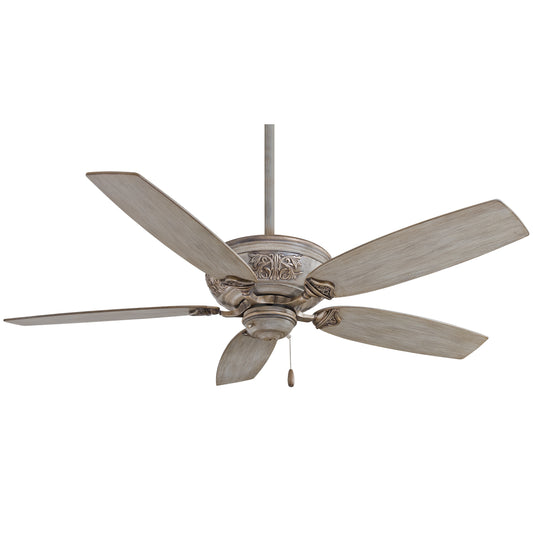


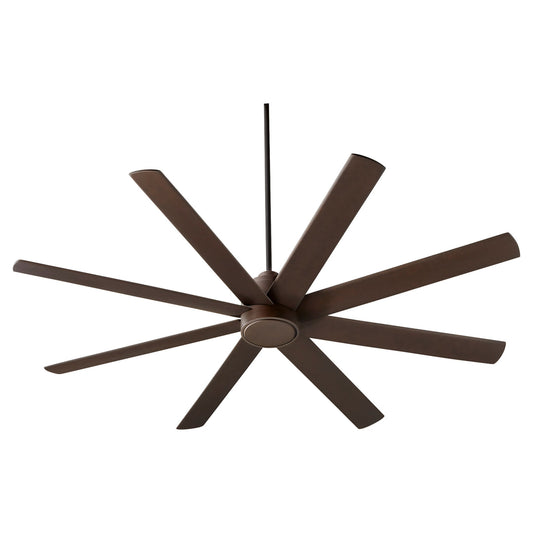


A Guide to Quiet Ceiling Fans for Bedrooms
Imagine this: your bedroom is perfectly cool, a gentle breeze rustles the air, and the only sound you hear is your own quiet breathing. That’s the promise of a truly premium, quiet ceiling fan for bedrooms. When you invest in a high-end model—usually in the $300 and up range—you're not just buying a fan. You're buying serenity.
Your Blueprint for a Truly Silent Bedroom
Let's be honest, the gentle hums, rattles, and wobbles from older fans are anything but relaxing. Achieving true silence in your sleep sanctuary isn't about luck; it's about understanding what makes a fan genuinely quiet. This guide is your roadmap. We’re going beyond simple product lists to give you the real knowledge you need to invest in high-end comfort. Think of this as your masterclass in picking a fan that doesn't just look good, but makes your bedroom the ultimate retreat.
We'll pull back the curtain on the engineering that separates a whisper-quiet fan from a rattling distraction. You'll learn exactly what justifies that premium price tag, ensuring your choice is a lasting upgrade for years of peaceful rest.
The Modern Standard of Silence
Over the past few years, the demand for quiet has completely reshaped the ceiling fan industry. It's no longer just a nice-to-have feature; it's a top priority. Today, you’ll see top-tier brands advertising bedroom fans that operate at or below 35 decibels (dB)—that’s about as loud as a soft whisper in a library.
It’s a big deal for buyers, too. Market analysis has shown that while features like lights and remotes are popular, noise complaints showed up in a staggering 25.9% of negative reviews. It’s clear: for the bedroom, silence is king.
Core Elements of a Premium Quiet Fan
So, how do manufacturers achieve that whisper-quiet performance? It all comes down to a few key components working in perfect harmony. When you're looking at fans, especially in the premium category, these are the non-negotiables.
- Advanced DC Motor: This is the heart of any quiet fan. Unlike older AC motors that have that distinct electrical hum, modern DC motors are virtually silent. They're also way more energy-efficient and give you much better speed control.
- Aerodynamic Blade Design: The shape, material, and angle of the blades are all meticulously engineered. The goal is to slice through the air with the least possible resistance, which cuts down on that "whooshing" sound you hear from air movement.
- Wobble-Free Installation: A high-quality fan comes with robust mounting hardware and perfectly balanced parts right out of the box. This eliminates any potential for the clicks, rattles, or swaying that can drive you crazy, even at high speeds.
"A truly quiet ceiling fan is a symphony of silent parts. The motor provides the power without the hum, the blades create the breeze without the noise, and a solid installation ensures you only feel the air, you don't hear the machine."
Of course, even the best fan can't block out a noisy neighbor. Mastering a few effective strategies to sleep through noise is a great final touch for your silent bedroom blueprint.
This guide will walk you through each of these critical elements in detail. We'll explore the technology behind silent motors, the science of blade aerodynamics, and the best practices for installation. By the end, you'll have the confidence to select a fan that delivers on its promise of peaceful, quiet comfort, making your bedroom the tranquil retreat you deserve.
Quick Guide to Premium Quiet Fan Features
To make things even clearer, here’s a quick summary of the key features that define a top-tier quiet fan. Think of this as your checklist when comparing models.
| Feature | Why It Matters for Silence and Comfort | What to Look For |
|---|---|---|
| DC Motor | Virtually silent operation, more energy-efficient, and offers more speed settings for precise airflow control. | Look for "DC Motor" or "Direct Current Motor" in the product specs. They are the industry standard for quiet fans. |
| Aerodynamic Blades | Specially shaped blades cut through the air cleanly, minimizing the "whoosh" sound of air movement. | Seek out fans with unique, curved, or pitched blade designs. Materials like wood or molded ABS are often used. |
| Solid Mounting & Balance | A robust mounting system and precision-balanced components prevent wobbling, clicking, and rattling noises. | High-quality hardware included, often with specific instructions for balancing if needed. |
| Multiple Speed Settings | More speeds (often 6+) allow you to find the perfect airflow level without creating unnecessary noise. | Fans with remote or wall controls offering at least 6 speed options. |
| Quality Bearings | High-grade, sealed bearings within the motor ensure smooth, frictionless rotation for years without noise. | Often mentioned in premium brand descriptions as "precision-sealed bearings" or "high-performance motor." |
Having this checklist handy will help you cut through the marketing noise and focus on the features that actually deliver a silent, comfortable experience.
The Engine of Silence: Understanding Fan Motors
At the heart of every ceiling fan is its motor—the engine that gets the blades spinning. When you're hunting for a fan that won't disturb your sleep, the motor isn't just another part on a spec sheet. It's the single most important factor that determines whether you get peaceful silence or a persistent, annoying hum.
Think of it like this: a traditional AC (alternating current) motor is like the engine in a standard car. It’s been around forever, it’s reliable, and it gets the job done. But there's always an underlying vibration and a low-level buzz you just can't escape. That faint electrical hum you probably associate with older fans? That’s the AC motor at work.
Now, picture the motor in a modern electric vehicle—it’s smooth, powerful, and almost totally silent. That’s the experience a DC (direct current) motor delivers. This is the undisputed champion of quiet performance, and it's what you'll find in virtually every premium fan on the market today, especially those priced at $300 or more.
The DC Motor Advantage
So, what makes a DC motor the quiet hero of the fan world? It all comes down to its brushless design. AC motors rely on physical contact between carbon brushes and a commutator to generate the magnetic field that spins the motor. This friction is exactly what creates that audible electrical noise.
DC motors, on the other hand, are much more sophisticated. They use a clever combination of magnets and electronics to create a seamless, frictionless rotation.
The result? The electrical "hum" is completely gone. The only sound you'll hear from a high-quality DC fan on a low setting is the gentle, soothing whisper of the blades cutting through the air.
But the perks don't stop there. DC motors are also incredibly energy-efficient. With less friction, they waste far less energy as heat and can use up to 70% less electricity than their old-school AC counterparts. Over time, that translates to real savings on your energy bill, especially if you're running the fan all night, every night.
DC vs AC Motors: A Head-to-Head Comparison
If you're serious about creating a peaceful bedroom sanctuary, the choice is clear. Here’s a quick breakdown that shows why DC motors have become the gold standard for anyone who values quiet comfort and efficiency.
| Attribute | DC Motor (The Premium Choice) | AC Motor (The Traditional Option) |
|---|---|---|
| Noise Level | Virtually silent; no electrical hum | Noticeable low-level hum |
| Energy Use | Up to 70% more efficient | Standard energy consumption |
| Speed Control | 6+ speeds for precise airflow | Typically only 3 speeds |
| Motor Lifespan | Longer-lasting due to less friction | Shorter lifespan due to wear |
| Reversibility | Conveniently reversible via remote | Manual switch on the fan body |
Ultimately, a DC motor fan is an investment in better sleep and lower energy bills. It’s the superior technology for anyone who refuses to compromise on comfort.
Precision Control for the Perfect Breeze
Another game-changing feature of DC motors is the incredible level of control they offer. We’ve all been there with a standard AC fan—low is too weak, medium is too strong, and high feels like a wind tunnel. You’re stuck with just three options.
Premium DC motor fans blow that limitation away. They often come with six or more speed settings, letting you fine-tune the airflow with surgical precision. You can dial in that perfect, gentle breeze that keeps you comfortable without rustling papers or making you feel chilled.
A DC motor gives you the power to dial in the exact comfort level you need, ensuring the fan works for you, not the other way around. It’s the difference between a blunt instrument and a precision tool for creating the ideal sleep environment.
This granular control is a lifesaver for light sleepers. You can set the fan to a nearly inaudible low speed and still get effective air circulation, something that's just not possible with a basic AC fan. To see what this technology looks like in action, you can explore our curated collection of the best DC motor ceiling fans.
What the Market Is Saying
This shift to DC motors isn't just a small trend—it's a massive, market-wide movement. Consumers want quieter, more efficient homes, and fan manufacturers have responded.
Technical data shows that DC motor adoption has dramatically lowered bedroom fan noise while boosting energy performance. These fans can operate at whisper-quiet levels as low as 30 dB while using 40–70% less power than similar AC models. It's no surprise that in North America, where quiet bedrooms are highly valued, the ceiling fan market was recently estimated at around USD 2.98 billion, with much of that growth fueled by homeowners upgrading to superior DC technology.
When you're shopping for your next fan, the quickest way to spot a high-quality, quiet model is to check the motor type. If the specs say "DC Motor," you can be confident you’re looking at a product designed from the ground up for serene, efficient, and powerful performance.
If the motor is the silent engine of your fan, then the blades are the artists of airflow. They're what sculpt the breeze in your bedroom, and a clumsy design can turn a gentle whisper of air into a noisy, disruptive 'whoosh.'
It's a common misconception that more blades automatically mean a quieter, more powerful fan. In reality, the opposite is often true. A well-engineered fan with just three meticulously sculpted blades can easily outperform a cheap five-blade model because it's all about quality over quantity. The real secret lies in how those blades slice through the air.
The Science of a Silent Slice
Think of a premium fan blade less like a paddle and more like an airplane wing. It’s not just a flat plank of wood; it’s a carefully shaped airfoil designed to cut through the air with the least amount of drag and turbulence. That turbulence is exactly what creates unwanted air noise.
When a flat, poorly designed blade just chops through the air, it creates chaotic little eddies and vortices. That's the source of that all-too-familiar buffeting sound.
Aerodynamic blades, on the other hand, are often crafted from materials like carved balsa wood or lightweight molded composites. Their unique shape is designed to guide air smoothly and efficiently across the surface. This creates a much quieter, more efficient "laminar flow." Top-tier manufacturers, especially for fans in the $300+ range, invest a ton of time and money into wind-tunnel testing to perfect these blade designs. The goal is simple: let you feel the breeze without having to hear it being made.
Blade Pitch: The Angle of Attack
Another huge piece of the puzzle is blade pitch—that’s just the angle of the blades relative to the ground. A steeper pitch, typically between 12 and 15 degrees, can move a lot more air. But if you get too aggressive with the angle, it forces the motor to work harder and can actually create more noise.
The perfect blade design is a balancing act. It needs a pitch steep enough to generate a real breeze, but it also needs an aerodynamic shape refined enough to do so without creating a racket. It’s the difference between a clumsy paddle splashing in the water and a sleek oar slicing through it effortlessly.
This is where that premium engineering really shows its value. The best quiet ceiling fans for bedrooms are perfectly calibrated to hit that sweet spot, giving you maximum airflow with a minimal sound profile. You can dive deeper into how blade count and design come together by exploring the impact of fan blade count and fan efficiency in our detailed guide.
Understanding CFM for Bedroom Bliss
When you're shopping for a fan, you'll see a rating called CFM, which stands for Cubic Feet per Minute. This number simply tells you how much air the fan can move. While a huge CFM number might look impressive, it isn't the only thing that matters, especially in a bedroom.
A fan blasting out 6,000 CFM on its highest setting might be perfect for a large, vaulted living room, but it's almost guaranteed to be too loud for sleeping.
For a bedroom, the goal is to find a fan that provides plenty of airflow on its lower, quieter settings. A well-designed fan can circulate air beautifully at a low speed, keeping you comfortable without creating a wind tunnel. Look for models that deliver a gentle, consistent breeze in the 1,000 to 4,000 CFM range on those lower speeds. That’s how you get the cooling you need with the peace you crave.
Take a look at the core technologies that power today's best fans, from the hyper-efficient DC motors that keep them quiet to the industrial AC motors found in other household workhorses.
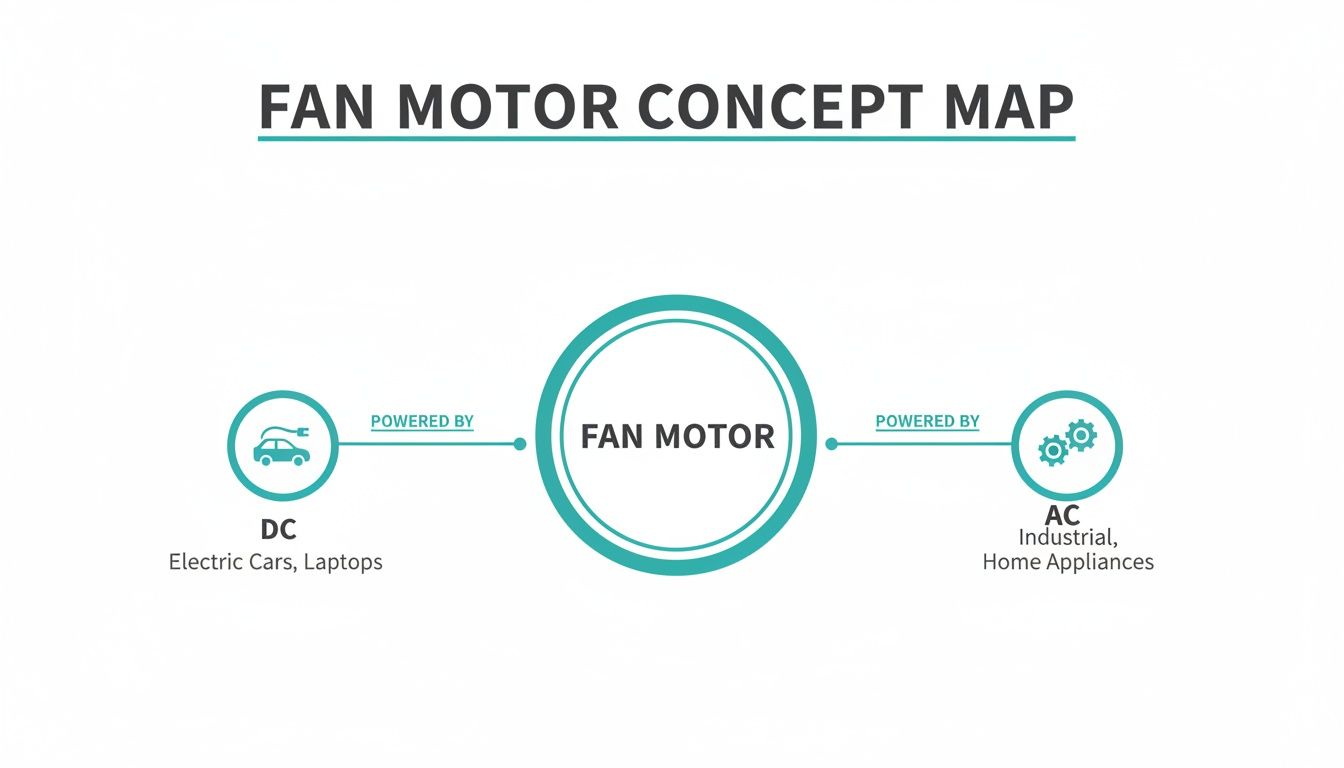
This just helps visualize how the premium DC motor technology found in quiet fans—and even electric cars—is specifically engineered for efficiency and low noise. It’s a world away from the traditional AC motors used in heavy-duty appliances.
Finding the Right Size and Fit for Your Bedroom
You can pick the most advanced DC motor and perfectly shaped blades, but if the fan is the wrong size or poorly installed, you'll never get that whisper-quiet performance you paid for. Let’s be clear: getting the size and fit right isn’t just a recommendation; it’s a non-negotiable step for a silent bedroom.
Think of it like this: a tiny engine in a huge truck has to scream at high RPMs just to get the job done. In the same way, an undersized fan will always be louder working overtime on its highest setting than a larger, properly sized fan coasting on a low, gentle speed.
Matching Fan Size to Your Bedroom
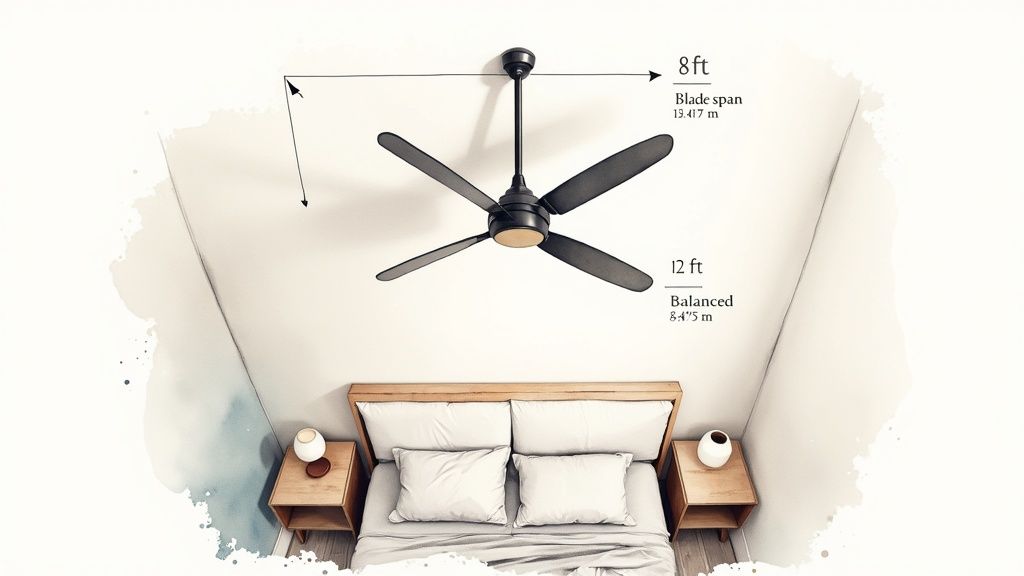
Picking the right fan size—measured by its blade span (the full diameter from blade tip to blade tip)—is absolutely critical. The goal here is to move air efficiently without having to crank it up. A fan that’s sized correctly for the room can circulate air effectively even on its lowest speeds, and that’s the real secret to silent operation.
Here’s a simple breakdown to match the fan to your room’s square footage:
- Small Bedrooms (Up to 150 sq ft): For a cozy guest room or home office, a fan with a blade span of 36 to 44 inches is perfect. It’ll provide a gentle breeze without overwhelming the space.
- Standard Bedrooms (150 to 300 sq ft): This covers most typical master or family bedrooms. Look for a fan in the 44 to 54-inch range to get optimal, quiet performance.
- Large Master Bedrooms (Over 300 sq ft): If you have a spacious master suite or a room with high, vaulted ceilings, you’ll need a fan that’s 54 inches or larger. These fans are built to move a ton of air effortlessly, even on their quietest settings.
Investing in a larger, premium fan for a big room isn't about excess; it's about efficiency. It lets you get the cooling you want at a much lower, quieter speed, protecting that peaceful atmosphere you’re after.
The Critical Role of a Wobble-Free Installation
Once you have the perfect size, the installation is the final gatekeeper of silence. A premium fan priced at $300 or more is a precision machine. Even the slightest imbalance during the install can ruin all that engineering, leading to those maddening clicks, rattles, and wobbles.
The two most important parts for a rock-solid installation are the downrod and the canopy. The downrod needs to be the right length for your ceiling height to ensure proper air circulation and keep the blades a safe distance from the ceiling (ideally, the fan should hang 8–9 feet from the floor). The canopy, which covers the electrical box, has to be attached securely to a fan-rated junction box. Any looseness here will translate directly into noise.
Why Professional Installation Is a Smart Investment
I know DIY is tempting, but installing a high-end ceiling fan is one of those jobs best left to a professional. Here’s why that extra cost is a worthwhile investment to protect your purchase:
- Guaranteed Balance: An electrician will ensure the fan is perfectly balanced right from the start, using balancing kits to eliminate even the tiniest wobble before it becomes a problem.
- Secure Mounting: They will make sure the ceiling’s junction box is properly braced and rated to support the fan’s weight and motion, preventing any future sagging or noise.
- Correct Wiring: A pro knows how to handle the electrical connections safely and securely, which prevents the electrical hums or buzzing sounds that can crop up from faulty wiring.
Think of it this way: you wouldn’t buy a luxury sports car and then try to align the wheels yourself in the garage. Paying for a professional installation guarantees that you get the silent, stable, and effective performance you paid for, right from day one.
Modern Features for a Better Bedroom Experience
Let's be honest, the days of yanking a pull chain and hoping for the best are long gone. Today’s best quiet ceiling fans for bedrooms are less like simple appliances and more like sophisticated pieces of tech designed for pure comfort. When you start looking at fans in the $300 and up range, you’re not just paying for a motor and blades; you're investing in features that can completely transform your bedroom's atmosphere.
Gone are the clunky, limited settings. Modern fans put an incredible amount of control right in your hands, making it easy to create the perfect environment without a second thought.
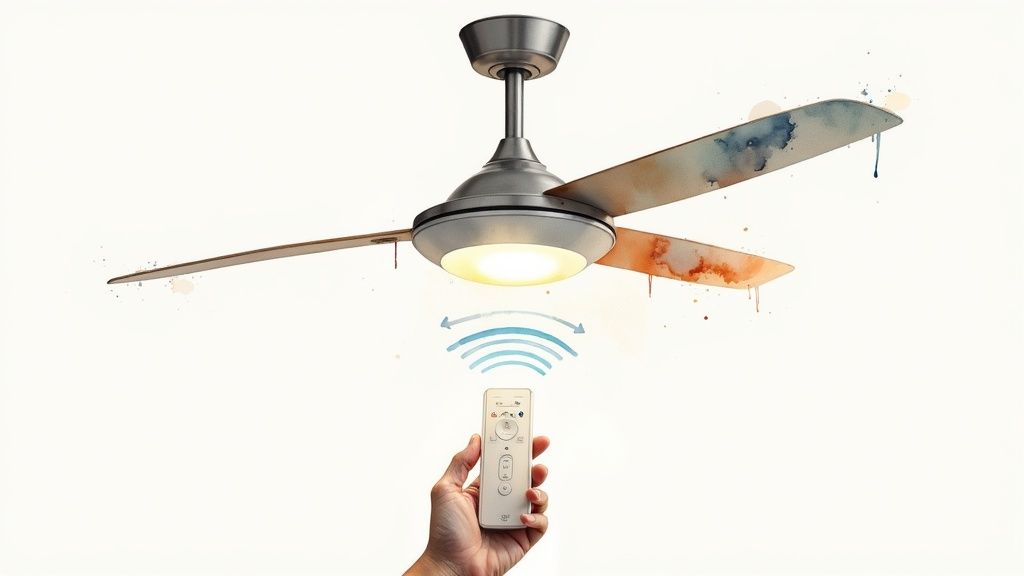
Precision Control and Smart Home Smarts
The most immediate upgrade you'll notice is the remote. Forget fumbling in the dark for a chain. Modern fans come with multi-speed remotes that let you fine-tune the airflow. Many DC motor fans, for example, offer six or more speed settings, so you can find that perfect, whisper-quiet breeze for sleeping.
But it gets even better. Many of our top-tier models now come with full smart home integration. Picture this: you're already cozy in bed when you realize the room feels a little stuffy. Instead of hunting for the remote, you just say, "Alexa, set the fan to level two." That seamless connection to voice assistants like Amazon Alexa or Google Assistant is a small luxury that makes a huge difference.
Year-Round Comfort with a Reversible Motor
One of the most valuable features you’ll find is a reversible motor. It’s a simple concept, but it turns your fan into a year-round workhorse for both comfort and energy savings.
- Summer Mode (Counter-Clockwise): During warmer months, the blades spin counter-clockwise to push cool air down, creating a pleasant downdraft. This "wind chill" effect makes the room feel cooler, letting you ease up on the AC and save some money.
- Winter Mode (Clockwise): When it gets cold, a quick flip of a switch (usually on the remote) reverses the direction. This pulls cool air up and gently pushes the warm air that naturally pools at the ceiling back down into the room. It’s a genius way to help your heater work more efficiently.
This dual-functionality means your investment pays off all year long, keeping you comfortable while trimming your energy bills.
Integrated Lighting That Sets the Mood
The lighting on modern bedroom fans is no longer just a basic bulb screwed into the bottom. Today’s premium fans feature integrated, dimmable LED lights that often include adjustable color temperatures—and this is a total game-changer for setting the right vibe.
"Modern fan lighting is about more than just illumination; it's about ambiance. The ability to shift from a bright, energizing light to a soft, warm glow gives you complete control over your bedroom's mood, turning it into a true sanctuary."
You can set the light to a crisp, cool white (around 5000K) in the morning to help you wake up and feel energized. Then, in the evening, you can dim it down to a warm, soft glow (around 2700K) that mimics candlelight, signaling to your body that it’s time to wind down. This level of control, all managed from your remote or smart home app, is what separates a good fan from a great one.
Keeping Your Fan Silent for Years to Come
When you invest in a premium fan, especially one priced at $300 or more, you’re not just buying a fixture—you’re buying years of peaceful sleep. Like any well-made machine, a little routine care is all it takes to keep it running in whisper-quiet condition. This simple maintenance plan will protect your purchase and ensure your bedroom remains a sanctuary for life.
Believe it or not, the most common source of fan noise isn't a faulty motor. It's usually just a bit of dust causing an imbalance. A simple cleaning routine is your best defense against wobbles and rattles.
The Power of a Simple Cleaning Routine
Over time, dust settles on the top of your fan blades. It might not look like much, but this buildup adds uneven weight and can throw the fan's delicate balance completely out of whack. This is the number one cause of wobbling, which often leads to annoying clicking or rattling sounds.
A quick wipe-down is all you need. Just grab a soft cloth or a duster every few months and clean the blades. This tiny bit of effort keeps the fan perfectly balanced, ensuring the airflow stays as smooth and silent as the day you installed it.
Tighten Up for Total Silence
Another key to long-term silence is making sure everything stays screwed down tight. The constant rotation of a ceiling fan can, over months and years, cause screws to loosen just a tiny bit. These microscopic movements are often the source of those mysterious clicks or hums that can drive you crazy at night.
Once a year, run through this quick checklist:
- Blade Screws: Gently check the screws holding each blade to its bracket. You want them snug, but don’t crank on them too hard.
- Mounting Bracket: Take a look at the screws connecting the fan's downrod and canopy to the mounting bracket on the ceiling.
- Light Fixture: If your fan has a light kit, make sure any glass shades or globes are securely attached and their fastening screws are firm.
This five-minute check-up prevents vibrations from turning into noise, keeping your fan mechanically sound and perfectly silent.
A Quick Guide to Troubleshooting Noises
Even with the best care, a random noise might pop up. Before you panic, just know that most issues are simple fixes. The most common culprit is a slight imbalance that causes a wobble. You can easily fix this yourself with a balancing kit, and our guide on how to balance a ceiling fan walks you through the entire process, step by step.
Don't let a minor wobble ruin your peace. A simple balancing adjustment is often all it takes to restore your fan to perfect, silent operation. It's an easy DIY fix that keeps your investment performing at its best.
Common Questions About Quiet Bedroom Fans
After digging into motors, blades, and installation, you might still have a few questions rolling around in your head. That's completely normal. Let's tackle some of the most common ones people ask right before they pick out the perfect fan.
What Decibel Rating Is Considered Quiet for a Bedroom?
For a bedroom, the sweet spot is a fan that runs at 35 decibels (dB) or lower on the speeds you'll actually use.
To give you a better idea of what that sounds like, a whisper is about 30 dB, and a quiet library is around 40 dB. Many of our best DC motor fans—especially those in the $300 and up range—hum along between 25-30 dB on their lower settings. That's so quiet it often gets lost in the normal ambient sound of a room.
Always look for the dB or Sone rating in the fan's specs to be sure you're getting that whisper-quiet performance.
Do More Blades Make a Fan Quieter?
This is a classic myth, but the short answer is no, not really. How quiet a fan is comes down to the quality of its motor, the aerodynamic design of the blades, and how well the whole thing is balanced.
A well-engineered three-blade fan with a high-end DC motor will run circles around a poorly made five-blade fan with a clunky AC motor when it comes to noise. So instead of counting blades, focus on what's driving them. That’s where the real silence is found.
The number of blades is an aesthetic choice. The quality of the motor and the design of those blades are what determine the noise level. A premium, well-balanced fan is quiet regardless of how many blades it has.
Are Expensive Ceiling Fans Really Quieter?
In our experience, yes. That higher price tag (usually $300+) isn't just for show; it's a direct reflection of better engineering, higher-grade materials, and modern tech like DC motors. All of those things are exactly what make a fan run silently and without a hint of wobble.
When you invest in a premium fan, you're paying for better components—from precision-sealed motor bearings to aerodynamically tested blades—all designed from the ground up for quiet, long-term performance. It’s one of those cases where you truly get what you pay for, especially when it comes to a peaceful night's sleep.
Can I Install a Quiet Fan on a Sloped Ceiling?
Absolutely. Most quality ceiling fans are designed to work with sloped or vaulted ceilings, but you'll need to check the fan's specs to see the maximum angle it supports.
For steeper ceilings, you might need a separate sloped ceiling adapter or a longer downrod to make it work. This ensures the blades have plenty of room to spin freely and, just as important, keeps the fan perfectly balanced for quiet, steady operation. Using the right accessories is the key to getting silent performance, no matter what your ceiling looks like.
Ready to find the perfect fan that combines serene silence with stunning style? Explore the curated collections at Fan Connection and discover a model engineered for the peaceful bedroom you deserve. Find your ideal match at https://www.fanandlights.com.


