

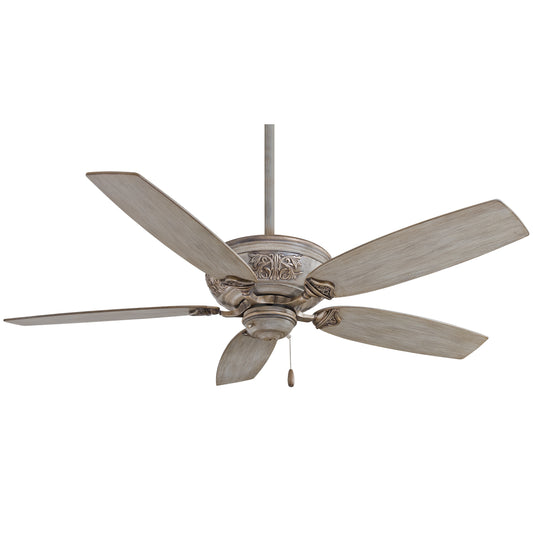


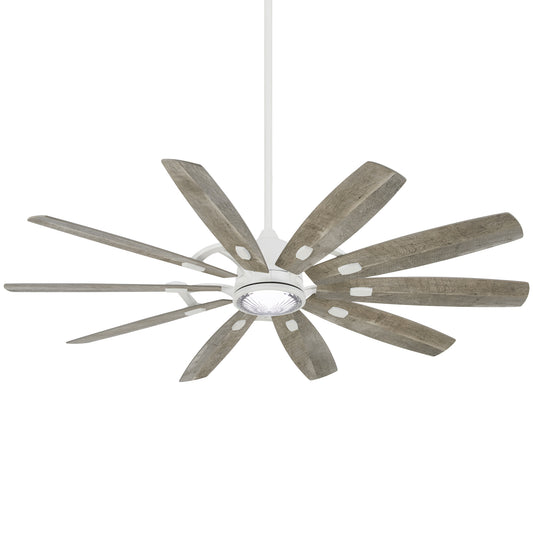

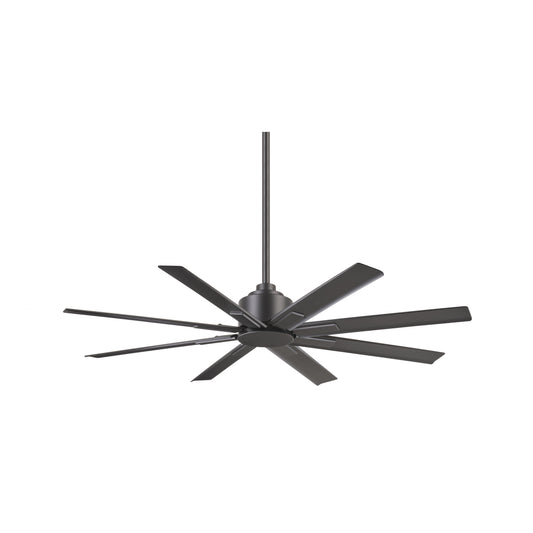

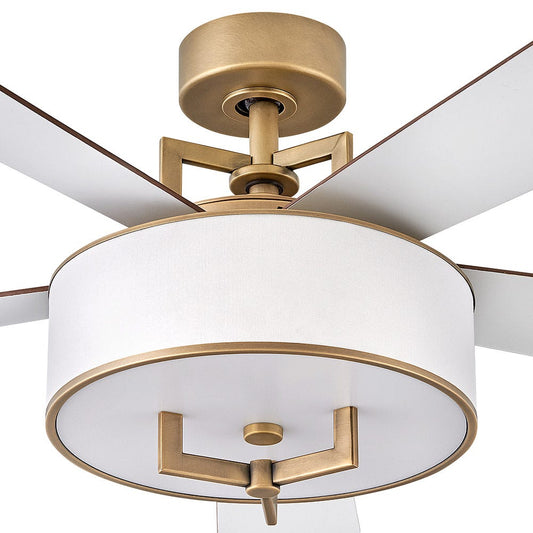






Wall Mount Ceiling Fans The Ultimate Space Saving Solution
Ever found yourself in a room where a standard ceiling fan is simply out of the question? We’ve all been there. Those tricky spaces with low, sloped, or just plain awkward ceilings can feel like a real dead-end, forcing you to choose between a comfortable breeze and a design you actually like. Let's be honest, nobody wants to sacrifice style for comfort.
But what if you didn’t have to compromise? What if there was a ridiculously cool solution that not only solved the problem but also added a serious dose of "wow" to your decor?
The Stylish Solution For Problem Spaces
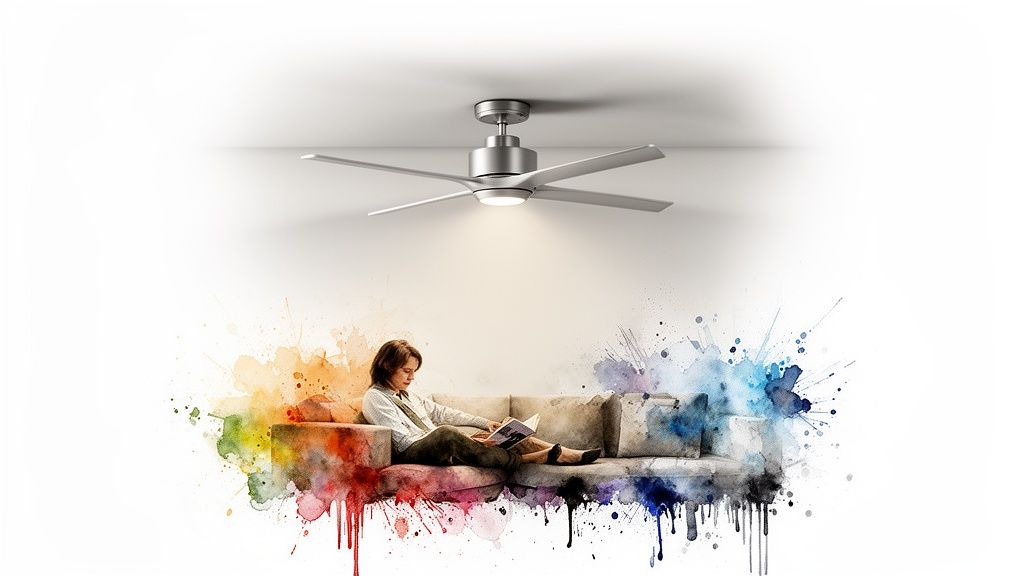
Enter the wall mount ceiling fan—an ingenious and surprisingly stylish fix for these common architectural headaches. Think of them less like a bulky appliance and more like a powerful, air-moving sconce that brings both function and a bit of flair to your walls. They tackle the problem head-on, delivering serious cooling without eating up an inch of that precious headroom.
This is a game-changer in modern homes where every square foot counts. A wall-mounted fan isn’t just a practical fix; it’s a smart, fun design move. It's the kind of clever addition that makes guests go, "Whoa, that's awesome!" and makes a compact area feel more open and intentional.
More Than Just a Wall Fan
Let's be clear: these aren't the same as the wimpy, rattling oscillating fans you might be picturing. Wall mount ceiling fans are a category all their own. High-end models, like the elegant Artiste or the powerful Aviation fans, are a sophisticated alternative that turns a basic need into a real design statement.
Here’s what makes them so great:
- They Save Space: By moving the fan from the ceiling to the wall, you instantly make rooms with low or angled ceilings feel bigger and less cluttered. It's like finding extra space you never knew you had!
- They Offer Targeted Airflow: You can aim the breeze right where you need it most, whether that's over your favorite reading chair or into a stuffy corner that never seems to get enough circulation.
- They're Incredibly Versatile: With styles ranging from sleek and industrial to breezy and tropical, you can find a fan that fits right in with your home’s decor.
A wall mount ceiling fan does more than move air. It reclaims unusable space, making it a go-to for designers and homeowners dealing with challenging layouts.
It's no secret that people love their overhead fans. The residential market makes up over 60% of the entire global fan market, and traditional ceiling fans account for more than 65% of that. People clearly prefer that overhead cooling effect, and wall-mounted versions cleverly adapt that concept for the spaces where it just wasn't possible before.
For more creative ways to bring a breeze into your home, take a look at our guide on creative ceiling fan placement ideas.
Understanding How Wall Mount Ceiling Fans Work

So, what really makes a wall-mount ceiling fan different from a regular old wall fan? It all comes down to its heavy-duty engineering. This isn't your average plastic fan you stick in a corner; it's a serious air circulator built with the guts of a high-end ceiling fan—same motor, same durability, same performance—just cleverly re-engineered to be mounted vertically.
Think of it as the best of both worlds. You get the targeted, directional airflow of a high-velocity fan combined with the wide, room-filling circulation and stylish looks of a designer ceiling fan. Understanding this hybrid nature is the key to appreciating why a premium model, like the gorgeous Artemis IV which can run over $800, is an investment that truly pays off.
The Anatomy of a Powerhouse
A wall-mounted ceiling fan is much more than just a fan head on a different kind of bracket. Every part of it is built to handle the unique physics of its orientation.
- Heavy-Duty Mounting Bracket: This is the fan’s anchor. It’s not just a simple hook; it's a robust piece of hardware designed to securely support the fan's weight and motor torque against a wall stud. This ensures it stays perfectly stable and vibration-free for years.
- Powerful, Quiet Motor: The heart of this machine is a motor made for continuous, demanding work. The best models often feature DC motors, which are a world away from their AC cousins—they’re whisper-quiet and way more energy-efficient, giving you a gentle hum instead of an annoying roar.
- Oscillating Head and Blade Design: The fan's ability to sweep back and forth is what allows it to cover a huge area and get rid of stubborn hot spots. The blades themselves are specifically shaped to move as much air as possible. We actually dive deeper into this in our article about the impact of fan blade count on efficiency.
The true value of a wall mount ceiling fan is its ability to deliver the air-moving capacity of a ceiling fan with the directional precision of a wall fan, all while serving as a compelling design element.
A Difference You Can Feel
Picture a long, narrow workshop or a sprawling outdoor patio. A traditional ceiling fan might struggle to push air all the way to the far corners. On the other hand, a standard wall fan might feel too weak or just create an annoying wind tunnel in one tiny spot.
This is where a wall-mount ceiling fan shines. By mounting it on a far wall, its oscillating head can sweep a powerful, consistent breeze across the entire length of the space. That wide arc of airflow creates a much more comfortable and evenly cooled environment, turning a once-stuffy area into a place you actually want to be. It’s this strategic air circulation that really sets it apart.
When To Choose A Wall Mount Fan
So, when does a wall mount ceiling fan go from being a cool, niche product to an absolutely essential fix? Certain spaces practically demand them, turning what seems like an impossible design challenge into a clever and stylish solution. These fans really shine in situations where traditional overhead options are unsafe, impractical, or just plain awkward.
Let’s break down the key scenarios where a wall-mounted fan isn't just a good idea—it's the best idea.
The Low Ceiling Dilemma
This is the big one. The most common reason homeowners start looking for a wall mount fan is a low ceiling. For safety, building codes generally require fan blades to be at least seven feet off the floor. In rooms with ceilings under eight feet, a standard fan is a non-starter. Even a hugger-style fan can feel uncomfortably close. If you're curious about those, check out our guide on what a flush mount ceiling fan is and how they work.
A wall mount fan completely sidesteps this problem. By positioning it high on the wall, you get powerful air circulation without creating a head-bumping hazard. It's the perfect answer for basements, attic rooms, or older homes with lower-than-average ceiling heights, keeping things comfortable without sacrificing an inch of headroom.
Tackling Tricky Ceilings and Narrow Spaces
Some rooms just weren't built with a center-mounted fixture in mind. Wall mount fans are the ultimate problem-solvers for these kinds of architectural quirks.
- Vaulted or Sloped Ceilings: While you can use a long downrod, it can sometimes look a little gangly or out of place. A wall mount fan installed high on a peak wall can push air down and across the entire room, giving you effective circulation without the awkward hardware.
- Long, Narrow Rooms: Think hallways, workshops, or skinny enclosed patios. A single ceiling fan in the middle of a long room often leaves the ends feeling stuffy. Placing a wall mount fan at one end lets it send a current of air all the way down the space for much more even cooling.
- Rooms with Obstructions: Got beautiful exposed beams or a big statement chandelier you don’t want to mess with? A wall mount fan lets you add airflow without interfering with your existing design elements.
Wall mount ceiling fans are the ultimate architectural troubleshooters, bringing a powerful breeze to the spaces that standard fans simply can't reach.
Perfect for Outdoor Living
This is where a high-quality wall mount fan truly shines. Covered patios, pergolas, and outdoor kitchens often lack a central, structurally sound place to hang a ceiling fan. But mounting a fan to an exterior wall? That’s usually pretty straightforward.
For example, a premium, wet-rated model like the Anywhere Fan, which costs around $450, is built to handle whatever the weather throws at it. Placing one on the wall of your house overlooking the patio allows its oscillating head to sweep a cool breeze over your entire outdoor seating area. This kind of targeted airflow is often more effective than an overhead fan, which can struggle to move air in a wide-open space. It can transform a hot, still patio into a comfortable oasis for relaxing and entertaining.
To make the choice even clearer, here’s a quick guide to help you decide which fan type is right for your space.
Wall Mount Fan Vs Traditional Ceiling Fan Decision Guide
A clear comparison to help you decide which fan type is right for your specific room conditions.
| Scenario | Best Choice | Why It's The Best Choice |
|---|---|---|
| Ceilings under 8 feet high | Wall Mount Fan | Maintains the required 7-foot safety clearance from the floor that a ceiling fan can't provide. |
| Standard room with 8+ foot ceilings | Traditional Ceiling Fan | Offers the most efficient, widespread, and even air distribution for a standard room layout. |
| Very long and narrow room | Wall Mount Fan | Can be positioned at one end to push a targeted stream of air down the entire length of the space. |
| Vaulted or cathedral ceilings | It Depends | A ceiling fan with a long downrod works well, but a wall fan on the peak wall is a stylish alternative. |
| Ceiling has obstructions (beams, lights) | Wall Mount Fan | Adds airflow without interfering with existing ceiling features or design elements. |
| Covered outdoor patio or pergola | Wall Mount Fan | Often easier to install on an exterior wall and provides targeted, oscillating airflow for open spaces. |
Ultimately, the best choice always comes down to the unique challenges of your room. While a traditional ceiling fan is the go-to for most standard spaces, a wall mount fan is the hero for those tricky, tight, or architecturally unique areas where nothing else will do.
Decoding The Technical Specifications
Ready to move past the looks and talk performance? Choosing the right wall mount ceiling fan means getting familiar with the technical specs. This isn't just confusing jargon; it's the language that tells you exactly how much comfort and efficiency you're buying.
Think of a fan's CFM (Cubic Feet per Minute) rating as its horsepower. Just like a powerful engine moves a car with more authority, a higher CFM means the fan moves more air, creating a stronger, more effective breeze. For a small patio, 1,000-3,000 CFM might be plenty, but for larger spaces, you'll want to look for fans pushing 4,000 CFM or more to truly feel the difference.
This infographic breaks down the most common scenarios where a wall mount fan is the perfect solution.
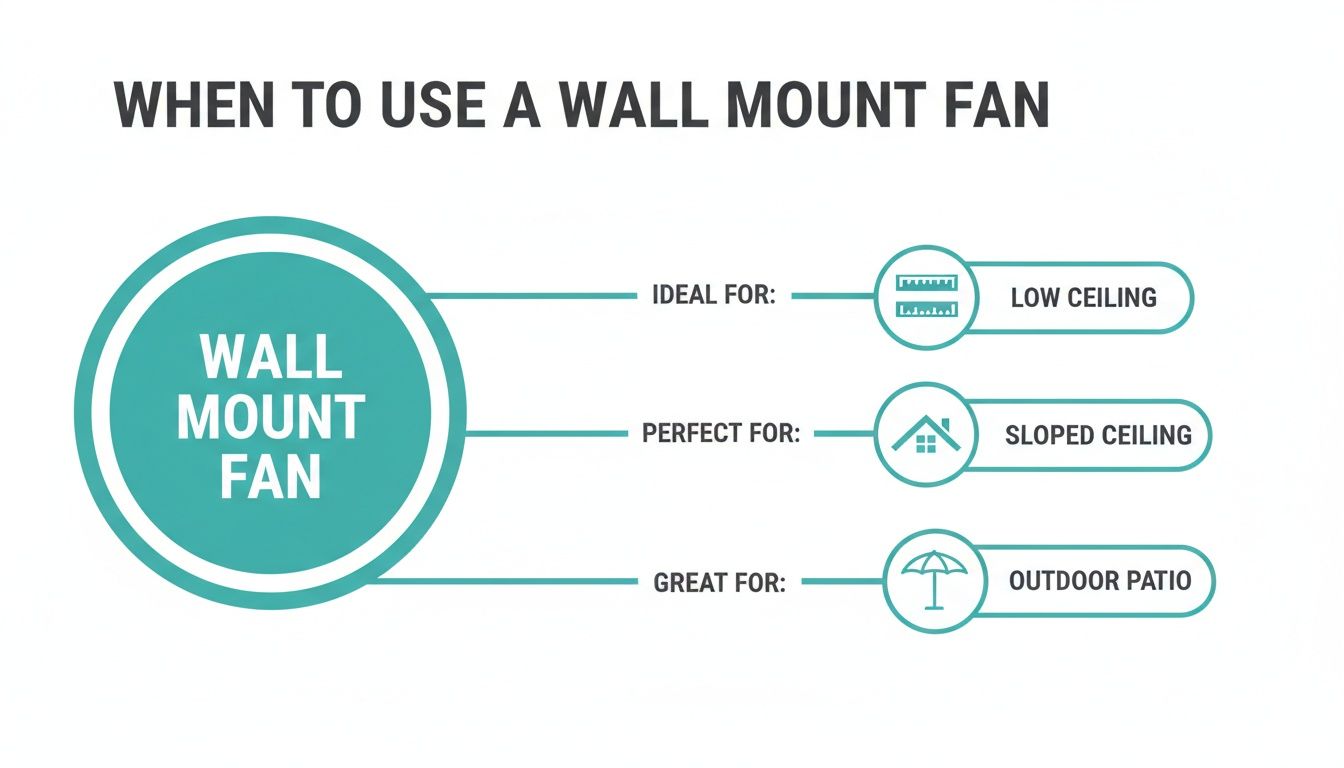
The key takeaway is that these fans are problem-solvers, designed for specific architectural challenges that traditional fans simply can't handle.
The Motor Makes The Difference
The motor is the heart of your fan, and you’ll mostly see two types: AC (Alternating Current) and DC (Direct Current). While older, more basic fans run on AC motors, nearly all premium models now feature DC motors—and for good reason. A DC motor is the modern, high-performance engine of the fan world.
Here’s why that matters for your investment:
- Whisper-Quiet Operation: DC motors are virtually silent. All you'll hear is the gentle sound of moving air, not a distracting mechanical hum.
- Incredible Energy Efficiency: They can use up to 70% less energy than their AC counterparts, which means lower electricity bills year after year.
- More Speed Options: DC motors offer more precise control, often with six or more speed settings, letting you fine-tune your comfort.
Models like the Artemis IV, which retails for over $800, use this advanced DC technology to deliver a superior performance that justifies the price. The shift toward energy-efficient motors is a huge driver in the global ceiling fans market, which was valued at $10.72 billion in 2026 and is projected to hit $12.61 billion by 2030. You can dive deeper into these market trends and the role of new motor technologies in this global market analysis.
Blade Size And Controls
The size and pitch (the angle) of the fan blades also play a huge role in airflow. Longer blades move a larger column of air, making them ideal for big, open areas. A steeper blade pitch will slice through the air more aggressively, creating a more powerful breeze. It’s a delicate balance of engineering that separates a great fan from a mediocre one. For rooms with vaulted ceilings, a traditional fan might need extra hardware; you can learn more in our article explaining how to choose the right downrod for a fan.
Finally, think about the controls. While classic pull chains are still around, modern convenience really comes from remote controls. A good remote lets you switch the fan on and off, adjust the speed, and control the oscillation from anywhere in the room. It makes creating the perfect environment easy, without ever having to leave your seat.
Essential Installation And Safety Guidelines
So you’ve picked out the perfect wall-mount fan. Awesome! Now comes the most critical part: getting it installed safely and securely. This isn't just about getting the fan to turn on; it’s about making sure your investment is stable, safe, and performs exactly how it should for years.
A fan that wobbles or pulls away from the wall is more than just an eyesore—it’s a serious hazard. That's why the absolute first rule of installation is structural integrity. Your fan must be anchored directly into a solid wall stud. Drywall simply isn't strong enough to handle the weight and torque of a fan motor in motion.
Finding The Perfect Spot
Where you place the fan makes all the difference. To get that amazing airflow without creating a safety issue, you need to follow a few key clearance rules. Think of these as non-negotiable for safe operation and effective air circulation.
- Height Requirement: The bottom of the fan blades must be at least seven feet above the floor. This is a standard safety code in most places for a good reason—it keeps heads and hands safely out of the way.
- Side Clearance: Make sure there’s at least 18 inches of clear space between the fan blades and any nearby walls or tall furniture.
- Oscillation Room: The fan head needs enough room to sweep back and forth without bumping into anything. Always check the fan's specs to see its full range of motion.
Proper clearance isn't just a suggestion. It ensures the fan can move air freely across the room without becoming a hazard or damaging itself.
The Electrical Connection
Getting the fan physically mounted is only half the battle; the electrical setup is just as important. A wall-mount fan needs a dedicated, properly wired junction box that’s rated to support its weight and electrical load. This is not a job for a standard wall outlet.
While we love a good DIY project, this is one area where calling a pro is money well spent. To protect your home and your new fan, we strongly recommend hiring a licensed electrician. They have the right tools and expertise to handle the wiring safely and ensure your fan is anchored securely to the wall's structure.
A professional will locate the stud, install a fan-rated junction box, and wire everything up to code, giving you total peace of mind. If you're curious about the general process, our guide on how to install a ceiling fan safely offers a great overview.
Discover Your Perfect Fan Style

Alright, let's get to the fun part—moving past the technical specs to find a fan that actually feels like you. A wall mount ceiling fan isn't just a piece of hardware; it's a design statement that can pull an entire room together. It’s that final touch that makes your carefully designed space feel complete.
After all, you picked this type of fan for a good reason. You had a tricky spot—low ceilings, slanted walls, or a corner that just wouldn't get cool. The great news? You don’t have to trade style for a smart solution. Our collections are handpicked to prove that incredible performance and beautiful design really can go hand in hand.
Finding a Style That Speaks to You
Whether your home is a minimalist retreat or a cozy, rustic hideaway, there's a premium fan out there waiting to complete the picture. The best wall mount ceiling fans are crafted with the same eye for detail as a luxury light fixture, turning them into statement pieces.
Here are a few styles to get you started:
- Modern and Sleek: If clean, contemporary lines are your thing, look for fans with minimalist shapes and metallic finishes. A bold, sculptural design like the Artemis XL5, which can run over $1,000, is more like functional art for your wall.
- Rugged and Industrial: Love the vibe of exposed brick and reclaimed wood? An industrial-style fan will feel right at home. Models like the Barn fan have that robust, hardworking character that complements this aesthetic perfectly.
- Tropical and Breezy: To bring a relaxed, resort feel to a patio or sunroom, choose a fan with blades that look like natural palm leaves. They’re a fantastic way to bring a little bit of the outdoors in.
Your fan shouldn't just fit into your room—it should elevate it. Think of it as the finishing touch that transforms your space from well-designed to unforgettable.
Quality You Can See and Feel
Our curated collection is focused exclusively on fans that meet a high bar for craftsmanship. These aren’t the big-box-store specials you see everywhere. Each model is chosen for its top-tier materials, durable motors, and thoughtful design, ensuring your investment not only looks incredible but is built to last.
Ready to find the perfect one? Browse our handpicked Fan Connection collections to explore styles that blend premium quality with exceptional design. Let’s find the ideal fan to cool your space and complete your vision.
Frequently Asked Questions
Still have a few questions floating around about wall mount ceiling fans? That's completely normal. Let's walk through some of the most common ones so you can feel 100% confident about your decision.
Can I Use a Wall Mount Ceiling Fan Outdoors
You bet, but there's a catch: you absolutely must choose a model specifically rated for outdoor use. Keep an eye out for fans with a "damp" or "wet" rating. Damp-rated fans are your go-to for covered spaces like porches, while wet-rated models are built tough enough to handle direct rain in open areas like pergolas.
Whatever you do, don't try to use an indoor fan outside. Moisture is its worst enemy and will lead to rust and serious electrical hazards in no time.
Are Wall Mount Fans as Powerful as Ceiling Fans
Yes, they can definitely hold their own. A fan's real muscle is measured in CFM (Cubic Feet per Minute), and you'll find that top-tier wall mount fans are engineered with beefy motors that can really move some air.
While a standard ceiling fan casts a wide, gentle breeze over a whole room, a wall-mounted fan delivers a much more focused, directional gust of air. That targeted airflow is what often makes it feel more powerful, and it's perfect for long, narrow rooms or pinpointing a specific outdoor seating area.
High-end wall mount fans are not a step down in power—they are a specialized tool designed to deliver high-velocity airflow precisely where it's needed most.
How Noisy Are Wall Mount Ceiling Fans
Noise all comes down to the quality of the motor. The best models, especially those with modern DC (Direct Current) motors, are designed to be practically silent on their lower settings. When you crank it up to high, what you'll hear is the sound of rushing air—not the annoying mechanical humming or clicking you get from cheaper fans.
For more insights into common home improvement projects, you might find this guide helpful: Frequently Asked Questions.
Ready to discover the perfect blend of style and power? At Fan Connection, we've curated a collection of premium wall mount ceiling fans designed for every space and aesthetic.
Explore our full collection at https://www.fanandlights.com and transform your challenging spaces today!


