

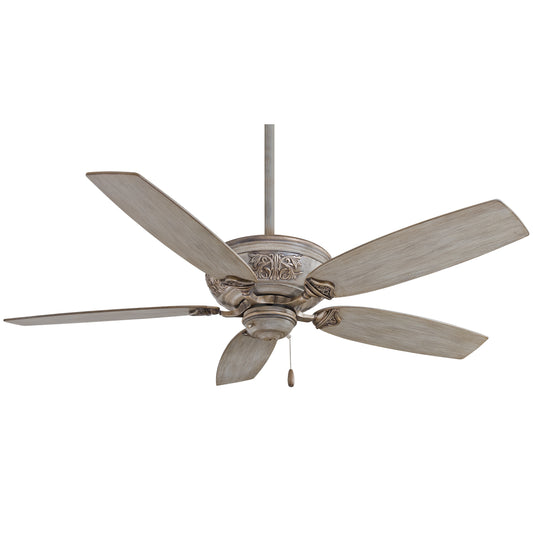

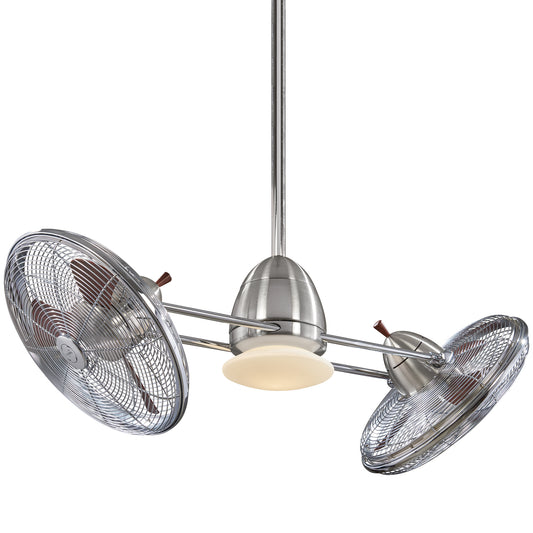

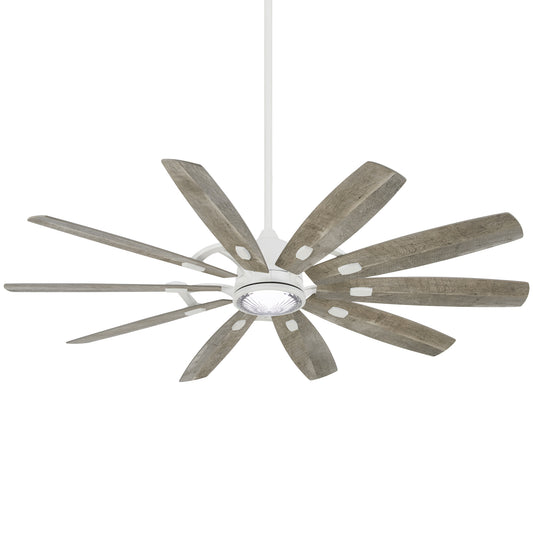

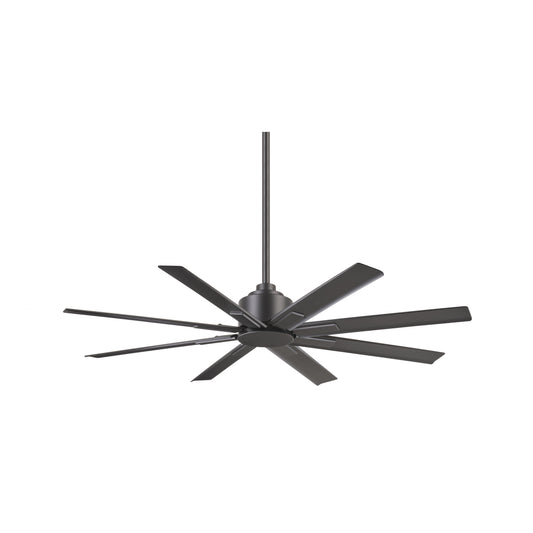







84 Inch Ceiling Fans: The Ultimate Buyer's Guide for 2026
A lot of people land on 84 inch ceiling fans after the same frustrating moment. The room is finished, the ceiling is tall, the furniture looks right, and yet the air feels dead. A standard fan spins overhead and somehow manages to be both visible and underpowered.
That’s where large-span fans start to make sense. In a great room, covered patio, loft, or commercial-style living area, the job isn’t to blast one chair with air. The job is to move a broad sheet of air across the whole space so the room feels calmer, cooler, and more comfortable.
Welcome to the World of Grand-Scale Airflow
An 84 inch ceiling fan is roughly seven feet across, but size alone doesn’t explain why it feels so different. The better way to think about it is this. A small fan often behaves like a quick handshake. A large fan acts more like a steady push across the entire room.
That distinction matters in real homes. Big rooms don’t just need more fan. They need wider air reach. The best 84 inch ceiling fans create a gentle, even wash of airflow instead of a choppy gust that hits one spot and misses the rest.

There’s a long history behind that idea. Ceiling fans became a mainstream energy-saving appliance after the 1973 oil embargo, with U.S. sales rising to 14 million units annually by the mid-1990s, driven in part by the potential to reduce cooling costs by up to 47% when used to let homeowners raise thermostat settings without sacrificing comfort, according to the Los Angeles Times archive. Today’s extra-large models are the modern version of that same logic.
If you’re comparing large formats, it helps to see where 84-inch fans sit in the broader size ladder. This quick guide to 72-inch ceiling fans is useful because it shows where a large fan is enough and where you really need to step up.
Practical rule: If a fan looks oversized in the box but balanced in the room, that’s often a sign you chose correctly for a large open space.
An 84 inch fan also changes the visual feel of a room. It stops looking like an accessory and starts acting like architecture. In the right setting, that’s a good thing. It can anchor a patio seating area, soften a vaulted living room, or make a commercial-style interior feel intentional instead of empty.
Beyond Size What Makes an 84-Inch Fan Different
The biggest misunderstanding about 84 inch ceiling fans is that people expect them to behave like scaled-up standard fans. They don’t. A well-made large fan isn’t trying to create a wind tunnel. It’s trying to move a large volume of air with less fuss.
Air reach beats air speed
Think of an 84 inch fan more like a windmill than a desk fan. The long blades sweep a much larger circle, so the fan can influence more of the room even when it isn’t spinning aggressively.
That’s why these models work so well in:
- Great rooms with wide seating zones
- Open kitchens and living areas where one fan needs to support multiple functions
- Covered patios with conversation areas spread out under a roofline
- Commercial or hospitality spaces that need broad, steady circulation
Large-span fans are also built for rooms that smaller fans struggle to fill evenly. Verified market guidance notes that 84-inch models suit spaces over 400 square feet, while 40 to 58 inch fans are suited for 75 to 175 square feet according to The Insight Partners market report. That’s a major jump in use case, not a minor upgrade.
The shape of the breeze matters
In real life, comfort comes from the feel of the airflow, not just the fact that air is moving. Some fans produce a sharp, obvious breeze directly below the motor. Others produce a smoother effect that spreads farther across the room.
A few design choices shape that feel:
| Design factor | What it changes in the room |
|---|---|
| Blade span | How much area the fan can influence |
| Blade count | The character of the airflow and visual style |
| Blade pitch | How strongly the fan pushes air |
| Motor control | How precisely you can tune comfort |
If you want a deeper look at blade count and how it affects efficiency, this piece on the impact of fan blade count and fan efficiency is worth reading.
Bigger blades usually let the fan do more work at calmer speeds. That’s why the room can feel better without the fan sounding busy.
Rule-of-thumb fit
An 84 inch fan works best when the room can visually and physically support it. Here’s the simple memory test:
- Room size: best for spaces over 400 square feet
- Ceiling height: usually best where the ceiling is high enough to hang the fan properly
- Clear sight lines: the blades need breathing room from walls, beams, and tall cabinetry
What doesn’t work? Cramming a seven-foot fan into a room that’s technically large on paper but crowded with obstacles. The fan may fit, yet the airflow will be compromised and the look can feel forced.
Sizing and Placement for Maximum Airflow
With 84 inch ceiling fans, installation geometry matters almost as much as motor quality. A strong fan mounted too high, too close to a wall, or tucked near a beam can underperform even if the spec sheet looks great.

Start with the room
The cleanest fit for an 84 inch fan is a room over 400 square feet, a use case specifically tied to large-format models in the verified product and market data cited earlier. If your layout is an expansive kitchen-living-dining area, you may also want to think in terms of activity zones rather than just square footage.
Designers working on open-plan living spaces already know this problem well. Air has to move across seating, kitchen heat, and circulation paths without feeling like the fan belongs to only one corner of the home.
Ceiling height and downrod logic
Large fans need room to breathe. Verified guidance notes that fans should sit 5 to 7 inches below minimum ceiling height for best performance in rooms with 8 to 10+ foot ceilings, and product guidance for 84-inch models shows they can work with residential ceilings when downrod selection is correct.
A short downrod can make a fan look sleek, but that doesn’t mean it will perform well. If the blades sit too close to the ceiling, the fan can’t draw and move air as effectively. It’s like asking a vacuum to work with its intake pressed against the floor.
Proper sizing matters more than style photos.
- Flat ceilings: center the fan in the active area when possible
- Vaulted ceilings: choose a downrod that drops the fan into the room, not up into the peak
- Rooms with beams or tall cabinetry: map the blade path before ordering
For a broader framework on choosing fan diameter by room, this guide on choosing the right ceiling fan size for maximum efficiency gives a solid baseline.
Reading the specs that matter
Two specs confuse buyers most often: CFM and RPM.
- CFM means cubic feet per minute. It tells you how much air the fan moves.
- RPM means revolutions per minute. It tells you how fast the motor turns.
Those aren’t the same thing. One verified example makes this clear. The Generation Lighting Aspen model reaches 300 RPM, while other 84-inch DC designs may offer 31 speed variations, and high-performance examples in this size can deliver 10,159 CFM depending on blade design and motor output, according to the Lowe’s listing for the Aspen 84-inch model.
That’s why two large fans can look similar and feel totally different.
Placement mistakes that hurt performance
A few issues show up again and again:
- The fan is too high. Air movement stays near the ceiling.
- The fan is too close to a wall or beam. The airflow gets disrupted.
- The room really needs two fans. One giant fan can’t always solve a long rectangular layout.
- The center of the ceiling isn’t the center of living activity. The room looks balanced, but the comfort lands in the wrong place.
The best placement is where people actually live, not where the electrical box happens to be.
Understanding Fan Performance and Power
Once the fan is in the right place, performance comes down to the motor, blade system, and control range. In these aspects, premium 84 inch ceiling fans separate themselves from oversized budget models.
Why DC motors dominate this category
In large fans, DC motors usually make more sense than traditional AC motors. They give finer speed control, they function with low noise, and they’re much better at matching output to actual comfort needs instead of forcing the fan into a few broad speed jumps.
One verified example shows how dramatic that can be. The Fanimation Odyn 84-inch uses a DC motor that consumes 32 watts on high while producing 10,159 CFM, and drops to 3 watts on low, according to the Palm Fan Store product listing. That same source notes that DC technology in this format can reduce electricity consumption by over 60 to 70% compared with fixed-speed alternatives.
That’s not a small spec-sheet detail. It changes how you use the fan. Homeowners tend to run a quiet, efficient fan more often because it feels easy to live with.
AC vs. DC Motors in 84-Inch Ceiling Fans
| Feature | AC Motor | DC Motor |
|---|---|---|
| Speed control | Fewer speed steps | More precise speed variation |
| Sound profile | Often more noticeable | Typically quieter in daily use |
| Energy use | Higher relative draw | More efficient operation |
| Large-fan suitability | Can work, but less refined | Usually the better fit for premium 84-inch models |
| Smart integration | More limited in feel and control | Better platform for remote and smart features |
If you’re shopping specifically for motor efficiency, this roundup of best DC motor ceiling fans helps narrow the field.
What the numbers mean in real rooms
A lot of shoppers chase the biggest airflow number they can find. That can backfire. In a residential great room, you often don’t need the fan running at maximum output all the time. What matters more is whether the fan feels smooth and controllable at everyday settings.
The verified data around 84-inch fans makes this point nicely. Residential applications often need only part of a large fan’s available capacity, while commercial lobbies or atriums may benefit from the highest output. That’s why speed range matters so much. You want headroom, not constant overkill.
Blade design changes the personality
Large fans don’t all feel alike. Blade pitch, blade width, and motor torque shape the personality of the airflow.
For example:
- A fan with a more aggressive blade geometry may feel stronger directly below.
- A fan designed for lower-speed volume can feel broader and softer.
- Multi-blade models often lean into statement style and smoother circulation.
- Sleeker three-blade designs often look more architectural and modern.
Neither approach is automatically better. It depends on the room. A minimalist loft may call for a sculptural three-blade fan. A resort-style patio may benefit from a wider visual presence and more layered airflow.
Field note: The fan that wins on paper doesn’t always win in a quiet room. If you’re installing above a seating area, noise character matters as much as peak airflow.
Safety is part of performance
A fan that isn’t mounted correctly can’t perform correctly. This is especially true with large spans. Wobble, canopy noise, and downrod movement often get blamed on the fan, but installation quality is usually the underlying issue.
Before focusing on features like lighting, app control, or finish, make sure the structure and mounting setup are ready for the load. On 84 inch ceiling fans, that’s not optional. A good motor can’t overcome a weak box, bad brace, or poor alignment.
Preparing Your Home for a Super-Sized Fan
A large fan asks more from the ceiling than most product listings admit. That’s especially true in retrofit projects where a small older fan or a basic light fixture used to hang.

The key issue is support. Verified product research notes that 84-inch fans weigh roughly 20 to 40 lbs and that their seven-foot diameter requires reinforced ceiling joist boxes rated for heavy loads, because standard boxes are not designed to handle the torque and weight safely, as summarized from the retail listing reference here.
What to check before you order
Start with the mounting location, not the finish sample.
- Fan-rated box: A light-duty fixture box isn’t enough for this category.
- Proper bracing: The load needs to be transferred into structure, not just drywall and hope.
- Adequate drop: The fan needs the right downrod length to perform and clear the room.
- Circuit confidence: Older homes sometimes need a closer look from an electrician before adding modern controls and receivers.
If you need a primer on drop lengths and fit, this guide to choosing the right downrod for fan setups is useful.
Retrofit realities
Residential retrofits and commercial retrofits are not the same job.
A residential great room often has decorative framing, limited attic access, or an existing box that was never intended for a large dynamic load. A commercial-style installation may have better structure but more demanding ceiling heights, larger open spans, and finish requirements that expose every wobble or alignment issue.
The common mistake is assuming a swap is simple because the wiring already exists. With a fan this large, the key question is whether the support system exists.
Indoor, damp, or wet rated
Location rating is part of prep work too. Buyers often mix these up.
| Rating | Best use case | What goes wrong if you choose badly |
|---|---|---|
| Indoor or dry-rated | Living rooms, bedrooms, offices | Moisture can damage finishes or materials |
| Damp-rated | Covered porches, sunrooms, humid spaces | Direct weather exposure can shorten life |
| Wet-rated | Open pergolas, exposed outdoor areas | Usually unnecessary indoors and may limit style choices |
A covered patio and an exposed pergola are not the same environment, even if both are technically “outside.” That distinction matters when the fan is a major purchase.
If the room has humidity, drifting rain, or salt air, rating should come before style.
Choosing Between Indoor and Outdoor Rated Models
Where the fan lives should decide the rating first, then the finish, then the look. That order saves a lot of frustration later.

Match the rating to the real environment
Ask yourself one practical question. Can weather or sustained moisture reach the fan?
If the answer is no, a dry-rated indoor model is usually the cleanest choice for living rooms, large bedrooms, and lofts. If the fan is under a roof but still exposed to moisture in the air, a damp-rated fan is the safer pick. If the fan is installed where rain, spray, or open-air exposure is part of normal life, step up to wet-rated construction.
That’s the part many buyers miss. “Covered” doesn’t always mean protected enough.
A quick buyer checklist
Use these questions while browsing:
- Is this space conditioned year-round? If yes, indoor may be enough.
- Does humidity linger here? A damp-rated model is often smarter.
- Can wind-blown rain or spray reach the fan? Choose wet-rated.
- Do I want a softer residential look or a more durable utility finish? Rating can narrow the design language.
Later in the buying process, it helps to see how installation choices affect performance in real homes. This video gives a useful visual overview:
Materials matter more outdoors
Outdoor-rated large fans are built around survival as much as style. The hardware, finish, and blade material all need to handle moisture swings better than a dry-rated indoor fan would.
A big outdoor fan also tends to work hard for long stretches. On a covered patio or lanai, it may run through humid afternoons, evening meals, and weekend gatherings. That’s why the right rating isn’t a technicality. It’s what keeps the fan looking good and operating reliably.
The Ultimate Buyer's Checklist for Your 84-Inch Fan
This is the simple filter that keeps a large-fan purchase on track. If you can answer these questions clearly, you’ll avoid most of the common mistakes.
Ask these before you buy
- Is the room large enough? An 84 inch fan belongs in a broad space. If the room is borderline, compare it against a smaller large-format fan instead of forcing the biggest option.
-
Is the ceiling high enough to hang it correctly?
Large blades need space above and below. A fan mounted too tight to the ceiling loses part of what makes it effective. -
Is the mounting point ready for the load?
Don’t assume an older ceiling box can handle a large-span fan just because a smaller unit was there before. -
Is the rating right for the environment?
Indoor, damp, and wet ratings are about longevity and safety, not just labels. -
Does the motor match how you’ll use the fan?
For most shoppers in this category, DC is the smarter choice because it gives a wider comfort range and better control.
Smart controls and ROI
Large fans are increasingly part of a broader home system, not a standalone appliance. Verified retail analysis notes that modern 84-inch fans with DC motors can deliver 200 to 300 CFM per watt, and that emerging Matter/Thread protocols in 2026 may enable an additional 20% in energy savings through better automation, according to the Lowe’s Breezary listing reference.
For tech-forward buyers, that means the fan may do more than cool the room. It can become part of routines, occupancy behavior, or property-management controls.
Style still matters
Performance gets the fan shortlisted. Style gets it installed with confidence.
A few examples of what buyers often gravitate toward in the over-$300 category:
- Artemis XL5 for a sculptural, design-driven look
- Aviation for an industrial statement
- Andros and Anywhere styles for large indoor-outdoor applications
- 6+ blade designs when you want visual presence and a fuller silhouette
- 3-blade modern fans when the architecture needs something cleaner
Common post-purchase questions
A few practical concerns often show up after checkout:
| Question | Straight answer |
|---|---|
| Should I run the fan all day? | If the fan is efficient and the room is occupied often, many owners do. |
| Can a big fan replace AC? | Usually no. It improves comfort and airflow, but it doesn’t cool air the way AC does. |
| Is some movement normal after install? | Slight movement can happen. Noticeable wobble means something should be checked. |
| Do smart features matter? | They do if you value schedules, scene control, or efficient day-to-day operation. |
Buy the fan for the room you actually have, not the photo you liked online.
Frequently Asked Questions About 84-Inch Fans
How much does it cost to run an 84 inch DC motor fan?
It depends on the specific model and the speed you use most. What matters is that a strong DC example in this category can be remarkably efficient. As noted earlier, one verified 84-inch DC fan uses 32 watts on high and 3 watts on low, which is a useful reminder that speed setting matters a lot in real operating cost.
Can I use a wall dimmer with a large ceiling fan?
Use the control type the fan is designed for. Fan motors and light dimmers are not interchangeable. If the fan includes a DC receiver, use the matching control system or approved smart integration. This is one of those details that seems minor until it causes erratic behavior.
How do I clean blades that are high above the floor?
Routine cleaning matters more on big fans because the blade surface area is larger. For practical methods, this guide on how to clean ceiling fans is particularly useful, especially if your fan is installed in a tall room where access is awkward.
What does wobble mean on a new installation?
A little motion can be normal. Pronounced wobble usually points to installation or balancing, not a defective fan. Check for uneven blade attachment, an improperly seated downrod, loose hardware, or a mounting issue. On a large fan, those small errors are easier to see because the blade span is so wide.
Are 84 inch ceiling fans too big for homes?
Not at all, if the room is large enough and the ceiling height supports the installation. In a properly scaled great room, a large covered patio, or a vaulted open living area, an 84 inch fan often looks more natural than a smaller fan that seems to disappear overhead while failing to move enough air.
If you're ready to compare large, design-forward models in one place, Fan Connection makes it easy to browse 84 inch ceiling fans by style, blade count, and application. It’s a practical place to shop if you want options like Artemis XL5, Aviation, Andros, Tropical styles, and other large-format fans priced above $300 with clear product organization and straightforward checkout.


