











Finding the Best Ceiling Fans for High Ceilings
When you're dealing with a soaring, cathedral-style ceiling, not just any fan will do. It’s like bringing a knife to a sword fight! The best ceiling fans for high ceilings are the ones with some serious muscle: think powerful DC motors, expansive blade spans over 60 inches, and the right downrod to bring the fan down to where you can actually feel it.
For these grand spaces, a premium model—often priced over $300—isn't just a luxury; it's a necessity. You're investing in the performance needed to truly conquer the vertical space, keeping you outrageously comfortable and making the room look like a million bucks.
Why Your High Ceiling Needs a Specialized Fan
If you've ever walked into a room with a high ceiling and immediately hit a wall of stuffy, stagnant air, you know the problem firsthand. It’s like the room is holding its breath. That huge volume of air is just too much for a standard ceiling fan to handle. It spins and spins, but it's just not powerful enough to create the kind of airflow you need for real comfort.
This is where fans designed specifically for high ceilings earn their keep. They aren't just scaled-up versions of regular fans; they’re engineered from the ground up to conquer the unique challenges of all that vertical space. They are the superheroes of air circulation.
The Science of Comfort in Tall Rooms
It helps to think of the air in your great room like layers in a cake. Because it's less dense, warm air naturally rises and gets trapped up by the ceiling. Down below where you're living, the cooler, denser air settles near the floor. A standard fan just can't break through and mix those layers, which is why you can feel chilly in the winter and too warm in the summer, even with the HVAC running full blast.
A high-performance fan, on the other hand, is a master air circulator. In the summer, its powerful downdraft creates a refreshing breeze that makes the room feel several degrees cooler. Come winter, you just reverse the fan's direction. It will then gently push all that trapped warm air back down into the living space, making the whole room feel cozier. It’s a year-round comfort machine!
This constant air mixing does more than just make you feel comfortable; it makes your home more efficient. By helping your heating and cooling systems maintain a consistent temperature, the right fan can lead to significant energy savings.
By taking the strain off your HVAC system, a high-ceiling fan becomes a key player in building an energy-efficient smart home that actually saves you money month after month.
Beyond Basic Airflow
Getting this right involves more than just picking a fan with a big motor. A few key factors have to work together perfectly to deliver the performance you need:
- Downrod Length: This is, without a doubt, the most critical piece. The downrod drops the fan down to the ideal height for moving air, which is typically 8-9 feet from the floor.
- Blade Span: It’s simple physics—a larger blade span moves a bigger column of air. That’s essential for covering a spacious room.
- Motor Power: A robust motor, especially a modern DC motor, gives you the torque needed to spin those long blades efficiently and almost silently.
- Smart Technology: With a fan mounted so high up, you don't want to be messing with pull chains. Remote or app controls are a must-have for convenience and fine-tuning.
This guide is your roadmap. We’ll cut through the confusion and give you a clear path to choosing a fan that not only looks incredible but completely transforms how your space feels.
To get you started, here’s a quick-reference table that lays out the key specs you’ll need to consider based on your ceiling height.
High Ceiling Fan Quick Reference Guide
| Ceiling Height | Recommended Downrod Length | Ideal Blade Span | Target CFM Range |
|---|---|---|---|
| 10-11 feet | 18"-24" | 52"-60" | 4,000-6,000 CFM |
| 12-13 feet | 24"-36" | 60"-72" | 5,000-8,000 CFM |
| 14-15 feet | 36"-48" | 60"-84" | 6,000-10,000 CFM |
| 16 feet & up | 48"-72" or more | 72" or larger | 8,000+ CFM |
This chart gives you a solid baseline for the key numbers to look for as you start shopping. Matching these specs will ensure your new fan has the power and reach to make your high-ceilinged room comfortable all year round.
Understanding Airflow in Large Spaces
Before you even start looking at different fan styles, let's get into what makes a room with a high ceiling so different. Picture a grand living room with a 15-foot ceiling. It’s like a tall glass of water—if you don't stir it, the water at the top and bottom will never be the same temperature. The air in your room behaves the exact same way.
Warm air is lighter, so it naturally rises and hangs out near the ceiling, creating a toasty layer way up high. At the same time, the cooler, heavier air sinks and settles right where you live, work, and relax. A standard ceiling fan just doesn't have the oomph to reach all the way up and mix those two layers together.
This phenomenon is called thermal stratification, and it's the number one enemy of comfort in homes with high ceilings. It’s the reason you might feel a chill downstairs in the winter even when the heat is on—all that cozy, expensive warmth is having a party near the ceiling!
Demystifying CFM: The Fan's Superpower
To beat thermal stratification, you need a fan with some serious muscle. The most important number to look for here is CFM, which stands for Cubic Feet per Minute. Don't let the technical name fool you; it’s just a simple measurement of how much air a fan can move in one minute.
Think of CFM as a fan's lung capacity. A fan with a low CFM is like someone taking shallow little breaths—it’s not moving much air. But a fan with a high CFM takes deep, powerful breaths, creating a strong column of air that can travel all the way from a high ceiling down to the floor where you can feel it.
For the best ceiling fans for high ceilings, a high CFM isn't just a nice-to-have feature; it's the whole point. A rating of 6,000 CFM or higher is what you’ll need to really get the air moving in a large, tall space.
This powerful airflow is what lets the fan act like a giant spoon, mixing the hot and cold air layers until you have one uniform, comfortable temperature throughout the room. Installing a high-CFM fan is a smart step toward better energy efficient home design principles, giving you total climate control while cutting down on energy waste.
Why Airflow Matters Year-Round
The real beauty of a powerful, high-CFM fan is that it works for you all year long. Its job changes with the seasons, but it’s always essential.
-
Summer Downdraft Mode: In the warmer months, you'll set your fan to spin counter-clockwise. This pushes a column of cool air straight down, creating a wind-chill effect on your skin that can make a room feel up to 8 degrees cooler. It’s like having your own personal breeze on demand.
-
Winter Updraft Mode: When it gets cold, just reverse the fan to spin clockwise. In this mode, the fan pulls cool air up from the floor. This forces the warm air trapped at the ceiling to gently move out toward the walls and back down into the room. This process, called destratification, can help you cut your heating costs by up to 15%.
Once you understand the power of CFM and how a fan works in both summer and winter, you can see why choosing a fan based on performance is so critical for large spaces. For more tips on matching a fan to your room's specific dimensions, check out our complete ceiling fan size guide. This is the key to picking a fan that doesn't just look good—it completely transforms the comfort and efficiency of your home.
Calculating Your Downrod and Blade Span
Alright, let's get down to the brass tacks and talk numbers. When you're dealing with high ceilings, two measurements are absolutely non-negotiable: the downrod length and the blade span. Getting these right is the difference between a fan that actually cools your room and one that just spins for show.
Think of the downrod as the fan's lifeline. It’s the pipe that drops the fan down from the ceiling into the "sweet spot" of the room. This zone is typically between 8 and 9 feet from the floor—the perfect height for the fan to move air effectively. Mounting a fan right up against a 15-foot ceiling is like trying to whisper across a football field; the effect just gets lost.
The blade span, on the other hand, is all about coverage. It's the full diameter of the fan, from one blade tip to the opposite one. The bigger the room, the wider the blade span you'll need to create a column of air that reaches every corner.
Finding Your Perfect Downrod Length
Figuring out the right downrod length is actually pretty simple. The goal is to get those fan blades hanging about 8 to 9 feet off the floor. Grab a tape measure and start with your ceiling height.
Let's imagine your great room has a soaring 15-foot ceiling. To hit that ideal 9-foot mark, you just subtract 9 feet from your 15-foot ceiling height. You're left with 6 feet, or 72 inches. That means you need a 72-inch downrod to position your fan perfectly.
The Downrod Formula:
(Your Ceiling Height in Feet) - (Ideal Fan Height, 8 or 9 Feet) = Required Downrod Length in Feet
Don't forget to convert the answer to inches by multiplying by 12.
For a deeper dive into picking the right length and navigating installation, our guide on how to choose a downrod for your fan has all the details you need.
Matching Blade Span to Room Size
Next up is blade span, and this one is all about your room's square footage. A small fan in a huge room is going to struggle, leaving the air weak and the corners stuffy. On the flip side, an enormous fan in a small room can feel like a wind tunnel.
To find your room's square footage, just multiply its length by its width. For instance, a living room that’s 20 feet by 20 feet is 400 square feet.
Here’s a quick cheat sheet for matching blade span to room size:
- Medium Rooms (up to 175 sq ft): A 42-48 inch blade span is a great fit.
- Large Rooms (175 - 350 sq ft): Look for fans in the 52-60 inch range.
- Great Rooms (over 350 sq ft): You’ll need an extra-large fan, 60 inches or more.
For our 400-square-foot room, a fan with at least a 60-inch blade span would be the right call to get that powerful, even airflow.
Why Blade Pitch Is Your Secret Weapon
Last but not least, don't forget about blade pitch. This is simply the angle of the blades, measured in degrees. Think of it like this: the steeper the angle, the more aggressively the blades "scoop" the air. A fan with flat blades might look modern, but it won't move much air.
For high ceilings, you really want a blade pitch between 12 and 16 degrees. This sharper angle lets the blades grab and push a serious amount of air downward, which is exactly what you need to feel a breeze from 10 or 15 feet below. A quality fan—especially one over $300—will almost always have an optimal blade pitch designed for real performance, ensuring it works as good as it looks.
Poor airflow, often caused by the wrong fan specs, is what leads to those frustrating hot and cold spots in homes with high ceilings.
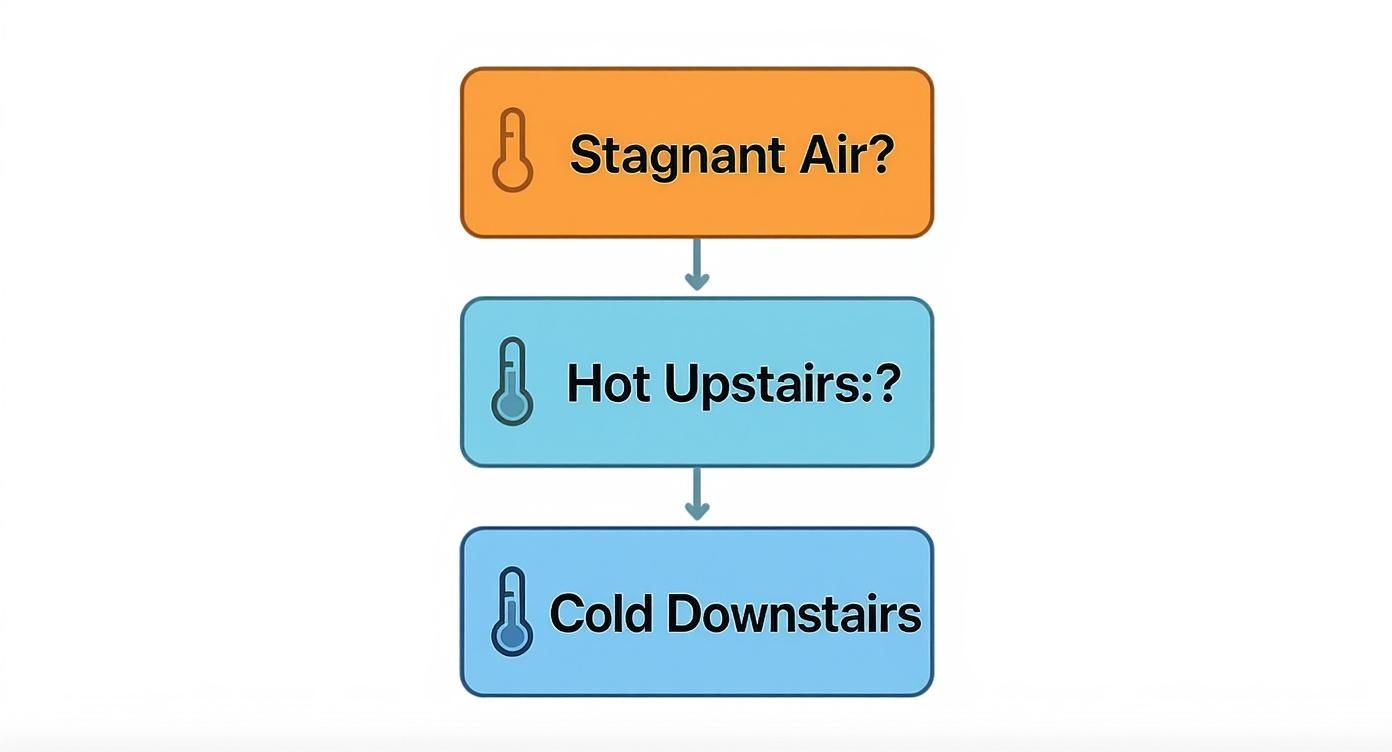
By taking the time to calculate your downrod and blade span correctly, you can solve these common issues and create a home that feels comfortable from top to bottom.
Choosing a Powerful Motor and Smart Controls
If the downrod and blades are the skeleton of your fan, the motor is its heart. For a fan expected to move a massive column of air from a high ceiling, a weak motor just won’t cut it. This brings you to one of the most important decisions you'll make: choosing between an AC (Alternating Current) and a DC (Direct Current) motor.
Think of it like a car's transmission. An AC motor is like an old-school manual transmission with just a few set speeds—low, medium, and high. It’s reliable, sure, but it isn't very precise and can be a bit noisy when shifting gears.
A DC motor, on the other hand, is the smooth, modern automatic transmission of the fan world. It offers a huge range of speeds for incredibly fine-tuned adjustments, which is exactly why we strongly recommend DC motors for high ceilings.
The Clear Advantages of DC Motors
DC motors have become the gold standard for any quality fan, especially those priced at $300 and up. The benefits they offer are perfectly suited for the demands of a great room or vaulted space.
- Whisper-Quiet Operation: DC motors are virtually silent. All you'll hear is the gentle whoosh of air, not a distracting mechanical hum.
- Superior Energy Efficiency: These motors are incredibly efficient, using up to 70% less energy than their AC cousins. That means real savings on your electricity bill.
- Precision Control: With six or more speed settings, DC motors give you exact control over airflow, from a barely-there stir to a powerful breeze.
This level of performance is fueling huge growth in the ceiling fan market. Valued at roughly USD 14.6 billion, the market is expected to grow by 8.1% annually through 2035, largely because people want energy-saving cooling solutions. High ceilings, in particular, demand fans with powerful motors and advanced features, a trend we see growing every day. You can read more about these market projections to see how technology is shaping the industry.
To see some of the best models in action, check out our guide to the best DC motor ceiling fans on the market.
Why Smart Controls Are Essential
Now, let's talk about controlling this thing. When your fan is mounted 15 feet in the air, climbing a ladder to yank a pull chain every time you want to change the speed is simply not an option. For high ceiling fans, modern smart controls aren't just a nice-to-have feature; they're an absolute necessity.
Gone are the days of the simple pull chain. Today’s best fans offer a whole suite of control options that make them an integrated part of your home.
Smart controls transform your ceiling fan from a standalone fixture into a responsive element of your home's ecosystem. They offer a level of convenience and customization that's essential for a fan mounted far out of reach.
Imagine adjusting the fan speed with a simple voice command or scheduling it to turn on a few minutes before you get home. These features make comfort effortless.
Modern Control Options
When you're shopping for a fan, keep an eye out for these must-have control features:
- Handheld Remotes: This is the most common option. A good remote gives you control over speed, direction (for summer and winter modes), and any built-in lights.
- Wall-Mounted Control Panels: A sleek wall panel offers a permanent, easy-to-access control point. No more hunting for a misplaced remote.
- Wi-Fi and App Integration: This is the ultimate in convenience. Wi-Fi-enabled fans connect to your home network, letting you control them from anywhere with a smartphone app. You can set schedules, adjust speeds, and even integrate them with systems like Alexa or Google Assistant for voice control.
By pairing a powerful DC motor with intuitive smart controls, you're making sure your high ceiling fan isn't just effective, but a genuine pleasure to use.
Matching Style with Special Requirements
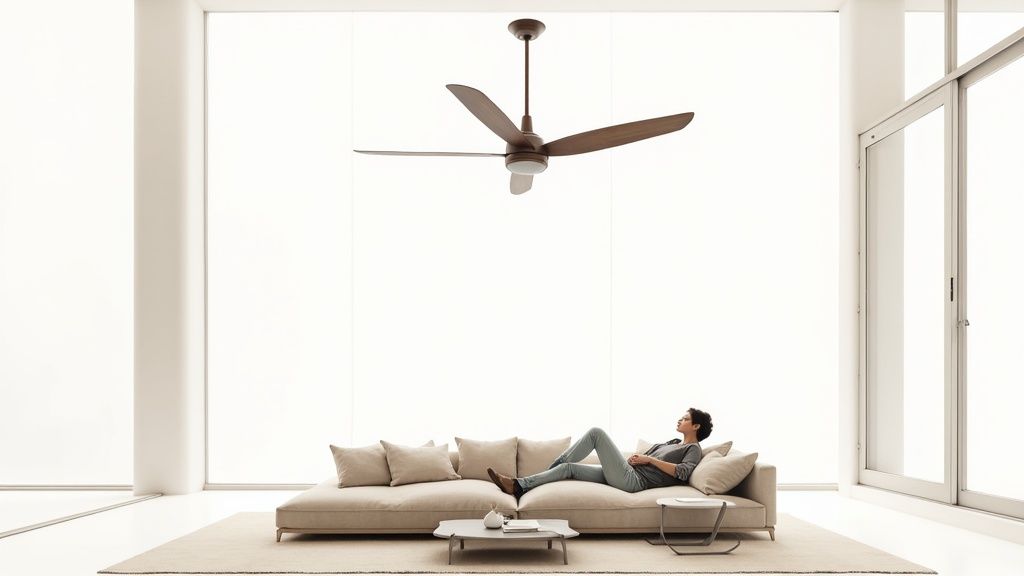
A huge fan in a grand room with a soaring ceiling is more than just an appliance—it’s a statement piece. This is your chance to tie the whole room together, turning a functional necessity into a stunning focal point. Finding a fan that complements your decor is the key to creating a space that feels cohesive and thoughtfully designed.
Whether your space is a sleek industrial loft or a cozy great room with rustic timber beams, there’s a premium fan out there for you. Modern designs often feature clean lines and minimalist blades, while rustic models might show off distressed wood or warm metallic finishes. The goal is simple: choose a fan that feels like it truly belongs in your room.
Lighting Up Your Lofty Space
Beyond just moving air, many of the best ceiling fans for high ceilings come with integrated lighting. This is a massive advantage in large rooms where a single overhead light just won't cut it. Modern LED light kits have completely changed the game, offering way more than a simple bulb.
Look for fans with features that let you dial in the perfect ambiance:
- Adjustable Brightness: Dimmable LEDs let you go from bright, get-things-done light to a soft, ambient glow with the touch of a button.
- Color Temperature Control: This fantastic feature lets you switch between warm, cozy light (around 2700K) for relaxing evenings and cool, crisp light (around 5000K) for a more energetic feel during the day.
Having this kind of control is a must-have for a multi-functional space like a great room, ensuring the mood always matches the moment.
Tackling Tricky Ceilings
Now for the technical stuff. Not all ceilings are flat, and high ceilings often come with their own challenges, like slopes and vaults. Before you fall in love with a fan's style, you need to be certain it can be installed safely and correctly in your space.
If you have a sloped or vaulted ceiling, checking the fan’s compatibility is non-negotiable. Most high-quality fans will specify a maximum slope angle they can handle, often up to 30 degrees. For anything steeper, you’ll probably need to buy a special sloped ceiling adapter or angled mounting kit. This piece of hardware ensures the fan hangs perfectly straight, preventing wobbling and putting unnecessary stress on the motor.
Don't skip this step! An improperly mounted fan isn't just wobbly and loud—it's a serious safety hazard. Always double-check that the fan and its mounting hardware are rated for your ceiling's specific angle.
Fans for Every Environment: Damp and Wet Ratings
The need for great air circulation isn't just for indoor living rooms. Large covered patios, expansive lanais, and even grand bathrooms with high ceilings can all benefit from a well-chosen fan. But you can't just install any old fan in these areas; you need one built to handle the elements. This is where damp and wet ratings come in.
- Damp-Rated Fans: These are perfect for covered outdoor spaces like patios or screened-in porches. They’re built with materials that can stand up to humidity and moisture but aren't meant to be exposed to direct rain.
- Wet-Rated Fans: For areas that will get hit with rain, like a pergola or an uncovered deck, a wet-rated fan is essential. These are tough customers, constructed with all-weather blades and sealed, water-resistant motors.
The demand for durable, high-performance fans is growing everywhere. Take the ceiling fan market in the GCC region—known for its high ceilings and tough climates—which was valued at USD 526.4 million. It's projected to climb to USD 904.6 million by 2033, all driven by a need for premium, tech-savvy fans that can handle local conditions. You can discover more about this market growth on IMARC Group. By choosing a fan with the right rating, you extend comfort and style to every part of your home, inside and out.
Your High Ceiling Fan Buying Checklist
Alright, let's put it all together. You've gotten the crash course on CFM, downrods, and motor types, so now it’s time to turn that knowledge into a smart purchase. Think of this checklist as your secret weapon for shopping—it breaks down the key decisions so you can pick the perfect fan for your high ceilings with total confidence.
Before you even start looking at styles, grab a tape measure. These three numbers are the foundation for getting it right.
- Ceiling Height: Measure straight from the floor to the ceiling in feet.
- Room Dimensions: Jot down the length and width of the room so you can figure out the square footage (Length x Width).
- Ceiling Angle: If you’ve got a sloped or vaulted ceiling, you'll need to know the angle in degrees.
The Actionable Checklist
With your room's measurements in hand, just walk through these five essential checkpoints. This little process ensures you nail the performance, fit, and style, leading you straight to a fan that will actually feel amazing in your grand space.
-
Calculate Your Downrod Length: You're aiming to hang the fan so the blades are about 8-9 feet from the floor. The simple formula is:
(Ceiling Height in Feet) - 9 = Downrod Length in Feet. Just don't forget to multiply that number by 12 to get the length in inches. -
Determine Your Blade Span: Match the fan's diameter to your room's size. For big great rooms over 350 sq. ft., a blade span of 60 inches or more is non-negotiable. Anything smaller just won't cut it.
-
Set Your CFM Target: Don't get stuck with a fan that looks good but barely moves any air. For high ceilings, you need power. Look for a fan with a rating of at least 6,000 CFM. If your ceilings are over 15 feet high, you really should be aiming for 8,000+ CFM.
-
Insist on a DC Motor: Seriously, for a space like this, a DC motor is the only way to go. They're whisper-quiet, incredibly energy-efficient, and give you the precise speed control you need to manage airflow in a large-volume room.
-
Confirm Any Special Requirements: Do you need a damp or wet-rated fan for a covered patio? A sloped ceiling adapter for that vaulted living room? How about an integrated, dimmable LED light? Make a final call on these must-have features.
Recommended Collections for High Ceilings
To give you a head start, here are a couple of Fan Connection collections that are perfectly suited for high ceilings. These are premium models that deliver on both the power and the looks.
Scenario 1: The Modern Loft (450 sq. ft. room, 16-foot flat ceiling)
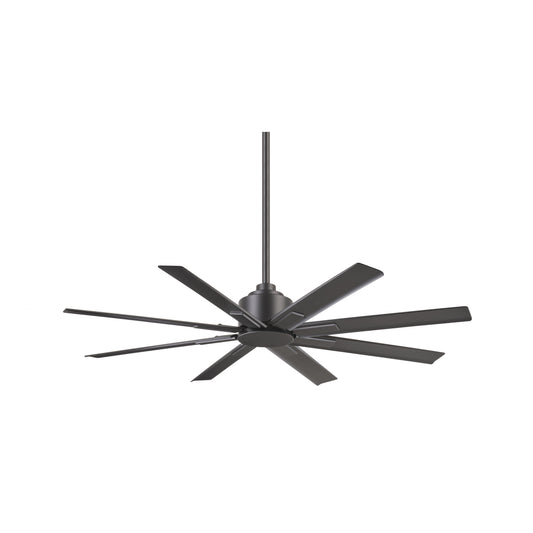
- Recommendation: The Aviation Collection 70" Fan. Priced at $489.95, this powerhouse fan is known for its formidable DC motor and sleek, expansive blades literally designed to move massive amounts of air. It’s the perfect blend of industrial cool and raw performance.
- Configuration: Pair this 70-inch fan with a 72-inch downrod. This will position it perfectly at 9 feet above the floor for ideal airflow and a breathtaking look.
Scenario 2: The Rustic Great Room (400 sq. ft. room, 14-foot sloped ceiling)
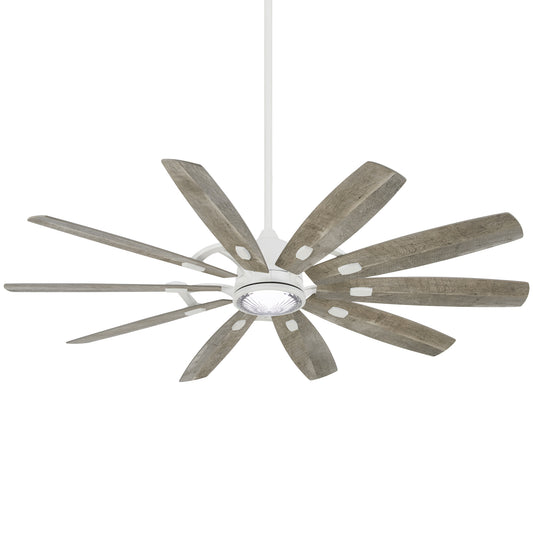
- Recommendation: The Barn Collection 60" Fan. At $389.95, this fan delivers that coveted rustic look without compromising on modern performance. It's built with robust features and is ready to tackle sloped ceilings.
- Configuration: A 60-inch Barn fan with a 60-inch downrod and a sloped ceiling adapter kit. This setup ensures a secure, level installation and keeps the air moving just right, blending seamlessly with your rustic decor.
Got Questions About High Ceiling Fans?
Choosing the right fan for a grand space can feel a little daunting, but it doesn't have to be. Let's clear up some of the most common questions we hear, so you can pick your fan with total confidence.
Can I Just Put a Long Downrod on a Regular Fan?
It seems like a simple hack, right? Unfortunately, it's not a great idea. The motors in standard fans just aren't built to handle the extra strain and torque needed to spin long blades effectively from way up high.
Trying to make it work often leads to a wobbly, unstable fan, weak airflow, and a motor that burns out way too soon. The best ceiling fans for high ceilings are designed as a complete system, pairing a powerful, heavy-duty motor with the right downrod for stable, reliable performance for years to come.
Do More Blades Mean More Airflow?
This is one of the biggest myths out there. In reality, the number of blades has more to do with style and noise level than raw cooling power.
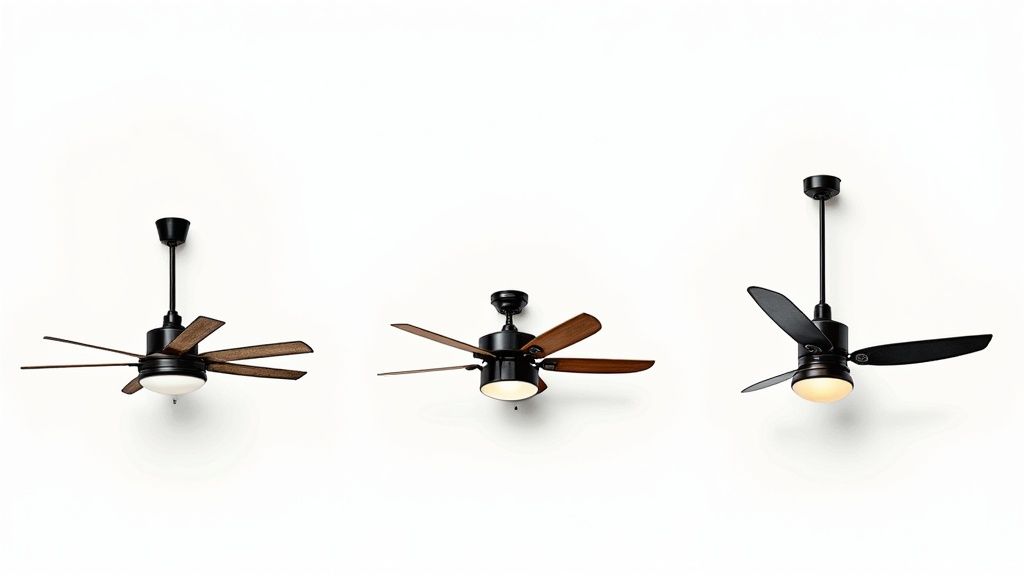
Fans with fewer blades—usually three—often move air more efficiently and create a zippier breeze because they have less drag. On the other hand, fans with five or more blades tend to be quieter, delivering a gentler, more consistent airflow. When you're dealing with a high ceiling, your focus should be on a high CFM rating and a brawny motor, not just the blade count.
A fan's real power comes from its motor, blade pitch, and overall design—not just how many blades it has.
How High Should a Ceiling Fan Be Hung?
For the best possible air circulation, you want the fan's blades to hang somewhere between 8 and 9 feet from the floor. This is the sweet spot that allows the fan to create a comfortable breeze without getting in the way.
To hit that target in a room with tall ceilings, the downrod is your key. For instance, if your ceiling is 15 feet high, a 6-foot (72-inch) downrod will put the fan right in that perfect 8-to-9-foot zone.
Ready to find the perfect fan to transform your grand space? Explore the curated collections at Fan Connection and discover premium, high-performance models designed to conquer any ceiling height.


