







The Ultimate Guide to the Best Ceiling Fans for Kitchens
Let's face it, your kitchen is the heart of your home—and it gets hot in there! To keep your culinary command center from turning into a sauna, you need one of the best ceiling fans for kitchens. The secret? Look for models that are damp-rated to handle humidity, have easy-to-clean blades made from materials like ABS plastic, and run on a whisper-quiet, efficient DC motor. Top-tier options like the stunning Kichler Starkk ($374.97) deliver the serious airflow (CFM) you need to banish heat and cooking smells, making it a brilliant investment for any busy kitchen.
Why a Great Ceiling Fan Belongs in Your Kitchen
Picture this: one kitchen is stuffy and humid, still thick with the smell of last night’s fish tacos. The other is fresh, airy, and inviting. What’s the difference? A fantastic ceiling fan. It's more than just an appliance; it's an essential tool for turning your kitchen into a place you actually want to be.
A well-chosen fan is the unsung hero of the busiest room in the house. It works quietly in the background to improve air circulation, whisking away steam from a boiling pot or dissipating smoke from a sizzling skillet. This constant air movement doesn't just make the room feel better—it also seriously cuts down on how much you rely on your power-hungry air conditioner.
More Than Just a Breeze
Kitchen fans have come a long way. They’ve transformed from purely functional fixtures into stylish centerpieces that can define the look of your entire space. Whether your kitchen is sleek and modern or has a cozy, rustic vibe, there's a fan out there designed to perfectly match your decor.
This shift is a big deal. The global ceiling fan market was valued at an impressive $11.83 billion in 2025 and is expected to climb to $17.98 billion by 2034. That growth is all about homeowners wanting both style and efficiency. Studies have even shown that a ceiling fan can slash air conditioning needs by up to 30-40%, which means real savings on your energy bills.
The Foundation of a Comfortable Kitchen
Putting one of the best ceiling fans in your kitchen is about prioritizing a few key things that will keep you happy for years to come.
- Better Air Quality: It keeps the air moving, so you don't get those stagnant pockets where cooking odors and heat love to hang out.
- Year-Round Comfort: Most modern fans have reversible motors. In the winter, you can flip the switch to push warm air down, making your kitchen feel cozier without ever touching the thermostat.
- Improved Safety: By clearing out steam and smoke, a fan helps you see what you're doing and reduces that slick, greasy buildup on your cabinets and floors.
A great kitchen fan doesn't just cool you down; it creates a more pleasant and functional environment for cooking, dining, and gathering. It’s a foundational piece that combines powerful performance with sophisticated design to elevate your entire cooking experience.
This guide will walk you through exactly how to choose the perfect fan that ticks all these boxes. For a deeper dive into the all-around perks of adding a fan to your home, check out our article on the breezy benefits of having a ceiling fan.
Understanding Fan Performance: Sizing, CFM, and Motors
Choosing the perfect kitchen fan goes way beyond just picking a style you like. To get the performance you actually need, you have to look under the hood—just like you would with a car. It's the technical specs that determine whether a fan can really handle the heat, steam, and cooking smells of a busy kitchen.
What Is CFM and Why Does It Matter?
The first spec you’ll run into is CFM, or Cubic Feet per Minute. Don't let the acronym scare you off. Think of it as a measure of the fan's "lung capacity"—it tells you exactly how much air the fan can move in one minute.
A higher CFM number means more power. More power means the fan can quickly whisk away the steam from a boiling pot of pasta, clear out lingering smells from last night's fish tacos, and circulate cool air to keep you comfortable. It's the single most important number for judging a fan's raw performance. For a deeper dive, check out this guide on Understanding CFM.
Matching Fan Size to Your Kitchen
Once you’ve got a handle on CFM, the next piece of the puzzle is matching the fan’s blade span to the size of your kitchen. It’s a bit of a "Goldilocks" situation: a fan that’s too small will just spin its blades without making a real difference, while a fan that’s too big can turn your cozy kitchen into a wind tunnel.
For most standard kitchens, a fan with a blade span between 44 and 52 inches is the sweet spot. It's powerful enough to move a serious amount of air but still compact enough to fit comfortably above an island or in the center of the room.
To help you find the right fit, here’s a quick sizing chart. Just match your kitchen's square footage to the recommended blade span.
Kitchen Ceiling Fan Sizing Guide
| Kitchen Size (Square Feet) | Recommended Blade Span (Inches) | Example Premium Model |
|---|---|---|
| Up to 75 sq. ft. | 29 - 36 inches | The Clarke ($359.99) |
| 76 - 144 sq. ft. | 36 - 44 inches | The Aviation ($578.00) |
| 145 - 225 sq. ft. | 44 - 52 inches | Kichler Starkk ($374.97) |
| 225 - 400 sq. ft. | 52 - 60 inches | The Aerovon ($438.00) |
Getting the sizing right is a huge step toward a more comfortable cooking space. If you want to dig deeper, our full guide on choosing the right ceiling fan size for maximum efficiency has even more detail.
This little decision tree can also help you figure out if a fan is the right move for your kitchen's comfort issues.
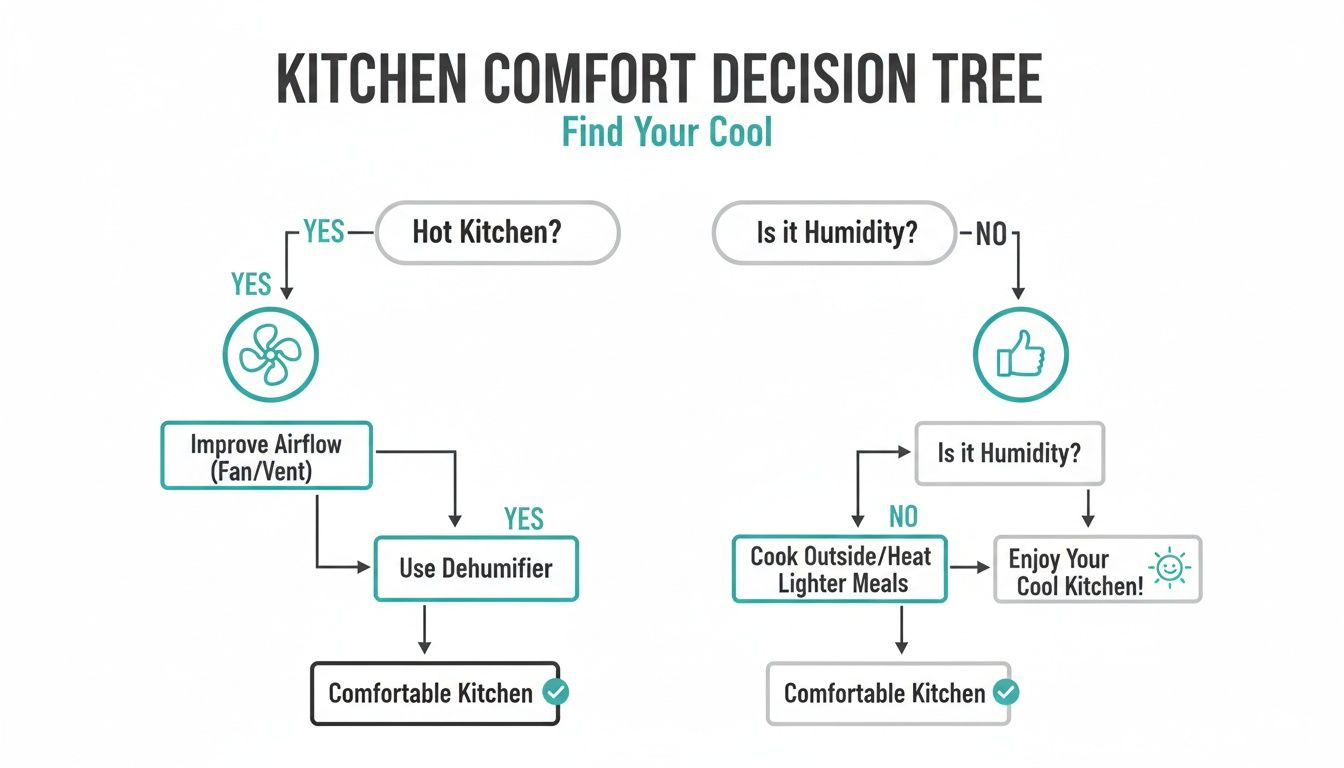
As you can see, if heat is your main problem, a ceiling fan is one of the most direct and effective solutions you can choose.
The Engine Behind the Blades: AC vs. DC Motors
Now, let's talk about what actually makes the blades spin: the motor. Ceiling fans generally come with one of two types—Alternating Current (AC) or Direct Current (DC). For decades, AC motors were the standard, but today, DC motors are the clear winner for a modern kitchen.
AC motors are the old workhorses. They're reliable, but they usually only offer three speeds (low, medium, high) and can sometimes produce that familiar, annoying hum. DC motors, on the other hand, are the high-performance engines of the fan world.
DC motors are now the gold standard for any quality kitchen fan. They run almost silently, give you way more speed options (often six or more), and are drastically more energy-efficient than their AC cousins.
That whisper-quiet operation is a game-changer, especially in open-concept homes where kitchen noise can easily spill over into the living room.
The global ceiling fan market, which topped $11.2 billion in 2024, is shifting fast toward these energy-saving models. With an estimated 75% of U.S. households renovating recently, more people are choosing smarter, more efficient appliances. A brushless DC (BLDC) motor can use 50-70% less power than an old-school AC fan. Premium models often run at a barely-audible 35 dB, and the energy savings can add up to $200 a year on cooling costs.
When you invest in a fan with the right CFM, size, and a powerful DC motor, you're not just buying an appliance. You're guaranteeing your kitchen will be a comfortable, inviting space for years to come.
Choosing Materials Built for Kitchen Environments
Your kitchen is probably the hardest-working room in your house. It’s a constant whirlwind of steam from boiling pots, grease splattering from a hot pan, and temperatures that swing up and down. These conditions can wreak havoc on normal home fixtures, and a ceiling fan is no exception.
When you're picking out a ceiling fan for your kitchen, the materials and construction aren't just minor details—they're your first line of defense against the daily grind.
You wouldn't wear suede shoes to walk through a muddy field, right? The same logic applies here. Putting a standard "dry-rated" fan—the kind you’d find in a bedroom or living room—into a humid, greasy kitchen is asking for trouble. It’s just not built for the job.
This is why understanding fan ratings is so important. These ratings aren't just jargon; they tell you exactly what kind of environment a fan is designed to handle.
Understanding Dry vs. Damp Ratings
Ceiling fans are generally sorted into three categories based on how well they stand up to moisture. Getting this right is the difference between a fan that lasts for years and one that fails in months.
- Dry-Rated Fans: These are your everyday indoor fans, perfect for bedrooms, living rooms, and hallways. They can't handle any moisture or condensation. If they get damp, you’ll end up with rusted parts, a warped motor housing, or droopy blades made from materials like MDF (medium-density fiberboard).
- Damp-Rated Fans: This is the absolute minimum requirement for a kitchen ceiling fan. These fans are specifically constructed to handle humidity and moisture in the air, though they aren't meant for direct contact with water. Their motors are sealed to stop corrosion, and the blades are made from tough, moisture-resistant materials like treated wood or ABS plastic.
- Wet-Rated Fans: These are the heavy-hitters, built for the outdoors on patios or pergolas where they might get hit with rain. While a wet-rated fan would work in a kitchen, a damp-rated one is usually more than enough and often comes in a wider variety of styles.
Think about it: every time you boil pasta, wash dishes in a steamy sink, or just cook on a humid day, you’re creating a damp environment. A damp-rated fan is your guarantee that this everyday moisture won't cut its life short.
Blade Materials That Go the Distance
The blades on a kitchen fan take a serious beating. They’re constantly exposed to airborne grease, steam, and heat, which can cause standard blades to warp, sag, or become a nightmare to clean. That's why the best kitchen fans use tougher materials.
ABS plastic is a fantastic choice because it’s incredibly durable. It won’t warp or droop in high humidity, it's lightweight (which is great for motor efficiency), and its smooth surface is a breeze to wipe down. Many top-tier models, like the Kichler Starkk ($374.97), use ABS blades that perfectly mimic the look of real wood but offer far better resilience.
Solid wood blades can also look amazing in a kitchen, but they absolutely must be sealed and treated to resist moisture. This keeps them from losing their shape and finish in a challenging climate. If you want to see other fans built to handle tough conditions, check out some of the best outdoor ceiling fans, as they often use similarly rugged materials.
Finishes That Fight Grease and Grime
Finally, you have to think about the fan's finish. The last thing you want is a beautiful new fixture coated in a sticky layer of kitchen grime. The best ceiling fans for kitchens come with finishes designed to resist all that buildup and make cleaning simple.
Look for options like these:
- Brushed or Satin Nickel: These finishes are great at hiding fingerprints and smudges, and their smooth surface wipes clean in seconds.
- Powder-Coated Finishes: This is a dry finishing process that bakes on a hard, durable layer that’s much tougher than regular paint. It resists chipping, scratching, and fading.
- Treated Metals: Materials like steel with a protective coating, like you see on the Kichler Starkk, ensure long-term durability and prevent rust, even in a humid kitchen.
By choosing a fan with a damp rating, durable blades, and a tough finish, you’re not just buying a fan. You’re making a smart, long-term investment in your kitchen’s comfort, cleanliness, and style.
Top Kitchen Ceiling Fans for Every Design Aesthetic
Okay, now for the fun part. Let's see how a high-performance fan can become the stunning centerpiece of your kitchen. A great ceiling fan doesn't just push air around; it completes the room's story. This is where real-world performance meets distinct personality.
We’ve pulled together a collection of premium models that are more like design solutions than simple appliances. Each one is built with a powerful, efficient DC motor, durable damp-rated blades, and integrated lighting. To ensure we're looking at top-tier quality and construction, we've focused on models priced over $300. Think of this as an inspirational lookbook to help you picture that perfect finishing touch for your kitchen.
Modern Minimalist The Aerovon Fan
For kitchens defined by clean lines, uncluttered surfaces, and a "less is more" philosophy, the Aerovon Fan ($438.00) is a natural fit. Its sleek, three-blade design avoids any visual noise, blending right into a modern aesthetic without demanding attention. It’s the definition of quiet confidence.
The Aerovon is also engineered for performance that matches its understated look. It has a high-efficiency DC motor that runs almost silently, so it will never interrupt a conversation or the sizzle of onions in a pan. Its blades, made from durable ABS plastic, are not only resistant to humidity but are also incredibly easy to wipe clean of any airborne grease. The integrated LED provides bright, even light over an island or prep space, keeping that clean, functional feel of a minimalist design.
- Best For: Open-concept kitchens with flat-panel cabinets, quartz countertops, and a neutral color scheme.
- Key Features: Whisper-quiet DC motor, durable ABS blades, integrated dimmable LED light.
- Why It Works: Its simple form enhances the minimalist style instead of competing with it, giving you powerful airflow without the visual clutter.
Industrial Loft The Aviation Fan
Industrial design is all about celebrating raw materials, exposed mechanics, and a bit of rugged history. The Aviation Fan ($578.00) captures this spirit perfectly. With its robust metal housing, prominent hardware, and blades often inspired by vintage propellers, this fan makes a bold statement.
This fan is a true workhorse, built to move a massive volume of air in big, open spaces like a converted loft kitchen. Its powerful motor delivers an impressive CFM rating, which is essential for clearing out heat and cooking smells in a room with high ceilings. The combination of metal and treated wood blades means it can handle the tough kitchen environment while adding a layer of textural warmth. The Aviation isn't just a fan; it’s a piece of functional sculpture that anchors the whole industrial theme.
- Best For: Kitchens with exposed brick, concrete floors, stainless steel appliances, and open shelving.
- Key Features: High-CFM output, durable metal and wood construction, statement-making design.
- Why It Works: It perfectly complements the raw, utilitarian feel of industrial decor while providing the serious air circulation needed for large, open spaces.
Rustic Farmhouse The Clarke Fan
The modern farmhouse look is all about mixing rustic charm with contemporary comfort, and the Clarke Fan ($359.99) is designed to hit that exact note. It often features distressed wood-look blades, a simple but sturdy housing in finishes like matte black or galvanized steel, and an overall design that feels both timeless and fresh.
But beyond its charming appearance, the Clarke is built for today’s kitchen. It uses a reversible DC motor for year-round comfort—creating cooling downdrafts in the summer and gently circulating warm air in the winter. The blades are typically made from damp-rated, all-weather materials that look just like reclaimed wood but won’t warp. An integrated light, often housed in a simple glass shade, provides a warm, inviting glow that really enhances the cozy vibe of a farmhouse kitchen.
Choosing a fan is like choosing a piece of art for your ceiling. It should reflect your style and enhance the overall feel of the room, all while performing its job flawlessly in the background.
Transitional Elegance The Kichler Starkk
Transitional design elegantly walks the line between traditional warmth and modern simplicity. The Kichler Starkk ($374.97) is the perfect example of this balanced style. Its sophisticated natural brass finish adds a touch of classic luxury, while the clean, sweeping lines of its five blades feel entirely up-to-date.
This fan is a powerhouse, too, boasting an impressive airflow of 4,051 CFM. That makes it ideal for clearing heat and steam from even the busiest kitchens. One of its best features is the reversible blades, offering a choice between a medium cherry wood finish and a darker walnut look. This flexibility lets you perfectly tailor the fan to your kitchen's specific color palette. The Starkk is built from solid steel and is damp-rated, so you know it will withstand kitchen humidity while looking incredible.
- Best For: Kitchens that blend classic elements like shaker cabinets with modern touches like sleek hardware or countertops.
- Key Features: Powerful 4,051 CFM airflow, reversible wood blades, durable steel construction, and elegant brass finish.
- Why It Works: It bridges the gap between different design eras, offering a timeless look that’s backed by serious, modern performance.
Smarter Controls for a Modern Kitchen Experience
Let's be honest, the best ceiling fans for kitchens today do a lot more than just move air around. They bring a level of convenience and control that makes the busiest room in the house run a whole lot smoother. We've moved way beyond those old pull chains, turning fans into smart fixtures that actually adapt to what you're doing.
Imagine you're prepping dinner at the kitchen island. A great fan doesn't just cool you down—it lights up your workspace, too. Integrated, dimmable LED lighting is a complete game-changer. It gives you soft, ambient light for a relaxed meal or bright, focused task lighting when you're chopping vegetables. This two-in-one function saves space and adds a touch of practical elegance.
Beyond the Pull Chain
Fan controls have come a long way, offering everything from a simple wall switch to sophisticated remotes. While a wall control gets the job done, a multi-functional remote puts total command right in your hand. You can adjust the fan speed, dim the lights, or even reverse the blade direction for winter without ever leaving your spot.
If you want a deeper dive into how these work and what to look for, our guide on remote control ceiling fans has all the details. Trust me, these small upgrades make a huge difference in day-to-day life.
Embracing Smart Technology
The real magic, though, happens with smart, Wi-Fi-enabled fans. These fixtures connect right to your home network, so you can control them through an app on your phone or with simple voice commands using Alexa or Google Assistant.
Picture this: your hands are covered in flour, but the kitchen is getting a little too warm. Instead of stopping, washing up, and fumbling for a remote, you can just say, "Alexa, set the kitchen fan to medium." This hands-free control isn't just a cool party trick; it’s a seriously practical feature that keeps your workflow going without interruption.
The move toward smart technology in kitchen fans is part of a bigger trend in connected homes. What used to be a simple appliance is now part of a whole ecosystem designed for ultimate convenience and efficiency.
When you're picking out the best ceiling fans for kitchens, this blend of smart design and energy efficiency is something you'll want to think about. We're seeing a huge demand for smart home integrations, and IoT-enabled fans are a big part of that growth. In fact, data shows that 65% of renovated kitchens in the US now include ceiling fans, which can help slash AC usage by as much as 39%. For a truly modern kitchen, think about integrating smart controls everywhere, including advanced under cabinet lighting solutions.
Essential Installation and Maintenance Tips
Proper setup and a little bit of care are what really separate a good fan experience from a great one. You can invest in one of the best ceiling fans for your kitchen, but without the right installation and upkeep, you won't get the performance you paid for.
Think of it this way: you wouldn't buy a high-performance car and then ignore the oil changes. Simple upkeep protects your investment and keeps it running safely and quietly for years to come.
Installation Safety and Clearance
Before you even open the box, let's talk about placement and support. A ceiling fan needs room to breathe, and its mounting point must be rock-solid to handle the weight and constant motion.
Here are the critical numbers you absolutely need to remember:
- Floor Clearance: The blades must be at least 7 feet from the floor. No exceptions—this is for safety. If your kitchen ceilings are higher than 8 feet, you’ll need a downrod to bring the fan down to the right height.
- Wall and Cabinet Clearance: Make sure there’s at least 18-24 inches of space between the fan's blade tips and any nearby walls or tall cabinets. Anything closer will just chop up the air instead of creating a smooth, efficient breeze.
- Secure Mounting: Your fan must be attached to a ceiling joist or a fan-rated electrical box. A standard box made for a light fixture just isn't strong enough to support the weight and torque of a running fan.
Because kitchen fans can be heavy and the electrical work is crucial, we always recommend getting a professional to handle the installation. It’s a small price to pay for the peace of mind that your fan is installed safely and correctly.
Keeping Your Fan Clean and Quiet
A kitchen fan is a magnet for a unique mix of dust and airborne grease. Keeping it clean isn't just about looks—that sticky buildup can throw the blades off balance, leading to annoying wobbling and noise.
A simple cleaning routine will keep your fan in top shape:
- Safety First: Always kill the power to the fan at the circuit breaker before you start.
- Protect Your Space: Lay an old sheet or drop cloth over your countertops and floor to catch any falling dust or drips.
- Wipe the Blades: For regular dust, a soft cloth or an old pillowcase slipped over each blade works perfectly. To tackle greasy buildup, use a cloth lightly dampened with a mild, grease-cutting soap. This works like a charm on ABS or metal blades.
- Clean the Housing: Give the motor housing and any light fixtures a quick wipe-down with a slightly damp cloth to get rid of any grime.
Doing this every few months will ensure your kitchen fan continues to look great and run like new. For a complete walkthrough, you can learn more about how to clean ceiling fan blades in our detailed guide.
A Few Lingering Questions
Before you make a final decision, let's tackle a few common questions that pop up when people are choosing a ceiling fan for their kitchen. Getting these details right will help you feel completely confident in your pick.
Can I Install a Ceiling Fan Directly Over My Stove?
This is a big one, and the answer is a firm no. It's a really bad idea to install a fan directly over your cooktop, and for a couple of important reasons.
The downdraft from the fan can play havoc with a gas flame, causing it to flicker, cook unevenly, or even blow out completely. The fan's airflow will also grab smoke and grease particles and scatter them around the room, which is the exact opposite of what your range hood is trying to do.
The sweet spot for a kitchen fan is usually in the center of the room or over an island—somewhere it can move the air without getting in the way of cooking.
What's a Reversible Motor, and Do I Need One in the Kitchen?
A reversible motor is an incredibly handy feature for any fan, and it’s especially useful in a kitchen. It simply lets you change the direction the blades spin, giving you year-round climate control.
- Summer Mode (Counter-Clockwise): In the summer, you want the blades spinning counter-clockwise. This pushes air straight down, creating a cool, direct breeze that makes the room feel instantly more comfortable.
- Winter Mode (Clockwise): In the winter, you flip the switch, and the blades spin clockwise. This creates a gentle updraft that pulls cool air up while pushing the warm air that’s pooled near the ceiling down the walls. It circulates warmth without creating a draft.
Aren't Modern Kitchen Ceiling Fans Really Noisy?
That's a myth from the days of wobbly, squeaky fans. High-quality modern fans, especially those with an energy-efficient DC motor, are engineered to be incredibly quiet.
Many of the best models are practically silent on their lower settings, operating at sound levels below 35 decibels—that's quieter than a whisper.
This is a game-changer in today's open-concept homes, where the kitchen is the hub of activity and any noise can easily travel into the living or dining areas. As you shop, keep an eye out for fans with low decibel ratings to guarantee peaceful performance.
Ready to find the perfect fan that blends style, quiet power, and serious performance for your kitchen? Take a look through the curated collections at Fan Connection and find the model that will completely transform your cooking space.
Shop the full collection of premium kitchen ceiling fans at Fan Connection


