











Your Ultimate Guide to Remote Control Ceiling Fan Technology
Picture this: you're settled into the perfect spot on the couch, drink in hand, ready for movie night. But wait... the air is a little stuffy. Instead of awkwardly stretching for a dangling pull chain, you just grab a remote and, with a satisfying click, a cool breeze starts to circulate. That's the magic of a remote control ceiling fan.
It’s exactly what it sounds like: a modern fan that lets you control everything—speed, light, even the direction the blades spin—with a handheld remote or an app on your phone. It’s all about ditching those clunky old pull chains for good and stepping into a world of effortless comfort. This simple upgrade offers a huge leap in convenience, especially for rooms with high ceilings, and fits perfectly into the way we live today with our smart homes.
The Evolution from Pull Chains to Smart Control
Remember fumbling with a dangling pull chain, trying to guess which one controlled the light and which one cycled through the fan speeds? It was a clumsy, often frustrating experience, especially in the dark. Thankfully, that era is quickly fading into the rearview mirror. You're living in the future now!
The modern remote control fan has completely reinvented how we interact with one of our home’s most essential comfort appliances. It’s a bit like the jump from a rotary phone to a smartphone. Sure, both get the job done, but once you experience the ease and functionality of the new way, it’s impossible to go back. Today’s fans aren’t just about moving air; they’re about creating a personalized atmosphere with a simple click.
To give you a quick snapshot of why homeowners have embraced this shift, here's a look at the core benefits.
Remote Control Fan Benefits at a Glance
| Feature | Primary Benefit |
|---|---|
| Wireless Operation | Adjust fan speed, lighting, and more from anywhere in the room. |
| Enhanced Safety | Eliminates the need to reach for chains, reducing hazards. |
| Accessibility | Makes it easy to control fans on high or vaulted ceilings. |
| Smart Home Ready | Integrates with apps and voice assistants for seamless control. |
| Energy Efficiency | Allows for precise adjustments that can help lower energy bills. |
These features come together to create a more comfortable, convenient, and modern living space.
Beyond Basic Cooling
The real magic of a remote control fan is having effortless, precise command over your environment. It’s this convenience that has fueled a massive shift in what people look for in a ceiling fan.
- Effortless Adjustments: Want to change the fan speed, dim the lights for movie night, or reverse the blade direction for winter? You can do it all without ever leaving your couch.
- Enhanced Safety: No more reaching for chains that can be a hazard for kids or get tangled in furniture placed under the fan.
- Accessibility Perfected: For homes with high or vaulted ceilings, a remote isn't just a luxury—it's a necessity. Forget about teetering on a ladder just to make a simple adjustment.
The Smart Home Connection
This move away from manual controls is more than just a trend; it's a reflection of our increasingly connected lives. The global market for ceiling fan remote control kits has already soared past $1.36 billion, which shows just how much people want this wireless convenience.
Here in the U.S., where smart home adoption has hit 45% of households, these fans have been shown to cut down on manual adjustments by up to 70%. That doesn’t just save you a little hassle; it also boosts energy efficiency. In fact, some users report seeing up to 10% lower electricity bills simply by optimizing their fan use with a remote. You can discover more about these market trends and their impact.
This progression is happening all over the house, transforming how we interact with everything from our ceiling fans to our window coverings with innovations like motorized blinds. In this guide, we'll walk you through the technology that makes it all possible so you can choose the perfect fan for your space.
Understanding How Your Fan Remote Communicates
Think of your fan's remote control as a private conversation happening between your hand and the fan motor. Not all remotes speak the same language, and figuring out which dialect works best for your home is the key to getting a system you’ll love using every day.
The magic all happens through invisible signals. You'll generally run into three main types: the classic Infrared (IR), the more versatile Radio Frequency (RF), and the super-connected Wi-Fi or Bluetooth for smart fans. Each one has its own personality and quirks that affect how you’ll interact with your fan.
The Classic Point-and-Shoot: Infrared Remotes
The most basic of the bunch is Infrared (IR). If you've ever used a TV remote, you already get the gist. The remote sends a narrow beam of invisible light to a receiver on the fan.
It’s a lot like a flashlight. You have to point it directly at the sensor for it to register. If someone walks in front of you or a piece of furniture is in the way, the signal is blocked, and nothing happens.
This “line-of-sight” rule is IR's biggest weakness. It’s perfectly fine for smaller rooms where you have a clear shot at the fan, but it’s not the best choice for large spaces or trying to control the fan from another room.
The Go-Through-Walls Solution: Radio Frequency
Next up is Radio Frequency (RF), a much more flexible and common technology in modern ceiling fans. Instead of a beam of light, an RF remote sends out radio waves.
This is the same tech that powers your garage door opener or car's key fob. Since radio waves can travel right through walls, doors, and furniture, you don't need to aim at all. You could be in the kitchen and still adjust the fan speed in the living room without a problem. That freedom makes RF remotes a huge step up from IR, offering way more convenience for how we actually live.
This infographic really nails down why remote-controlled fans—especially those with RF and smart tech—are so popular.
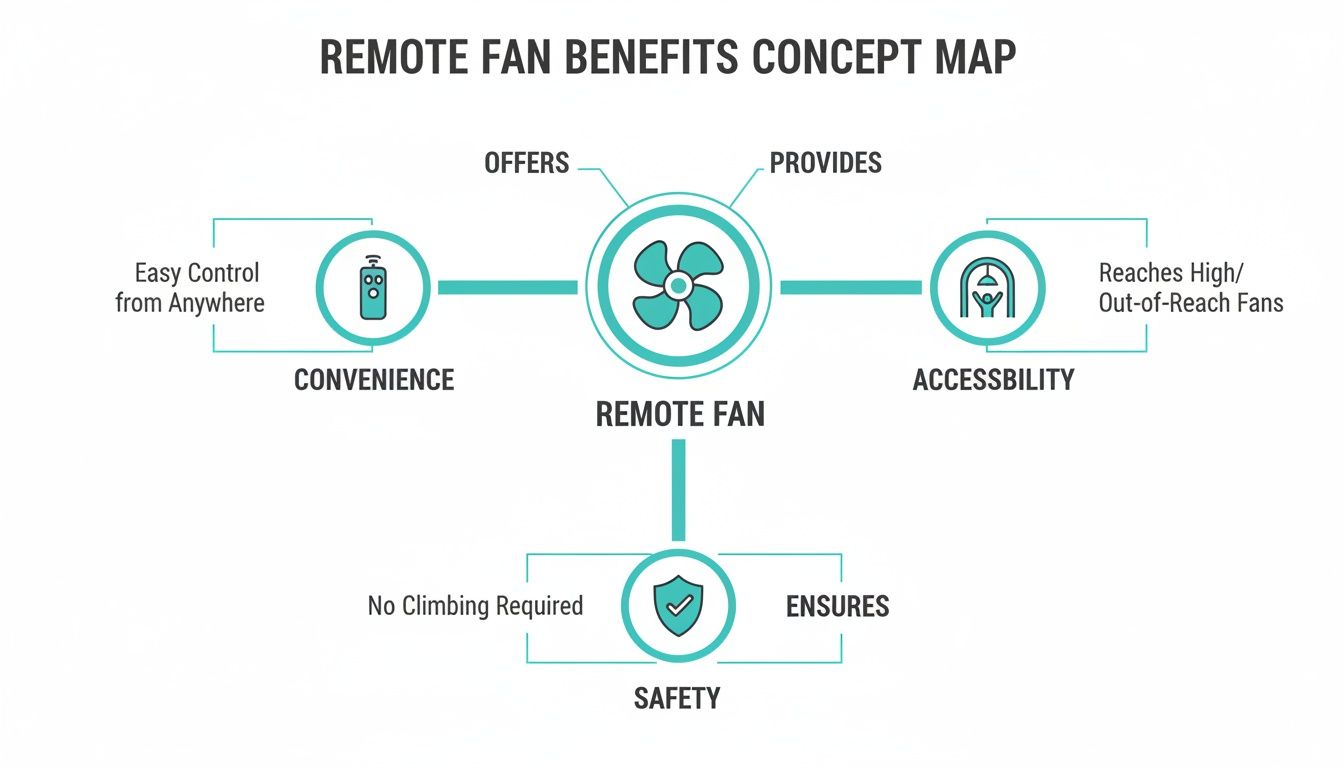
It all comes down to pure convenience, the ability to easily reach fans on high ceilings, and an added layer of safety.
The Ultimate in Connectivity: Smart Fans
The most advanced option is the smart fan, which taps into your home's Wi-Fi or Bluetooth to connect with your phone, tablet, or a smart home assistant. This is where control and convenience hit their peak. With a dedicated app, your phone becomes a powerful remote you can use from literally anywhere you have an internet connection.
This connectivity is a game-changer. The market for smart connected ceiling fans hit USD 560 million and is expected to reach USD 796 million by 2030. It's not just a fad; people want smarter homes. Surveys show 68% of buyers pick remote fans for convenience, and 40% specifically want them to sync up with their HVAC for better climate control. Find out more about the connected ceiling fan market.
So, what does that mean for you?
- Voice Control: Just say, "Alexa, set the living room fan to medium." It feels like the future, and it works with assistants like Amazon Alexa and Google Home.
- Scheduling: You can program your fan to turn on a few minutes before you get home or shut off automatically after you fall asleep. It’s great for saving energy.
- Grouping: Control all the fans in your house at once, right from a single app screen.
If you’re looking for a top-tier, fully integrated experience, a smart fan is the only way to go. Consider the Monte Carlo 56" Maverick II Smart Ceiling Fan, which sells for about $850. This stunner combines a sleek, modern design with full Wi-Fi control through the Bond Home app. You get voice command compatibility with Amazon Alexa and Google Assistant, making it a perfect example of how smart technology can deliver a truly premium feel.
Remote Technology Comparison: IR vs. RF vs. Smart
Feeling a little overwhelmed by the options? Don't be. This table breaks down the three main remote technologies side-by-side, so you can easily see which one is the right fit for your home and lifestyle.
| Technology Type | How It Works | Pros | Cons |
|---|---|---|---|
| Infrared (IR) | Sends a beam of invisible light to a receiver on the fan. | Simple, inexpensive technology. No signal interference with other devices. | Requires a direct line of sight. Signal can be blocked by obstacles. Limited range. |
| Radio Frequency (RF) | Uses radio waves to transmit signals, similar to a garage door opener. | Works through walls and doors. No need to aim. Longer range than IR. | Can sometimes experience interference from other RF devices. |
| Smart (Wi-Fi/Bluetooth) | Connects to your home network, controlled via smartphone app or voice assistant. | Control from anywhere. Voice commands, scheduling, and grouping. Integrates with smart home systems. | Requires a stable Wi-Fi connection. Can be more complex to set up. Higher price point. |
Ultimately, the best choice depends on what you value most. For simple, straightforward control in a single room, IR or RF gets the job done. But for total convenience, advanced features, and a home that works for you, smart fans are in a league of their own.
Premium Features That Define a High-End Fan
When you start looking at remote control ceiling fans in the $300 and up range, you're not just buying a way to move air around. You're really investing in a piece of home technology—an upgrade that brings a whole new level of comfort and engineering into your space. What sets these fans apart are the features that go way beyond a simple on/off switch, turning a basic appliance into a smart, responsive part of your home.
At the heart of almost every great fan is a DC motor. Unlike the old-school AC motors you’ll find in most budget models, DC motors are the real gold standard. Why? For starters, they use up to 70% less energy, which you'll definitely notice on your electricity bill over time. Even better, they are virtually silent. This makes them perfect for bedrooms or quiet living spaces where the constant hum of a motor would drive you nuts.
If you want to dig deeper into the tech, checking out the best DC motor ceiling fans will give you a good sense of why they’re a hallmark of premium design. The whole point is to have comfort you can feel, not hear.
Beyond Basic Speed Settings
Forget the clunky, three-speed pull chain. A high-end remote offers a much more refined level of control, often with six or more speed settings. This kind of precision lets you dial in the exact airflow you need for any situation, whether it's a powerful downdraft on a hot day or a gentle, barely-there stir.
One of the coolest features you’ll find is a ‘breeze’ mode. This clever setting automatically varies the fan’s speed to mimic the feeling of a natural, shifting wind. It’s a subtle touch, but it adds an organic, relaxing feel that you just don't get from a constant, artificial gust.
A premium fan doesn’t just move air; it curates it. The goal is to create an atmosphere that feels natural and effortless, and advanced speed settings like breeze mode are key to achieving that.
Another must-have for year-round comfort is the reverse function, which you can control right from the remote. With one button press, you can change the blade direction to push warm air down from the ceiling during winter. This simple trick helps heat your room more evenly and gives your furnace a much-needed break.
Advanced Lighting and Smart Control
These days, a high-end fan is as much a light fixture as it is an air mover. While integrated LED lights are pretty standard now, premium models take it to a whole new level.
- Full-Range Dimming: This lets you set the perfect mood, adjusting the light from bright and functional all the way down to a soft, ambient glow.
- Color Temperature Control: This is a fantastic feature. It lets you shift the light’s color from a warm, cozy white (around 2700K) to a crisp, cool daylight (around 5000K). It’s like having several different light fixtures in one, perfect for any time of day or activity.
Of course, the real game-changer is smart home integration. Many top-tier fans come with Wi-Fi, allowing you to connect them to your favorite smart home system. This opens up a world of possibilities:
- Voice Commands: Just tell Amazon Alexa or Google Assistant what to do, and your fan and light will obey.
- Scheduling and Timers: You can program your fan to turn on right before you get home or to shut off automatically after you’ve fallen asleep. It saves energy without you even thinking about it.
- App Control: Use a dedicated app on your phone to manage every setting from anywhere, whether you’re on the couch or on vacation.
Investing in a model like the Minka-Aire F844-DK Light Wave, which typically goes for around $350, gets you this powerful combination of a silent DC motor, dimmable LED lighting, and easy remote operation, all in one sleek package. It’s these thoughtful, high-performance features that truly define the luxury fan experience.
Choosing and Installing Your Perfect Remote Fan
Picking the right remote control ceiling fan is more than just finding a style you love—it’s about matching the fan's power to your room. Think of it like this: you wouldn't put a tiny engine in a huge truck. You need the right size for the job. Too small, and the fan will struggle to move any air. Too big, and it might feel like a wind tunnel.
This guide will walk you through the essentials of getting it right. We'll cover how to size your fan, where to place it for the best results, and what to expect during installation, so you can feel confident you’ve made the perfect choice.
Sizing Your Fan for Optimal Airflow
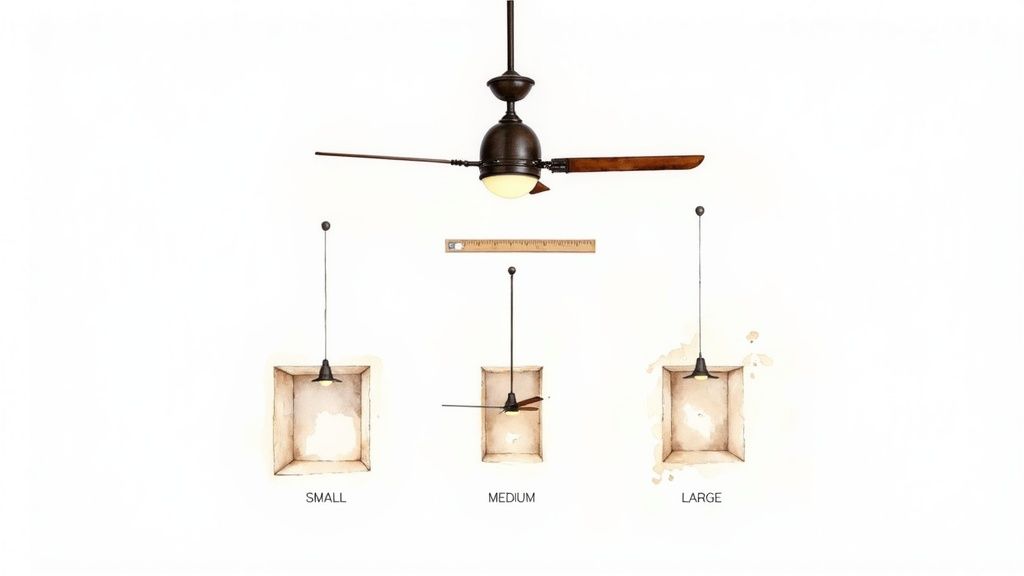
The single biggest factor in a fan's performance is its blade span—the diameter from the tip of one blade to the tip of the opposite one. It's a common mistake to go too small, which leaves you with a fan that looks nice but barely creates a breeze.
Here’s a simple cheat sheet to match fan size to your room:
- Small Rooms (Up to 75 sq. ft.): Think bathrooms, laundry rooms, or walk-in closets. A fan with a 29-36 inch blade span is perfect here.
- Medium Rooms (75-175 sq. ft.): This covers most standard bedrooms and kitchens. You'll want a 42-48 inch blade span.
- Large Rooms (Over 175 sq. ft.): For big living rooms, open-plan great rooms, or master suites, go with a blade span of at least 52 inches to move air effectively across the space.
Getting the size right means your fan can do its job without working overtime, which is great for both comfort and your energy bill.
Placement and Mounting Considerations
Where you hang your fan is just as important as its size. For both safety and performance, the fan blades should be at least 7 feet off the floor. You also want to give them breathing room—at least 18 inches of clearance from any walls or tall furniture—so the air can circulate freely instead of getting trapped.
Next, look up. Your ceiling height determines how you'll mount the fan. For standard 8-foot ceilings, a "hugger" or flush-mount fan that sits right against the ceiling is a great choice. But for anything taller, you’ll need a downrod.
A downrod is simply an extension pipe that lowers the fan from the ceiling. In a tall room, a fan without a downrod just spins air around way up high, where you can't feel it. The downrod brings the breeze down to you.
A good rule of thumb is to add one foot of downrod for every foot of ceiling height over nine feet. This positions the fan in the sweet spot to really circulate the air throughout the living space.
Installation and Remote Pairing Basics
We always suggest hiring a licensed electrician for any wiring, but it helps to know the basics of what’s involved. Installing a remote control fan means adding a small receiver unit into the fan's canopy at the ceiling. This little box is the brain that listens for the remote's signals.
The process usually breaks down like this:
- Safety First: The power to the room is shut off at the circuit breaker. No exceptions.
- Wiring the Receiver: Wires from the ceiling, the fan, and the receiver are all connected following the manufacturer's diagram.
- Mounting the Fan: The fan is secured to the ceiling box, and the receiver is tucked neatly inside the canopy.
Once it's all installed, the last step is pairing the remote. This is usually pretty simple. You'll turn the power back on, then press a "pair" button on the remote within about a minute. The fan will usually beep or flash its light to let you know it’s connected. If you want to dive deeper into the technical side, our guide to understanding a ceiling fan remote wiring diagram is a great resource.
By keeping these key points in mind—sizing, placement, and installation basics—you can make sure your new remote control fan doesn't just look amazing, but works perfectly from the moment you turn it on.
Our Top Recommendations for Luxury Remote Control Fans
When you’re ready to graduate from a fan that simply works to one that makes a statement, the world of luxury remote control ceiling fans is where you want to be. These aren't just appliances; they're thoughtfully engineered pieces of design. We're talking about fans that pair stunning looks with whisper-quiet power, and they typically start around $300 to reflect that leap in quality.
Think of it like the difference between a standard sedan and a luxury car. Both get you from A to B, but one provides an experience defined by quiet performance, premium materials, and smarter technology. This is where you find blades carved from real wood, bodies with hand-brushed metal finishes, and smart features that feel like a natural part of your home.
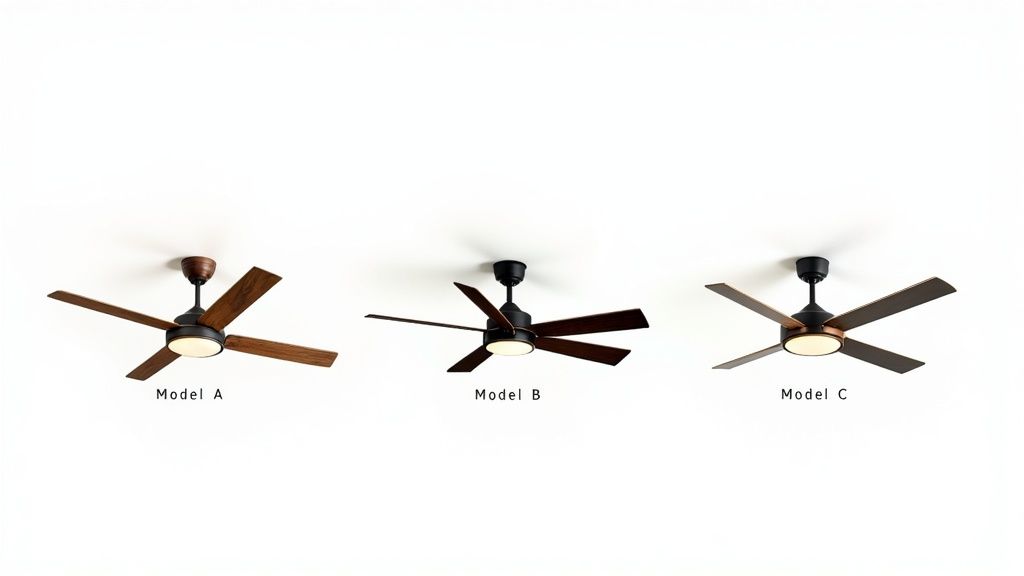
Let's look at a few standouts that show just what a high-end remote fan can bring to your space.
For the Modern Minimalist: The Minka-Aire Sleek
If your style is all about clean lines and understated elegance, the Minka-Aire F747L-BNW Sleek is a masterclass in modern design. Coming in around $380, this fan is the very definition of "less is more." Its impressive 60-inch blade span is perfect for larger living rooms or master bedrooms, moving a serious amount of air without making a peep.
The secret sauce here is its powerful, ultra-efficient DC motor. This is the technology that's really pushing the high-end fan market forward. In fact, the market for fans with these motors—which includes many remote-controlled models—has exploded from USD 1.4 billion to a projected USD 2.6 billion. That growth is all thanks to the efficiency of Brushless DC motors, which use 50-60% less power than old-school AC fans. That's a perfect match for the convenience of remote operation. You can learn more about the rise of these energy-efficient fan motors to see why they're taking over.
The Sleek includes a full-function remote to manage its six speeds, reverse direction for winter, and dim the integrated LED light, making it every bit as smart as it is stylish.
For the Smart Home Enthusiast: The Hunter Advocate
For anyone who wants their fan to be a seamless part of their connected home, the Hunter 54" Advocate Smart Ceiling Fan is a clear winner. Usually priced around $380, this fan was built from the ground up for the tech-savvy homeowner. It’s equipped with Hunter's SIMPLEconnect® Wi-Fi technology, giving you complete control right from your smartphone.
This isn't just a remote control—it's total home automation. You can sync it with Amazon Alexa, Apple HomeKit, and Google Assistant for effortless voice commands.
Imagine walking into a room and just saying, "Alexa, turn the fan on." The Advocate makes that happen. Beyond its smarts, it features a powerful, quiet motor and a clean, contemporary design that fits right into modern living spaces.
For the Grand Statement: The Fanimation Odyn
When your space demands a fan that's both massive in scale and absolutely stunning in design, the Fanimation Odyn is in a class of its own. With a breathtaking 84-inch blade span and a price tag that often tops $1,000, this fan is less of an appliance and more of an architectural centerpiece. It's made for great rooms, vaulted ceilings, and large open-concept areas.
The Odyn is proof of what happens when performance and design go hand-in-hand. Here’s what makes it so special:
- Massive Airflow: Its nine-blade design moves an incredible amount of air, creating a comfortable breeze in even the biggest rooms.
- Energy-Efficient DC Motor: Despite its massive size, the Odyn's DC motor is incredibly efficient, keeping your energy bills from skyrocketing.
- Advanced Remote Control: It ships with a handheld remote that gives you six speeds, a reverse function, and full control over its integrated LED light kit.
This fan isn’t just about cooling a room; it’s about making a bold design statement. Choosing a luxury remote control fan is an investment in comfort, style, and technology that truly elevates your home.
Frequently Asked Questions
Jumping into the world of remote-controlled ceiling fans can bring up a few questions, especially when you're dealing with installation, a finicky remote, or just trying to get the most out of your new fan. We get it. Think of this as your go-to guide.
We’ve rounded up the questions we hear most often and answered them in a way that’s clear and simple. Whether you’re looking to upgrade an old pull-chain fan or figure out why your remote suddenly went on strike, we’ve got your back.
Can I Add a Remote Control to My Existing Ceiling Fan?
In most cases, yes, you absolutely can! If you've got a fan that still relies on pull chains, you can easily bring it up to speed with a universal remote control kit. It's a fantastic way to get a modern convenience without having to replace the whole fan.
These kits usually include two pieces: the handheld remote you’ll use every day and a small receiver unit. This little receiver is the real brains of the operation. It needs to be installed inside the fan’s canopy (that's the dome-shaped part against the ceiling) and wired in between the house wiring and the fan itself. Since this involves working with electricity, we always recommend hiring a licensed electrician if you're not 100% comfortable with the job.
Just be sure to check for compatibility before you buy. Most standard AC motor fans play nicely with universal kits, but some fans with complex lighting or high-efficiency DC motors might need a specific kit from the original manufacturer.
What Should I Do If My Ceiling Fan Remote Stops Working?
It's always frustrating when a remote suddenly decides to stop talking to your fan, but don't panic. The fix is often surprisingly simple. Before you assume the worst, just run through these quick checks.
- Start with the Obvious: The number one reason a remote stops working? Dead batteries. Pop in a fresh set and see if that does the trick. Also, take a peek at the wall switch for the fan—sometimes it gets flipped off by accident, cutting power to the fan entirely.
- Try a Re-Sync: Every now and then, the remote and the fan’s receiver can lose their connection. Re-pairing them almost always solves the issue. We'll walk through the exact steps for that in a minute.
- Check for Interference: Your remote uses radio frequencies (RF) to communicate with the fan. Occasionally, other wireless gadgets in your home, like a garage door opener or even a new smart plug, can operate on a similar frequency and jam the signal. Try turning off other nearby electronics to see if your remote suddenly springs back to life.
If you’ve tried all that and are still stuck, it's possible the remote itself or the receiver inside the fan has failed. If you find yourself in that boat, our guide on finding a replacement fan remote control can walk you through finding the right one.
Are Remote Control Ceiling Fans Energy Efficient?
They sure are. In fact, they are often more energy-efficient than their old-school pull-chain cousins for a couple of important reasons. Many of the modern fans we carry are built with DC motors, which are a game-changer. These motors can use up to 60% less energy than the traditional AC motors you find in older fans.
The remote itself adds another layer of smart efficiency.
Having total control right at your fingertips just naturally encourages better energy habits. You're far more likely to tweak the fan speed, set a timer, or turn it off when you leave the room if it only takes a simple button press.
Features like sleep timers and scheduling also prevent the fan from running all night or when no one's home. And let's not forget the reverse function for winter—being able to easily switch the blade direction helps push warm air down from the ceiling, giving your heating system a break and potentially trimming down your energy bills.
How Do I Sync a New Remote to My Ceiling Fan?
Syncing—or "pairing"—a remote is how you create a unique communication channel between the remote and the receiver in the fan. Think of it just like pairing your phone to a new Bluetooth speaker. The whole process is designed to be quick, usually taking less than a minute.
While you should always check your user manual, here are the basic steps that work for most fans:
- Power Cycle the Fan: Head to your circuit breaker and turn off the power to the fan's room. Leave it off for about 30 seconds, then flip it back on. This simple reset clears the receiver's memory and gets it ready to learn a new remote.
- Get Ready to Pair: As soon as the power comes back on, you have a short window of opportunity—usually 30 to 60 seconds—to make the connection. Grab your remote and look for a "pair," "learn," or "set" button. It's often tucked away inside the battery compartment to keep you from pressing it by accident.
- Make the Connection: Press and hold that pairing button for a few seconds. The fan will usually give you a little signal—like a beep or a flash of its light—to let you know the sync was successful.
And that's it! Once paired, your remote should have full control of your fan's speed and light.
Ready to experience the ultimate in comfort and style? At Fan Connection, we've curated a collection of the finest remote control ceiling fans designed to elevate any space. From sleek, minimalist designs to bold, architectural statements, you'll find the perfect match for your home. Explore our collections and discover the difference that a premium fan can make.


