







Finding the Best Low Profile Ceiling Fans for Modern Homes
For years, picking out a ceiling fan for a room with a low ceiling—anything under eight feet—felt like choosing between your head and your comfort. You either got a fan that hung precariously low or one that looked clunky and out of place. But that's not the case anymore! Modern low-profile designs have completely changed the game, turning these compact fans from a necessary evil into a stylish centerpiece that won't give your taller friends a haircut.
The best ones now come with powerful, silent DC motors and sleek aesthetics, so you don't have to sacrifice an inch of headroom for a cool, comfortable room.
Why Low Profile Ceiling Fans Are a Modern Necessity
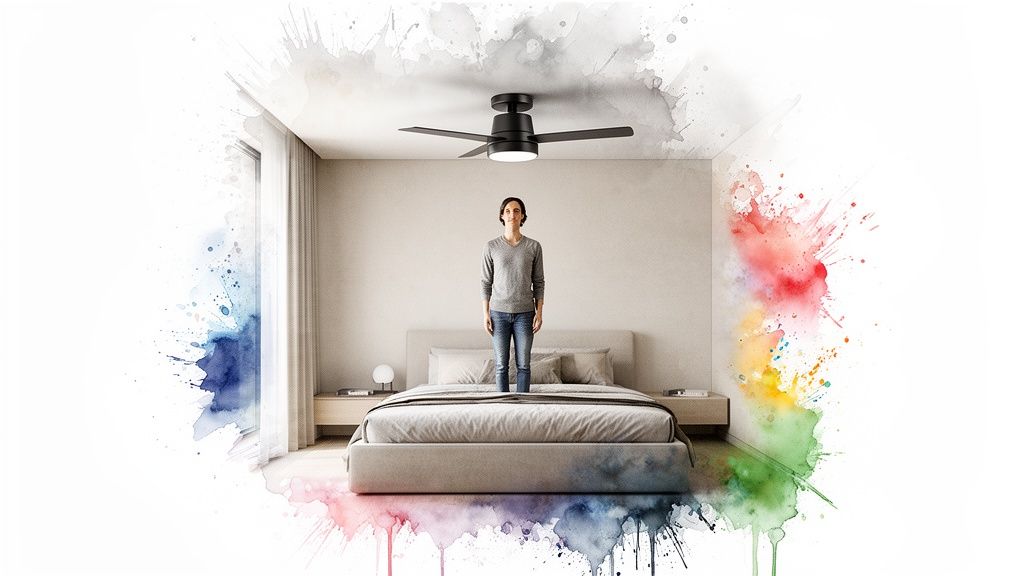
Trying to work around a low ceiling is a design headache many of us know all too well. A standard fan with a downrod can make the space feel claustrophobic and, let's be honest, can be a bit of a safety risk for anyone over six feet tall.
That’s where low-profile fans, often called "hugger" or "flush mount" fans, swoop in to save the day. They’re built to mount directly against the ceiling, maximizing every precious inch of vertical space. It’s not just about saving a few inches; it's about making your room feel open, airy, and comfortable again.
More Than Just a Space Saver
Beyond their smart design, the best low-profile ceiling fans are now packed with high-end features that used to only be found in larger, pricier models. They’ve gone from being a niche solution to a go-to choice for homeowners who want both performance and style. It's a noticeable shift; hugger models are on track to make up 25-30% of all residential fan sales by 2025. That's no surprise when you consider that over 40% of homeowners are dealing with this exact ceiling height problem.
Here's a pro tip: try choosing a fan that matches your ceiling color. A white fan on a white ceiling practically disappears, which tricks the eye into thinking the room is taller. It's a simple way to keep the focus on your decor, not the hardware overhead.
Unlocking Efficiency and Style
Modern hugger fans are also big on energy efficiency. They don't just look good; they're an easy way to reduce cooling costs, especially when the summer heat kicks in. By moving the air around, they create a wind-chill effect that lets you turn up your thermostat a few degrees without feeling any warmer.
Today’s top-tier options come with a ton of benefits, including:
- Whisper-Quiet DC Motors: These motors are way more efficient and quieter than their old-school AC counterparts, making them perfect for bedrooms or living rooms where peace and quiet matter.
- Integrated LED Lighting: Sleek, built-in lights give you the illumination you need without adding any extra bulk. Most come with dimmable features and even adjustable color temperatures.
- Smart Home Integration: Imagine controlling your fan speed, lights, and schedules right from your phone or with a simple voice command to Alexa or Google Home.
This guide will walk you through everything you need to know, from understanding the tech to checking out the top collections at Fan Connection. We’ll help you find a fan that not only fits your low ceiling but also takes your home's comfort and style to the next level. For more on this, you can also check out our article on the eco-friendly benefits of ceiling fans.
What Makes a Great Low Profile Fan?
When you're shopping for a low profile ceiling fan, the spec sheet can feel a little overwhelming. But once you know what to look for, you can see past the price tag and pick a fan that truly performs. Think of it like looking under the hood of a car—this knowledge is what separates a good purchase from a great one.
The single most important number to know is CFM, or Cubic Feet per Minute. Forget how many blades it has for a second; CFM is the fan's real horsepower. It tells you exactly how much air the fan can move, and a higher CFM means more powerful cooling. A fan might look stylish, but if the CFM is low, it’s all show and no go.
The Great Motor Debate: AC vs. DC
The motor is the heart of your fan, and today, you have two main choices: AC (Alternating Current) and DC (Direct Current). A DC motor is like a modern electric vehicle—it's whisper-quiet, incredibly efficient, and packed with smart features. An AC motor is more like a classic sedan: it's reliable and gets the job done, but it doesn't have the same finesse or efficiency.
So, why does this matter for your low profile fan? Let's break it down.
- Energy Savings: DC motors use up to 70% less energy than old-school AC motors. That means real, noticeable savings on your electricity bill over the life of the fan.
- Quiet Operation: Thanks to their design, DC motors are virtually silent. This makes them a perfect fit for bedrooms, nurseries, or any room where you want peace and quiet.
- More Speed Options: AC fans usually give you three speeds (low, medium, high). DC fans, on the other hand, often come with six or more speeds, giving you total control over the airflow.
A DC motor fan might cost a bit more upfront, but its quiet performance and long-term energy savings make it a fantastic investment. If you want to get into the nitty-gritty, you can learn more about the advantages of DC motor ceiling fans in our detailed guide.
To make things even clearer, here's a quick comparison of the two technologies.
AC vs DC Motor Fans: A Quick Comparison
This table breaks down the key differences between AC and DC motor technologies to help you choose the right low profile fan for your home.
| Feature | AC Motor Fans | DC Motor Fans |
|---|---|---|
| Energy Use | Standard efficiency | Up to 70% more efficient |
| Noise Level | Audible hum, especially at high speeds | Virtually silent operation |
| Speed Control | Typically 3 speeds | Usually 6+ speeds for precise control |
| Reversible | Manual switch on the motor housing | Convenient remote or wall control |
| Initial Cost | More budget-friendly | Higher upfront investment |
| Overall Value | Good for basic, occasional use | Excellent long-term value and performance |
In short, while AC motors are a proven, cost-effective choice, DC motors deliver a premium experience with better efficiency, more features, and quieter operation.
Why Blade Pitch Matters
Another key detail is blade pitch—the angle of the fan blades. Think of them like airplane wings. A steeper angle (or pitch) lets the blades "scoop" and move more air with every spin. The sweet spot for most home ceiling fans is a pitch between 12 and 15 degrees.
When you pair a high blade pitch with a strong motor, you get a powerful, high-CFM fan that creates that refreshing breeze you're after. Cheaper fans often have a flat pitch so they can get away with using a weaker motor, which results in weak airflow even when the fan is spinning on high.
A common mistake is focusing only on the number of blades. A well-designed three-blade fan with a 14-degree pitch and a strong DC motor will outperform a poorly designed five-blade fan every time. It's the engineering, not just the aesthetics, that moves the air.
Integrated Lighting: The Modern Standard
Finally, let's talk about lights. Many of the best low profile fans now come with integrated LED light kits. This is a game-changer because it means you don't need a bulky, separate light fixture, which helps keep the fan's profile sleek and truly close to the ceiling.
Look for models with dimmable lights and adjustable color temperatures. This lets you switch from a bright, cool white light (around 3000K) for tasks during the day to a warm, soft glow (around 2700K) for a relaxing evening vibe. It’s this kind of versatility that makes your fan more than just a fan—it becomes a central part of your room's design.
Choosing the Right Size and Placement for Your Space
Picking out the perfect low-profile ceiling fan is only step one. The real magic happens when you get the size and placement just right—that’s what unlocks its full cooling potential.
Think of it like buying a sound system. A massive speaker will overwhelm a small office, while tiny bookshelf speakers will get lost in a cavernous living room. The goal here is the same: to create balanced, efficient airflow without making your ceiling feel crowded or your fan feel useless.
Sizing Your Fan to Your Room
First things first, you need to match the fan's blade span to your room's square footage. The blade span is simply the full diameter of the fan, from the tip of one blade to the tip of the opposite one. Getting this right is crucial for both comfort and energy efficiency. It ensures the fan is powerful enough to circulate air effectively without creating a wind tunnel.
Here’s a simple cheat sheet to guide you. Just measure your room's length and width, then multiply them to get the square footage.
- Small Rooms (Up to 100 sq. ft.): Think home offices, laundry rooms, or walk-in closets. A fan with a blade span of 30-42 inches is perfect here.
- Medium Rooms (100-400 sq. ft.): This covers most bedrooms, kitchens, and standard living rooms. Look for a fan between 44-52 inches.
- Large Rooms (400+ sq. ft.): For great rooms, open-concept living areas, or master suites, you’ll need a fan with a blade span of 54 inches or more to really move enough air.
It’s a common misconception that a bigger fan is always better. In a small room, an oversized fan can create an uncomfortable, turbulent breeze. It's all about finding that Goldilocks-just-right balance for your specific space.
If you’re trying to make the most of a compact living area, checking out some studio condo design ideas can offer some great inspiration for maximizing every inch. And for a more detailed breakdown, our comprehensive ceiling fan sizing guide can help you fine-tune your choice.
This flowchart breaks down the choice between AC and DC motors—a key decision to make once you've landed on the right fan size.
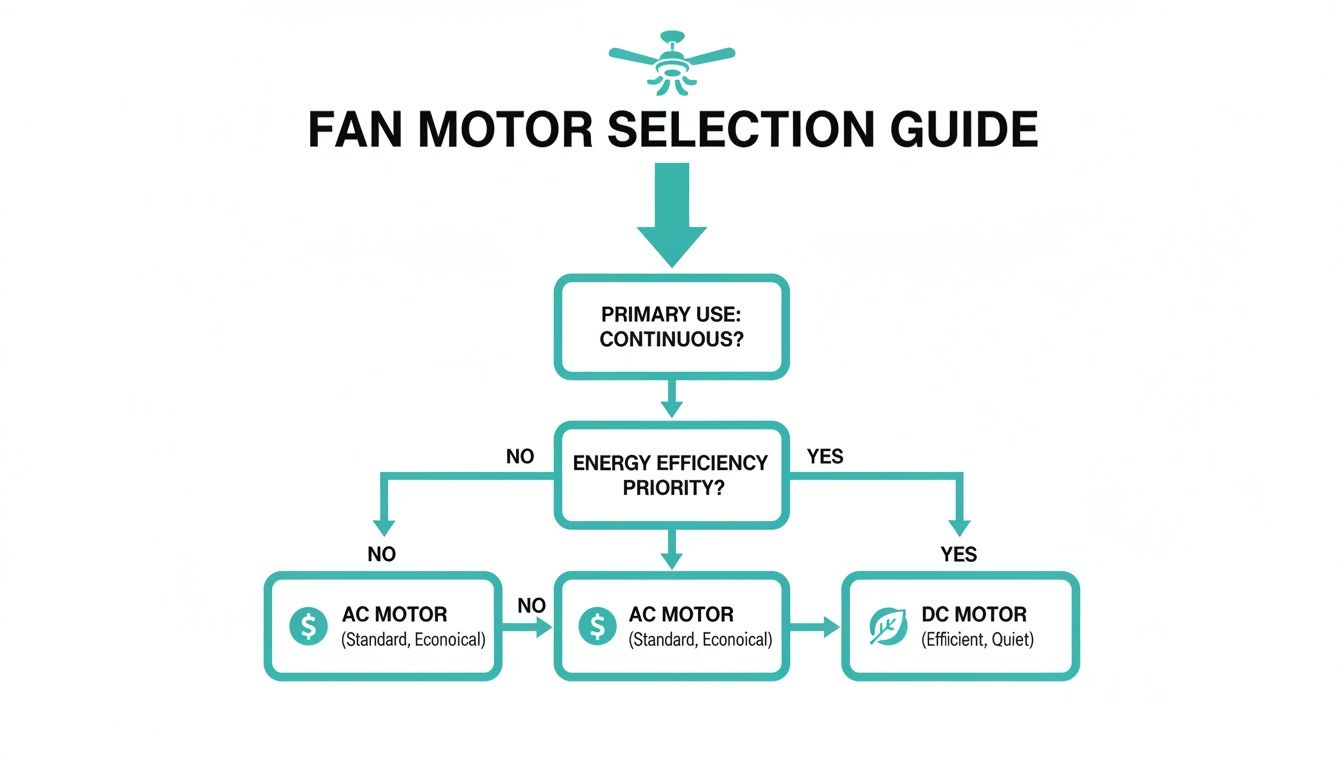
As you can see, if ultimate efficiency and whisper-quiet operation are what you're after, a DC motor is the clear winner.
The Golden Rules of Clearance
Once you've picked the right size, placement is the next hurdle, especially with low ceilings where every inch counts. For both safety and performance, there are a couple of non-negotiable clearance rules to follow.
First, the fan blades must hang at least 7 feet (84 inches) from the floor. This is a standard safety code requirement to prevent any unfortunate accidents. On a typical 8-foot ceiling (which is 96 inches high), a low-profile fan with a height of 11 inches leaves you with 85 inches of clearance—safely within the guidelines.
Second, make sure the blades have room to breathe. They need to be at least 18 inches away from any wall or obstruction, like a tall cabinet or a sloped ceiling. This space is essential to prevent the airflow from getting choppy and allows the fan to circulate air properly throughout the room. Installing a fan too close to a wall will choke its airflow, reduce its effectiveness, and can even cause it to wobble.
Exploring Premier Low Profile Fan Collections
When you step up to a premium low profile ceiling fan, you’re not just buying another home appliance; you're choosing a centerpiece. This is where high-performance engineering really meets intentional design, and our curated collections showcase that blend perfectly. We're moving beyond simple function to explore fans that tell a design story, transforming your space from the ceiling down.
These aren't your average, off-the-shelf models. We’re highlighting premier fans priced at $300 and above, where you can really see and feel the difference that superior materials and advanced technology make. Forget clunky, utilitarian designs—these are statement pieces built to perform.
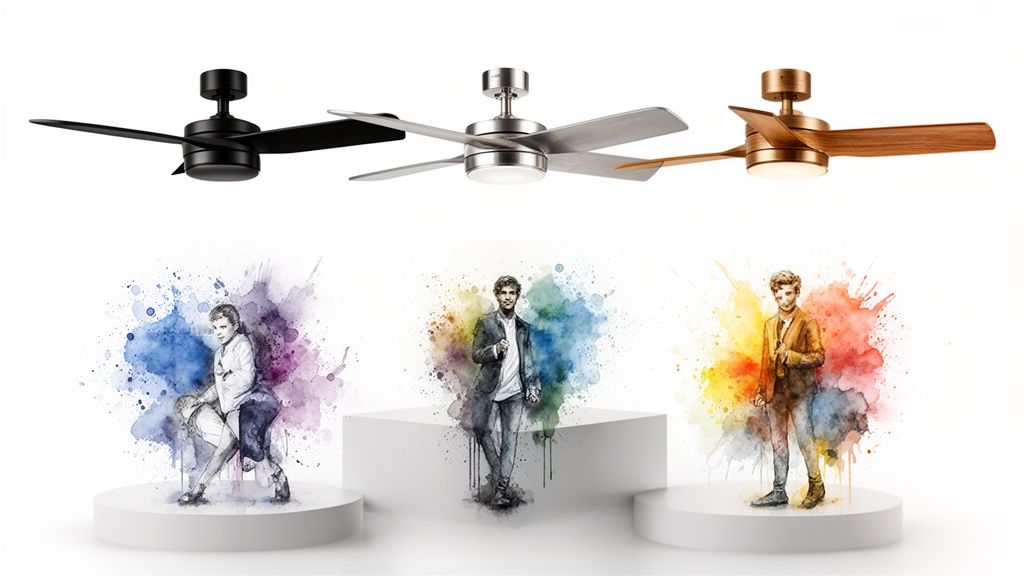
Architectural Elegance and Power
If you appreciate clean, architectural lines, some collections truly stand out for their minimalist yet powerful presence. They’re designed to complement a modern aesthetic without overwhelming the space.
The 'Artemis IV' and 'Apex' collections are prime examples. These fans are known for their sleek forms and robust performance, often featuring aerodynamically crafted blades that slice through the air with minimal drag. Think of them as functional sculptures that bring both comfort and a touch of sophistication to a room.
- Ultra-Quiet DC Motors: At the heart of these models are powerful DC motors, which ensure they operate almost silently. This makes them perfect for bedrooms and living areas where peace is a priority.
- High CFM Ratings: Don't let their slim profiles fool you. These fans are engineered to move a serious amount of air, with CFM ratings often exceeding 4,500.
- Premium Materials: From hand-carved balsa wood blades to die-cast aluminum housings, the quality is evident in every detail. You're getting longevity and a timeless look.
Fans as Functional Art
Moving beyond simple good looks, some of the best low profile ceiling fans are designed to be focal points in their own right. These models blur the line between a home utility and a piece of art, commanding attention with unique shapes and finishes.
The 'Bowie' and 'Chisel' models embody this idea perfectly. They're crafted for homeowners who want their fan to be a conversation starter. With bold designs and innovative forms, they prove that a ceiling fan can be just as impactful as a chandelier. Investing in a fan like the Artiste or Aerovon is an upgrade to your entire room's design language.
"A well-chosen ceiling fan does more than circulate air; it completes the room's design narrative. When you choose a fan for its artistic merit, it becomes a dynamic element that enhances the entire living space, blending form and function seamlessly."
And these design-forward fans don't compromise on performance. Many are equipped with smart home compatibility, allowing you to control speed, light, and direction with your voice or a simple tap on your phone.
The Power of Efficiency
A major advantage of these premium collections is their incredible efficiency. This is largely thanks to the advanced DC motor technology that has become standard in high-end fans. These motors are the driving force behind the quiet power and long-term value of models like the Anywhere and Axis.
Driven by energy mandates, low-profile fans have seen huge technological advancements. In fact, these efficiency goals have propelled fans into the spotlight, with BLDC technology adding +1.2% to the global market's 3.88% CAGR from 2026-2031. Models with DC motors can deliver 4,500+ CFM while using just 30-40 watts, potentially slashing energy bills by 60% and saving homeowners $50-75 per fan annually.
This efficiency means you can enjoy a cool, comfortable room without worrying about a spike in your energy bill. It’s a smart investment that pays for itself over time. For an even more compact and efficient option, you might also be interested in our Ultra-Slim fan model. By choosing a premium fan, you are investing in a product designed for superior performance, lasting style, and intelligent energy use.
The Convenience of Smart Fan Technology
The ceiling fan has officially moved beyond simple pull chains and wall switches. Home comfort has taken a huge leap forward, and today's best low-profile ceiling fans are no longer just fixtures—they're becoming a seamless part of your smart home.Think about it: adjusting your fan’s speed or dimming the lights from your smartphone without ever leaving the couch. Or even better, scheduling it to turn on just before you get home, so you're greeted by a cool breeze after a long day. This isn't science fiction anymore; it’s the new standard.
Seamless Control at Your Fingertips
Smart technology completely changes how you interact with your fan. High-end low-profile models now integrate perfectly with popular smart home platforms like Amazon Alexa and Google Assistant, making voice commands a breeze.
Instead of fumbling for a remote in the dark, you can just say, "Alexa, set the bedroom fan to medium." This kind of hands-free operation is more than just a cool party trick; it’s about creating a home that responds to you. Great examples are the Fan Connection ‘Breeze’ and ‘Bola’ models, which come with user-friendly apps that put total control right in the palm of your hand.
The real magic of a smart fan isn't just turning it on or off remotely. It's the ability to create schedules and automated routines that fit your life, helping you manage energy use more effectively and maintain perfect comfort without a second thought.
The Driving Force Behind Smart Integration
This shift toward connected appliances is happening all over the home. The rise of smart low-profile ceiling fans reflects a boom in IoT technology, contributing +0.8% to the market's growth in North America alone. With smart home adoption projected to hit 35% of households by 2025, it’s clear this trend is here to stay. In fact, app-compatible hugger fans like the Breeze and Bola are boosting user convenience in 70% of new installations. You can read the full research on ceiling fan trends here.
This integration offers some real-world advantages:
- Energy Management: Schedule your fan to run only when you need it, cutting down on wasted electricity.
- Enhanced Comfort: Automatically adjust settings based on the time of day or even the temperature in the room.
- Ultimate Convenience: Control every fan in your house from a single app on your phone.
When you invest in a smart fan, you're getting more than just a cooling device. You're upgrading to a smarter, more efficient, and incredibly convenient way of living. For a deeper look at modern controls, check out our guide on what to look for in a remote control ceiling fan. This is the future of home comfort, and it's available today.
Common Questions About Low Profile Ceiling Fans
Making a big purchase often comes with a few last-minute questions, and picking the right low-profile ceiling fan is no different. It’s a key piece of your home's comfort and style, so it makes sense to want to get every detail just right.
To help you feel totally confident in your choice, we’ve put together the questions we hear most often from our customers. We’re here with clear, straightforward answers to put your mind at ease and make sure you find the perfect fan for your space.
Can I Install a Low Profile Fan on a Sloped Ceiling?
This is a fantastic question. So many homes have vaulted or angled ceilings, even in rooms that don't feel particularly tall. The short answer is yes, it's often possible, but you’ll need to check the specifics of the fan you want.
Most hugger fans are built for flat ceilings, but some of the more premium models are designed with extra flexibility. Certain collections from Fan Connection come with adaptable mounting hardware or offer optional angled adapters that can handle a slope. The key detail to look for is the fan's maximum supported slope angle, which you'll find in the product specs. For really steep ceilings, a traditional fan with a downrod might still be the better option just to ensure the blades have plenty of clearance.
As a rule of thumb, always check the installation manual before you buy. If you're still not sure, a quick call with a professional electrician can save you a ton of guesswork and guarantee a safe, solid installation.
Are Low Profile Fans as Powerful as Standard Fans?
Absolutely. It’s a common myth that losing the downrod means you lose performance, but modern engineering has completely closed that gap. The best low profile ceiling fans can easily go head-to-head with their standard-mount cousins.
The secret is in the motor technology and blade design. High-end hugger fans, especially those with powerful DC motors and aerodynamically shaped blades like the ones in the Fan Connection lineup, produce some seriously impressive airflow. The number to pay attention to is the CFM (Cubic Feet per Minute) rating. A top-tier model like the Artemis IV or Apex can push out over 4,500 CFM, which is more than enough power to cool a large room. In fact, a quality hugger fan will always outperform a generic, poorly designed standard model.
What Is the Minimum Ceiling Height for Installation?
Safety always comes first. Building and safety codes are crystal clear on this: fan blades must be at least 7 feet (84 inches) off the floor to prevent any accidents. This is where low-profile fans really shine.
Because they mount flush with the ceiling, they are the go-to solution for rooms with ceilings as low as 8 feet. To be absolutely certain, just do this quick math: take your ceiling height in inches (so, 96 inches for an 8-foot ceiling) and subtract the fan's total height—from the ceiling to its lowest point (say, 11 inches). The number you get has to be more than 84 inches. Always measure your room and double-check the fan's dimensions before you make your final decision.
Should I Choose a Fan With or Without a Light?
This one really boils down to your room's current lighting and your personal taste. There's no right or wrong answer here, just what works best for your home.
If the fan is going to replace the main light source in the room, then picking a model with an integrated LED kit is almost a must. For the best experience, look for features like:
- Dimmable LEDs: This lets you adjust the brightness to fit any mood or activity, from game night to movie night.
- Adjustable Color Temperature: You can switch between a bright, cool white for focused tasks and a warm, cozy glow for relaxing in the evening.
On the other hand, if your room is already well-lit with recessed lighting, track lights, or plenty of lamps, a fan without a light can offer a cleaner, more minimalist look. This streamlined style helps the fan blend into the ceiling, making the room feel even more open and spacious. Fan Connection has beautiful options in both styles, from the sleek, light-free Axis to the luminous Bola, so you’re sure to find the perfect match.
Ready to find the perfect fan that brings together style, performance, and a space-saving design? Explore the curated collections at Fan Connection and discover a model that will transform your room.
Shop the Best Low Profile Ceiling Fans Now at Fan Connection


