










The Ultimate Ceiling Fan Sizing Guide
Getting the right size ceiling fan is the single most important decision you'll make for keeping a room comfortable. It's not just about looks; the perfect fan is a careful balance of your room's dimensions, ceiling height, and your personal airflow needs. Let's walk through how to nail this choice for top-notch performance and efficiency.
Why The Right Fan Size Matters More Than You Think
Picking a ceiling fan can feel like just another design choice, but getting the size right is absolutely critical for your home’s comfort. We’ve all been there—stuck under a tiny fan on a hot day, feeling like it's doing absolutely nothing. On the other hand, a fan that’s way too big for a room can create a disruptive wind tunnel, turning a cozy space into a blustery mess.
This guide goes beyond aesthetics to focus on a core idea: the fan’s performance has to fit the space. Think of it like putting the right engine in a car. You wouldn't put a tiny motor in a huge truck and expect it to go anywhere, just like you wouldn't drop a race car engine into a golf cart. It’s all about finding that perfect, breezy match.
The Foundation of Comfort and Efficiency
An improperly sized fan doesn't just feel wrong—it works poorly and wastes a ton of energy. A fan that’s too small has to run on its highest setting just to try and keep up, creating a lot of noise without moving much air. This leaves you with frustrating "dead air" zones where you can't feel a thing. A fan that's too big might look impressive, but it can make a room feel uncomfortably chilly even on its lowest setting.
The goal is to find that sweet spot where your fan moves a high volume of air gently and quietly. That’s how you get consistent, breezy comfort throughout the entire room, whether you're kicking back in the living room or trying to get some sleep.
A correctly sized ceiling fan not only improves your comfort but also makes a measurable impact on your utility bills. It's an investment in both your home's atmosphere and its efficiency.
It’s More Than Just Blade Span—It’s About Performance
Ultimately, we're going to walk you through a clear, practical path to finding the perfect fan. We'll be digging into the key factors that really matter:
- Room Dimensions: We'll show you how to calculate your room's square footage to find the ideal blade span.
- Ceiling Height: Choosing the right downrod is essential for safety and effective air circulation.
- Airflow Needs: We’ll demystify CFM (Cubic Feet per Minute) so you can match a fan’s power to how you use the room.
Did you know that picking the right ceiling fan can slash your cooling costs by up to 65% compared to relying solely on air conditioning? It's a huge deal. In the U.S., where fans are a fixture in over 80 million homes, proper sizing is everything. This isn't just a hunch; the global ceiling fan industry is projected to hit $16.18 billion by 2032, largely because people are demanding more energy-efficient solutions. You can discover more about these industry trends and see how they're benefiting homeowners.
Whether you’re eyeing a sleek, modern fan like the Aerovon for a minimalist room or a grand statement piece like the Artemis XL5 for a soaring great room, understanding these core principles will ensure you make a choice you’ll love for years to come.
Matching Fan Size To Your Room's Square Footage
Before you get lost in styles and finishes, the first and most important step in choosing the right ceiling fan is getting to know your room. Think of it like buying a new sofa—you wouldn't just guess if it fits, you'd measure first. The same logic applies here, and it all starts with your room's square footage.
Getting this number is simple: just multiply the length of your room by its width. So, if your home office is 10 feet long and 12 feet wide, you're working with 120 square feet. That simple number is your starting point for finding a fan that will actually do its job.
Why Square Footage Is The Key
So, why all the fuss about one little number? It all comes down to the physics of moving air. A fan's purpose is to circulate all the air in a room, not just the bit directly underneath it.
If your fan is too small, its blades just can't push enough air to reach the corners. You'll end up with a weak, isolated breeze while the rest of the room stays stubbornly stuffy. Imagine a tiny 44-inch fan trying to cool down a massive great room—it’s like trying to stir a swimming pool with a teaspoon. You’ll get a lot of motion in one spot, but it won't make a dent in the overall temperature.
On the other hand, putting a giant fan in a small room is just as bad. A huge 72-inch fan in a cozy bedroom will create an overwhelming wind tunnel, turning a gentle breeze into an uncomfortable gust. The goal is perfectly balanced, room-filling circulation, and that's where matching the fan to the square footage comes in.
This handy guide breaks down the key decisions, starting with your room's size and moving on to other factors like height and airflow.
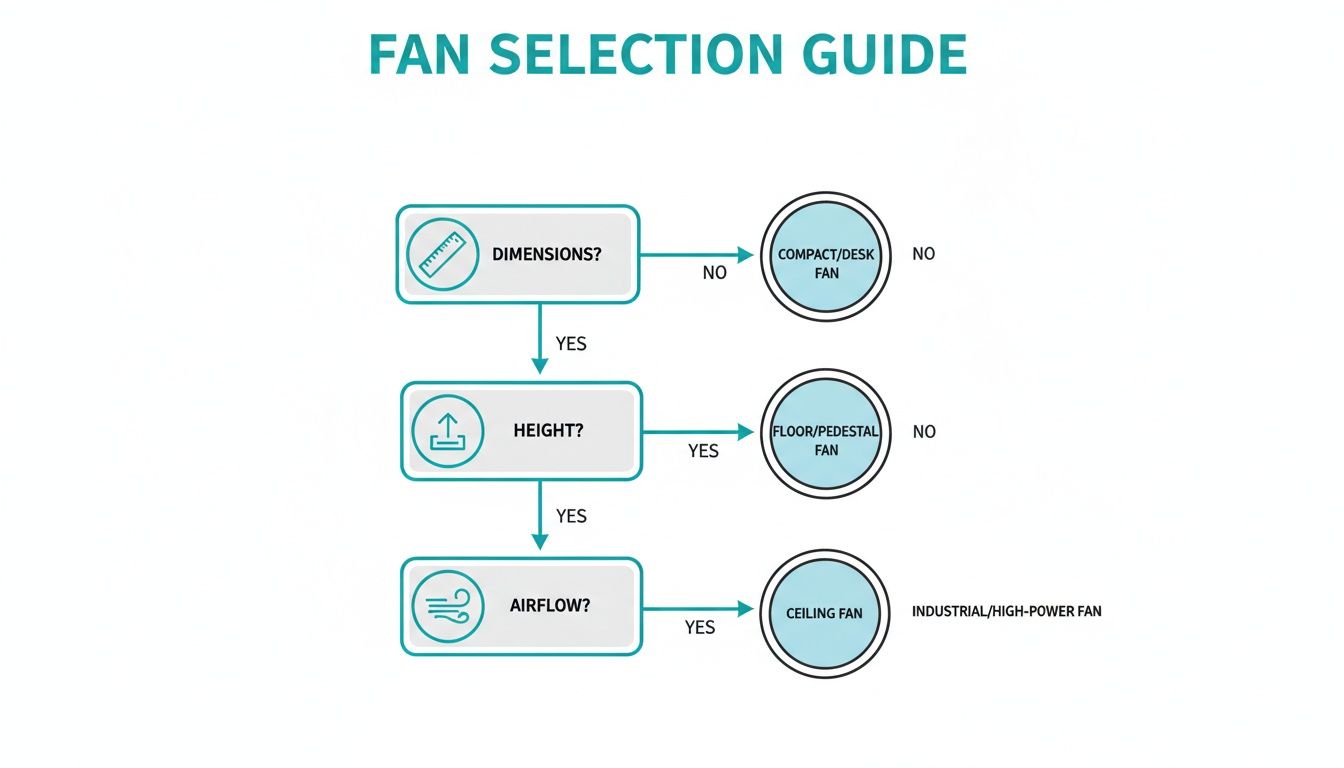
As you can see, getting the blade span right for your room's square footage is the critical first step to getting the comfort and efficiency you're looking for.
Ceiling Fan Size Chart By Room Dimensions
To make things even easier, we’ve put together a quick-reference chart. It maps your room's size directly to the ideal fan blade span, taking all the guesswork out of the process. These recommendations are tried and true, designed to deliver that sweet spot of perfect air movement without creating drafts or leaving dead zones.
| Room Size (Square Feet) | Longest Wall (Feet) | Recommended Fan Blade Span (Inches) | Example Fan Connection Models |
|---|---|---|---|
| Up to 100 sq ft | Under 10 feet | 30 – 48 inches | Small Room Fans |
| 100 – 225 sq ft | 10 – 15 feet | 48 – 54 inches | Medium Room Fans |
| 225 – 400 sq ft | 15 – 20 feet | 54 – 60 inches | Large Room Fans |
| Over 400 sq ft | Over 20 feet | 60 inches & Larger | Great Room Fans |
Following this chart ensures you’re not just picking a fan that looks good, but one that’s engineered to perform in your specific space.
This isn't just theory—it's backed by real-world data. Ever notice how many 52-inch fans you see? There's a reason for that. They make up roughly 40% of residential fan sales in the U.S. because they're perfectly suited for the average American living room (around 200-300 sq ft). It’s not a coincidence; it’s just good design.
By starting with a simple measurement of your room, you’re setting yourself up for success. This one calculation connects you to the right blade span, which is the most important step toward a home that’s comfortable, efficient, and perfectly breezy.
Calculating The Right Downrod For Your Ceiling Height
Once you've picked a blade span that fits your room's square footage, the next crucial piece of the puzzle is vertical placement. Getting the fan's height just right is every bit as important as its width. For the absolute best airflow and safety, a fan's blades should hang around 8 to 9 feet above the floor. Think of this as the "sweet spot" where the fan can really do its job, moving air effectively without being low enough to be a hazard.
This is where the downrod comes into play. A downrod is simply the metal pipe that connects the fan motor to the ceiling mount, letting you position the blades at that perfect height. It's a non-negotiable component for rooms with high, vaulted, or sloped ceilings.
Why Downrod Length Is So Important
Imagine trying to use a showerhead that’s mounted 15 feet up on the ceiling. By the time the water gets to you, it's just a weak, misty spray. A ceiling fan works on a similar principle. If it’s mounted way too high, the column of air it pushes down will spread out and lose its power long before it ever reaches you. You’ll be left with a whole lot of nothing.
On the flip side, a fan that hangs too low is a safety risk and can create an uncomfortably intense, concentrated blast of air. The whole point is to drop the fan into that ideal 8 to 9-foot zone above the floor. The downrod is what makes this happen, ensuring your investment in a quality fan actually pays off with powerful, room-filling comfort.
Finding Your Perfect Downrod Length
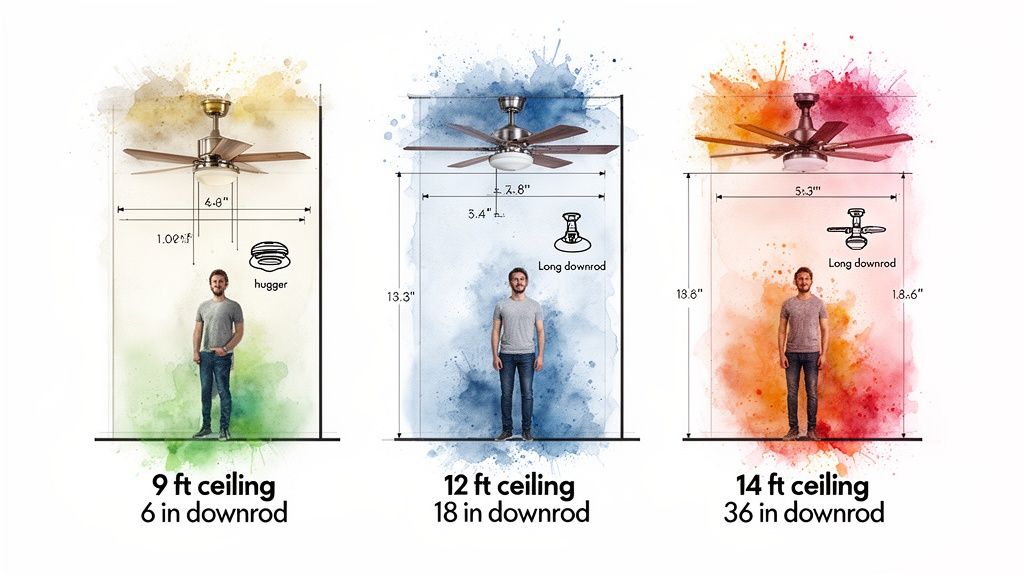
Figuring out the right downrod length is refreshingly simple. Here’s the rule of thumb: take your total ceiling height and subtract 9 feet. This accounts for the target 8-foot blade height plus about a foot for the fan motor itself. What’s left is your recommended downrod length.
To make it even easier, here’s a quick-reference chart:
| Ceiling Height | Recommended Downrod Length |
|---|---|
| 9 feet | 6 inches |
| 10 feet | 12 inches |
| 12 feet | 24 inches |
| 14 feet | 36 inches |
| 16 feet | 48 inches |
| 18 feet | 60 inches |
| 20 feet | 72 inches |
This simple math ensures that a stunning fan like the Chateaux by Fanimation, which costs over $600, makes the grand statement it was designed for in a two-story entryway. With the correct downrod, it’s not just a fan—it's a dramatic and functional centerpiece. For a deeper dive, you can learn more about downrods for fans in our dedicated guide.
Solutions For Low Ceilings
But what if your ceiling is under 8 feet high? In that case, a standard fan with a downrod is off the table due to safety clearance rules. This is exactly why low-profile fans, often called "hugger" or "flush-mount" fans, were invented. These fans are built to mount directly to the ceiling, giving you as much headroom as possible.
Key Takeaway: For ceilings under 8 feet, a low-profile or "hugger" style fan is non-negotiable. It's the only way to guarantee safe clearance while still getting effective air circulation.
These models are specifically engineered to perform well in tight spaces. A fantastic example is the Basic Max by Hunter, a stylish and efficient option that starts around $300 and is perfect for rooms where every inch of vertical space counts. Choosing the right type of fan for your ceiling height is the key to guaranteeing both safety and performance.
Understanding CFM For True Airflow Power
So far, we've focused on the physical side of things—blade span and downrod length. While getting those dimensions right is crucial for fitting a fan to your room, it doesn't tell you the whole story. Now, let's talk about the real measure of a fan's muscle: CFM, or Cubic Feet per Minute.
Think of it this way: blade span is like the size of a car's tires, but CFM is its horsepower. It’s the metric that tells you how much air a fan actually moves. A big blade span is a great start, but a high CFM rating is what delivers that powerful, refreshing breeze you're after.
What Is A Good CFM Rating?
The CFM rating tells you exactly how much air a fan can circulate in a minute when it's running on its highest speed. This number is your key to matching a fan's performance to your room.
-
Low CFM (Under 4,000): These fans are perfect for smaller spaces like a home office or a guest bedroom. They create a gentle, quiet breeze that provides subtle air movement without being disruptive.
-
Medium CFM (4,000 - 6,000): This is the sweet spot for most standard-sized living rooms and master bedrooms. Fans in this range deliver noticeable, comfortable airflow that keeps the space feeling fresh.
-
High CFM (Over 6,000): Welcome to the powerhouses. High-CFM fans are built for large great rooms, open-concept living areas, and even covered patios. They move a serious amount of air, making them a worthy investment for any space that gets hot and stuffy.
For example, the impressive Aviation by Minka Aire, priced well over $500, boasts a CFM rating over 6,000. It's an investment in serious comfort, engineered to circulate air effectively across a large area.
The Science Behind Powerful Airflow
So what gives a fan its high-CFM punch? It's not just one thing, but a combination of smart engineering.
- Motor Strength: A powerful, high-quality motor is the heart of any great fan. It provides the torque needed to spin the blades at optimal speeds without wobbling or making a racket.
- Blade Pitch: This is simply the angle of the blades. A steeper pitch, typically between 12 and 15 degrees, allows the blades to scoop and push more air with every single rotation.
- Aerodynamic Design: The shape and material of the blades really matter. Premium fans use aerodynamically designed blades that slice through the air with minimal resistance, which maximizes their efficiency.
The fan market's growth is directly tied to people understanding these performance metrics. Right now, medium-priced fans, ideal for rooms from 150-350 sq ft with 48-54 inch spans, hold a 53.9% market share. In hot climates like Saudi Arabia, where summers can top 40°C, the demand for correctly sized, high-CFM fans is soaring. It makes sense—oversizing a fan can increase energy use by 25%, while undersizing it leaves frustrating hot spots.
Expert Tip: Don't just shop by blade span. Always check the CFM rating to ensure you're buying a fan with the power to match its size. A fan with a huge blade span but a weak motor is just for show.
When you invest in a fan like the stunning Artemis XL5 by Minka Aire, which costs over $900, you're paying for this combination of premium engineering that delivers exceptional airflow.
While ceiling fans are all about circulating air inside a room, it's also helpful to know how they fit into the bigger picture of your home's air quality, which includes systems like mechanical ventilation.
Ultimately, choosing a fan with the right CFM rating ensures your investment pays off in true comfort.
Solving Airflow In Large Or Awkwardly Shaped Rooms
What happens when your dream open-concept living area turns into an airflow nightmare? A single fan, even a massive one, can struggle to keep the peace in large or unconventionally shaped rooms. For spaces like long rectangular living rooms, L-shaped kitchens, or sprawling great rooms, this often creates a frustrating situation where one half of the room is breezy while the other remains stubbornly still.
Instead of hunting for one giant fan to rule them all, the smarter strategy is to think like a professional designer and create dedicated airflow zones. This just means using multiple, well-placed fans to deliver consistent, targeted comfort to every corner of your space.
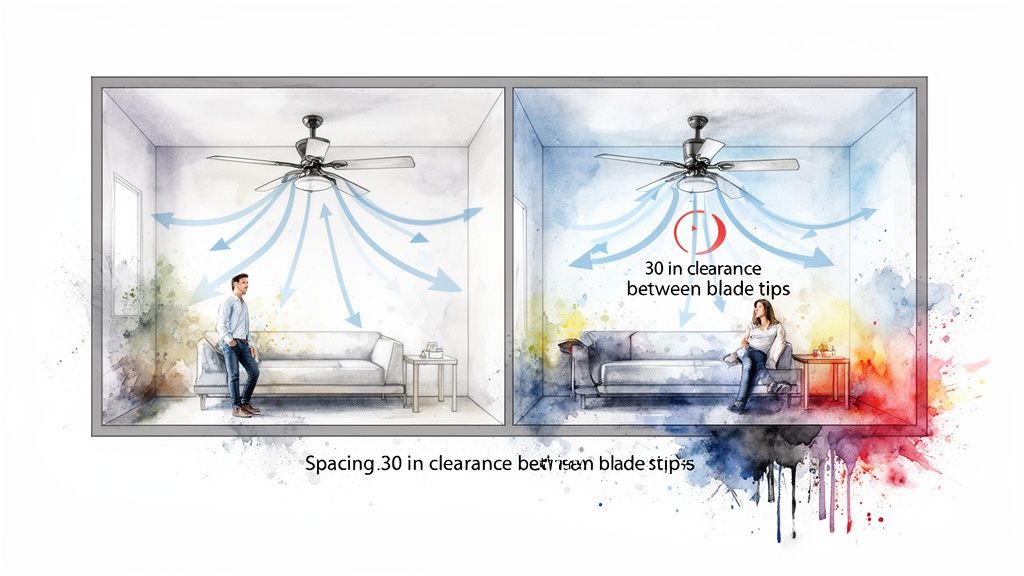
The Two-Fan Strategy For Long Rooms
Let's tackle the most common challenge: the long, rectangular great room. Trying to cool a 30-foot-long room with a single fan plunked in the middle is a recipe for disappointment. The air simply won’t reach the ends of the room effectively.
The solution is simple and elegant: divide and conquer. Mentally split your room into two roughly equal square zones. Then, install a fan in the center of each of those new zones. This approach ensures that both the seating area by the fireplace and the reading nook at the far end get the same refreshing breeze.
Here are the key rules for this layout:
- Center Each Fan: Place each fan in the middle of its designated zone, not just randomly spaced along the ceiling. This gives you the best coverage.
- Maintain Clearance: Ensure there are at least 30 inches of space between the blade tips of the two fans. This prevents them from creating turbulent, choppy air that feels less pleasant.
- Match The Style: Use two identical fans to create a balanced, intentional look. A mismatched pair can make the room feel cluttered and unplanned.
Imagine pairing two stylish Amped fans by Minka Aire in a large, modern living room. The result is a sophisticated, symmetrical design that delivers twice the comfort.
Tackling L-Shaped And Complex Layouts
For L-shaped rooms or other funky layouts, the same zoning principle applies. Just treat each "wing" of the room as its own distinct space that deserves its own dedicated airflow.
Place one fan in the center of the main living area and another in the center of the adjoining dining nook or kitchen space. This ensures that no matter where you are, a comfortable breeze is within reach. Trust us, this multi-fan approach is far more effective than installing one oversized fan off-center and just hoping for the best.
Pro Tip: Using multiple fans gives you way more control. You can run one fan over the dining area during dinner and another over the living space afterward, tailoring the comfort to how you actually use the room throughout the day.
For a cohesive and powerful pairing in an L-shaped space, consider two Axis fans by Minka Aire. Their sleek, three-blade design provides excellent airflow without visually overwhelming the room.
The Single-Fan Powerhouse Solution
While the multi-fan strategy is often the best bet for complex layouts, sometimes you just want to make a bold statement. In a large, square great room with high ceilings, a single, large-diameter fan can be a stunning and effective choice.
This is where the true giants of the fan world come in. We're talking about fans with blade spans of 72 inches or more. These are not just appliances; they are architectural centerpieces designed to move a massive column of air. An 84-inch powerhouse like the Andros by Fanimation is engineered to dominate a large space with commanding airflow and undeniable style.
If you're looking for one fan to handle a vast area, this is the way to go. You can explore more options in our deep dive on 72-inch and larger ceiling fans.
Final Checks For A Flawless Installation
You’ve done the heavy lifting—measuring your room, figuring out the downrod, and even decoding those CFM ratings. You're on the home stretch now. Before you hit that "buy" button, let’s run through a quick pre-flight checklist. These final checks will make sure your new fan not only looks great but runs safely and effectively from day one.
Think of it as the final walkthrough before you take the keys. It’s all about catching those small but critical details that are so easy to overlook in the excitement of picking a new fixture.
Confirm Your Clearances
First up, blade clearance. For everyone's safety and for the best possible airflow, your fan’s blades need some breathing room. Make sure you have at least 18 to 24 inches of clearance between the tip of the blades and any nearby wall, cabinet, or tall piece of furniture. This simple step prevents choppy, weak airflow and lets the fan create that smooth, consistent breeze you’re after.
Next, take a look at the electrical box in your ceiling. A standard box made for a simple light fixture just isn't built to handle the weight and constant motion of a ceiling fan. You absolutely must have a fan-rated electrical box, which is specifically braced to handle the load. This is a non-negotiable safety check.
Finally, if you have sloped ceilings, double-check that you have the right mounting gear. Most quality fans can be installed on an angle, but they often need a special sloped ceiling adapter or canopy. Just look at the fan's specs to make sure it's compatible with your ceiling's pitch.
Match The Fan To Your Final Vision
With the technical stuff out of the way, you can get back to the fun part—style. This is your chance to make sure the fan you've picked really clicks with your room's decor. A great fan doesn't just move air; it completes the whole look.
Think about how the fan's design will tie into your overall theme.
- For a breezy, coastal vibe: Look for fans with natural materials or blades shaped like palm leaves.
- For a clean, modern space: Sleek, minimalist designs with three or four blades work beautifully.
- For a rustic or industrial feel: Fans with reclaimed wood finishes or metal cages make a strong statement.
Don’t just install a fan; introduce a centerpiece. The right model can tie your entire room together, turning a functional appliance into a deliberate piece of design.
Our curated collections make this easy. If you're creating a relaxing, resort-like atmosphere, a fan like the stunning Cabana by Fanimation from our 'Tropical' collection is a perfect fit. For those who prefer sharp lines and an uncluttered look, the minimalist Chisel by Minka Aire from our 'Modern' selection is an exceptional choice. If you need more guidance on the installation process itself, you can learn more about how to install a ceiling fan in our comprehensive article. This final step transforms a well-planned project into a perfectly executed reality.
Frequently Asked Questions About Sizing Your Fan
Even with the best game plan, a few questions always seem to surface right before you make a final decision. We get it. Let’s tackle the most common ones we hear, giving you that last bit of confidence to pick the perfect fan for your space.
How Do I Choose a Fan for a Sloped Ceiling?
If you're dealing with vaulted or angled ceilings, you'll need a fan that can hang from a downrod and uses a sloped ceiling adapter (sometimes called a canopy kit). While many standard-mount fans can handle a bit of an angle, you absolutely have to check the product specs first.
Every fan will list the maximum slope it can handle. Make sure you confirm this before buying, as it's the key to ensuring your fan hangs perfectly level and operates smoothly without any wobble.
Does the Number of Fan Blades Actually Matter?
It's one of the biggest myths out there: more blades mean more air. The truth is, a fan's real muscle comes from its motor and the pitch (or angle) of its blades. The number of blades mostly comes down to two things: looks and sound.
Fans with more blades—say, five or six—tend to slice through the air more quietly. On the other hand, fans with fewer blades can create a more noticeable "chopping" sound as they push the air around.
Can I Put Any Ceiling Fan on My Covered Porch?
Definitely not. This is a big one. You have to use a fan that’s specifically rated for outdoor conditions. Putting an indoor fan outside is a recipe for rust, warped blades, and even dangerous electrical problems.
To know where a fan can be safely installed, check its UL rating:
- Damp-Rated Fans: These are your go-to for covered porches, patios, and screen rooms. They're built to handle humidity but shouldn't be exposed to direct rain.
- Wet-Rated Fans: These are the heavy-duty option. Built to withstand the elements, they can be installed in pergolas, gazebos, or anywhere else they might get hit with rain or snow.
At Fan Connection, our passion is helping you find a high-performance fan that doesn't just work great but looks incredible, too. Take a look through our handpicked collections and find a premium model to transform your space.


