











Choosing a Ceiling Fan in Stuart for Coastal Homes
Picking the right ceiling fan in Stuart is about so much more than just matching your decor—it's your secret weapon in the never-ending battle against Florida's notorious heat, humidity, and salty air. Think of the best fan for our area as a beautiful workhorse, blending tough-as-nails, weather-resistant materials with a powerful, whisper-quiet motor to keep your home feeling like a five-star resort, all without sending your FPL bill into the stratosphere.
Your Ultimate Guide to The Best Ceiling Fan in Stuart
Living on Florida's Treasure Coast is basically paradise, but it's a paradise that's incredibly tough on home fixtures. The constant triple-threat of intense sun, sticky humidity, and corrosive salt means a generic, off-the-shelf ceiling fan from a big-box store just won’t survive. Choosing the wrong one is a fast track to warped blades, rusted metal, and a motor that sighs its last breath years too soon. This guide is your treasure map to finding a fan that doesn't just survive our coastal climate—it absolutely thrives in it.
Putting a little thought into your ceiling fan is one of the smartest (and most satisfying) upgrades you can make to a Florida home. A high-quality fan lets you give your air conditioner a much-needed vacation, which can lead to some seriously cool savings. In fact, many homeowners see their cooling costs drop by as much as 30-50% just by using fans to supplement their AC, especially during those milder months. It’s part of a bigger trend toward home improvements that are both beautiful and energy-smart, which has helped the ceiling fan market boom globally. You can read more about the growth in the ceiling fan industry on BusinessWire.com.
Making the Right Choice for Your Home
The path to the perfect fan starts with understanding a few key things about our local environment. This isn't about just picking a pretty color; it’s about matching the fan’s guts and materials to your home's unique needs. We’ll walk through everything from blade materials that laugh in the face of moisture to motor tech that runs whisper-quiet and sips electricity.
This decision tree gives you a simple place to start, guiding you based on where the fan will go and how big the room is.
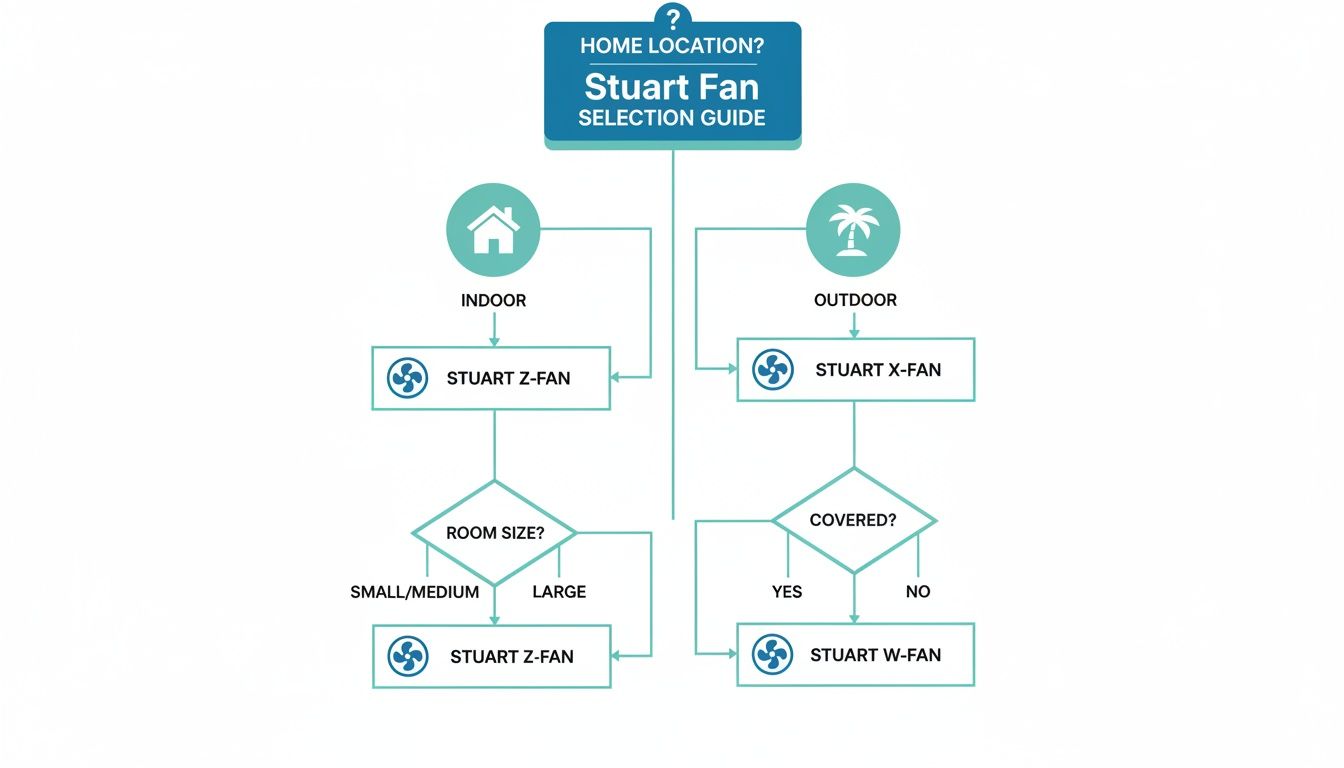
As the flowchart shows, the first big question is whether your fan will live indoors or out. This determines the weather rating you need for safety and longevity. After that, the size of your room will point you to the right blade span for the best possible airflow, making sure your new fan feels as good as it looks.
To make things even easier, here’s a quick rundown of what matters most when shopping for a ceiling fan in our area.
Stuart Ceiling Fan Quick Selection Guide
| Consideration | Why It Matters in Stuart | Recommended Feature |
|---|---|---|
| Material & Finish | High humidity and salt air cause rust, corrosion, and warping. | ABS Composite Blades and Marine-Grade or powder-coated finishes. |
| Weather Rating | Outdoor or lanai fans need to withstand direct moisture. | Wet-Rated for exposed areas; Damp-Rated for covered patios. |
| Motor Type | Energy efficiency is key to lowering FPL bills. | DC Motor for quiet, highly efficient operation. |
| Blade Span | Proper sizing ensures optimal airflow for the room. | 52-60 inches for most bedrooms and living rooms. |
| Energy Star | A certified fan guarantees lower energy consumption. | Look for the ENERGY STAR label. |
Ultimately, picking a fan with these features in mind will ensure you get a reliable, long-lasting solution that's perfectly suited for life on the Treasure Coast.
Selecting Materials That Defy Salt and Humidity
Stuart’s gorgeous coastal environment is paradise for us, but it’s a battleground for home fixtures. The salty air and relentless humidity team up to wage war on anything made from standard materials, leading to rust, corrosion, and those sad, droopy blades you see on an inferior ceiling fan in Stuart.
Choosing the right materials isn't just a style choice; it's a strategic move to make sure your investment actually lasts.
Think of it this way: you wouldn't take a regular sedan on a safari. In the same vein, you need a fan engineered for the specific challenges of coastal Florida. This means looking right past basic wood or standard painted metal and focusing on materials designed to thrive in our salty, humid climate.
Built for the Coast
The secret to a long-lasting fan in our area comes down to two key components: marine-grade plastics for the blades and powder-coated metals for the housing and motor.
- ABS Composite Blades: These all-weather blades are the undisputed champions of humidity. Unlike wood or MDF (medium-density fiberboard), ABS plastic is completely unaffected by moisture. That means no warping, sagging, or drooping—ever.
- Powder-Coated Finishes: This isn't just a quick coat of paint. A powder-coated finish is electrostatically applied and then cured under heat, creating a hard, durable shell. It's far more resistant to chipping, scratching, and—most importantly—corrosion from salt spray.
Of course, you want your fan to fit your home's aesthetic, too. For some great inspiration on blending durability with style, check out these [modern coastal interior design ideas](https://liveprivada.com/modern- coastal-interior-design-ideas/). The goal is to find a fan that works hard and looks great doing it.
Understanding Weather Ratings
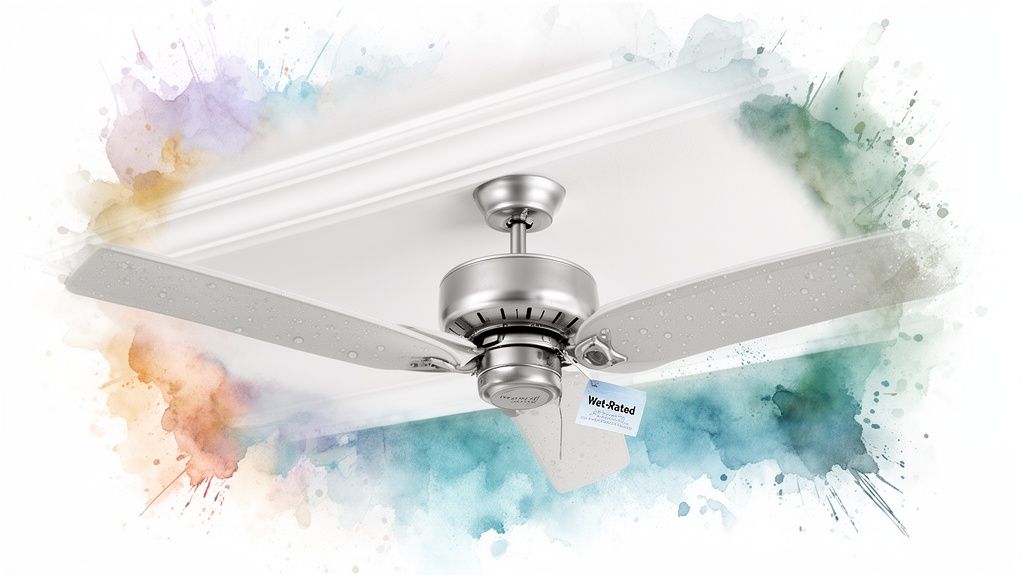
For any outdoor or semi-outdoor space like a lanai or porch, a UL (Underwriters Laboratories) rating is non-negotiable. It’s your guarantee of safety and durability against the elements.
Key Takeaway: A UL weather rating ensures the fan's internal wiring and motor are sealed to prevent moisture damage. This is a critical safety feature in a humid, rainy climate like Stuart's.
There are two main ratings you need to know:
- Damp-Rated: This is perfect for covered lanais, porches, and screened-in patios. These fans can handle high humidity and condensation but shouldn't be exposed to direct rain.
- Wet-Rated: This is the top tier of outdoor protection. A wet-rated fan is built to withstand direct exposure to rain, salty sea spray, and even a wash-down with a hose. It's the only real choice for pergolas, gazebos, or uncovered patios.
For a deeper dive, you can explore our guide to the best outdoor ceiling fans to see how these ratings apply to different models.
Investing in a premium, appropriately rated model like the rugged Andros ($318.00) or the tropical-inspired Cabana ($558.00) means you're buying peace of mind. These fans are engineered to keep their performance and beauty for years, making them a smart choice for any coastal home.
Matching Fan Size to Your Florida Room
Picking the right size ceiling fan is a lot like Goldilocks finding the right bowl of porridge—it needs to be just right. A fan that’s too small for your Stuart living room will just spin its heart out, barely stirring the air. On the flip side, a massive fan in a small bedroom can create an overwhelming, gusty vortex. The sweet spot is all about balance, and getting it right unlocks maximum airflow and that blissful, cooling comfort we crave.
Thankfully, this isn't rocket science. It really just comes down to matching the fan's blade span (the full diameter from blade tip to blade tip) with your room's square footage. Stuart homes are known for their mix of cozy bedrooms, sprawling great rooms, and breezy lanais, and each space needs its own perfectly sized fan.
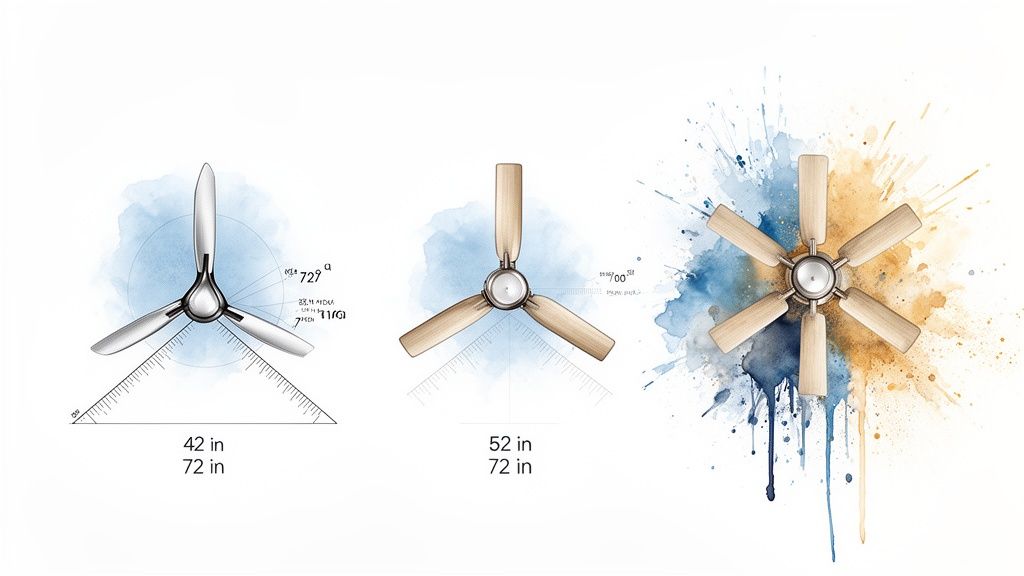
It’s Not Just About the Diameter
But here’s a pro tip: size isn't the whole story. You also have to look at the blade pitch, which is just the angle of the blades. Think of it like a boat propeller slicing through water. A steeper pitch "grabs" more air with every single turn, pushing a bigger column of it down toward you. A fan with a decent pitch—somewhere in the 12 to 15-degree range—will almost always move more air than one with flatter blades, even if the motors are identical.
This trio of blade span, pitch, and motor power all adds up to a fan's CFM (Cubic Feet per Minute) rating. This number is the real MVP of fan performance. The higher the CFM, the more air that fan is moving, period. If you’re serious about finding the best ceiling fan in Stuart to beat our infamous humidity, the CFM rating is what you should be focusing on.
A higher CFM means you'll feel a much stronger cooling effect. This lets you turn your thermostat up a few degrees, which directly translates into lower energy bills. It's the single most important number to look for when you're buying a fan.
Fan Size vs. Stuart Room Type
To make it even easier, we've put together a quick guide based on the typical room sizes we see around here in Stuart. This will help you narrow down your search from the get-go.
| Room Type (Example Sq. Ft.) | Recommended Blade Span | Example Fan Connection Model |
|---|---|---|
| Small Bedroom (Up to 144 sq. ft.) | 42" – 50" | Aerovon ($398.00) |
| Master Bedroom (144 - 225 sq. ft.) | 52" – 56" | Maverick ($668.00) |
| Living Room (225 - 400 sq. ft.) | 56" – 70" | Lehr ($1,098.00) |
| Great Room/Lanai (Over 400 sq. ft.) | 70" and up | Artemis XL5 ($998.00) |
This table is a great starting point, but every home is a little different. For a deeper dive into all the measurements and factors, our complete ceiling fan size guide has a comprehensive chart to help you nail the perfect choice for your space.
Matching the Fan to the Room
Different rooms have different needs, both for performance and style.
-
A sleek, three-blade fan like the Aerovon ($398.00) is perfect for a contemporary bedroom. It creates a gentle, subtle breeze without visually dominating the space.
-
For those large, high-ceilinged great rooms or lanais, you need to bring in the big guns. A larger fan like the impressive Artemis XL5 ($998.00), with its huge blade span, is built specifically to move a serious amount of air across a grand space, making sure every corner feels that cool relief.
Understanding Your Fan's Motor and Efficiency
Think of your ceiling fan's motor as its engine. It’s the powerhouse that determines everything from raw cooling power and energy consumption to how quietly it operates. When you’re choosing a ceiling fan in Stuart, understanding the motor is your secret weapon for long-term savings and comfort.
You’ll generally find two main types of motors on the market: the traditional AC (alternating current) and the more modern DC (direct current). While older AC motors still get the job done, premium fans today almost exclusively use DC motors—and for very good reason. They are the undisputed champions of efficiency.
The DC Motor Advantage
A DC motor is a complete game-changer for Florida homeowners. They might have a higher price tag upfront, but the benefits quickly start to add up, especially when your fan is running for months on end.
- Massive Energy Savings: DC motors are incredibly efficient, using up to 70% less energy than their AC counterparts. That translates directly to a lower FPL bill.
- Whisper-Quiet Operation: These motors are virtually silent. This makes them absolutely perfect for bedrooms, home offices, or any quiet space in your home.
- More Control: DC motors usually come with more speed settings, often six or more. This gives you much more precise control over your comfort level.
This push for greater efficiency is reshaping the entire industry. As homeowners look for more sustainable ways to stay cool, fans are actually outselling AC units in many warmer regions. The trend is also driving demand for oversized fans (over 56 inches) to cool large rooms, which is perfect for high-performance models like the Aviation ($498.00). Since fans use about 95% less electricity than central AC, it's easy to see why they're such an attractive option for anyone looking to cut their energy costs.
Decoding Efficiency Labels
When you're comparing different fans, two things will tell you almost everything you need to know about its power and efficiency: the CFM rating and the ENERGY STAR label.
CFM (Cubic Feet per Minute): This number measures the volume of air a fan moves. A higher CFM means a more powerful breeze and a greater cooling effect. It's the single best metric for judging a fan's raw performance.
An ENERGY STAR certified fan is your guarantee that it's among the most efficient on the market. These models are independently tested to meet strict energy performance standards set by the U.S. Environmental Protection Agency. For a deeper dive, check out our article on what makes for truly energy-efficient ceiling fans. To cut down on long-term costs even more, you might also be interested in how other energy-efficient features in new homes can help save on utility bills.
Investing in a high-efficiency model like the Artiste ($698.00) is a smart move. It’s proof that powerful cooling and beautiful design don't have to come with a high energy cost.
Navigating Installation in Stuart Homes
You’ve picked out the perfect fan, and now comes the final hurdle: getting it installed. This is where the rubber meets the road. A proper installation is the difference between a fan that runs silently for decades and one that develops an annoying wobble or click a few months down the line. In Stuart, our homes have plenty of character, from soaring vaulted ceilings to classic Florida layouts, and each presents its own little quirks.
Getting the installation right isn't just about hanging it up; it's about safety, performance, and making sure your investment pays off with that perfect, cooling breeze you've been dreaming of.
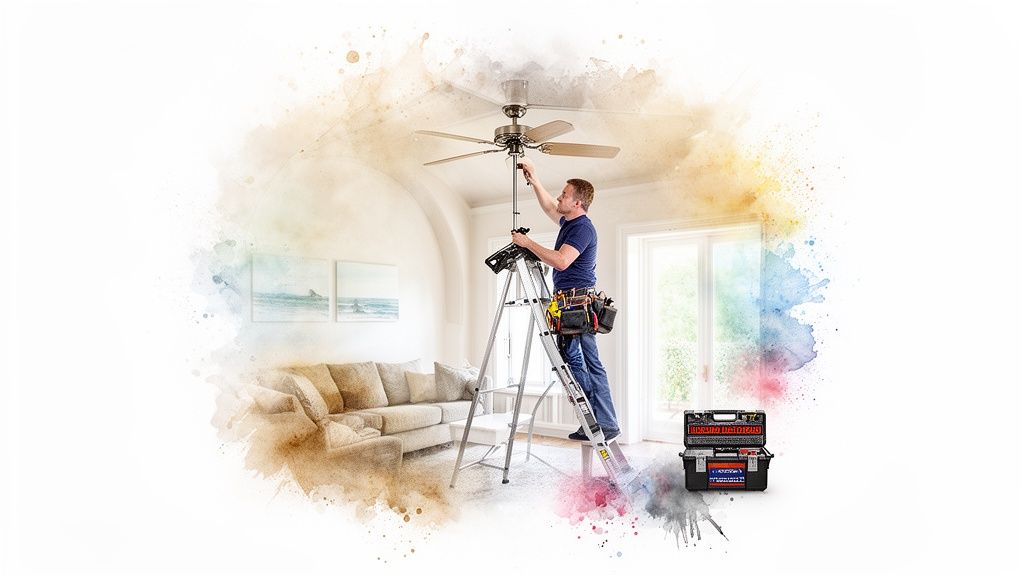
Addressing Sloped and Vaulted Ceilings
Many of the most beautiful homes here in Stuart feature vaulted or sloped ceilings that create an incredible sense of openness. While they look amazing, they do require a little extra thought when it comes to installing a ceiling fan. You can’t just bolt a standard mount onto an angled ceiling and call it a day—the fan has to hang perfectly level to work properly and safely.
To make that happen, you'll need two key pieces of hardware:
- Longer Downrods: Essential for any high ceiling. A downrod brings the fan down to the sweet spot—usually 8 to 9 feet above the floor—where it can actually move the air around you. Hang it too high, and all that airflow gets lost up in the rafters.
- Angled Mounting Kits: This little piece of hardware is a non-negotiable for sloped ceilings. Sometimes called a sloped ceiling adapter, it allows the fan to hang straight down from an angled surface, preventing stress on the motor and killing any chance of a wobble.
Safety First and Local Codes
Look, if you're just swapping out an old fan for a new one, it can sometimes be a manageable DIY project. But if your installation involves running new wiring, it's time to call in a pro. Electrical work isn't the place to try and save a few bucks, especially with our coastal humidity adding another layer of risk. A licensed electrician in Martin County is your best friend here.
A licensed electrician is your guarantee that all the wiring, junction boxes, and mounting hardware meet current Florida building codes. This is a big deal for your family’s safety and for keeping your homeowner's insurance valid.
Bringing in a professional gives you peace of mind. They'll ensure your new ceiling fan in Stuart is anchored to a properly braced electrical box that can handle the weight and motion. They'll also make sure everything is grounded correctly to avoid any electrical hazards. Here at Fan Connection, we're with you from start to finish—from helping you choose a stunning model like the Maverick ($668.00) to making sure it's installed safely so you can enjoy it for years to come.
Alright, you've got the basics down—you know which materials, size, and motor are right for Stuart's climate. The big question now is, where do you actually find one of these top-tier fans?
Sure, you could pop into a big-box store, but you’ll likely find a sea of generic, one-size-fits-all options. For a home in a place like Stuart, you need something built for the long haul. That's where an online specialist like Fan Connection comes in. We’ve done the hard work for you, curating a collection of high-performance fans that can actually handle the coastal air.
Instead of wading through hundreds of mediocre models, you can jump straight to what you're looking for. Love a timeless look? Our 5 Blade series has that classic charm. Want something that feels a bit more like a vacation? Check out our Tropical collection. It's all about finding a fan that not only performs but also fits your home's personality, without the guesswork.
The Good Stuff: Premium Fans and a Handpicked Selection
Let's be honest: quality costs a bit more upfront but saves you headaches down the road. We've built our collection around premium fans priced over $300 because we know they're made with better materials and more advanced motors. These aren't the wobbly, noisy fans you remember from your childhood; they're engineered to deliver powerful, quiet cooling for years.
Just to give you an idea of what's out there:
- The Chisel ($598.00): This isn't just a fan; it's a piece of modern sculpture that also happens to move a lot of air.
- The Bowie ($758.00): If you've got a big, open living area, this is the kind of bold, high-performance fan that can handle it.
It's no surprise that people are investing more in quality fans. The global ceiling fan market was valued at a whopping USD 11.39 billion in 2024 and is expected to climb to USD 16.18 billion by 2032. Homeowners and designers are realizing that a great fan is a key part of a comfortable, stylish home. Models like our popular Artemis IV ($758.00) are a perfect example of that blend of form and function. If you're a data nerd, you can dig into the market trends over at Fortune Business Insights.
Here at Fan Connection, we want to be the go-to online shop for Stuart residents. That means offering top-notch quality, great design, and the kind of powerful performance a coastal home truly needs.
We also know that buying online needs to feel safe and straightforward. That’s why we make sure all our shipping and lead time info is crystal clear, and we use modern, secure payment options. You can get your new ceiling fan in Stuart delivered with total peace of mind.
Your Stuart Ceiling Fan Questions, Answered
When you're shopping for a ceiling fan, a few questions always pop up—especially when you’re dealing with Stuart's coastal climate. Let's clear the air on some of the most common ones so you can feel totally confident in your choice.
Do I Really Need a Wet-Rated Fan for My Covered Lanai?
Yes, you absolutely do. I can't stress this enough. Even if your lanai is covered, the intense humidity, salt in the air, and wind-driven rain we get here will destroy a standard indoor fan.
A wet-rated fan is your only real option. Its motor is completely sealed off from moisture, and the blades are made from all-weather materials that won't rust or warp. It’s a small investment upfront that guarantees your fan will last for years and operate safely.
How Much Can I Actually Save on My FPL Bill?
Quite a bit, actually. A ceiling fan works by creating a wind-chill effect, which makes a room feel several degrees cooler than the thermostat says. This means you can comfortably bump up your AC setting without breaking a sweat.
For a lot of homeowners, that simple adjustment can cut air conditioning costs by up to 30% during our long, sticky summers. That's real money back in your pocket.
Is a DC Motor Fan Really Worth the Extra Cost?
For most of us here in Stuart, the answer is a resounding yes. Think about how often we run our fans—practically year-round.
DC motors are up to 70% more energy-efficient than the old AC models, run almost silently, and give you way more speed settings for perfect control. The energy savings alone make it a smart investment that easily pays for itself. A sleek model like the Alto ($398.00) is a perfect example of this super-efficient tech in action.
What Blade Material Prevents Drooping in Florida Humidity?
To avoid that sad, droopy look, always go for fans with ABS composite blades. Natural wood or MDF blades are like sponges in our humidity—they absorb moisture, warp, and start to wobble.
ABS is a tough, durable plastic that humidity can't touch. This means your fan blades will stay perfectly balanced and whisper-quiet for years of reliable, wobble-free comfort.
Ready to find the perfect fan that ticks all these boxes? Come explore the premium, weather-ready collections at Fan Connection.


