







Choosing Ceiling Fans in Port St. Lucie: A Complete Guide
Here in the heart of sunny Florida, a good ceiling fan isn't just a stylish accessory—it's your secret weapon for comfort. Finding the perfect ceiling fans in Port St. Lucie means investing in your well-being, your home's efficiency, and its overall vibe. This guide is your treasure map to navigating all the options and making a choice you'll love for years.
Why a Premium Fan Is Your Best Investment in Port St. Lucie
Living on the Treasure Coast means your ceiling fan is going to work overtime. It’s not just a seasonal appliance; it's a year-round workhorse that's essential for keeping your home cool and comfortable. This is exactly why settling for a generic, big-box store model so often leads to a wobbly, noisy disappointment.
When you invest in a premium fan from a dedicated retailer like Fan Connection, you're getting a whole lot more than just circulating air. You're bringing home a piece of expertly engineered equipment, one designed to deliver powerful, whisper-quiet cooling while doubling as a stunning centerpiece for your room. These fans are built with superior motors and materials, which translates directly to more durability and real energy savings over their lifetime. A fantastic example is the Aviation fan, priced over $500, which combines industrial design with powerful airflow—a true investment piece.
The Growing Trend of Quality Upgrades
It's clear that homeowners here in Port St. Lucie are catching on to the value of these upgrades. This shift is part of a bigger trend across North America, where the ceiling fan market is seeing some serious growth, driven by a boom in home renovations and a new focus on energy efficiency.
The market, currently valued at USD 3.90 billion, is expected to climb all the way to USD 5.55 billion by 2033. A huge driver of this is the surge in home renovations—over 7 million existing homes got minor updates in 2023 alone, and you can bet a lot of those included swapping out an old, wimpy ceiling fan. You can discover more insights on the North American ceiling fan market and its projected growth.
A well-chosen ceiling fan does more than just cool a room—it defines it. It’s an opportunity to blend real-world function with your home's unique coastal, modern, or traditional vibe, making it one of the most impactful upgrades you can make.
Elevate Your Space with Designer Models
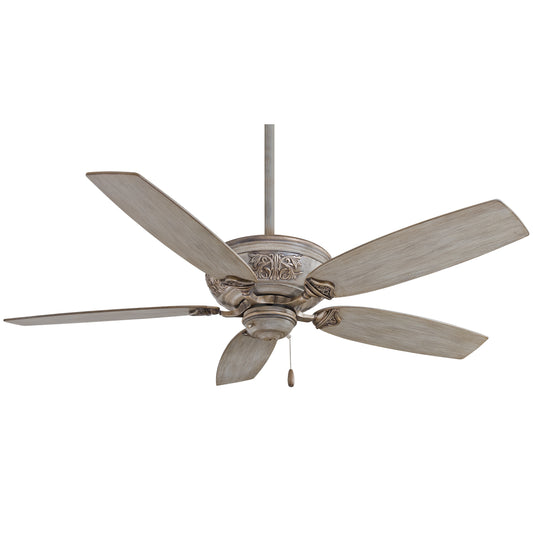
Forget the wobbly, noisy fans you remember from the past. Today’s market is full of designs that are as beautiful as they are powerful. Just imagine the elegant sweep of the Aerovon fan in your great room, or the breezy, coastal charm of the Cabana model out on your lanai. These aren't just fans; they're statement pieces that level up your decor while providing tangible comfort.
Choosing a premium model means you get to enjoy:
- Superior Airflow: They're engineered for maximum cooling power to truly combat that Florida heat.
- Whisper-Quiet Operation: Advanced motors run so silently, you only notice the breeze, not the buzz.
- Lasting Durability: High-quality construction is built to withstand the humidity and demands of our climate.
- Stunning Aesthetics: You get access to unique designs that complement and elevate your interior design.
Matching Fan Size and Style to Your Room
Picking out the perfect ceiling fan is one of those things that’s part art, part science. When you nail it, you get a beautiful fixture that keeps your room feeling just right. But if you get it wrong, you’re stuck with a wobbly, useless fan that just doesn't do the job. For anyone looking for the best ceiling fans in Port St. Lucie, the very first step—and the most important one—is matching the fan to your room’s size and style.
Think of a fan's blade span like the engine in a car. You wouldn't put a tiny engine in a huge truck, and a monster V8 is total overkill for a little compact car. It's the same idea here. A small fan will just get lost in a big, open great room, barely stirring the air. On the other hand, a massive fan can turn a cozy bedroom or home office into a wind tunnel. The real sweet spot is finding that perfect balance for maximum comfort.
Finding the Right Fan Size
Before you get attached to a specific look, grab a tape measure. The size of your room, calculated in square feet (just multiply the length by the width), is the single biggest factor in figuring out the right blade span. This isn't just a friendly suggestion; it's a proven standard that guarantees you'll get the airflow you're paying for.
Lucky for us, the professional guidelines are pretty straightforward.
For most standard rooms between 75 and 175 square feet—think a guest bedroom or home office—a fan with a 42- to 48-inch blade span is your best bet. Step up to a master bedroom or family room in the 176 to 350 square foot range, and you’ll need a more substantial 52- to 56-inch fan to really move the air around.
And for those spacious great rooms and open-concept living areas so common in Port St. Lucie homes, which are often bigger than 350 square feet, you'll want to look at fans larger than 60 inches. If you want to dig a little deeper, we've got a whole guide on how to choose a ceiling fan size.
Here’s a quick-reference table to make it even easier.
Ceiling Fan Sizing Guide for Port St Lucie Homes
Use this table to quickly find the recommended fan blade span based on your room's square footage for optimal airflow.
| Room Size (Square Feet) | Recommended Blade Span (Inches) | Ideal For | Fan Connection Example (>$300) |
|---|---|---|---|
| Up to 75 | 36 or less | Bathrooms, laundry rooms, small offices | Mini Breeze 30" |
| 76 to 175 | 42 - 48 | Guest rooms, home offices, kitchens | Modernaire 44" |
| 176 to 350 | 52 - 56 | Master bedrooms, family rooms, lofts | Artemis IV 54" |
| Over 350 | 60 or larger | Great rooms, open-concept living areas | Andros 60" |
Getting the size right ensures your fan works efficiently and looks like it belongs.
This chart shows how the ceiling fan market is broken down, with residential renovations being a huge piece of the pie.
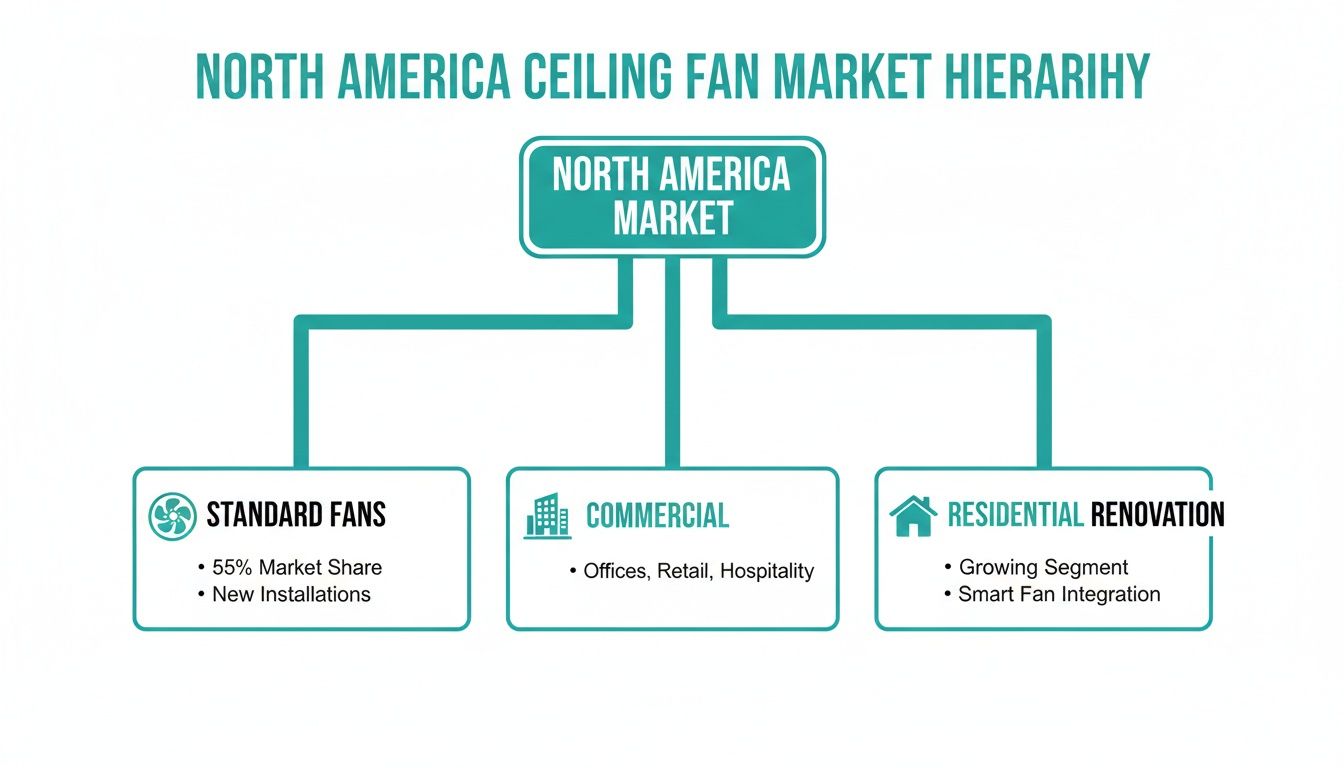
As you can see, standard fans and home projects are major drivers, which just goes to show how important it is to make a smart choice for your own home upgrade.
Choosing the correct fan size isn't just about airflow; it's about scale and proportion. The right-sized fan looks intentional and integrated, while the wrong size can make an entire room feel unbalanced.
Harmonizing Style with Your Home's Decor
Once you have the right size locked in, the fun really begins: picking a style that actually fits your home's vibe. A ceiling fan shouldn't feel like an afterthought; it should be a seamless part of your decor. Thinking about the overall aesthetic is a big deal, and it can be helpful to explore some contemporary ceiling designs to see how a fan can really complete a room.
Here at Fan Connection, we specialize in premium fans (all over $300) that are designed to match the diverse styles you see all over Port St. Lucie, from coastal chic to clean and modern. The number of blades, for instance, can completely change a fan's look.
- 3-Blade Fans: These usually have a sleek, aerodynamic feel that’s perfect for modern or minimalist spaces. A model like the Artemis IV, with a sale price over $700, brings in a touch of sophistication with its fluid, almost sculptural form.
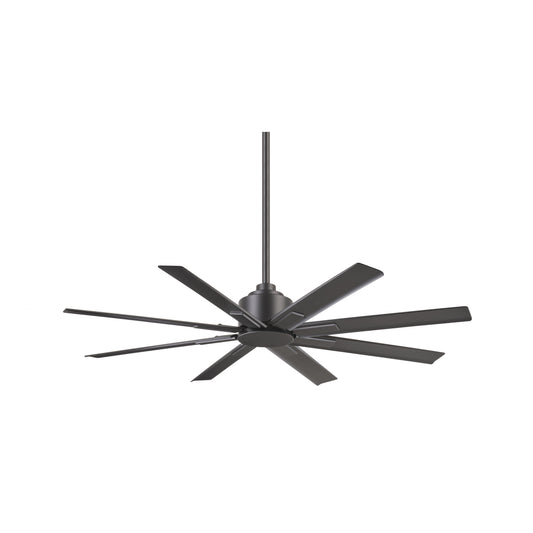
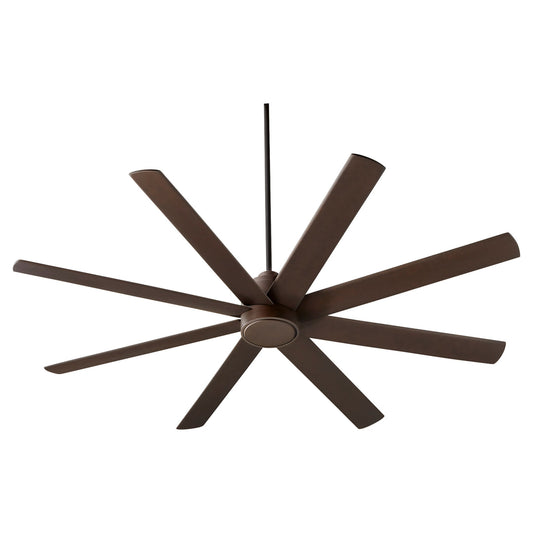
- 6+ Blade Fans: Fans with more blades, like the industrial-style Andros (over $1,000), create a much bolder, more commanding look. This is a great fit for rustic, industrial, or modern farmhouse interiors where you want the fan to make a strong statement.
Just keep in mind that installation costs can vary. Here in Port St. Lucie, you can expect to pay anywhere from $85 to over $605 for installation. The final price tag depends on how complex the fan is and whether your room is already wired for a fixture. Upgrading to a stunning dual-motor fan might be a bigger project, but for many homeowners, it's a fantastic investment in both comfort and home value.
Decoding Performance for Florida's Climate
Here in Port St. Lucie, a ceiling fan isn't just a nice-to-have accessory; it's your first line of defense against our relentless heat and humidity. But let's be real—not all fans are built for the job. To truly tame the Florida climate, you have to look past the pretty finishes and get into the specs that determine whether you get a lazy stir of air or a powerful, cooling gust.
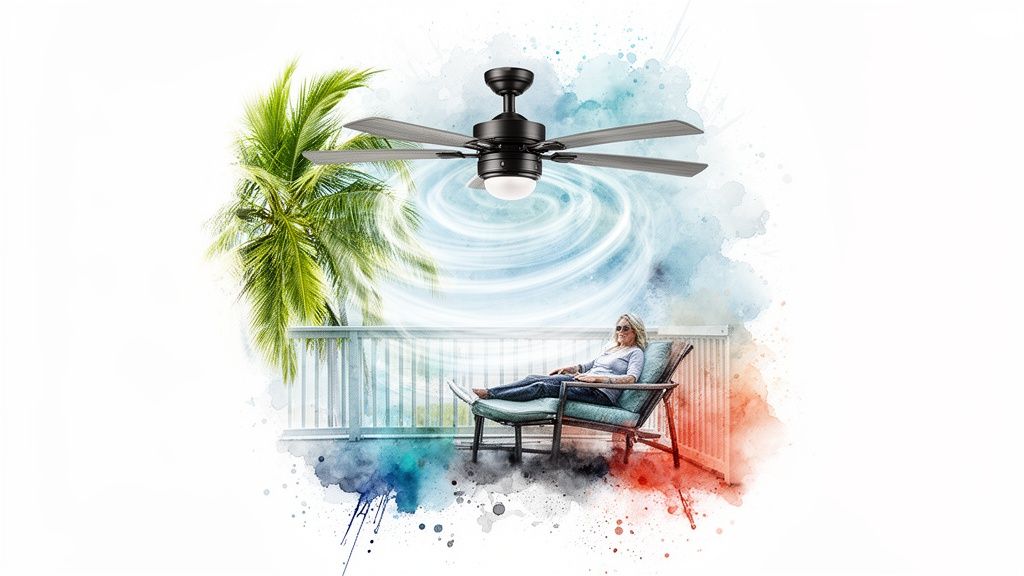
This is where the numbers really start to matter. When you’re looking at high-quality ceiling fans in Port St. Lucie, one of the most important metrics you'll see is CFM, which stands for Cubic Feet per Minute. This isn't just some techy jargon; it’s a direct measurement of how much air the fan actually moves. Think of it like a car's horsepower—a higher CFM means more airflow and a much bigger impact on how cool the room feels.
The Power of DC Motors
The engine driving all that performance is the motor, and today’s technology has a clear winner for both power and efficiency: the DC (Direct Current) motor. While older fans almost always used traditional AC (Alternating Current) motors, the premium models you see now—like the sleek, whisper-quiet Apex fan (which has a sale price over $400)—are built with advanced DC motors.
This is a huge upgrade. DC motors can use up to 70% less energy than the old AC motors, which you'll definitely notice on your FPL bill. They also give you way more control, often with six or more speed settings, and they run so quietly you'll barely know they're on. You can dive deeper into what makes these so great in our guide to energy-efficient ceiling fans.
Why Blade Pitch Is a Game Changer
Another spec that makes a massive difference, but often gets ignored, is blade pitch. This is simply the angle of the blades, measured in degrees. It might seem like a tiny detail, but it dramatically affects how much air the fan can scoop up and push downward.
Think about trying to row a boat with the oars held flat on the water—you wouldn't get very far. Angle them, and you start moving. A ceiling fan works on the exact same principle.
- Low Pitch (10-12 degrees): You’ll find this on a lot of budget fans. It moves less air and just can't create that satisfying breeze.
- High Pitch (13-15+ degrees): This steeper angle is the signature of a high-performance fan. It grabs a much larger volume of air with every spin, generating a strong downdraft you can actually feel.
A fan with a powerful motor and a high blade pitch is the winning combination. Together, they create that refreshing "wind chill effect" that makes a room feel several degrees cooler, even when the thermostat hasn't changed.
Built for Florida's Indoor-Outdoor Lifestyle
Living in Port St. Lucie means our lanais, patios, and porches are extensions of our homes. But our coastal humidity is brutal on electronics and furniture, and standard indoor fans are no exception. The moisture will warp blades and rust metal parts in no time. That’s why picking a fan with the right environmental rating is non-negotiable.
You’ll generally see two ratings for outdoor-ready fans:
- Damp-Rated Fans: These are your go-to for covered outdoor spaces like patios and screened-in lanais. They’re built to handle the humidity and ambient moisture without drooping or corroding, as long as they aren't directly hit by rain.
- Wet-Rated Fans: These are the heavy-duty option, engineered to withstand direct exposure to the elements—rain, salt spray, you name it. They're perfect for pergolas, gazebos, or any spot where the fan might get wet.
A versatile, damp-rated model like the Anywhere fan from Fan Connection (well over $300) is a smart investment for our area. It's built from the ground up with durable, all-weather blades and a moisture-resistant housing, so you can count on it to deliver a cooling breeze for years to come.
Navigating Installation in Port St. Lucie
You’ve done the fun part and picked out the perfect fan—maybe it's the powerful Aviation model or the elegant Artiste. Now for the final, and most critical, step: getting it installed correctly and safely. For homeowners installing new ceiling fans in Port St. Lucie, this part of the process is just as important as the fan you choose. A great installation is the difference between a quiet, efficient fan and one that wobbles and makes noise.
The first big question is always: should you do it yourself or call in a pro? If you're just swapping out an old light fixture for a new fan, a handy homeowner might be able to tackle it. But there are definitely times when calling a professional isn't just a good idea—it's essential.
If you're installing a fan where there was never a fixture before, you're not just hanging a fan; you're running brand-new electrical wiring. That's a job for a licensed electrician, no question about it. They'll make sure the wiring meets local codes and, just as importantly, that the electrical box in the ceiling is properly braced. That little detail is what keeps a heavy, spinning fan from becoming a serious hazard down the road.
DIY vs. Hiring a Licensed Electrician
The choice between DIY and hiring a pro really boils down to safety, the complexity of the job, and your own comfort level with electrical work. Let’s break it down to help you make the right call.
- DIY Installation: This is a good option if you're replacing an existing fixture where the wiring is already in place and you know the ceiling box is fan-rated. It can save you some cash on labor, but you need to be confident you know what you're doing.
- Professional Installation: This is a must for any new wiring, high or vaulted ceilings, or for those really heavy, complex fan models. A pro guarantees the work is safe, up to code, and done right the first time.
For those more complicated jobs, or even if you just want the peace of mind knowing it's done perfectly, it’s smart to look into expert ceiling fan installation services from a trusted local company.
Vetting Installers and Understanding Costs
When you hire a contractor in Port St. Lucie, doing a little homework upfront can save you a lot of headaches. Always ask to see proof of their license and insurance—this protects you from any liability and confirms they're qualified for the job. It's also a good idea to get quotes from at least two or three different electricians to see how their pricing and services stack up.
Be crystal clear about the project when you ask for a quote. Is it a simple swap, or will they need to install a new support box and run wiring? The more information you give them, the more accurate your estimate will be, and you'll avoid any surprise charges. For a bit more help on what to look for, check out our guide on finding top-rated ceiling fan installation services near you.
Remember, the total cost of your project isn't just the price of the fan. It's the fan plus labor. Budgeting for professional installation from the start ensures you can afford both the premium product and the quality workmanship it deserves.
Local Codes and Permit Considerations
Finally, let's touch on local building codes. Most of the time, if you're just replacing an existing fixture with a fan using the same wiring, you won’t need a permit here in Port St. Lucie. But things change once new electrical circuits enter the picture.
Running new wiring to a spot that didn't have a fixture before is considered new electrical work, and that almost always requires a permit and a follow-up inspection. Your licensed electrician will handle the entire permitting process, making sure your new installation is fully compliant with St. Lucie County's regulations. This isn't just red tape; it's a system designed to keep your home safe. Knowing this upfront helps you manage the installation of your beautiful new fan with total confidence.
Here's the rewritten section, crafted to sound like a local expert sharing practical advice.
Getting the Most Out of Your Fan (and Your FPL Bill)
Living in Port St. Lucie, we all know that keeping the house cool is a year-round battle. Your air conditioner probably feels like the hardest-working appliance you own. But what if you could give it some backup—a secret weapon that could seriously trim your FPL bill without sacrificing comfort? That's exactly what a quality ceiling fan brings to the table. It’s more than just a fixture; it's a smart investment.
The magic isn't in making the air colder. It's all about the wind chill effect. Think about how great a light breeze feels on a hot day at Jensen Beach. Your fan does the same thing indoors. Its blades create a gentle downdraft that helps moisture evaporate from your skin, making you feel much cooler even though the thermostat hasn't budged.
This simple bit of physics is your ticket to real savings. By creating that personal cooling zone, you can comfortably nudge your thermostat up by as much as 4°F. That might not sound like a huge number, but the U.S. Department of Energy says that for every degree you raise the thermostat in the summer, you can save up to 3% on your cooling costs. For anyone with ceiling fans in Port St. Lucie, that's a strategy that adds up fast.
Year-Round Performance with a Reversible Motor
A great fan doesn't take the winter off, either. Most quality models include a reversible motor, a small feature that makes a big difference when our cooler, drier months finally arrive.
During our mild Port St. Lucie winters, you just flip a switch on the fan's housing to reverse the blade direction. Instead of pushing air down, the fan will spin clockwise, gently pulling cool air upward. This circulates the warm air that naturally rises and gets stuck at the ceiling, mixing it back into the room. The result? A more evenly heated space, which means your heating system doesn't have to work nearly as hard.
Why ENERGY STAR® Certified Fans are Worth It
If you're serious about maximizing your savings, always look for the blue ENERGY STAR® label. These fans are independently tested and certified to be way more efficient than their standard counterparts, often thanks to advanced DC motors and smarter blade designs.
An ENERGY STAR® certified fan can be up to 60% more efficient than a conventional model. That means it moves more air with less electricity, giving you powerful cooling without the powerful bill to match.
At Fan Connection, we focus on stocking these high-efficiency models—you’ll find them in our collection of fans priced over $300, where performance and durability are a given. Choosing a fan like the ultra-efficient Apex DC or the stylish Artemis IV doesn't just upgrade your home's look; it delivers real, long-term savings.
Don't Forget About Local Rebates
Here's another great perk for us Port St. Lucie residents: local utility rebates. Companies like Florida Power & Light (FPL) often run programs that give you money back for installing energy-efficient appliances, and ENERGY STAR® certified ceiling fans are frequently on that list.
These incentives are designed to encourage conservation, and they can help offset the initial cost of a better fan. It’s always smart to check the FPL website or give them a call to see what rebates are currently active for energy-saving upgrades. When you combine a fan's built-in efficiency with a local rebate, your investment pays for itself even faster.
Caring for Your Investment with Long-Term Maintenance
You've picked out the perfect fan for your Port St. Lucie home—maybe it’s a classic like the Chateaux (over $600) or something more modern like the Chisel (over $500). Either way, you’ve made a great investment in your comfort. Now, let’s talk about keeping it running like new for years to come. A little bit of simple care goes a long, long way.
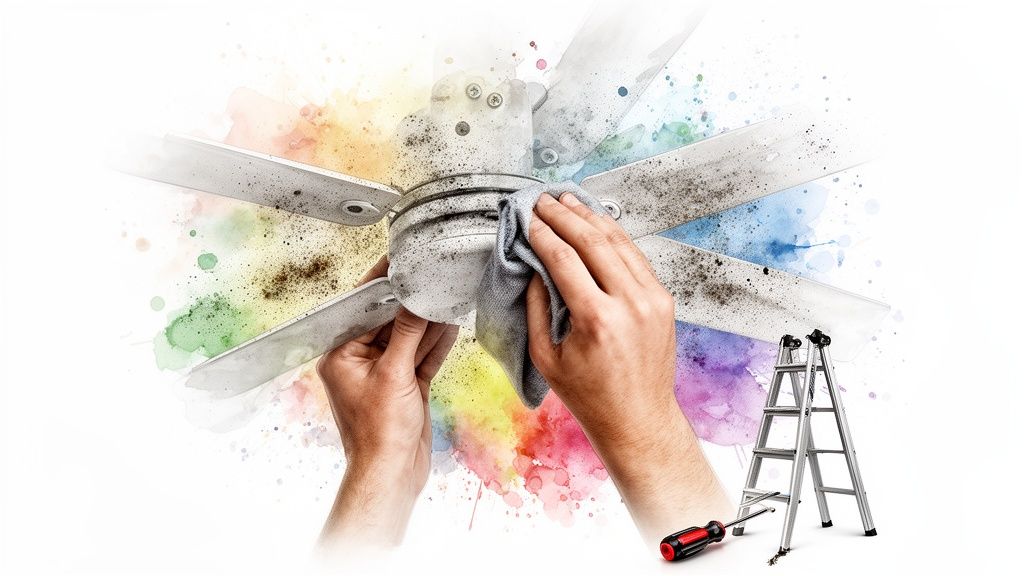
The number one job is keeping those blades clean. Here in our climate, dust and pollen love to build up on the leading edge of fan blades, and that build-up is just enough to throw the whole fan off balance. That annoying wobble or clicking sound? It almost always starts with dusty blades.
A Simple Blade Cleaning Routine
Cleaning the blades isn't just about looks; it’s about keeping your fan balanced for quiet, smooth operation. How you do it depends on what your blades are made of.
- For Wood Blades: Grab a soft, dry cloth or a duster. You’ll want to avoid water and liquid cleaners entirely—moisture can ruin a wood finish and even cause the blades to warp over time.
- For Metal or Plastic Blades: A slightly damp cloth with a gentle, non-abrasive cleaner works perfectly. Just make sure you wipe them dry when you’re done to prevent water spots or streaks.
Taking a few minutes to do this every so often is the best way to prevent those frustrating clicking and whirring sounds that neglected fans are famous for.
Keeping Everything Secure
A ceiling fan is constantly in motion, and over time, that movement can cause screws to loosen up just a tad. About twice a year, it's a smart idea to do a quick check to make sure every connection is still tight and secure. It’s a simple preventative step that’s huge for performance and safety.
First, kill the power to the fan at the circuit breaker. Then, gently check and tighten the screws holding each blade to its bracket (also called the blade iron). Next, move on to the screws connecting the blade irons to the motor itself. Finally, give the mounting hardware at the ceiling a quick check to make sure it’s snug.
A wobbly fan is often just a symptom of a loose screw. A few minutes with a screwdriver can restore perfect balance, eliminate noise, and extend the life of your fan's motor.
Maintaining Your Fan Light Kit
If your fan has a light, keeping the fixture clean ensures you’re getting the most light possible. You can usually remove any glass shades or bowls for a proper cleaning. A quick wash in warm, soapy water will do the trick. Just let them dry completely before putting them back on.
While you're at it, this is the perfect time to think about upgrading your light bulbs. Swapping old incandescent bulbs for modern LEDs is one of the smartest, easiest upgrades you can make. LEDs use a tiny fraction of the energy, last for years, and produce almost no heat—which is always a plus here in Florida.
Still Have Questions About Ceiling Fans in Port St. Lucie?
Even with all this info, you might still be wrestling with a few questions. That's perfectly normal. Let's tackle some of the most common ones we hear from homeowners right here in Port St. Lucie.
What Is the Best Ceiling Fan for a Covered Patio?
For any covered outdoor space in our humid climate—whether it’s a lanai, porch, or outdoor kitchen—you absolutely need a fan that is at least "damp-rated." These aren't your average indoor fans; they're built with materials that won't rust, corrode, or sag when exposed to our thick, salty air.
You only need a "wet-rated" fan if the area gets hit directly by rain. For most covered patios in Port St. Lucie, a solid damp-rated model is the perfect fit. A versatile option like the Anywhere fan (which runs well over $300) is a great example of getting that blend of style and rugged durability you need to beat the humidity.
How Much Can I Really Save on My FPL Bill?
The savings are real, and frankly, they're pretty significant. Just by running a ceiling fan, you can nudge your thermostat up by about 4°F and not feel a bit warmer. That gentle breeze creates a "wind chill effect" that takes a huge load off your air conditioner.
According to the Department of Energy, making that one simple change can cut your cooling costs by up to 15%. Here in Port St. Lucie, where the AC is one of our biggest household expenses, those savings pile up fast. It makes a good, efficient fan one of the smartest financial moves you can make for your home.
Do I Need a Permit to Install a Ceiling Fan?
This is a big one, and it's all about safety. For the most part, if you're just swapping out an old light fixture for a new fan and using the existing wiring, you likely won't need a permit in Port St. Lucie.
However, if you're putting a fan in a spot where there wasn't one before—meaning you need to run new electrical wiring—then a permit is almost always required. This isn't just red tape; it ensures a licensed electrician installs a properly braced junction box that can actually handle the weight and wobble of a running fan. When in doubt, always have a quick chat with a local pro.
Why Choose an Online Retailer Over a Big-Box Store?
Look, the big-box stores are convenient, no doubt about it. But when it comes to selection and quality, a specialized online retailer is in a different league. You'll find premium, design-forward fans that you just won't see sitting on their shelves. We spend our time curating collections from brands known for top-tier motors, better materials, and genuinely unique designs.
Shopping with a dedicated expert gives you access to standout pieces like the sculptural Artemis XL5 (over $1,000) or the bold Bowie (over $400). You get the detailed specs you need to make a smart choice, and it all gets delivered right to your door. It’s about finding the perfect fan, not just a fan.
At Fan Connection, we live and breathe this stuff. We're here to help you find that perfect ceiling fan that marries incredible style with performance that can handle the Florida climate. Take a look through our collections and find the new centerpiece for your Port St. Lucie home.


