











Finding Ceiling Fans Stores Near Me: A Smarter Search Guide
When you type "ceiling fans stores near me" into a search bar, you're not just looking for directions. You're kicking off a thrilling hunt for the perfect blend of style, airflow, and quality for your home. And let's be real, the best place to buy your next fan might not even be a physical store. This brings up the classic showdown: do you shop local or go with a dedicated online retailer for that premium, show-stopping piece?
Your Modern Search For Local Ceiling Fan Stores
That simple search query is the first step in a much bigger, more exciting process. You’re not just buying a fan; you're finding a solution to make your home more comfortable, stylish, and a little more you. This lines up perfectly with a huge trend we're seeing in home appliances, where people are more focused than ever on both energy efficiency and saving a few bucks on their utility bills.
This push for smarter, more efficient cooling is making a real impact. The global ceiling fan market is expected to grow from USD 10.17 billion to USD 12.09 billion, largely because rising electricity costs have everyone thinking twice about their energy use.
Differentiating Your Local Options
Before you grab your keys and start driving, it pays to do a little digital reconnaissance. Your search results will probably give you a mix of big-box hardware stores and smaller, specialized lighting showrooms. Knowing the difference between them will save you a lot of time and frustration.
- Big-Box Retailers: Think convenience and a decent selection of budget-friendly models. The downside? Their selection is often limited to mass-market brands, and the staff might not have the deep expertise you need for specific questions about high-end models.
- Specialty Showrooms: This is where you'll find the high-end, designer fans and staff who really know their stuff. You can ask detailed questions and get expert advice, but you'll likely face higher prices and a smaller inventory than what a dedicated online store can offer.
Getting some general advice on how to vet local businesses is always a good idea. You can even find helpful tips to choose the best furniture stores near you that apply just as well to fan shopping.
The most important thing you can do is figure out what you really need. Is a unique design your top priority? Or maybe whisper-quiet operation for a bedroom? Or are you all about saving every penny on your energy bill? Knowing your must-haves will point you to the right type of store.
If energy efficiency is high on your list, our guide on finding ceiling fans with energy-efficient ratings near you is a great place to start.
What To Look For During An In-Store Visit
Walking into a showroom filled with dozens of spinning fans can feel a bit dizzying. To turn this potentially overwhelming experience into a productive mission, you need to go in with a game plan. Forget aimless wandering; it’s time to evaluate these fans like a seasoned pro.
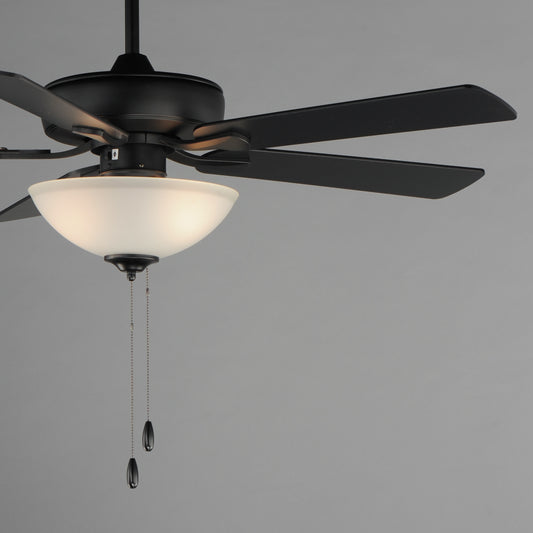
Start by getting up close and personal with the floor models. This is your chance to see the little details that product photos just can’t capture. How does the finish on the blades really look under the showroom lights? Is the motor housing solid and hefty, or does it feel flimsy? Run your hand over the materials—whether it's rich koa wood or sleek brushed nickel—to gauge the true quality.
Smart Questions To Ask The Staff
Once you've zeroed in on a few contenders, it’s time to chat with the sales staff. Their expertise is a huge part of why you're visiting a physical store in the first place, so don't be shy.
Here are a few essential questions to get the conversation started:
- What type of motor does this fan use? Ask about AC vs. DC motors. A premium DC motor fan, like the stunning Modern Forms Wynd, which sells for over $400, offers whisper-quiet operation and is up to 70% more energy-efficient than its AC counterparts.
- What is the CFM rating? Airflow, measured in Cubic Feet per Minute (CFM), is the single most important performance metric. A higher CFM means more powerful air movement, plain and simple.
- Can you explain the warranty details? You're looking for models with a lifetime motor warranty. That's a clear signal that the manufacturer has confidence in their product.
Remember that showroom lighting is designed to make everything look its absolute best. Snap a few photos of your favorite fan finishes and take notes on your phone. This makes it so much easier to compare options later and imagine how they'll actually look in your home's unique lighting.
Knowing what to look for is half the battle. For a deeper dive, check out our guide on how to choose a ceiling fan to become a true expert before you even set foot in a store.
Local Showrooms vs. Online Specialists: Where Should You Buy?
When you search for "ceiling fans stores near me," you'll quickly find yourself at a crossroads: should you head to a local showroom or buy from a dedicated online retailer? It's a classic dilemma, and the right answer really depends on what you value most in the shopping experience.
The big appeal of a physical showroom is, of course, getting to see and touch the fans. You can get a true feel for the finish, see how the light kit looks in person, and judge the overall build quality with your own hands. But here's the catch—that hands-on experience usually comes with a much smaller selection. Local stores just don't have the floor space to display anything beyond the most popular, mainstream models.
The Endless Aisles of Online Retail
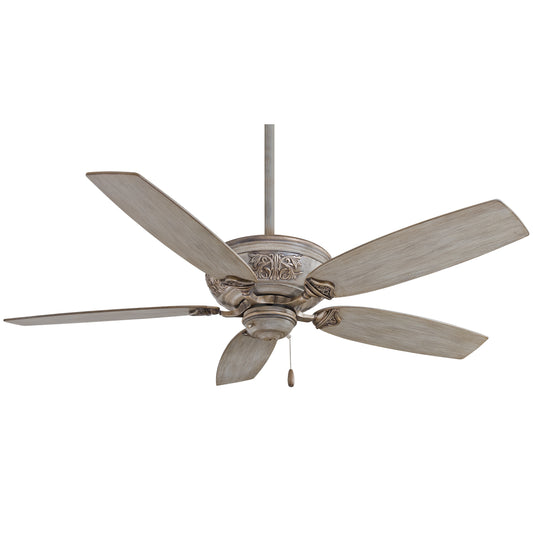
This is where an online specialist like Fan Connection really shines. Instead of being limited to a few dozen options, you get access to a massive, curated catalog of fans from all the best brands. It’s your chance to discover unique designs that a local shop would never risk stocking, like the sculptural Minka-Aire Light Wave (which runs over $350) or the breezy, tropically-inspired Casablanca Caneel Bay (around $500).
Online, every product page is packed with detailed specs, high-res photos, and customer reviews. You can easily compare critical details like airflow (CFM), motor type, and energy efficiency without a salesperson hovering over you. It puts you in the driver's seat, letting you make a decision based on hard data, not just what happens to be in stock.
This flowchart breaks down what you should be looking for if you do go in-store, but it also highlights why having all that detailed info online is so critical when you can't inspect a fan yourself.
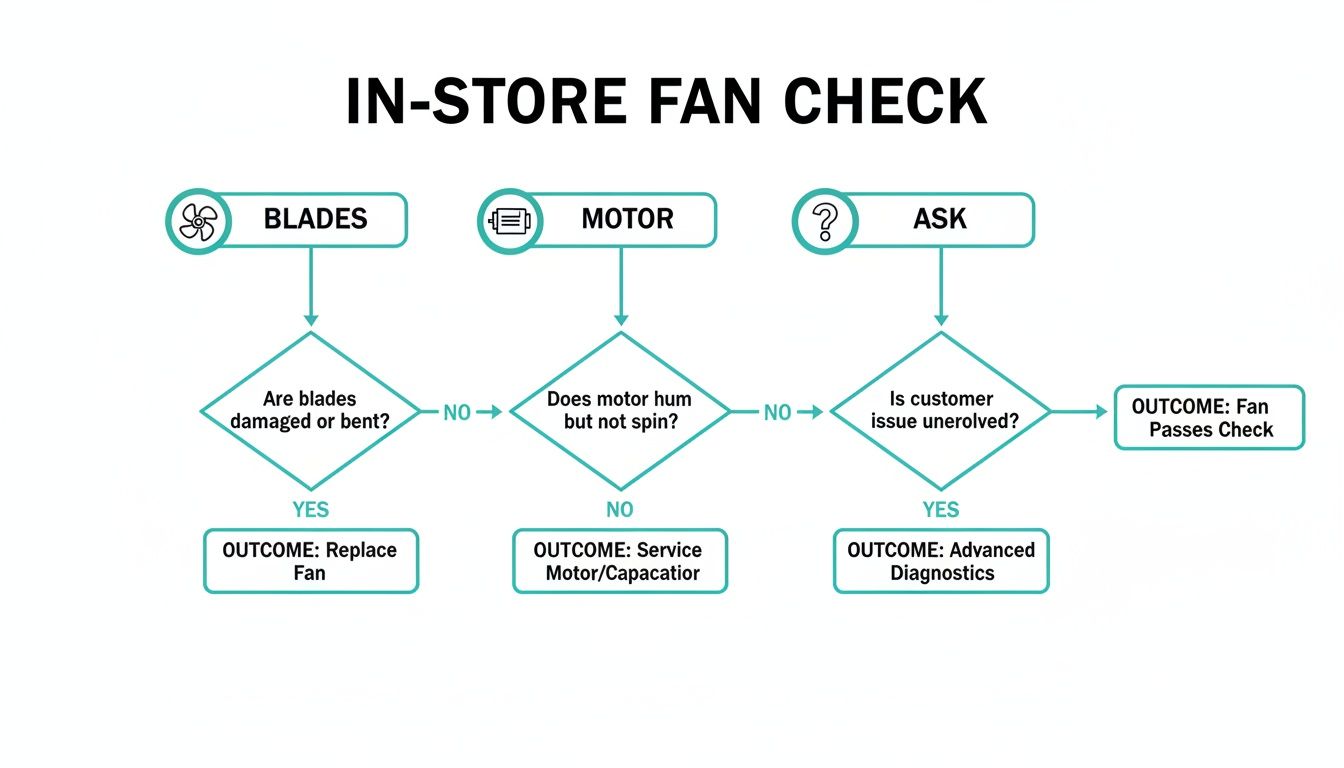
From blade pitch to motor housing, there’s a lot to consider. Comprehensive online specs give you the full picture.
How We Shop for Fans Is Changing
The search for local stores also points to a bigger trend. The global smart ceiling fan market is on track to hit a staggering USD 993.6 million by 2025, and experts agree that online stores are the fastest-growing part of that market. More and more, people are choosing the massive selection and convenience of having the perfect fan delivered right to their door.
This choice between local and online isn't unique to fans; it's a common thread across home decor. For a broader look, you can check out this fantastic guide to luxury home furnishings from local showrooms to online shops.
Ultimately, it comes down to what works for you. To make it a bit clearer, here's a side-by-side look at the pros and cons.
Local Store vs Online Retailer Fan Connection
| Feature | Local Showroom | Fan Connection (Online) |
|---|---|---|
| Selection | Limited to floor models and popular styles. | Vast catalog with hundreds of designs, finishes, and sizes. |
| Convenience | Instant gratification, but requires travel and store hours. | Shop anytime, from anywhere, with delivery to your door. |
| Expertise | Depends on the salesperson on duty. | Detailed specs, customer reviews, and expert support available. |
| Pricing | Often higher due to overhead costs. | Competitive pricing with direct-to-consumer value. |
| Hands-On Feel | You can see and touch the fan before buying. | Relies on high-quality images, videos, and detailed descriptions. |
While a trip to a local showroom can be great for getting a feel for different styles, an online specialist like Fan Connection almost always wins on selection, price, and pure convenience. You get the best of both worlds: inspiration from everywhere, with the power to find the exact right fan for your space.
Investing In A Statement Ceiling Fan
For some of us, a ceiling fan is more than just a way to move air around. It's a piece of kinetic art—the focal point that ties a whole room together. When your hunt for "ceiling fans stores near me" is about finding something truly special, the basic, off-the-shelf options just don't make the cut. This is where you start looking at premium, design-forward models, typically costing over $300, that turn a simple appliance into a conversation piece.
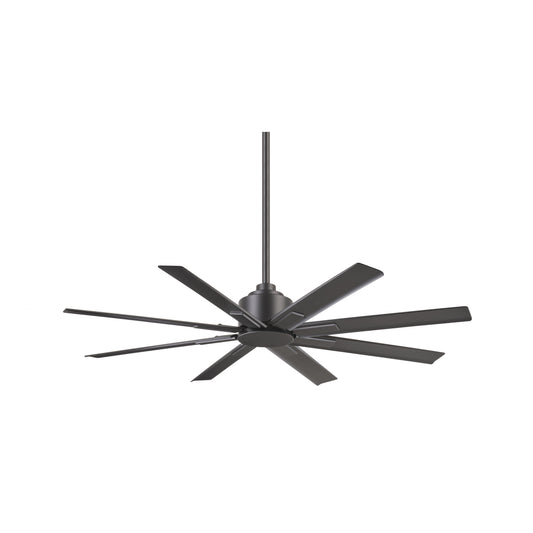
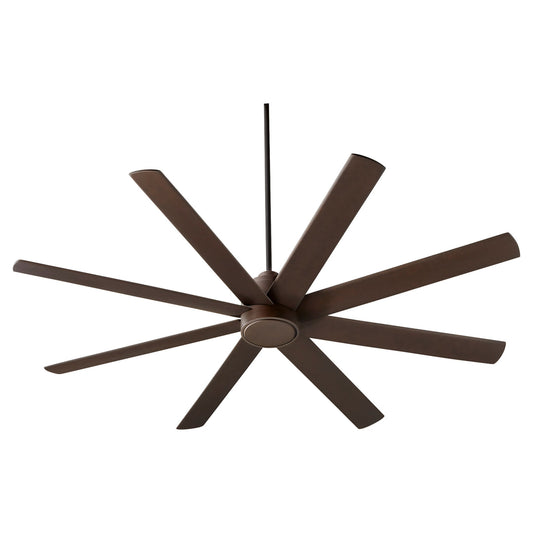
These aren't your run-of-the-mill fans; they're an investment in both style and engineering. Take the sleek, three-bladed Fanimation Spitfire model, for example, which often goes for more than $500. Its minimalist, propeller-inspired design is a perfect fit for modern or industrial spaces, making a powerful statement without ever feeling overbearing. It’s a classic case of form meeting function in the best possible way.
Going Bold With Design And Power
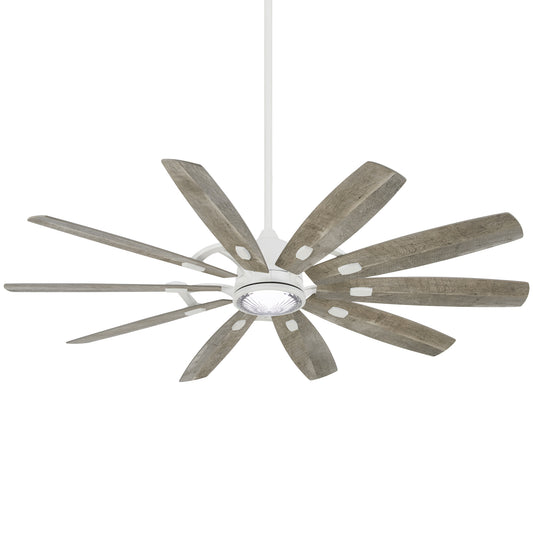
If you're dealing with a large space that needs serious airflow and a major visual anchor, a fan like the Kichler Gentry XL is a true showstopper. Usually priced over $800, its distinctive, nine-blade windmill design creates a dynamic centerpiece that’s ideal for great rooms or spaces with high, vaulted ceilings. It looks like modern art and performs like a beast.
These high-end fans earn their price tags with top-notch materials, whisper-quiet DC motors, and designs that have a real story behind them. It’s no surprise that more people are seeking out these standout models. The global ceiling fan market is projected to hit around USD 12.4–14.6 billion by 2025, a growth driven by a desire for unique, design-led fans that you simply won't find at the local hardware store. You can learn more about this growing market and see just how much design is influencing what people buy.
A statement fan does more than circulate air; it elevates the entire design language of your room. It communicates a commitment to quality and a refusal to settle for the ordinary, becoming a conversation starter that guests will always notice.
Finalizing Your Choice and Planning The Installation
You've found the perfect fan—awesome! Now, before you swipe your card or click "buy," let's make sure your home is ready for its grand entrance. A few quick checks right now will save you a world of headache later and ensure the installation is totally stress-free. This isn't just about making sure it fits; it's about guaranteeing your new fan runs safely and performs at its best from day one.
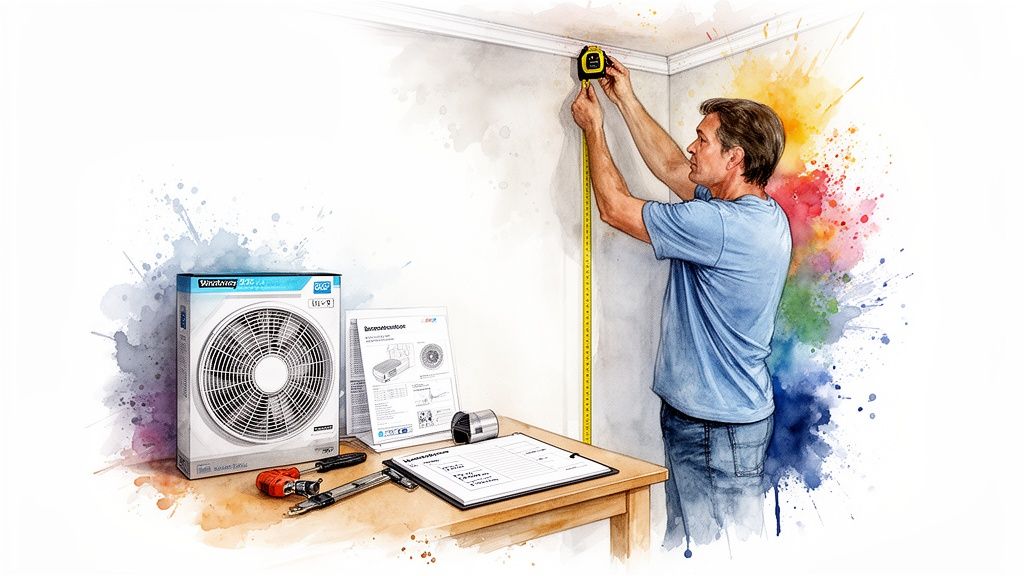
First things first, grab a tape measure. You need to know your ceiling height. If you're working with ceilings under 8 feet, a low-profile or "hugger" style fan is a must. For anything 9 feet or taller, you'll definitely need a downrod to get proper airflow. The rule of thumb is simple: the higher the ceiling, the longer the downrod.
Pre-Installation Safety Checklist
Next up is the electrical setup, and this part is crucial. Not all ceiling electrical boxes are built the same. A standard box designed for a lightweight light fixture simply isn't strong enough to handle the weight and constant motion of a spinning ceiling fan.
- Confirm the Rating: Take a look at your existing electrical box. It must be stamped as "fan-rated" to safely support your new fixture. If it isn't, it has to be replaced.
- Check the Wiring: Make sure you have the necessary wiring ready to go. If you're just swapping out an old light fixture, you're probably in good shape. If this is a brand-new spot for a fan, you'll need to get a power source there first.
The DIY versus pro installation debate is a big one. Honestly, if you're doing a simple replacement and you're comfortable with basic wiring, you can probably handle it. But if you're dealing with new wiring, a questionable electrical box, or just aren't 100% confident, call a licensed electrician. Safety is the one thing you can't compromise on.
Figuring out the installation can feel like a big decision, but getting an expert to do it right is often the smartest money you'll spend. You can learn more by exploring some top-rated ceiling fan installation services close to you to see what the pros can offer. Taking these quick steps ensures your new fan will be a source of comfort—not problems—for years to come.
Got Questions About Ceiling Fans? We've Got Answers.
Jumping into the world of ceiling fans can feel a little overwhelming. From sizing to motors, a lot of questions pop up whether you're searching for "ceiling fans stores near me" or clicking through options online. Getting the right answers is the key to picking a fan you'll love for years.
Here are a few of the most common things we get asked by shoppers.
How Do I Figure Out the Right Fan Size for My Room?
This is probably the most important question to get right. Matching the fan's blade span to your room's square footage is essential for getting that perfect breeze. A fan that's too small will barely stir the air in a big room, while an oversized one can feel like a wind tunnel in a tight space.
Here’s a quick cheat sheet:
- Small Spaces (Up to 75 sq. ft.): Think home offices, laundry rooms, or breakfast nooks. A fan with a blade span under 36 inches is your best bet.
- Standard Rooms (Up to 175 sq. ft.): For most bedrooms and living rooms, look for a fan in the 42- to 50-inch range.
- Large Rooms (Up to 350 sq. ft.): Bigger family rooms and master suites need the airflow from a 52- to 60-inch fan.
- Great Rooms (Over 350 sq. ft.): For those truly open, expansive spaces, go for an oversized fan 62 inches or larger. You might even consider installing two fans to keep the air moving evenly.
A pro tip: While size is a great starting point, the real measure of a fan's power is its CFM (cubic feet per minute) rating. A higher CFM number means more air movement, so always check the specs!
What's the Big Deal About AC vs. DC Motors?
This is a big one, and it affects everything from your energy bill to how quiet your fan runs. AC (Alternating Current) motors have been the industry standard for ages. They're reliable workhorses and generally cost less upfront.
But DC (Direct Current) motors are the modern, premium choice for a reason. They are incredibly efficient, using up to 70% less energy than their AC counterparts. They also run almost silently and typically offer more features, like six speed settings and a simple remote-controlled reverse function. A high-end DC model like the Monte Carlo Maverick, which sells for over $600, is a true investment in superior, quiet performance and long-term energy savings.
Can I Actually Put a Ceiling Fan on a Sloped Ceiling?
Yes, you absolutely can! Most fans today are designed with vaulted ceilings in mind. The mounting hardware included in the box can typically handle a slope up to a certain angle, usually around 15-30 degrees.
If you're dealing with a steeper pitch, you'll just need a separate sloped ceiling adapter, which is an easy-to-find accessory. The main goal is making sure the blades have plenty of room to spin without smacking the ceiling. Sometimes this means you'll also need a longer downrod to get the fan to the perfect height for both safety and airflow. Just be sure to double-check the fan's specifications to confirm what it can handle.
Ready to skip the local search and find the perfect fan from a curated collection? Fan Connection offers an extensive range of statement-making fans with detailed specs to help you choose with confidence. Find your perfect model at https://www.fanandlights.com.


