











A Homeowner's Guide to Ceiling Fans with LED Lights
If you’ve ever found yourself staring up at an old, wobbly ceiling fan, you know it’s more than just an eyesore—it’s an opportunity. The single biggest upgrade you can make to a room is often a ceiling fan with integrated LED lights. This isn’t just about screwing a bulb into a fan anymore. It's about combining powerful, quiet air movement with beautiful, efficient lighting in one modern package.
The Modern Upgrade for Style and Efficiency

It’s time to move on from the clunky fan-and-light combos of the past. Today’s best fans are designed from the ground up to be stylish centerpieces that also happen to lower your energy bills. They solve two of the most basic needs in any home—airflow and light—with one elegant solution.
The real shift happened with the arrival of LED technology. For years, fan designers had to work around the bulky shape of a standard light bulb. This often led to clumsy, tacked-on light kits that ruined the fan’s silhouette. But the slim, compact nature of modern LED panels has blown the doors wide open for design, allowing for the aerodynamic, minimalist, and even artistic shapes that just weren’t possible before.
Why Make the Switch?
Choosing a modern fan with an integrated LED isn't just about looks. The practical benefits show up right away:
- One Cohesive Look: The fan and light are built to work together, creating a clean, unified design that elevates the whole room.
- Serious Efficiency: Integrated LEDs and modern DC motors use a fraction of the power of their older cousins. You’ll see the difference on your electricity bill.
- Better All-Around Performance: You get powerful, whisper-quiet airflow and a light source that’s specifically engineered to illuminate your space perfectly.
Think of it this way: choosing an integrated LED fan is like getting a custom-tailored suit instead of one off the rack. The fit, form, and function are all perfectly harmonized to deliver a superior experience.
This guide will walk you through everything, from decoding the technical specs to picking a fan that completely changes the feel of a room. For example, a statement piece from our Artemis IV Collection, with its sculptural blades and powerful LED, can become the focal point of a great room, proving that functional fixtures can also be high art.
We'll show you how investing in the right fan is less of a purchase and more of an upgrade to your lifestyle. You’re not just buying a fan; you're creating a more comfortable, stylish, and efficient home.
Why Integrated LED Is the Superior Design
Ever wondered what really makes the difference between a basic ceiling fan and one of those stunning, high-end models that cost over $300? Nine times out of ten, the secret is integrated LED technology. Think of it like buying a suit: you can get one off the rack, or you can have one tailored to fit you perfectly. Integrated LED is the tailored option.
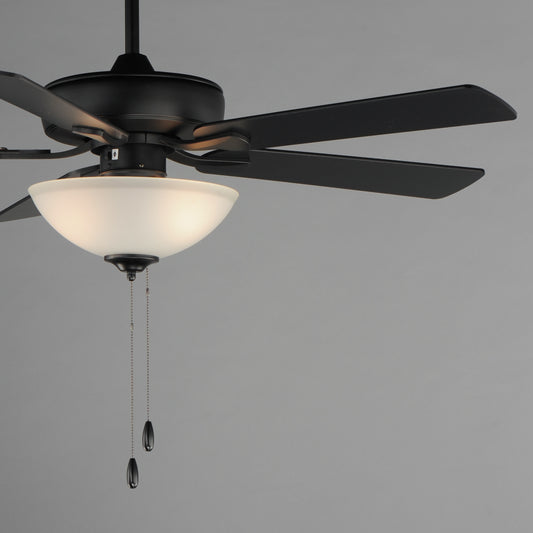
Traditional ceiling fans are built with a generic light socket meant for a standard, screw-in bulb. This almost always leads to a clunky, tacked-on light kit that just looks like an afterthought, completely disrupting the fan's design.
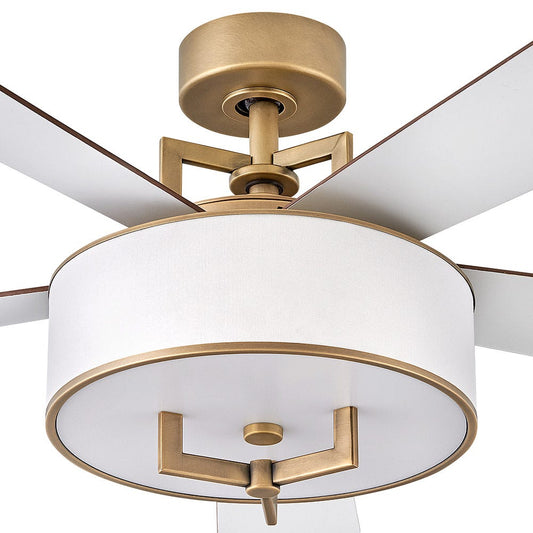
In contrast, premium ceiling fans with led lights are designed from the ground up as a single, seamless unit. The light source isn’t just an attachment; it’s woven into the very fabric of the fan’s design. This holistic approach is what unlocks truly breathtaking forms.
A Fusion of Form and Function
Because integrated LED panels are so slim and versatile, designers are free to create aerodynamic, minimalist, and even sculptural shapes that would be impossible with big, bulky bulbs. It’s not just about looking good, either—it’s about smarter performance.
When the light is built directly into the fan’s body, it’s engineered for perfect light distribution. You get a soft, even glow across the room instead of a harsh, concentrated spotlight. The light becomes a core part of the room's ambiance, not just a utility.
It's no surprise the market for these fixtures is taking off. The global ceiling fans with lights market was valued at a massive $28.65 billion in 2025 and is still climbing, showing a clear shift toward appliances that blend beautiful design with smarter tech.
The Long-Term Advantage
This is where integrated LEDs really pull ahead, delivering incredible value over the fan's lifespan. A regular bulb might last you a year or two if you're lucky. An integrated LED module, on the other hand, is designed to last for decades.
Most integrated LED panels are rated for 25,000 to 50,000 hours of use. Let's put that in perspective: if you run your fan's light for six hours every single day, it could last for over 22 years before you’d ever have to think about a replacement.
That incredible longevity means you can finally say goodbye to wobbling on a ladder to change a burnt-out bulb. The fan you install today will likely give you consistent, beautiful light for as long as you own your home.
The Proof Is in the Design
The best part of this technology is seeing what it makes possible. It’s what allows designers to create fans that are as much a piece of art as they are a functional appliance.
Just look at these examples from our own collections—these designs simply couldn't exist without integrated LEDs:
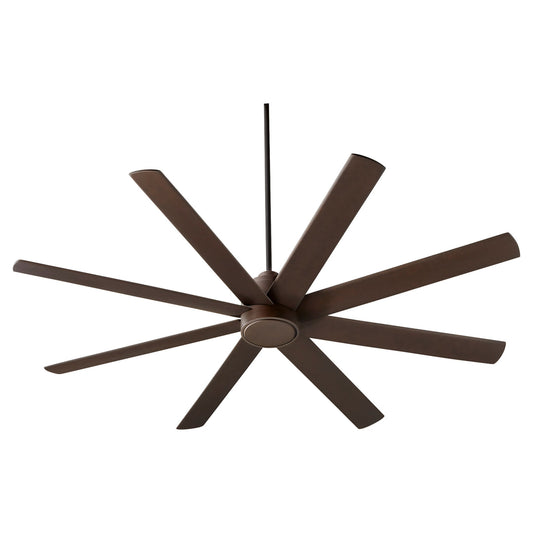
- The Sculptural Statement: Our Artemis IV Collection, with prices starting at $699, has gracefully twisting blades that flow directly into the central light source. That fluid, organic shape would be completely ruined by a clunky, traditional light kit.
- The Minimalist Marvel: The Aviation Collection, starting from $449, features a sleek, three-bladed profile with an ultra-slim light. It’s the perfect fit for modern spaces where you want powerful airflow and light without any visual clutter.
These models make it clear: an integrated LED isn't just a feature. It's the very foundation of superior fan design, elevating the style of the entire room. If you're still weighing your options, our guide on choosing a fan light kit offers more detail on the differences.
Decoding the Language of LED Light Specs
Shopping for ceiling fans with led lights can feel like you’ve been handed a technical manual when all you wanted was a simple on/off switch. You’ll see a bunch of terms thrown around—lumens, Kelvin, CRI—that can make your eyes glaze over.
Don’t worry. We’re going to cut through the noise. These aren’t just random specs; they’re the keys to getting the exact feel you want for your room. Let’s get you fluent in the language of light so you can choose your next fan with total confidence.
Lumens The Volume of Light
Think of lumens (lm) as the "volume" knob for your light. It's the simplest and most direct way to measure brightness. More lumens? More light. It's that easy.
We've all been trained to think about watts when it comes to brightness, but that's old-school thinking from the incandescent bulb era. LEDs are incredibly efficient, so lumens are what really count now. For example, a modern LED might give you 1,600 lumens of bright light while only using 15 watts, where an old bulb needed a whopping 100 watts to do the same job.
Kelvin The Tone of Light
If lumens are the volume, then Kelvin (K) is the tone. This spec is all about the color temperature of the light—from a warm, cozy glow to a crisp, bright white. This is what really sets the mood.
-
Warm White (2700K - 3000K): This is that familiar, inviting glow of a traditional light bulb or a sunset. It’s absolutely perfect for creating a relaxing atmosphere in bedrooms, living rooms, and dens. The Bola Collection is a great example, pairing sophisticated design with these warm, comforting light options.
-
Cool White (3500K - 4100K): This is a cleaner, more neutral white light. It's fantastic for kitchens, bathrooms, and home offices where you need clear, crisp visibility for tasks.
-
Daylight (5000K+): This is a very bright, blue-toned light that mimics natural daylight. It’s sharp and energizing, which makes it a great fit for workshops, garages, or any space where you need maximum focus and true-to-life color perception.
Sometimes you'll see a fan listed with "CCT," which stands for Correlated Color Temperature. This is a game-changing feature that lets you switch between different Kelvin settings on the same fan. You can go from a cozy warm light for movie night to a bright, focused light for cleaning, all with a simple click.
CRI The Quality of Light
Now for the Color Rendering Index (CRI), which is hands-down the most overlooked spec—and arguably the most important. On a scale of 0 to 100, CRI measures how accurately a light source shows the true colors of objects around it. For reference, natural sunlight has a perfect CRI of 100.
Ever been in a room where everything looks a little dull or washed out? That’s low CRI at work. Your beautiful red accent chair might look muddy, and skin tones can appear flat and unnatural. For anywhere in your home, you should always aim for a CRI of 90 or higher.
If you've put time and money into your interior design, a high-CRI fan isn't just a nice-to-have; it's essential. It protects your investment by making sure your paint, furniture, and decor look exactly as you intended. The bold, modern look of our Chisel Collection (starting at $489) is backed by high-CRI LEDs specifically to make the colors in your kitchen or dining room pop.
Here’s a quick-reference table to help you keep these specifications straight while you shop.
Understanding LED Lighting Specifications
| Specification | What It Measures | What to Look For |
|---|---|---|
| Lumens (lm) | Total light output (brightness) | Higher for task areas (1,500+ lm), lower for ambient light (800-1,200 lm). |
| Kelvin (K) | Light color temperature (mood) | 2700K-3000K for cozy spaces, 3500K-4100K for kitchens/offices, 5000K+ for garages. |
| CRI | Color accuracy (quality) | 90+ for residential use to ensure true-to-life colors. |
Having this cheat sheet makes it much easier to dial in the perfect lighting for any room in your house.
The image below gives a great visual breakdown of how an older fan setup compares to the clean, efficient design of a modern integrated LED fan.

As you can see, the integrated design is sleeker and more purpose-built. When you understand how lumens, Kelvin, and CRI come together, you can really appreciate how these fans deliver a superior lighting experience. And when you factor in the energy efficiency and cost savings, switching to a modern LED fan becomes a no-brainer.
How to Size and Place Your Fan for Perfect Airflow

Choosing the right ceiling fan with led lights is about more than just finding a style you love. It’s also a science of space and proportion. One of the most common mistakes we see is installing the wrong size fan, which can ruin both the look of your room and the fan's performance.
A tiny fan in a big great room will look out of place and have to work overtime just to stir the air. On the flip side, a massive fan in a small bedroom can create an overwhelming, windy vortex.
Don't worry, getting it right isn't hard, but it is crucial. The goal is gentle, consistent airflow that makes the whole room feel more comfortable. It all starts with matching the fan's blade span—the full diameter from blade tip to blade tip—to your room's square footage.
Matching Fan Size to Your Room
Think of a fan's blade span like the speakers in a sound system. You wouldn't expect a tiny Bluetooth speaker to fill a concert hall with sound, and a small fan just can't move air effectively across a huge room. You need to pick a blade span that's properly scaled for the job.
Here’s a quick guide to get you started. Just measure your room's length and width, then multiply them to get the square footage.
- Small Rooms (Up to 75 sq. ft.): These are your home offices, laundry rooms, or walk-in closets. Look for a fan with a blade span of 36 inches or less.
- Medium Rooms (76 - 175 sq. ft.): Perfect for most standard bedrooms and kitchens. A blade span of 42 to 50 inches will do the trick.
- Large Rooms (176 - 350 sq. ft.): This covers most living rooms, primary bedrooms, and family rooms. You’ll want a larger blade span between 52 and 60 inches.
- Extra-Large Spaces (Over 350 sq. ft.): For those open-concept areas, vaulted great rooms, or lofts. Go big with an oversized fan of 62 inches or more.
If you want to make a real statement in a soaring living room, a model like the Artemis XL5 is a showstopper. With blade spans up to 96 inches and starting at $999, it delivers both stunning design and serious air circulation.
Here's a pro tip: It's always better to run a larger fan on a low speed than a smaller fan on high. The airflow is quieter, feels more pleasant, and it’s more efficient for the fan’s motor.
Perfect Placement for Safety and Airflow
Once you have the right size, where you hang it is just as important. Bad placement can block airflow and even create a safety hazard. Just follow these simple rules for a safe and effective installation.
- Height: For safety and performance, the fan blades should always be at least 7 feet from the floor. If you have ceilings lower than 8 feet, you'll want a "hugger" or flush-mount fan. For ceilings 9 feet or higher, a downrod is essential to lower the fan to its sweet spot: 8-9 feet off the floor.
- Clearance: Make sure the blades have at least 18 inches of space from any walls, sloped ceilings, or other obstructions. This gives the air plenty of room to move freely.
It’s clear homeowners are catching on to how much a good fan can improve a space. In the United States, 71.82% of the ceiling fan market is driven by household use, making up a market valued at $394.0 million in 2024. If you're curious, you can find more details in this Verified Market Research report.
Finally, think about where the fan will live. For a covered porch or patio, you'll need a damp-rated fan that can handle humidity, like our stylish Cabana model, starting from $379. For a deeper dive into all the sizing details, be sure to check out our comprehensive ceiling fan size guide.
Unlocking Smart Controls and Ultimate Efficiency
The real magic of today’s best ceiling fans with led lights isn't just how they look—it's how they think. Beyond stunning design, the two biggest game-changers are whisper-quiet DC motors and seamless smart home integration. These features are what turn a simple fixture into a high-performance appliance that quietly works for you.
At the heart of it all is the Direct Current (DC) motor. Think of it as the high-efficiency engine of the fan world. If old AC (Alternating Current) motors are the clunky, gas-guzzling sedans of yesterday, DC motors are the sleek, silent electric vehicles of today. They deliver serious power while sipping energy.
This isn’t just a small tweak; it’s a total shift in how ceiling fans operate. The result is a fan so quiet you might actually forget it’s running—perfect for creating a truly peaceful retreat in bedrooms and living rooms.
The Power of Whisper-Quiet DC Motors
The first thing you’ll love about a DC motor is its incredible energy efficiency. These modern fans, equipped with brushless direct current (BLDC) motors and LED lighting, use remarkably little power—typically consuming 50%-70% less electricity than their old-school counterparts.
That efficiency means lower electricity bills, so you can run your fan all summer long without a second thought. But the perks don't stop at your wallet.
- Silent Operation: DC motors are virtually silent, making them a dream for light sleepers or anyone who values a quiet, calm home.
- More Speed Options: They often give you up to six speed settings, compared to the standard three on AC fans, for much more precise control over the airflow.
- Reverse from the Remote: Easily switch the fan's direction for winter and summer use with the press of a button. No more wobbling on a ladder.
Welcome to the World of Smart Control
Now for the fun part—effortless control. The days of fumbling for a pull chain in the dark are officially over. High-end ceiling fans with led lights now work with the smart home systems you already use and love. This is where real convenience kicks in.
Imagine this: You’re settling onto the couch for a movie and notice the light is a little too bright. Instead of getting up, you just say, "Alexa, dim the living room fan to 20%." A moment later, the room is perfectly lit. That’s the power of smart integration.
Premium models give you multiple ways to command your comfort. You can use a sleek remote control, a dedicated wall panel, or—most excitingly—an app on your phone or voice commands through assistants like Amazon Alexa and Google Assistant. This level of control isn't just a gimmick; it’s about creating the perfect atmosphere on a whim.
Our high-end collections are designed for exactly this. The Aerovon Collection, with its bold design starting at $539, offers this seamless smart home functionality right out of the box. Likewise, the elegant Andros Collection, priced from $699, brings sophisticated style and smart control together beautifully. To dive deeper, you can learn more about ceiling fans with smart home integration options in our guide.
Choosing a fan with a DC motor and smart controls is about more than just buying an appliance. It's an investment in a quieter, more efficient, and more comfortable home. That combination of silent power and intelligent convenience is what truly makes a modern fan worth it.
Alright, you've done your homework. You know your lumens from your Kelvin, you get how airflow works, and you see the appeal of smart controls. Now for the fun part: picking out the perfect fan that pulls it all together for your space.
Here at Fan Connection, we've done the hard work of curating a collection of premium ceiling fans with led lights to make this last step feel less like a chore and more like a discovery.
Forget wandering through the endless, impersonal aisles of a big-box store. We've personally selected every fan in our lineup for its outstanding design, build quality, and performance. Think of us as your personal guide to the absolute best in home comfort and style.
Navigate by Style and Function
Every home has its own personality, and your fan should, too. We’ve organized our collections so you can zero in on the exact look and features you need for your space.
- Shop by Blade Count: Are you going for the clean, minimalist look of a 3 Blade fan? Or do you lean toward the more traditional, substantial feel of a 5 Blade model? We make it easy to browse based on the aesthetic that catches your eye.
- Shop by Style: Chasing a specific vibe? Our Tropical Collection will give your room that breezy, resort-like feel, while our modern designs are perfect for making a sleek, understated statement.
Investing in a high-end fan isn’t just about buying another fixture. It’s about choosing a centerpiece that brings years of comfort, style, and efficiency to your home. It’s a decision that elevates your daily life.
A Secure and Simple Shopping Experience
We think buying a premium fan should be just as smooth and satisfying as using one. That’s why we’ve built our checkout process on Shopify—it’s secure, simple, and straightforward. We also offer a whole host of trusted and flexible payment options, including:
- Visa & Mastercard
- American Express & Discover
- PayPal & Shop Pay
- Apple Pay & Google Pay
This commitment to a seamless customer experience is part of everything we do.
This is your chance to really upgrade your home. Don’t settle for a generic, off-the-shelf fan. Instead, invest in a piece of functional art that you’ll love seeing every day. Go ahead, explore our collections and see the Fan Connection difference for yourself.
For more shopping advice, you might also find our guide on where to find ceiling fans with led lights locally helpful.
Frequently Asked Questions
It’s only natural to have a few questions before you invest in a great ceiling fan. After all, it's an important upgrade for your home, and you want to be sure you're making the right choice. We get it. Here are some of the most common questions we hear from customers, with the straightforward answers you're looking for.
What If My Integrated LED Stops Working?
This is probably the number one question we get, and it’s a good one. The great news is, the integrated LED lights in today's fans are built to last an incredibly long time. Most are rated for 25,000 to 50,000 hours of use.
To put that in perspective, if you ran the light for eight hours every single day, it could easily last for over 17 years. These aren't your grandpa's screw-in bulbs; they are durable, high-performance lighting systems. On the very rare chance that one fails, the LED component is covered by the manufacturer's warranty, and an electrician can install a replacement part to get you back up and running.
Can I Install a Fan on a Sloped Ceiling?
Absolutely! We see beautiful vaulted and angled ceilings in homes all the time, and fan designers have this covered. The majority of our fans, including the popular Aviation Collection (starting from $449), can be installed on a slope right out of the box, usually up to about 30 degrees.
If your ceiling has a steeper pitch, you'll just need a sloped ceiling adapter, which you can find in our accessories section. This simple part ensures your fan hangs perfectly straight and level, so it operates safely and without a hint of wobble. Just be sure to double-check the fan's product specs for the exact degree of slope it can handle.
Investing in a quality fan means you're not just buying a product, but a full system of support. From warranty coverage on LEDs to adapters for unique installations, we ensure your fan works perfectly in your home for years to come.
Are Smart Ceiling Fans Hard to Connect?
Getting a "smart" fan set up might sound intimidating, but the whole process has become surprisingly easy. Fan manufacturers have put a ton of work into creating user-friendly mobile apps that guide you through every step.
It usually just takes a few minutes and follows these basic steps:
- Download the fan's specific app (like Bond, FanSync, or Minka-Aire).
- Follow the simple on-screen instructions to create an account and get your fan into pairing mode.
- Connect the fan to your home's Wi-Fi network.
Once it's connected, you can link the app to smart assistants like Amazon Alexa or Google Assistant. In no time, you'll be telling your fan to turn on or change speeds with just your voice. It’s a simple setup that unlocks a whole new level of convenience.
Ready to find the perfect centerpiece for your room? The expert team at Fan Connection is here to help you choose a fan that combines style, efficiency, and cutting-edge technology. Explore our curated collections and experience the difference a premium fan can make.


