

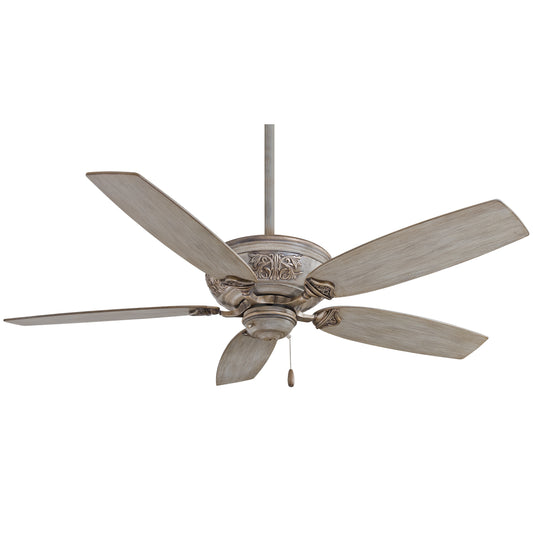


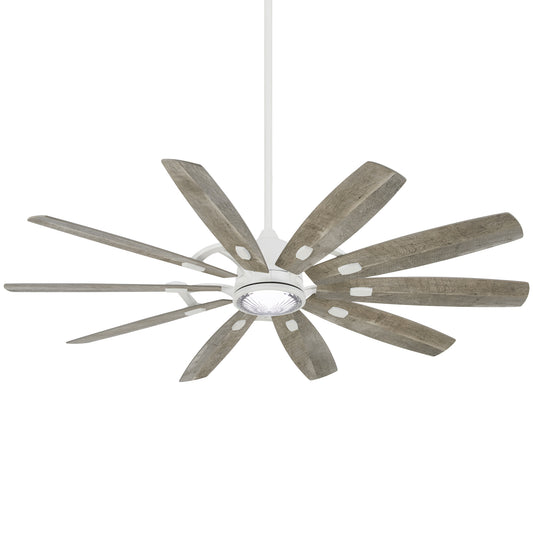

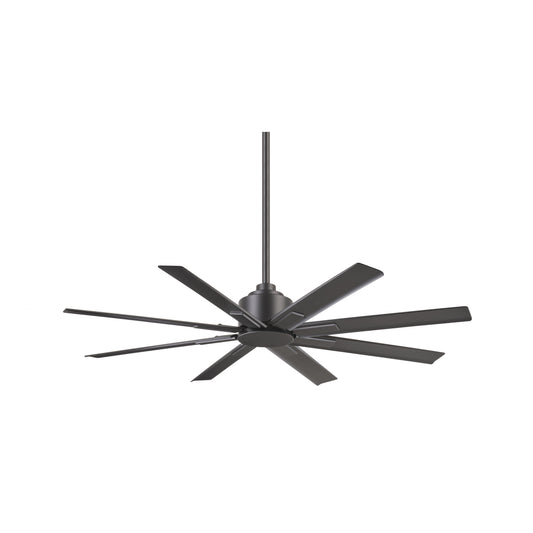

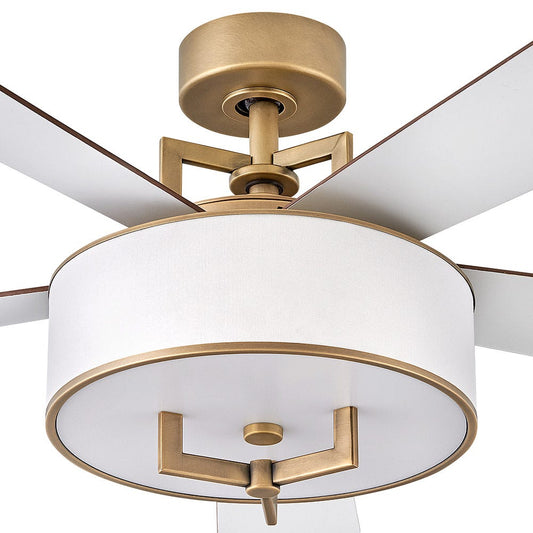


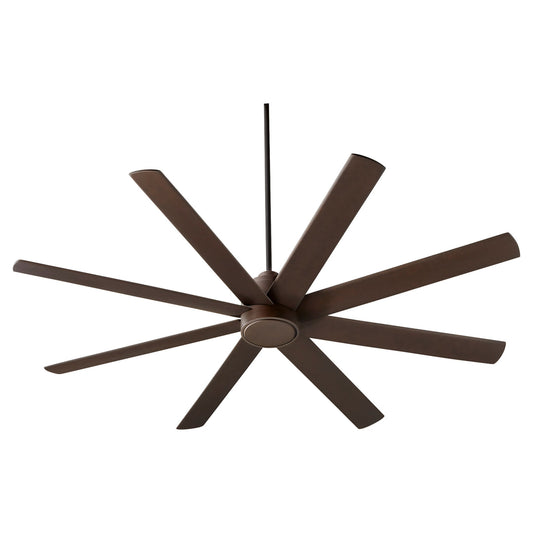


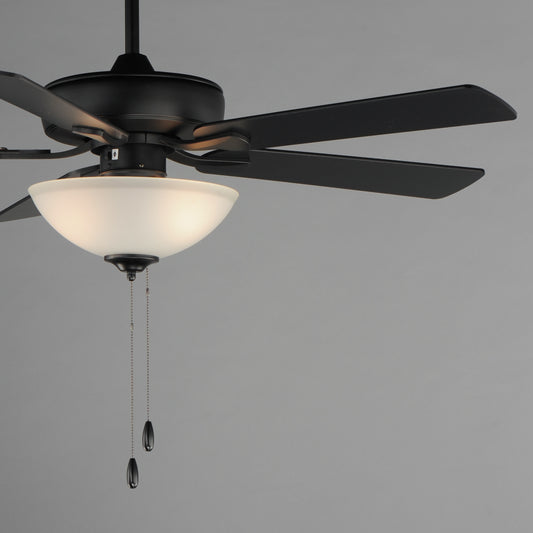


Your Guide to Hugger Ceiling Fans for Low Ceilings
Got a room with a low ceiling? You know the struggle. Finding a ceiling fan that won't feel like a looming hazard can be a real headache. That's where hugger ceiling fans, sometimes called flush-mount fans, come in. They're the superheroes of space-saving design, mounting directly to the ceiling to give you back that precious headroom while keeping you cool.
What Are Hugger Ceiling Fans Anyway?
Think of a standard ceiling fan like a pendant light. It hangs down from a rod, making a statement and pushing air down from above. This works great for high or vaulted ceilings. But in rooms with ceilings under eight feet—like you find in basements, older homes, or cozy bedrooms—that downrod becomes a problem. Who wants to duck every time they cross the room?
A hugger fan, on the other hand, is more like a recessed light. It sits tight against the ceiling, becoming a seamless part of the room’s design. This smart, low-profile approach is the secret to safely adding a cooling breeze where you thought it was impossible. It's the ultimate problem-solver for style-conscious homeowners with height restrictions.
The Problem-Solver For Low Ceilings
The main job of a hugger fan is to solve a common homeowner challenge: circulating air while meeting safety codes. Building regulations are pretty clear—fan blades need to be at least seven feet off the floor. In a room with an eight-foot ceiling, a standard fan just won't cut it.
Hugger fans close this gap—literally. By mounting directly to the ceiling, they provide the necessary clearance without sacrificing the comfort of a cool breeze.
This isn't a new idea, but it's become more essential than ever. Hugger fans really took off in the late 20th century as modern homes were built with lower ceilings. Their popularity has only grown as the global ceiling-fan market exploded to an estimated USD 10–14 billion in the mid-2020s, especially in places where compact living is the norm.
More Than Just A Space-Saver
But these fans are more than just practical. They're style chameleons. A hugger can blend right into the ceiling for a clean, minimalist look, or it can serve as a bold design element that ties the room together. They're a fantastic tool when you're exploring small space design ideas and trying to make a room feel bigger and more open.
Ultimately, choosing a hugger fan means you don’t have to compromise. You get the cooling you need in the spaces you love most, all while keeping your home safe, stylish, and comfortable.
Hugger Fan vs. Standard Fan at a Glance
So, what's the real difference? This quick table breaks it down, helping you see which fan type is right for your space.
| Feature | Standard Ceiling Fan | Hugger Ceiling Fan |
|---|---|---|
| Mounting | Hangs from a downrod, creating space between the fan and ceiling. | Mounts directly to the ceiling—no downrod. |
| Best Ceiling Height | 8 feet or higher. Works great for vaulted and high ceilings. | Under 8 feet. The perfect fit for low-ceiling rooms. |
| Airflow | Generally stronger, as blades are further from the ceiling. | Effective, but slightly less powerful due to proximity to ceiling. |
| Typical Use Case | Living rooms with high ceilings, great rooms, and master bedrooms. | Bedrooms, basements, hallways, and any room with height limits. |
The choice really comes down to your ceiling height. If you've got the space, a standard fan offers powerful airflow. But if you're working with a lower ceiling, a hugger is the only safe and stylish way to go.
How to Choose the Right Hugger Fan

Feeling a bit lost in the sea of hugger ceiling fans? You're not alone. Picking the perfect fan for your space doesn't have to be complicated. Let's walk through a no-fuss process to get it right, starting with the most important step: size.
A fan's blade span is everything. Go too big, and a small room will feel crowded and blasted with an overpowering downdraft. Go too small, and you’ll barely feel a whisper of air, leaving you wondering why you bothered. It's all about finding that Goldilocks fit.
Matching Blade Span to Room Size
Getting the size right means your fan will work efficiently without looking like it was meant for another house. The rule is simple: bigger rooms need a wider blade span to move air effectively to every corner. For a deep dive, our complete ceiling fan size guide has all the charts and details you'll need.
Here’s a quick breakdown to get you pointed in the right direction:
-
Small Rooms (Up to 75 sq. ft.)
- Think hallways, laundry rooms, or walk-in closets.
- Look for a blade span of 36 inches or smaller.
-
Medium Rooms (76 – 175 sq. ft.)
- This covers most standard bedrooms, home offices, and kitchens.
- You’ll want a blade span between 42 to 48 inches.
-
Large Rooms (Over 175 sq. ft.)
- Perfect for primary bedrooms, living rooms, or open-concept great rooms.
- A blade span of 52 inches or larger is what you need.
Demystifying Airflow with CFM
Once you've nailed the size, the next thing to look at is airflow, which we measure in CFM (Cubic Feet per Minute). Think of CFM as the fan's horsepower—it tells you exactly how much air the fan can move.
A higher CFM rating means a more powerful breeze. This is especially important for hugger fans because their blades sit so close to the ceiling, giving them less space to pull air from.
A strong motor is the engine behind great airflow. Premium fans, often priced at $300 or more, typically feature advanced motors that deliver high CFM ratings efficiently and quietly. Investing here means you get a powerful breeze without disruptive noise. The Wisp Smart Hugger Ceiling Fan, for instance, retails at $349.99 and is a perfect example of style meeting substance.
When you're shopping, always check the CFM rating in the fan's specs. A CFM of 4,000 to 6,000 is an excellent target for most rooms, ensuring you'll feel that satisfying cooling effect. Don't let a stylish fan fool you if it can't deliver the breeze you need.
The Impact of Blades and Pitch
Finally, let’s talk about what makes a fan look and perform the way it does: the blades. The number of blades and their angle—known as pitch—play a huge role in both aesthetics and function.
-
Blade Count: Fans with fewer blades (like three) tend to have a sleek, modern look and can move air very efficiently. On the other hand, fans with five or more blades create a more traditional vibe and often provide a gentler, quieter airflow.
-
Blade Pitch: This is simply the angle of the blades. A steeper pitch, usually between 12 to 15 degrees, lets the blades scoop up and push more air with each rotation. The best hugger fans are engineered with an optimal pitch to maximize airflow, making up for their low-profile design.
By balancing blade span, CFM, and these design elements, you can find a hugger fan that not only cools your room like a champ but also looks like it was made for it.
Exploring Features That Justify a Higher Price Tag
When you see a price tag over $300 on a hugger ceiling fan, it's easy to wonder if it's really worth it. The answer? Absolutely. Today’s premium hugger fans are so much more than just air movers—they're sophisticated, efficient, and stylish centerpieces that genuinely elevate a room. Investing in a high-end model unlocks a world of features that pay off for years to come.
The single biggest game-changer in premium fans is the motor. Forget the noisy, energy-guzzling AC motors of the past. Modern high-end fans are powered by whisper-quiet DC (Direct Current) motors.
The Power and Silence of DC Motors
A DC motor is the heart of a luxury fan experience. They operate almost silently, which makes them a must-have for bedrooms, nurseries, or any quiet space where a constant motor hum would be a distraction. Imagine enjoying a powerful breeze without any of the noise. That quiet performance is one of the top reasons people decide to invest in a better fan.
But the benefits don't stop there. Modern low-profile fans increasingly use brushless DC (BLDC) motors, which can sip as little as 20–70 watts. Compare that to older AC motors that draw 75–120+ watts, and you can see the savings. This drive for efficiency is a huge factor in the global ceiling fan market's growth, as more people want products that deliver real household energy savings. You can see more on this trend and other market projections on Future Market Insights.
On top of being quiet and efficient, DC motors offer way better control. A traditional AC fan might give you three speed settings—low, medium, and high. A DC fan often provides six or more, letting you fine-tune the airflow to your exact comfort level. For a deeper dive into this technology, check out our guide on the best DC motor ceiling fans.
Smart Integration and Total Convenience
Premium hugger fans are also right at the forefront of smart home technology. Many models come with handy remote controls or can be paired with systems like Amazon Alexa or Google Assistant. That means you can adjust the fan speed, change the light settings, or even set schedules with a simple voice command or a tap on your phone.
Convenience is king. With smart features, you no longer have to stumble out of bed to pull a chain or flip a switch. It's about creating a seamless, comfortable environment tailored to your lifestyle.
Finally, most high-end hugger fans bundle in other great features, like integrated LED lighting and reversible blades. The LED lights are incredibly energy-efficient and often dimmable, letting you set the perfect mood. The reversible function adds year-round value; in winter, just switch the blade direction to push warm air down from the ceiling, helping to heat your room more efficiently. This combination of advanced features really shows why spending more means getting more in comfort, convenience, and style.
Getting Installation and Safety Right
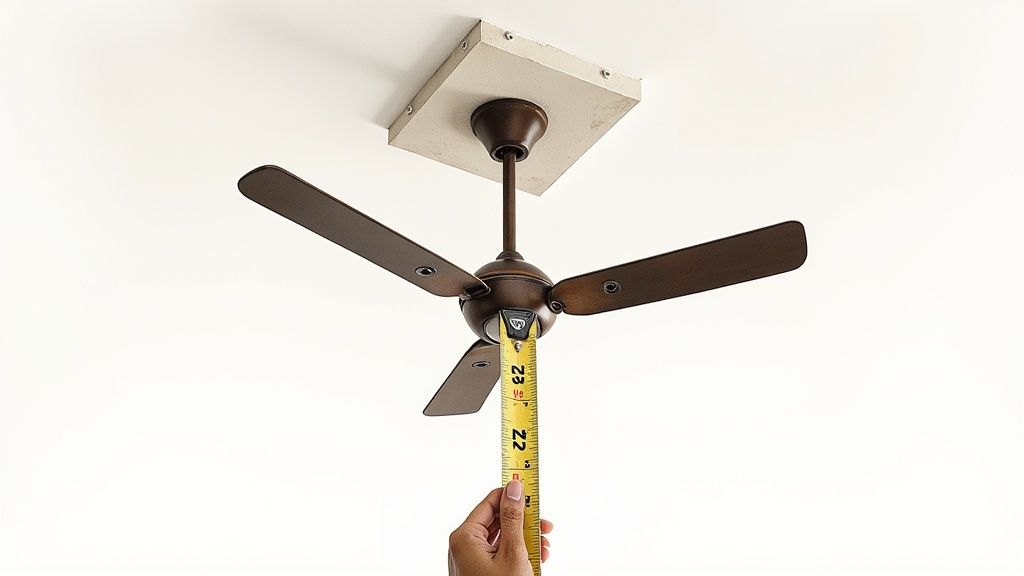
When it comes to installing a ceiling fan, safety isn't just a good idea—it’s everything. This is especially true in rooms with lower ceilings, where the right choice of fan and a rock-solid installation make all the difference. Before you even touch a wire, let's walk through the essential safety rules you absolutely can't ignore.
The biggest rule is simple and universal: fan blades must be at least 7 feet from the floor. This isn't a friendly suggestion; it’s a standard building code requirement designed to keep everyone safe. In a room with a typical 8-foot ceiling, a standard fan hanging from even a short downrod would immediately violate this rule.
This is precisely where hugger ceiling fans shine. By mounting flush with the ceiling, their low-profile design ensures they can easily meet that 7-foot clearance, making them the only truly safe option for these very common spaces.
The Foundation of a Secure Installation
A secure fan starts from the ceiling down. A ceiling fan is a heavy, spinning object, and the electrical box it connects to has to be built to handle that kind of dynamic load. You can’t just use any old light fixture box and hope for the best.
It is absolutely critical to use a fan-rated electrical box. These are specifically engineered with heavy-duty materials and mounting hardware to support both the weight and the constant motion of a fan. This prevents dangerous wobbling or, in a worst-case scenario, the entire fan from falling.
Think of it like this: You wouldn't hang a heavy punching bag from a simple picture hook. A fan-rated box is the specialized, reinforced anchor that ensures your fan stays exactly where it belongs—safely overhead.
Knowing When to Call a Professional
While this guide covers the core principles, it’s not a substitute for the detailed manual that comes with your fan. For a more detailed walkthrough, our article on how to install a ceiling fan offers in-depth guidance. But remember, electrical work always carries risks.
Since many hugger fans come with built-in lights, understanding the details of professional light fixture installation is a huge plus for a safe and proper setup. If you have any doubt about your wiring, your home's age, or your own skills, hiring a licensed electrician is always the smartest—and safest—move you can make.
Finding a Hugger Fan That Matches Your Style
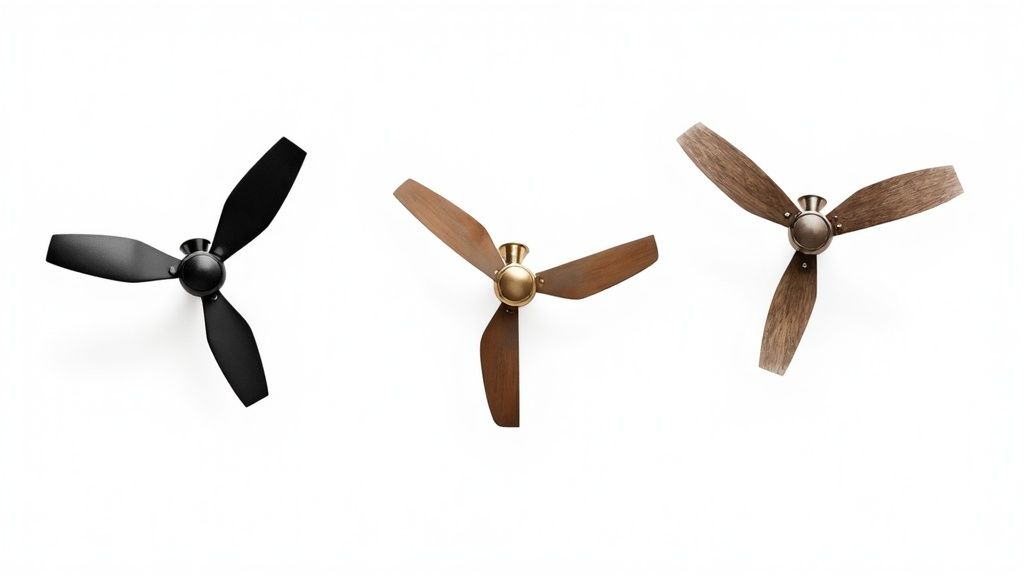
A ceiling fan should never be a boring, functional afterthought. Let's think of it as the crown jewel of your room instead—a piece that pulls your entire design vision together. Premium hugger ceiling fans, especially those priced over $300, are built to be stunning focal points, proving that practicality and high style can absolutely coexist.
The right fan does so much more than move air; it completes a room’s story. It's a chance to bring in texture, color, and form where people least expect it. Consider the Riptide Smart Hugger Ceiling Fan, which sells for $489.99. With its striking design and powerful performance, it’s not just an appliance—it's a piece of functional art that elevates your whole space.
From Minimalist Modern to Rustic Charm
The best part about modern hugger fans is their incredible stylistic range. Gone are the days of clunky, one-size-fits-all designs. Today, you can find a fan that perfectly captures your home's unique personality.
If you love clean lines and uncluttered spaces, a minimalist three-blade fan is a perfect fit. With sleek profiles and simple geometry, these models just melt into contemporary, Scandinavian, or mid-century modern rooms. They make an understated yet powerful statement, proving that less really is more.
On the flip side, if your style is all about cozy character, a rustic hugger fan can bring in some incredible warmth. Look for models with blades in reclaimed wood finishes or with hand-carved details. These designs add an organic, earthy vibe to farmhouse, industrial, or bohemian-inspired rooms, making the space feel instantly more inviting.
Finishes That Define the Look
The finish you choose is the final touch that can either harmonize with your decor or create a bold, eye-catching contrast. It's the detail that ties everything together. The premium market offers a whole palette of sophisticated finishes that go way beyond basic white.
Consider some of these popular choices:
- Matte Black: This finish delivers a powerful, modern punch. It’s perfect for creating contrast against a white ceiling or complementing dark hardware and accents in industrial or minimalist rooms.
- Brushed Brass: For a touch of warmth and glamour, brushed brass is unbeatable. It pairs beautifully with deep jewel tones, warm woods, and both modern and vintage-inspired decor, adding a layer of luxe elegance.
- Polished Nickel: Cool, crisp, and timeless, polished nickel has a bright, reflective quality that can make a room feel more open. It’s a versatile choice that works well in transitional, coastal, and classic interiors.
This focus on premium design is part of a bigger global picture. While some regions prioritize sheer volume, the North American and European markets show a strong appetite for high-end, feature-rich models sold online. This trend pushes up average prices and contributes to a robust, multi-billion-dollar global market. You can read more about these global market trends on marknteladvisors.com.
Common Questions We Hear About Hugger Ceiling Fans
Even with the basics covered, a few questions always pop up when people are trying to pick the right fan. And that’s a good thing! When you’re choosing a fixture that’s going to be part of your home for years, you want to be sure. Let’s clear up some of the most common myths and concerns about hugger ceiling fans.
We'll get straight to the point on airflow, installation, and all the little details so you can feel completely confident in your choice.
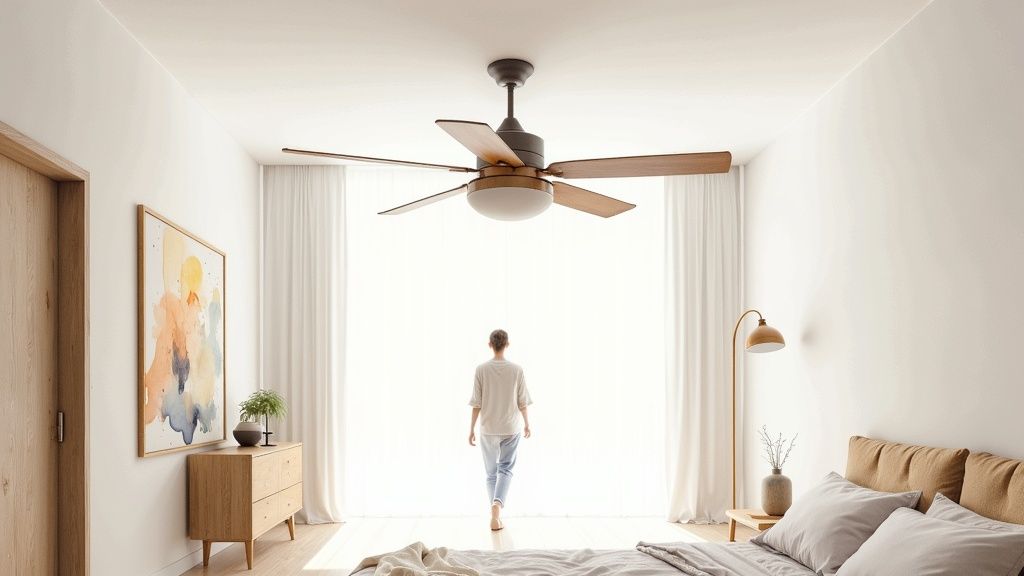
Do Hugger Fans Really Move Less Air?
This is probably the biggest misconception out there. It’s easy to assume that because the blades are closer to the ceiling, the airflow must be weaker. But it’s not about how close the blades are—it’s about the quality of the engineering.
A well-made hugger fan is designed specifically to work around that limited space. High-end models with powerful DC motors and precisely angled blades are absolute workhorses, generating incredible airflow. The number you really want to pay attention to is the CFM (Cubic Feet per Minute) rating. A quality hugger fan with a high CFM can cool a room just as effectively as many standard downrod fans.
Can I Put a Hugger Fan on a Sloped Ceiling?
In almost every case, this is a firm "no." Hugger fans are built for one job: to be mounted on a perfectly flat, level ceiling. The entire design of their flush-mount base depends on a flat surface for a secure, stable, and wobble-free fit.
Trying to mount one on a vaulted or angled ceiling is just asking for trouble. For those gorgeous high ceilings, you'll want a standard fan on a downrod paired with a sloped-ceiling adapter. That setup is what lets the fan hang perfectly level, which is non-negotiable for both safety and performance.
Is a Hugger Fan Harder to Install?
The process is pretty much the same as a standard fan, but that tight workspace can be a real headache. Since you’re working right up against the ceiling, there’s not a lot of elbow room for your hands and tools. Connecting the wiring inside the housing is usually the trickiest part.
The core steps are all the same: secure the mounting bracket to a fan-rated electrical box, wire up the motor, and attach the blades. If you’re a seasoned DIYer, it's definitely manageable. But if you’re not a fan of cramped spaces, calling an electrician can save you a lot of time and frustration.
What’s the Perfect Ceiling Height for a Hugger Fan?
Hugger fans are the undisputed champs for ceilings that are 8 feet high or a little less. Their whole reason for being is to keep the fan blades at least 7 feet off the floor, which is a critical safety code in most places. They make it possible to get a breeze going without anyone having to duck.
Once you get to ceilings that are 9 feet or higher, a standard fan with a short downrod is usually the better bet. That extra space between the fan and the ceiling gives it more room to breathe, letting it pull air from above and push it down more efficiently.
How Often Should I Clean My Hugger Fan?
Just like any ceiling fan, dust is going to build up on the blades. The tricky part with hugger fans is that since they’re so close to the ceiling, the dust can be a little out of sight, out of mind. A good rule of thumb is to give the blades a quick wipe-down every 3-4 months.
Keeping them clean isn't just about air quality; it also helps prevent the fan from getting unbalanced. An unbalanced fan can start to wobble and put extra strain on the motor. All it takes is a quick dusting or a wipe with a damp cloth to keep it spinning smoothly for years.
Ready to find a hugger fan that delivers powerful performance without sacrificing style? At Fan Connection, we’ve hand-picked a collection of premium, design-forward fans made to elevate any room with a low ceiling. Come see what a difference the right fan can make.


