











Finding the Best Ceiling Fans for Low Ceilings
Don't let low ceilings box you in. When you've got limited vertical space, the go-to solution is a "hugger" or flush-mount fan. These fans mount directly against the ceiling, maximizing every precious inch of headroom. They are, without a doubt, the best ceiling fans for low ceilings because they're built specifically for safety and performance in these exact situations.
Your Guide to Low-Profile Ceiling Fans
Having a low ceiling—which is usually 8 feet or less—can feel like a real design challenge. You want the cooling breeze and energy savings of a ceiling fan, but the thought of blades spinning just a little too close for comfort is a genuine safety concern. This is a common problem, but thankfully, one with some fantastic solutions. The world of low-profile ceiling fans is no longer about making a compromise; it’s a category packed with powerful, stylish, and high-end options designed to solve this very issue.
Think of it like trying to park a big truck in a garage with low clearance. A standard pickup just won't fit. You need a vehicle designed with a lower profile. In the same way, a standard downrod fan is simply the wrong tool for a low-ceiling room. A hugger fan is the purpose-built answer that gives you the clearance you need without skimping on the airflow you want.
Finding the Perfect Fit for Your Space
Choosing the right fan isn't just about avoiding a headache (literally!); it's about optimizing the comfort and feel of your room. This guide will walk you through picking a premium model that truly transforms your space. We'll dive into the critical factors to make sure you invest with confidence, including:
- Non-negotiable safety measurements to guarantee proper clearance.
- Performance metrics like CFM (Cubic Feet per Minute) that tell you a fan's true power.
- Design and style considerations to perfectly match your home’s look.
The key is to find a fan that works with your room's architecture, not against it. A well-chosen low-profile fan should feel like an integrated part of the design, enhancing both the look and feel of the space while delivering exceptional performance.
Before you go any further, it helps to understand the basics. You can learn more about what a flush mount ceiling fan is and how it’s different from traditional models. Getting this foundational knowledge down is a huge help. For more great articles and advice on optimizing your indoor climate, check out the resources over at airconheat.com's blog.
To give you a head start, the table below offers a quick snapshot of what to look for when you begin your search.
Low-Ceiling Fan Quick Reference Guide
This table summarizes the essential factors to consider when choosing a ceiling fan for a room with low ceilings. It's a great starting point to ensure you focus on what truly matters.
| Consideration | Recommendation for Low Ceilings | Why It Matters |
|---|---|---|
| Mount Type | Flush Mount (Hugger) | Mounts directly to the ceiling, maximizing vertical space and ensuring safe clearance. |
| Ceiling Height | 7 to 8 feet | Ideal range for low-profile fans. Anything lower may not meet safety codes. |
| Blade Clearance | Minimum 7 feet from floor | This is a standard safety requirement to prevent injury from moving blades. |
| Fan Height | Look for models under 12 inches tall | The shorter the fan's total height (from ceiling to bottom), the more headroom you'll have. |
| Airflow (CFM) | 3,000 - 6,500+ | Don't sacrifice power for size. A good CFM ensures effective air circulation even in a compact design. |
| Lighting | Integrated or Low-Profile Light Kit | Choose built-in lighting that doesn't add significant height to the fan's profile. |
With these key points in mind, you're well-equipped to find a low-profile fan that is not only safe and effective but also a stylish addition to your home.
Mastering Measurements for Safety and Performance
Before you even think about style or finish, grab a tape measure. When it comes to choosing the right ceiling fan for a low ceiling, accurate measurements are everything. They're the difference between a fan that's a safe and effective centerpiece and one that's a head-bumping hazard. Getting this right from the start gives you peace of mind and ensures your fan actually does its job.
The golden rule of ceiling fan installation is simple but non-negotiable: the blades must be at least 7 feet from the floor. This isn't just a friendly suggestion; it's a critical safety standard. If you have standard 8-foot ceilings, you can see the problem right away.
Calculating Your Maximum Fan Drop
Think of your room like a parking garage with a low clearance sign. You wouldn't drive a tall truck in there, right? The same logic applies here. A standard fan with a downrod hangs too far down for an 8-foot ceiling.
Let's do the math: an 8-foot ceiling is 96 inches high. The required safety clearance is 84 inches (7 feet). That leaves you with a measly 12 inches of total space for the fan itself—motor, blades, and all.
This is exactly why flush-mount, or "hugger," fans were invented. They're engineered to mount directly against the ceiling, taking up as little vertical space as possible. They are the compact car for your low-clearance garage, making them the only truly safe and functional choice for rooms with low ceilings.
This simple chart breaks down the process.
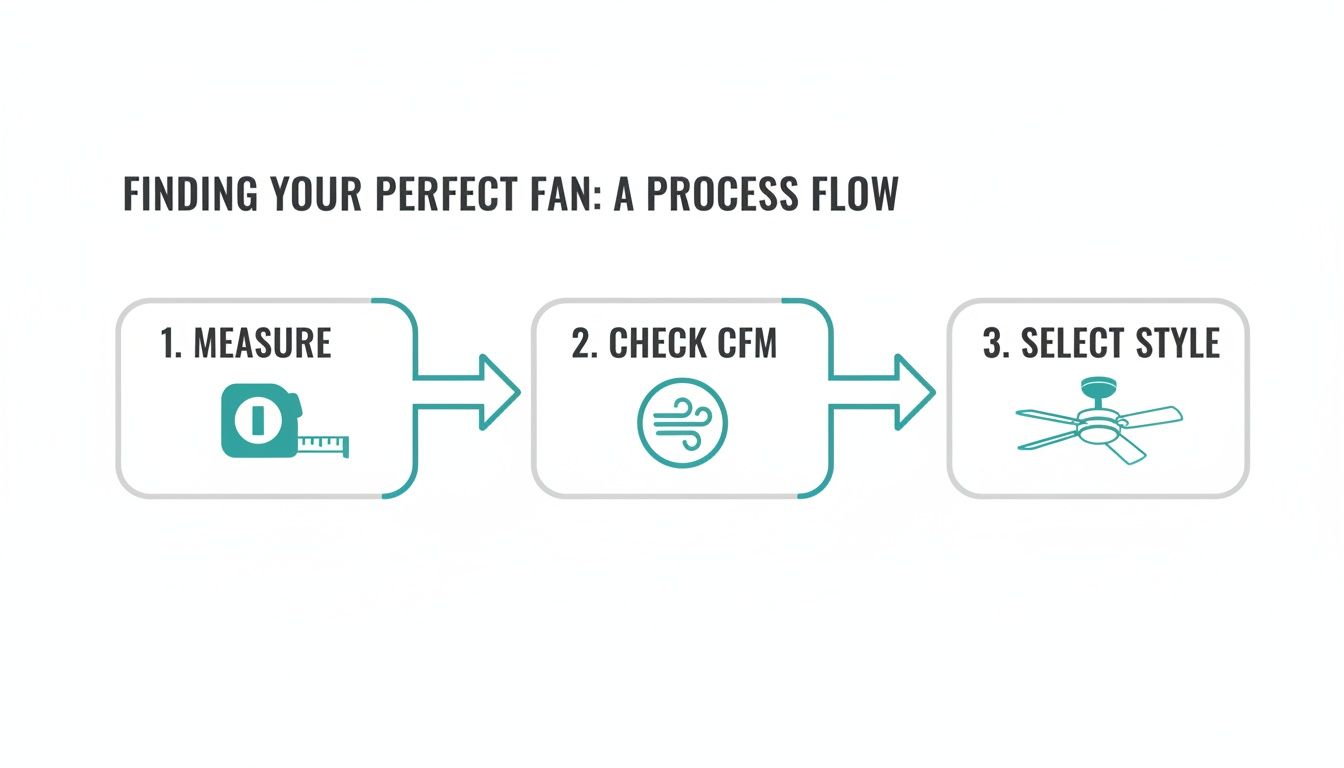
As you can see, it's a straightforward path: measure first, check the performance specs (CFM), and then have fun picking a style you love.
The growing popularity of these specialized hugger fans, which often need just 8-10 inches of total clearance, is no surprise. It's a huge part of why the U.S. ceiling fans market hit USD 2,388.1 million in 2023 and is expected to climb to USD 3,088.7 million by 2030.
Sizing Fan Diameter for Optimal Airflow
Once you've sorted out the height, the next measurement to tackle is the fan's diameter, also known as the blade span. This is just as important for performance as the height is for safety. A fan that's too small will struggle to move air around the room, and one that's too big can create an unpleasant, gusty wind tunnel.
To figure out your room's square footage, just multiply its length by its width. With that number in hand, you can follow these guidelines to pick the right blade span.
- Small Rooms (Up to 144 sq. ft.): A fan with a 36 to 48-inch blade span is perfect. Think bedrooms, home offices, or cozy breakfast nooks.
- Medium to Large Rooms (144 to 400 sq. ft.): You'll want a 52 to 60-inch fan to get great air circulation in living rooms, master bedrooms, and open-concept spaces.
One more tip: make sure to leave at least 18 inches of clearance between the tip of the fan blades and any walls or tall furniture. This gives the fan room to breathe and prevents choppy, turbulent air.
By nailing down these key measurements, you can browse with confidence, knowing you're choosing a premium fan that’s perfectly sized for your space in every dimension. For a deeper dive, check out our comprehensive ceiling fan size guide. It’ll help you lock in the perfect choice for powerful, safe airflow.
Understanding Airflow CFM and Blade Design
Let's be honest: a gorgeous fan that can't move air is just an expensive ceiling decoration. When you're shopping for the best ceiling fans for low ceilings, there are two things that truly matter for performance: CFM (Cubic Feet per Minute) and blade design. This is the heart and soul of your fan—the stuff that determines whether you get a refreshing breeze or just a lazy spin.
Think of CFM as the horsepower of the fan's motor. It’s the single most important number that tells you how much air a fan can actually circulate. A higher CFM means more power and better cooling. It’s a common myth that adding more blades automatically creates more airflow, but the real magic happens when a powerful motor works hand-in-hand with well-designed, aerodynamic blades.
Decoding Blade Pitch and Motor Power
A high-performance car is a great analogy here. A massive engine is useless without the right aerodynamics and tires that can grip the road. For a ceiling fan, the motor is the engine, and the blade pitch—the angle of the blades—is like the car's aerodynamic design. A steeper pitch, usually somewhere between 12 and 15 degrees, lets the blades "grab" and push more air with every single rotation.
But there's a catch. A steeper pitch also creates more resistance, which demands a stronger, higher-quality motor to keep the fan spinning smoothly without wobbling or burning out. This is where you see the difference between a cheap fan and a premium one. Great fans pair a robust motor with expertly angled blades to push out the highest possible CFM without all the noise and instability.
For a room with a low ceiling, this motor-and-blade combo is absolutely critical. You need a fan that can generate serious airflow without having a long downrod to give it space. A well-engineered hugger fan pulls this off by perfecting its internal mechanics.
Matching CFM to Your Room Size
Picking the right CFM is all about getting the comfort you're paying for. A fan that’s too weak for the room will leave it feeling stuffy. One that’s too powerful will feel like you're in a wind tunnel. Here are some simple guidelines to get it just right:
- Small Rooms (up to 100 sq. ft.): Look for a CFM of 1,000 to 3,000. This is perfect for home offices, laundry rooms, or even large walk-in closets.
- Medium Rooms (100 to 225 sq. ft.): Aim for a CFM between 3,000 and 4,500. This range is the sweet spot for most bedrooms and smaller living areas.
- Large Rooms (225 to 400 sq. ft.): You'll need a workhorse. Find a fan with a CFM of 4,500 to 6,500 or more to keep the air moving in master bedrooms, family rooms, or open-concept spaces.
The goal is to feel a gentle, consistent breeze, not a disruptive gust of wind. When you match the CFM to your room’s square footage, you create a comfortable space where the air feels fresh and circulated, not chaotic.
Performance Without Compromise in Low-Profile Designs
A lot of people worry that a hugger fan just can't perform as well as a standard fan with a downrod. While being close to the ceiling does create an airflow challenge, the best low-profile models are engineered specifically to overcome it. They are living proof that you don't have to give up performance for a compact, clean look.
For instance, high-end models from our collections are designed with this very challenge in mind. A fan like the three-blade Aerovon has a minimalist style but a motor built to produce incredible airflow, making it ideal for modern rooms with low ceilings. And for larger rooms that need serious air movement, the Artemis XL5 delivers an impressive CFM rating in a sophisticated hugger design that becomes a real statement piece.
These top-tier models, all priced above $300, show that the best ceiling fans for low ceilings never make you choose between style, safety, and power. To dig a little deeper into how blade count impacts airflow, you can learn more about the impact of fan blade count and efficiency in our detailed guide. By investing in a fan with superior engineering, you get the robust performance you need in a package that fits your space perfectly.
Smart Controls and Integrated Lighting
When you’re working with a low ceiling, every inch of vertical space is prime real estate. This is where combining fixtures becomes a brilliant move, and ceiling fans with built-in lighting really start to shine. It's a two-in-one solution that delivers both airflow and illumination without cluttering your ceiling—a total game-changer for rooms with limited height.
This isn’t just about saving space, either. It’s about creating a cleaner, more functional, and more stylish room. Modern designs have come a long, long way from the clunky, tacked-on light kits of the past. Today’s best low-profile fans feature sleek, powerful lighting that’s built right into the fan’s body, creating a unified and polished look.
Modern Lighting Options for Low-Profile Fans
The lighting you’ll find in high-end hugger fans is just as thoughtfully engineered as the fan itself. Forget being stuck with a single, boring bulb under a glass dome. Today, you can find a whole range of sophisticated options that fit your room's style and lighting needs perfectly.
Here are a few popular choices you’ll find in premium models:
- Integrated LED Panels: These offer a super clean, minimalist look. The LED lights are built directly into the fan's central housing, often sitting completely flush. This design adds zero extra height and provides bright, even light that can usually be dimmed to set the perfect mood.
- Elegant Statement Lights: Some low-profile fans, like the stunning Bola from our collection, feature beautiful, enclosed light fixtures that really make a design statement. They give you the feel of a chandelier or pendant light without eating up that precious headroom.
- Adjustable Color Temperature: Many high-end models let you change the light's color temperature on the fly. You can shift from a warm, cozy glow (around 2700K) for relaxing in the evening to a cool, crisp white ( 4000K+) for focused tasks during the day.
As you shop, considering energy-efficient lighting solutions will not only enhance the look of your space but can also help lower your utility bills.
The Rise of Smart Home Integration
A fan’s real value goes way beyond just its cooling power. Today, smart home controls are completely changing how we interact with our ceiling fans, turning them from simple appliances into an intelligent part of our home. This is especially true for the premium models designed for modern living.
Gone are the days of fumbling for a pull chain in the dark. Modern fans put effortless control right at your fingertips.
Smart control isn't a gimmick; it's about practical luxury. It’s the ability to adjust the fan speed from bed without getting up, or telling your voice assistant to turn on the light when your hands are full. This level of convenience makes a huge difference in daily life.
The best fans offer a whole suite of control methods, so you can pick what works for you. Models like the architectural Chisel really nail this blend of form and function, offering superior control alongside a striking design. These high-end fans, typically priced over $300, are an investment in both comfort and convenience.
For a deeper dive into how these systems work, check out our guide on how remote control ceiling fans work.
Choosing Your Control Style
Different fans offer different ways to command them. Here’s a quick rundown of what’s out there:
- Handheld Remotes: The classic modern control. A good remote lets you manage fan speed, light intensity, and even the fan’s direction (for summer/winter modes) from anywhere in the room.
- Wall-Mounted Panels: If you prefer a permanent fixture and hate losing remotes, wall panels offer a sleek, modern alternative to traditional switches.
- Wi-Fi and App Control: Many top-tier fans connect to your home’s Wi-Fi, letting you control them from a smartphone app. This often includes cool features like scheduling, so your fan can turn on automatically before you even get home.
- Voice Assistant Compatibility: This is the ultimate in hands-free convenience. Fans that work with Amazon Alexa, Google Home, or Apple HomeKit let you adjust speed and lighting with simple voice commands.
Choosing a Fan That Complements Your Style
Alright, you’ve wrestled with the technical stuff—clearance, CFM, and smart controls. Now comes the fun part. Picking out the best ceiling fans for low ceilings is where smart function gets to meet great design. A truly great fan doesn't just move air; it completes the room, acting as a centerpiece that ties your whole look together.
Forget scrolling through generic, cookie-cutter options. This is about finding the right style for your space. Having low ceilings doesn't mean you have to settle for a low-impact fan. In fact, today’s premium hugger fans are designed to make a statement, proving you can have it all: safety, powerful airflow, and serious style.
The trick is to think of your fan as a piece of functional art. It should feel right at home with your existing decor, whether your vibe is modern and minimal, cozy and rustic, or breezy and tropical.

For the Serene and Tranquil Bedroom
Your bedroom is your sanctuary. It’s a place to unwind, and the last thing you want is a clunky, noisy fan ruining the calm. For this space, style and silence are partners in crime. You need a fan that whispers, not shouts—both visually and audibly.
Look for models with clean lines, soft finishes, and an ultra-quiet motor. This is where our 5 Blade Collection really shines. These fans are engineered for perfectly balanced, silent operation, making them ideal for creating that undisturbed atmosphere you crave. With gentle curves and finishes like matte white, brushed nickel, or soft wood tones, they blend right into a peaceful bedroom design. Each model is priced over $300, which reflects the superior materials and precision motor built for years of silent, reliable performance.
For the Sleek and Contemporary Living Room
In a modern living room, a ceiling fan should feel like an intentional architectural element, not an afterthought. You’re looking for a design that’s bold and clean. Think sharp lines, metallic finishes, and a minimalist profile that complements an open, airy space.
Our 3 Blade Collection is the hands-down choice for contemporary aesthetics. These fans often have dramatic, sleek blades and powerful motors that deliver impressive airflow without looking cluttered. A perfect example is the Apex fan, which is the definition of minimalist elegance. Its stripped-down design makes a strong statement without overwhelming the room, making it a great fit for spaces with clean furniture and a neutral color palette. These fans are an investment in design, promising standout style and robust performance.
This shift toward stylish, decorative fans is a huge trend. In fact, decorative models are the fastest-growing segment because homeowners are no longer willing to sacrifice style for headroom. This is especially true in the U.S. market, which is expected to grow from USD 2,388.1 million to USD 3,088.7 million by 2030. Sleek fans with three or fewer blades have captured the majority of the market, offering the perfect profile for standard 8-foot rooms. You can dig deeper into these trends in this detailed industry report.
For the Breezy Covered Porch or Sunroom
Your style shouldn't stop at the back door. For covered porches, patios, and sunrooms, you need a fan that can handle a bit of humidity while bringing a touch of the outdoors in. This is the perfect place to play with organic materials and a more relaxed, resort-like feel.
A fan in an outdoor living space should do more than just move air; it should help create an escape. The right design can transport you, making your porch feel like a tropical veranda or a rustic cabin retreat.
Our Tropical Collection is curated specifically for these kinds of spaces. Featuring fans with blades that mimic natural leaves and finishes like weathered wood or bronze, these models are damp-rated for safe use in covered outdoor areas. Models like the Cabana or the Andros can instantly give a space that vacation vibe. Their sturdy construction ensures they can stand up to the elements while providing a welcome breeze on warm days. These fans, all priced above $300, are built to last, combining durable materials with a design that makes every day feel like a getaway.
Getting Your Low-Profile Fan Installed and Maintained
You’ve picked out the perfect hugger fan—that's a great first step. Now, let's make sure it's installed flawlessly. Whether you’re a seasoned DIY pro or calling in an electrician, a proper setup is the secret to a fan that’s secure, silent, and wobble-free for years.
The absolute most important part of the job is the electrical box in your ceiling. This isn't just a place to tuck away wires; it needs to be a fan-rated electrical box. A standard box meant for a light fixture just can't handle the weight and constant motion of a fan. Skipping this step is a major safety risk, so make it your number one priority.
The Secret to a Wobble-Free Fan
Once the fan is mounted, there's one last little step to get it running perfectly: balancing the blades. Even the highest-quality fans can have a tiny wobble if the blades aren't perfectly aligned and weighted. That's why most fans come with a simple balancing kit.
Taking a few minutes to follow the instructions will make all the difference. You'll be rewarded with a fan that runs so smoothly and quietly you'll forget it's there—aside from the breeze, of course. For a full walkthrough, learn more about how to install a ceiling fan safely in our guide.
Our support doesn't stop once you've bought the fan. We want you to enjoy it for a lifetime, and a little bit of care goes a long way in keeping it looking and performing like new.
Simple Care for Long-Lasting Performance
Keeping your low-profile fan in great shape is easier than you think. Just a few simple habits will protect its finish and ensure it runs as well as it did on day one.
- Clean the Blades Regularly: Dust isn't just an eyesore; it can actually throw the blades out of balance and cause wobbling or noise. A quick wipe with a soft, damp cloth every few months is all it takes to keep things running smoothly.
- Check the Hardware Once a Year: The fan's subtle vibrations can loosen screws over time. Once a year, just give all the visible screws a quick check to make sure they’re snug.
- Be Gentle on the Finish: Stay away from harsh chemical cleaners. They can damage the fan's beautiful finish. A simple, gentle cleaning solution is all you need.
That's it. This easy routine helps you get lasting value from your fan, and we’re here to help you keep your home comfortable for the long haul.
Still Have Questions About Low-Ceiling Fans?
I get it. Even after you’ve done the measuring and picked a style, a few nagging questions can pop up. Let's tackle some of the most common ones I hear from homeowners so you can move forward with total confidence.
Can I Just Put a Short Downrod on a Standard Fan?
It's a tempting thought, but trust me on this one—it’s not a safe shortcut. Even with the shortest downrod you can find, a standard fan's motor housing is just too tall for a typical 8-foot ceiling. You simply won't be able to achieve that mandatory 7-foot clearance from the floor to the blades.
That’s why hugger and flush-mount fans exist. They are specifically engineered with a compressed, compact body that sits right against the ceiling. This isn't just a style choice; it's a purposeful design that maximizes every inch of headroom and keeps everyone safe.
Do Hugger Fans Actually Move Enough Air?
This is probably the biggest myth out there, and modern engineering has completely debunked it. It’s true that having blades closer to the ceiling presents an airflow challenge, but a well-designed hugger fan is built to overcome it.
The secret is looking for a model with a high CFM (Cubic Feet per Minute) rating. The best low-profile fans use powerful, efficient motors and perfectly pitched blades to generate a surprisingly strong breeze. They can easily go toe-to-toe with many standard downrod models, proving you don't have to sacrifice performance for a compact fit.
Don't let anyone tell you a low-profile fan means weak airflow. The best ones are a testament to smart engineering, moving a serious amount of air without stealing an inch of precious headroom.
Are There Any Good-Looking Hugger Fans?
Absolutely! The days of settling for a bland, purely functional hugger fan are long gone. The market is now full of stunning low-profile designs that can complement any aesthetic, whether you're into sleek modern minimalism or a cozy rustic farmhouse vibe.
We’ve curated collections featuring premium models over $300 that are designed to be true centerpieces. Just look at architectural options like the Artiste or the streamlined Axis—they prove you never have to choose between safe function and high-end style. These fans often come loaded with features like dimmable LED lighting and smart home controls, blending beauty and brains perfectly.
Ready to find the perfect fan that fits your space and your style? Explore the premium low-profile collections and discover a world of powerful, safe, and beautiful options designed just for rooms like yours. Visit our collections today and find the ideal solution for your low ceilings.


