











Your Guide to the Best Small Ceiling Fan with Light
When you’re working with a small room, every single design choice matters. A bulky floor lamp or a clunky window fan can eat up precious space and make a cozy room feel crowded. That's where a small ceiling fan with a light comes in—it's not just an appliance, it's a clever, high-end solution that tackles two problems at once.
Think of it as the ultimate space-saver. Instead of trying to find room for separate lighting and a fan, this single, elegant fixture handles both from one central spot on your ceiling. It keeps the room feeling open and uncluttered, a huge win for anyone looking to maximize style in a smaller home or apartment.
Why a Small Ceiling Fan Is Your Secret Weapon for Compact Spaces
Living in a compact space doesn't mean you have to compromise on comfort or luxury. When every square foot is precious, a small ceiling fan with light becomes a strategic design choice. Forget choosing between a bulky floor lamp and a noisy window fan—this one fixture delivers both cooling airflow and essential illumination with an air of sophistication.
This dual-purpose design is a game-changer. Instead of cluttering your ceiling with a light fixture and a fan, a single, elegant unit keeps your line of sight clean and open, which can actually make the room feel larger. Premium models, like the sleek Aerovon fan, are engineered specifically for this, proving you don't need a huge wingspan to make a big impact.
Maximizing Comfort and Style
The benefits of a high-quality small ceiling fan go way beyond just saving space. They offer a smarter, more fun way to manage your home's climate and ambiance.
- Targeted Airflow: A small fan is perfect for getting the air moving in a cozy bedroom or a focused home office. It’s just what you need to make a stuffy room feel fresh and comfortable without creating a wind tunnel.
- Integrated Illumination: The built-in light kit means one less lamp to worry about, freeing up valuable floor and table space. Of course, lighting is a big topic, and there are lots of tricks for making a space feel more inviting—you can even learn how to brighten a dark room with other creative strategies.
- Energy Efficiency: Running a small, efficient ceiling fan can seriously cut down your reliance on a power-hungry air conditioner. That means lower energy bills all year long, which is always a fun bonus.
It's no surprise that these fixtures are getting more and more popular. The global market for ceiling fans with lights was valued at USD 2,909.51 million and is expected to more than double by 2031. Within that trend, small ceiling fans are seeing steady growth as savvy homeowners catch on. You can dig into more insights about this expanding market and its trends.
At the end of the day, choosing a small ceiling fan isn't a limitation—it's a smart, efficient, and stylish solution for modern living.
How to Match Fan Size to Your Room and Ceiling Height
Picking the right size for a small ceiling fan with light isn't just about looks—it's the single most important decision for how well it will actually work. Think of it like buying a bespoke suit; the most stylish one in the world is useless if it doesn't fit. A fan that’s way too big for a room creates an annoying, windy vortex, while one that's too small will barely stir the air, leaving you hot and disappointed.
Getting this right is easy. Just grab a tape measure and figure out your room's square footage by multiplying its length by its width. For example, if you have a cozy 10-foot by 12-foot home office, you're working with 120 square feet. This number is your key to finding the perfect fan.
This quick visual guide can help you map out the best choice for your smaller room, zeroing in on size, airflow, and your lighting needs.
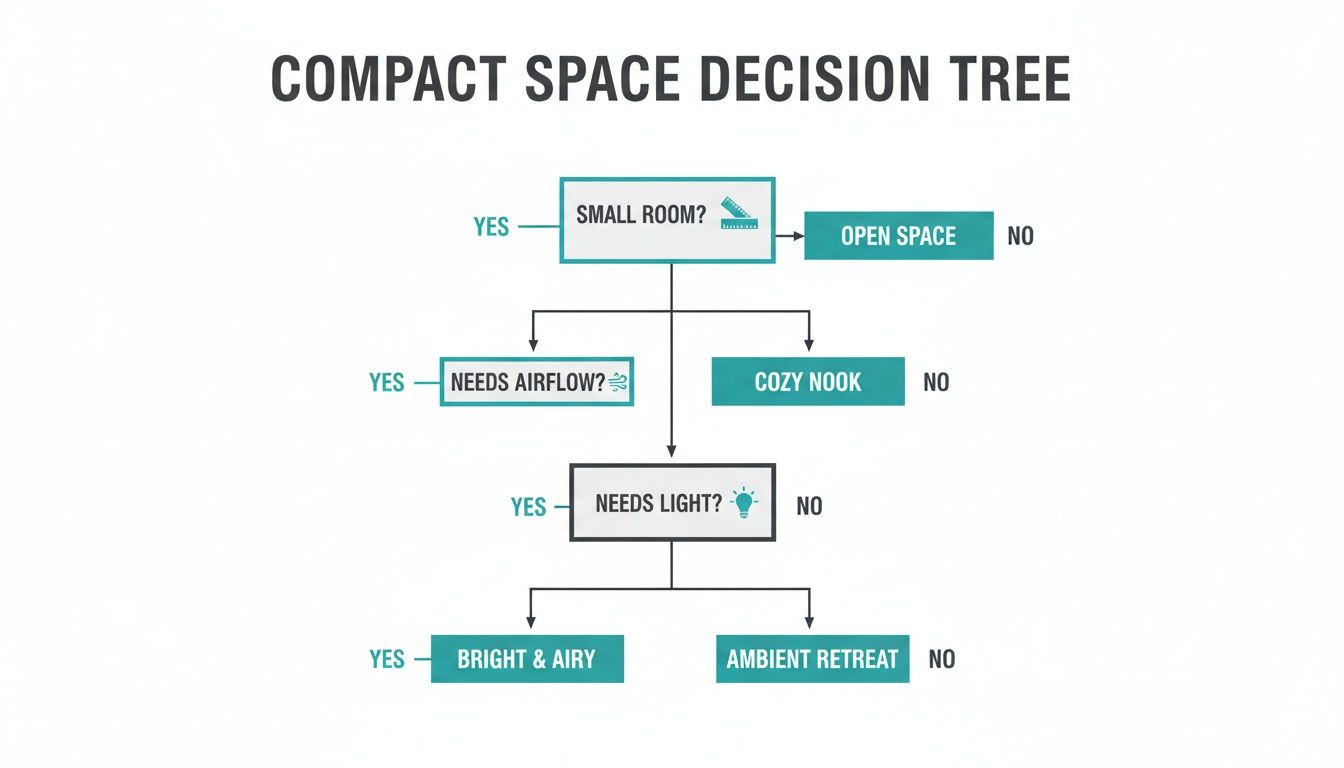
As the chart shows, once you know you're dealing with a small room, it's a straight path to figuring out if you need air movement, built-in light, or both—which leads you right to a multi-functional fan.
Matching Blade Span to Room Size
Now, let's turn that square footage into the right blade span. A fan's "blade span" is simply the measurement from the tip of one blade straight across to the tip of the opposite blade. It’s the most direct way to know if a fan has the right muscle for your space.
Here’s a simple table we put together to help you quickly match your room's dimensions to the ideal blade span for the best air circulation.
Quick Guide to Fan Size and Room Dimensions
| Room Size (Square Feet) | Recommended Blade Span (Inches) | Example Premium Model ($300+) |
|---|---|---|
| Under 75 sq. ft. | 29-36 Inches | The ultra-compact Mini-Breeze Fan |
| 75-150 sq. ft. | 36-44 Inches | The sleek and powerful AeroJet Fan |
| 150-225 sq. ft. | 44-50 Inches | The elegant Alto Grande Fan |
This chart makes it clear why a fan like the Mini-Breeze Fan, with its compact design, is perfect for tight spots like a powder room or a small laundry room. It delivers a refreshing breeze without overwhelming the space. If you want to get even more granular, our complete ceiling fan size guide has all the extra details you could need.
Considering Your Ceiling Height
The last piece of the puzzle is your ceiling height. This will tell you exactly how the fan needs to be mounted to be both safe and effective.
Safety First: This is non-negotiable. For proper clearance, the bottom of your fan's blades absolutely must hang at least 7 feet from the floor.
It’s a simple rule with big implications for your installation choice.
- Low Ceilings (Under 8 Feet): You’re going to need a flush mount fan, sometimes called a hugger fan. These models, like our low-profile Mini-Breeze, mount directly against the ceiling without a downrod. This gives you the maximum possible headroom in a tight space.
- Standard Ceilings (8-9 Feet): A short downrod is your best bet here, and it usually comes right in the box with the fan. This small extension lowers the fan just enough to create the perfect gap between the blades and the ceiling for great airflow.
- High or Vaulted Ceilings (Over 9 Feet): For these, you'll need a longer downrod. This brings the fan down to a more effective height, ensuring the air it's moving actually reaches you instead of just swirling around way up high.
By carefully matching the blade span to your room’s square footage and the mount type to your ceiling height, you can guarantee your new fan won't just look fantastic—it'll perform flawlessly, too.
Getting the Lighting Right for Perfect Ambiance
The "light" in a small ceiling fan with light is so much more than a bulb—it's what sets the entire mood of your room. Choosing the right fan means really digging into its lighting capabilities. We're not just talking about how bright it is, but about creating the perfect vibe, whether you’re grinding through work, kicking back with a book, or hosting friends. It's the secret to making your space feel truly special.

Two terms you’ll see pop up constantly are lumens and Kelvin. Just think of lumens as the amount of light—how bright it gets. Kelvin, on the other hand, is all about the feel of the light—its color.
Lumens and Kelvin Explained
Let's break it down with a fun analogy. Imagine you're lighting a room with candles. The number of candles you use is like lumens—more candles, more brightness. A small home office might only need about 800-1000 lumens to feel right, while a larger bedroom could use 1500 lumens or more to be properly lit.
Now, think about the color of sunlight throughout the day. That's Kelvin.
- Warm White (2700K - 3000K): This is that cozy, golden glow you get from a sunrise or a sunset. It’s absolutely perfect for creating a relaxing, intimate atmosphere in bedrooms and living rooms.
- Cool White (3500K - 4100K): Think of this as the crisp, clear light of midday. It’s ideal for task-oriented spaces where you need to see what you’re doing, like kitchens, home offices, and bathrooms.
- Daylight (5000K+): This is a very bright, almost blue-ish light that mimics direct noon sunlight. It’s fantastic for workshops, craft areas, or anywhere color accuracy is super important.
Premium fans often give you the best of all worlds. A sophisticated model like the Artiste fan, which runs over $400, comes with an adjustable LED light. With a click of the remote, you can shift between different color temperatures, tailoring the ambiance to your exact needs in that moment.
Why Integrated LEDs are the Way to Go
Take a look at modern, high-end ceiling fans, and you'll notice they almost all use integrated LED light kits. There’s a good reason for that. Unlike the old-school bulbs you have to keep replacing, integrated LEDs are built to last for tens of thousands of hours—often for the entire lifespan of the fan itself.
That means no more wobbling on a ladder every few months just to change a burnt-out bulb. How fun is that?
An integrated LED light kit is a long-term investment in convenience and efficiency. It eliminates the hassle of bulb replacements while providing superior, consistent illumination and saving you money on your energy bills.
These advanced light kits also offer features that used to be considered luxuries. Dimmability, for instance, is now a standard feature on top-tier models like the powerful Artemis IV, which retails for over $600. This lets you smoothly transition from bright, functional light to a soft, ambient glow, making a single fixture incredibly versatile.
For a deeper dive into all the options, you can explore our full guide to choosing a light kit for a ceiling fan and see just how far the technology has come. By investing in a fan with a high-quality, dimmable LED, you're not just buying a fan; you're getting complete control over your room's environment.
The Engine Driving the Breeze: Airflow and Efficiency
Beyond the looks and the light fixture, the real heart of a small ceiling fan with light is its motor. This is what powers its performance, dictating how much air it moves and how much electricity it sips. The raw power of a fan is measured in Cubic Feet per Minute (CFM), which is just a straightforward way of saying how much air it can circulate.
Think of CFM as the horsepower of a car. A higher CFM means the fan is better at creating a cooling wind-chill effect, making your room feel more comfortable on a stuffy afternoon. For a small room, you don't need a hurricane, but you definitely want enough airflow to make a noticeable difference.
AC vs. DC Motors: The Power Behind the Blades
As you start exploring higher-quality fans, you'll run into two main motor types: AC (Alternating Current) and DC (Direct Current). Traditional AC motors have been the standard for years and get the job done. But modern DC motors are a serious upgrade, especially if you care about quiet operation and energy savings.
Here’s a quick rundown of how they compare:
- AC Motors: These are the reliable workhorses. They’re less expensive upfront but usually only offer three speed settings and aren't as energy-efficient.
- DC Motors: These are the high-performance engines of the fan world. They're incredibly efficient, using up to 60% less energy than their AC counterparts. They are also virtually silent and give you a much wider range of speed options—often six or more.
Investing in a fan with a DC motor is a direct investment in long-term savings and superior comfort. The whisper-quiet operation is perfect for bedrooms and offices, while the energy savings help lower your electricity bills year after year.
This is why premium models like the Aerovon fan, which is priced over $300, are built with advanced DC motors. You're not just paying for a brand name; you're paying for cutting-edge engineering that delivers powerful, silent airflow while using minimal power.
Efficiency That Pays You Back
The shift toward better motors isn't just some niche trend; it's changing the whole market. The combination of great lighting and powerful airflow in small ceiling fans is making homes more comfortable than ever, with household use projected to grow at a CAGR of 10.09% through 2031.
Modern fans with advanced motors, like the BLDC (Brushless DC) models, use 50-60% less power than older fans, which is a fantastic reason to upgrade. While AC motors still make up a huge chunk of the market because they're cheaper to make, the long-term benefits of DC are undeniable. You can get more details on these industry shifts by checking out ceiling fan market trends.
Ultimately, choosing a fan with a superior motor means you’re getting more than just a light breeze. You’re getting a high-performance appliance that makes your home more comfortable, keeps things quiet, and saves you money in the long run. If you want to dive deeper, you might like our guide on energy-efficient ceiling fans.
Finding a Style That Complements Your Decor
Let’s be honest, a ceiling fan is a pretty major fixture. It’s not just a utility—it's a design element that can either tie the whole room together or stick out like a sore thumb. When you're picking out a small ceiling fan with light, think of it less like an appliance and more like a piece of art for your ceiling. It's your chance to have some fun with your decor!
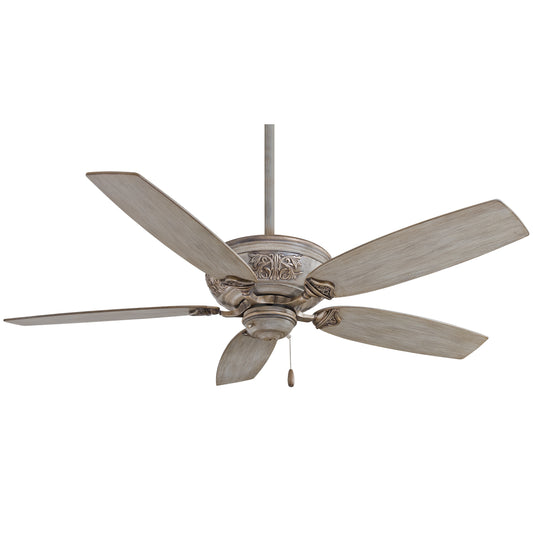
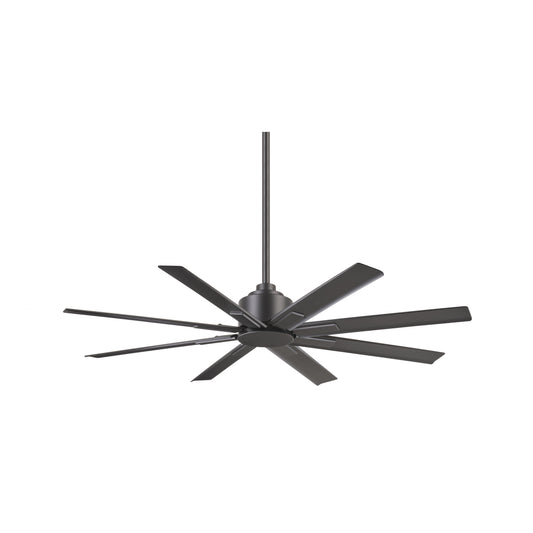
The right style can reinforce your home's entire vibe. The finish, the shape of the blades, and the overall silhouette all contribute to the fan's character. A sleek, matte black fan brings a modern edge, while one with warm wood blades can make a room feel cozier and more grounded. This is your chance to make a real style statement.
Curating Your Look with Different Collections
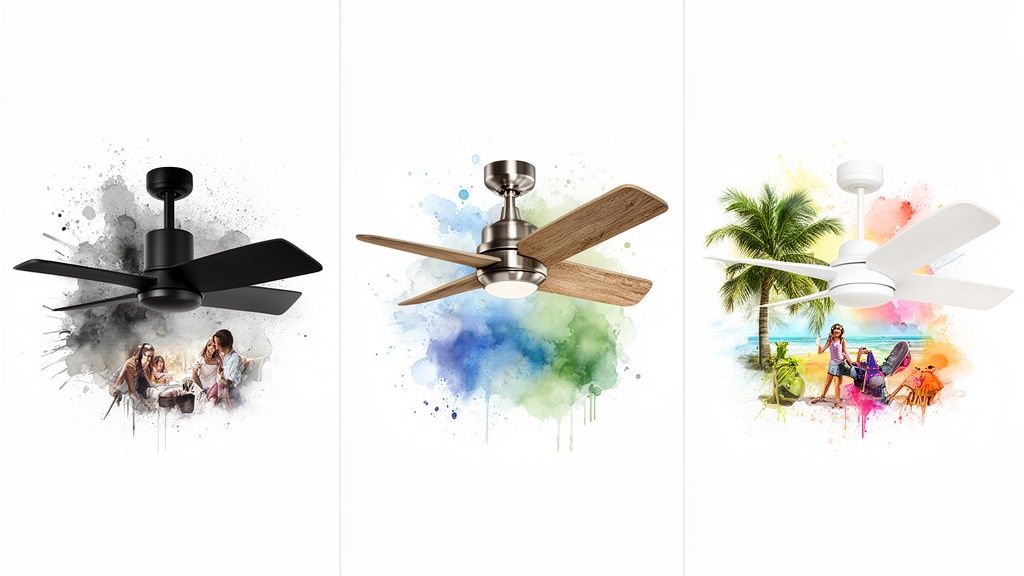
Trying to navigate all the different fan styles can feel like a chore, but breaking them down into design collections makes it much easier. Each collection is curated to fit a specific aesthetic, so you can quickly find one that speaks your language.
-
For the Minimalist: If your home is all about clean lines and zero clutter, a 3-blade fan is your best bet. Models like the Apex Pro fan (retailing for over $350) have sharp, aerodynamic lines built for simplicity and efficiency. It’s a sophisticated, almost sculptural look that’s perfect for modern spaces.
-
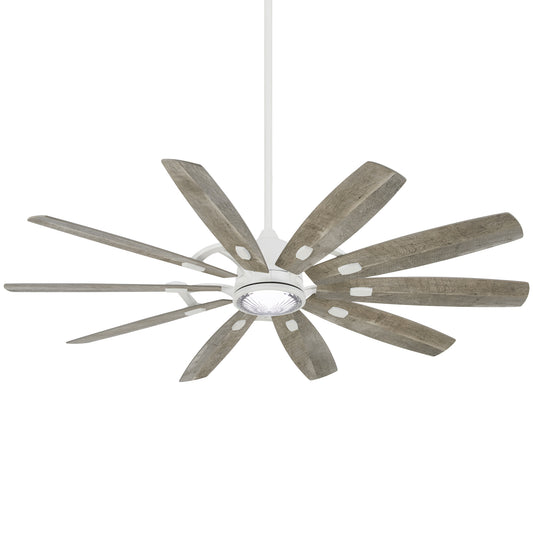
For the Rustic Enthusiast: To get that cozy, modern farmhouse feel, you need a fan with some character. Look at our Timberland or ChiselCraft models, both priced above $300. Their weathered wood-look finishes and sturdy, inviting designs add just the right amount of rustic charm to make any room feel like a retreat.
-
For the Vacation Dreamer: Want to feel like you're on a tropical getaway without leaving home? The Cabana Breeze fan, a premium model over $400, is designed for exactly that. Its wide, leaf-like blades and relaxed vibe instantly evoke a breezy, seaside resort, turning any room into a year-round escape.
Making a Statement with a Premium Fan
While some fans are meant to blend in, others are born to be the center of attention. Investing in a high-end fan—something over $300—isn't just about getting a better motor. It’s about choosing a true statement piece that draws the eye.
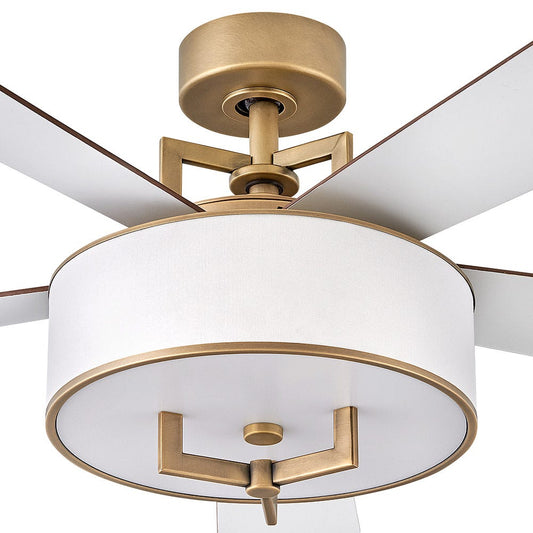
A premium fan like the Artemis XL5, with its sweeping, fluid design, is more than just a source of air and light—it's a focal point that defines the character of a room. It shows a commitment to quality and an eye for exceptional design.
A fan with a unique silhouette or an unexpected finish can anchor your decor in a really powerful way. These bolder choices often become the most talked-about feature in the room, proving that even functional items can be beautiful. To get more ideas, you can explore a wide variety of ceiling fan design trends and find a style that’s a perfect match for your personality.
Installation Tips and Smart Controls
So, you’ve picked out the perfect small ceiling fan with light. Now for the final, exciting step: getting it installed and spinning. Many of our fans are designed with the handy DIYer in mind, but it’s just as important to know when to call in the pros.
If you’re just swapping out an old light fixture or fan that’s already wired to a secure ceiling box, you can probably tackle this yourself. But if your project means running brand-new wiring or putting a fan where there was never a fixture before, it’s time to call a licensed electrician. They’ll make sure everything is properly supported and up to code, which is crucial for safety and protecting your home.
Embracing Modern Controls
Gone are the days of fumbling for a pull chain in the dark. Today’s premium ceiling fans come with a whole suite of control options that add a serious layer of convenience and fun to your room.
-
Wall Controls & Remotes: Most high-quality fans will come with either a wall-mounted control or a sleek handheld remote right in the box. This lets you adjust fan speed, dim the lights, and even reverse the motor’s direction with just the push of a button. If you want to dive deeper into what these can do, check out our guide on the benefits of a remote control ceiling fan.
-
Smart Fan Integration: The most forward-thinking models now have Wi-Fi built right in. This lets you control your fan from a smartphone app or with your voice through systems like Alexa and Google Assistant. This is where a simple fan becomes a true part of your smart home, working alongside other smart controls to make your life easier.
This demand for connected features is only getting bigger. Small ceiling fans with lights are a fast-growing part of a global market that’s expected to jump from USD 12.9 billion to USD 18.1 billion by 2035. The rise of these IoT-integrated fans is a huge piece of that puzzle, giving homeowners app-controlled lighting and airflow right at their fingertips.
A Few Common Questions, Answered
Jumping into the world of ceiling fans can bring up a few questions. That's perfectly normal. We've put together some straightforward answers to the things we get asked most often about small ceiling fans with light, so you can feel totally confident picking the right one.
Can a Small Fan Really Cool a Room?
You bet it can. While a ceiling fan doesn’t actually lower the room’s temperature like an air conditioner, it creates a powerful wind-chill effect that makes you feel several degrees cooler. It's all about moving air, and it's a super fun way to beat the heat.
The trick is matching the fan's blade span and its CFM (Cubic Feet per Minute) rating to your room’s size. A well-made model with a strong DC motor, like those in fans over $300, is surprisingly effective at creating a comfortable breeze, even in the tightest of spaces.
Are Those Built-In LED Lights Replaceable?
For the most part, you won't ever need to. Modern ceiling fans with integrated LED lights are built to last—we’re talking tens of thousands of hours. That’s often the entire lifespan of the fan itself.
This design is a huge plus, as it means you can forget about climbing a ladder to swap out dead bulbs. While a few specific models might have replaceable LED modules, the whole point is to give you consistent, energy-efficient lighting that you never have to think about.
What's the Big Deal with a Reversible Motor?
A reversible motor is a game-changer, turning your fan into a year-round workhorse that helps out in every season. It's one of the most overlooked, yet valuable, features.
- In Summer: You’ll want the blades spinning counter-clockwise. This pushes cool air straight down, creating that refreshing breeze you crave on a hot day.
- In Winter: A simple flip of a switch reverses the direction to clockwise. This motion gently pulls cool air up and circulates the warm air that gets trapped near the ceiling, helping your heater work more efficiently and making the whole room feel cozier.
Ready to find that perfect mix of style, airflow, and light for your smaller room? Take a look through the curated collections here at Fan Connection and discover a fan that will elevate your home's comfort and design.
Shop our premium small ceiling fans with lights at Fan Connection


